Month: August 2025

Styx – Pieces Of Eight

More of the Music of Styx

  • This vintage copy was doing just about everything right, with both sides earning solid Double Plus (A++) grades or close to them – exceptionally quiet vinyl too
  • Here is the kind of sound we want on our ELP, Yes and Queen-like multi-layered Proggy Pop Rock – big, full-bodied and lively (particularly on side one)
  • 4 stars: “Styx’s feisty, straightforward brand of album rock is represented best by ‘Blue Collar Man,’ an invigorating keyboard and guitar rush… reaching number 21, with the frolicking romp of ‘Renegade’ edging in at number 16 only six months later… the rest of the album includes tracks that rekindle some of Styx’s early progressive rock sound, only cleaner. Tracks like ‘Sing for the Day,’ ‘Lords of the Ring,’ and ‘Aku-Aku’ all contain slightly more complex instrumental foundations…”

Who likes their Wall of Sound small and closed-in? Certainly not big speaker guys like us. By all accounts this band wanted their records to sound good, or at least as good as their contemporaries (and the bands that inspired them, name-checked above). There’s no shortage of production polish here and on the best pressings, the sound really works.

(more…)

Piano Concerto Testing and Inner Groove Distortion

Hot Stamper Pressings of the Music of Rachmaninoff Available Now

The piano is huge and weighty, the strings rich and highly resolving, and the overall presentation is powerful, balanced, dynamic and exciting like few other piano concerto recordings we have ever had the pleasure to audition.

Not only is the sound amazing — yes, it’s on the TAS Super Disc list, and for good reason: a copy as good as this one really is a Super Disc — but this copy has another vitally important characteristic that most copies of the record do not: no inner groove distortion.

We can’t begin to count the times we have had to return (or toss) a copy of one of these expensive Byron Janis records because the piano breakup for the last inch or so of the record was just unbearable. That’s a sound no serious listener could possibly tolerate, yet I would venture to guess that many Mercury piano concerto recordings suffer from this kind of groove damage.

As a matter of grading policy, we check the inner grooves of every record we offer on the site,

The Sound

The sound is rich and natural, with lovely transparency and virtually no smear to the strings, horns or piano. What an amazing recording! What an amazing piece of music.

The recording is explosively dynamic — on the best copies the sound comes jumping out of the speakers. In addition, the brass and strings are full-bodied, with practically no stridency, an unusual feat the Mercury engineers seem to have accomplished while in Russia (and not as often in the states).

Big, rich sound can sometimes present problems for piano recordings. You want to hear the percussive qualities of the instrument, but few copies pull off that trick without sounding thin. This one showed us a piano that was both clear and full-bodied.

With huge amounts of hall space, orchestral weight and performance energy, this is Demo Disc quality sound by any standard. Once the needle has dropped you will quickly forget about the sound (and all the money you paid to get it!) and simply find yourself in the presence of some of the greatest musicians of their generation, captured on one of the greatest analog recordings of all time.

Fine and Cozart

The piano is huge and powerful, yet the percussive and lighter qualities on the instrument are clearly heard in proper relation to the orchestra as a whole.

I simply cannot criticize the work that Fine and Cozart have achieved with this recording, and believe me, there are very few records in this world about which I could not find something to criiticize. After all, it is our job, and we like to set very high standards for the work we do.

Lately we have been writing quite a bit about how good pianos are for testing all aspects of your system, room, tweaks, electricity and the rest, not to mention turntable setup and adjustment.

  • We like our pianos to sound natural (however one chooses to define the term).
  • We like them to be solidly weighted.
  • We like them to be free of smear, a quality that for some reason is rarely mentioned in most audiophile reviews.

Our twenty or so of our favorite piano concerto recordings with top quality sound can be found here.

To read the 50 reviews and commentaries we’ve written for some of the greatest piano concerto recordings ever pressed on vintage vinyl, please click here

(more…)

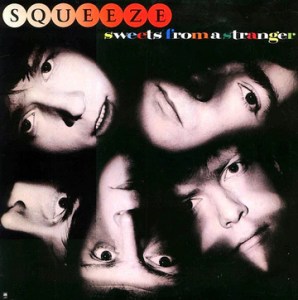
Squeeze – Sweets from a Stranger

More New Wave

  • Boasting two excellent Double Plus (A++) sides or close to them, this vintage UK pressing is guaranteed to handily beat any other Sweets from a Stranger you’ve heard
  • We shot out a number of other imports and this one had the midrange presence, bass, and dynamics that were missing from most other copies we played (particularly on side two)
  • If you’re a fan of Elvis Costello, Graham Parker, Nick Lowe, Joe Jackson and even quite a few other lesser-knowns from this era, Squeeze is the band for you

I put them right up there with Elvis Costello and Peter Gabriel in the pantheon of British Pop Music of the era.

Squeeze’s prime period with Jools Holland on keyboards encompasses four albums, any of which is worth owning. The band really gets going with their second album, Cool for Cats (1979), pulls it all together and takes it to another level for their breakthrough third, Argybargy (1980), and produces two more of high quality, East Side Story (1981, produced mostly by Elvis Costello) and the darker but equally brilliant Sweets from a Stranger(1982).

I’m a huge fan of all four, as well as two from their later days, the amazing-to-this-day Cosi Fan Tutti Frutti (1985) and the weaker but enjoyable Babylon and On (1987). I play all of them on a regular basis.

(more…)

How Does the Heavy Vinyl Rubber Soul Sound?

Hot Stamper Pressings of Rubber Soul Available Now

This review was originally written in 2015.


We are so excited to tell you about the first of the Heavy Vinyl Beatles remasters we’ve played! As we cycle through our regular Hot Stamper shootouts for The Beatles’ albums we will be of course be reviewing more of them*. I specifically chose this one to start with, having spent a great deal of time over the last year testing the best vinyl pressings against three different CD versions of Rubber Soul.

The short version of our review of the new Rubber Soul vinyl would simply point out that it’s awful, and, unsurprisingly, it’s awful in most of the ways that practically all modern Heavy Vinyl records are: it’s opaque, airless, energy-less and just a drag.

I was looking forward to the opportunity to take Michael Fremer, the foremost champion of thicky vinyl, to task in expectation of his usual rave review, when to my surprise I found the rug had been pulled out from under me — he didn’t like it either. Damn!

MF could hear how bad it was. True to form, he thinks he knows why it doesn’t sound good:

As expected, Rubber Soul, sourced from George Martin’s 1987 16 bit, 44.1k remix sounds like a CD. Why should it sound like anything else? That’s from what it was essentially mastered. The sound is flattened against the speakers, hard, two-dimensional and generally hash on top, yet it does have a few good qualities as CDs often do: there’s good clarity and detail on some instruments. The strings are dreadful and the voices not far behind. The overall sound is dry and decay is unnaturally fast and falls into dead zone.

It strikes me as odd that the new vinyl should sound like a CD. I have listened to the newly remastered 2009 CD of Rubber Soul in stereo extensively and think it sounds quite good, clearly better than the Heavy Vinyl pressing that’s made from the very same 16 bit, 44.1k remixed digital source.

If the source makes the new vinyl sound bad, why doesn’t it make the new CD sound bad? I can tell you that the new CD sounds dramatically better than the 1987 CD I’ve owned for twenty years. They’re not even close. How could that be if, as MF seems to believe, the compromised digital source is the problem?

Lucky for me I didn’t know what the source for the new CD was when I was listening to it. I assumed it came from the carefully remastered hi-rez tapes that were being used to make the new series in its entirety, digital sources that are supposed to result in sound with more analog qualities.

Well, based on what I’ve heard, they do, and those more analog qualities obviously extend to the new Rubber Soul compact disc. At least to these ears they do.

It’s possible my ignorance of the source tape allowed me to avoid the kind of confirmation bias — hearing what you expect to hear — that is surely one of the biggest pitfalls in all of audio and a pit that Fremer falls into regularly.

(more…)

Letter of the Week – “I kept putting the volume up little by little and it just got better and better and better.”

Hot Stamper Pressings of the Music of Pink Floyd Available Now

One of our good customers had this to say about some Hot Stampers he purchased recently:

Hey Tom, 

I got around to listening to The Wall last weekend, a 3+ / 3+ / 2+ / 3+ copy. It was yet another of those cannot-concentrate-on-anything-else experiences, simply astonishing.

I kept putting the volume up little by little and it just got better and better and better.

The quality is mind-blowing.

I want you guys to know how much pure pleasure you’re able to generate, and it’s priceless. Thank you all.

Rich 

Rich,

So glad you liked the pressing we sold you as much as we did!

Of course we agree with you wholeheartedly about the joy of turning up the volume on a record that sounds as good as the one you played.

The Wall has long been a member of our Top 100 and a true Demo Disc, especially if you can play it on big speakers at loud levels.

One obvious reason that the turn up your volume makes such a great test is that the louder the volume, the more obvious the problems with the sound become, and the harder it is to ignore them.

If you turn up the volume on the copy of The Wall you now own and it gets better and better, I think we can safely say it passed the turn up your volume test.

Some folks complain about our pricing, a subject we discuss here, but the question our detractors have the most trouble answering is, “What’s a priceless record worth?”

Thanks for writing,

Best, TP

(more…)

The Best Pressings of Love Over Gold Have Surprisingly Natural Sound

Hot Stamper Pressings of the Music of Dire Straits Available Now

This modern album (1982) can sound surprisingly good on the right pressing.

On most copies the highs are grainy and harsh, not exactly the kind of sound that inspires you to turn your system up good and loud and get really involved in the music. I’m happy to report that the best pressings have no such problem – they rock and they sound great when playing loud.

We pick up every clean copy we see of this album, domestic or import, because we know from experience just how good the best pressings can sound.

What do the best copies have?

REAL dynamics for one.

And with those dynamics you need rock solid bass. Otherwise the loud portions simply become irritating.

A lack of grain is always nice — many of the pressings we played were gritty or grainy.

Other copies that were quite good in most ways lacked immediacy, and we naturally took serious points off for that.

The best copies of Love Over Gold are far more natural than the average pressing you might come across, and that’s a recognizable quality we can listen for and give weight to in our grading.

It’s key to the sound of the better pressings, which means in our shootouts it’s worth a lot of points. Otherwise you might as well be playing the CD.

Domestics or Imports?

(more…)

Falla – Three Cornered Hat / Ansermet

More of the Music of Manuel de Falla

  • An early London pressing of Falla’s orchestral spectacular with stunning Nearly Triple Plus (A++ to A+++) grades from start to finish, just shy of our Shootout Winner – this copy is a true Demo Disc in the world of vintage classical vinyl
  • It’s also fairly quiet at Mint Minus Minus, a grade that even our most well-cared-for vintage classical titles have trouble playing at
  • When you play the best pressings of this title it’s almost hard to believe how well recorded it is – even Billboard in 1961 noted the brilliant sound jumped from their speakers
  • “Anyone interested in theatrical music will know that within a few months the work had earned the category of a ‘classic’ and since then has been placed in the annals of great ballets such as Petrushka and Schéhérazade.”
  • If you’re a fan of delightful orchestral showpieces such as these, Decca’s wonderful recording from 1961 belongs in your collection
  • There are about 150 orchestral recordings we think offer the best performances with the highest quality sound. This record is certainly deserving of a place on that list.

This is High Fidelity Audiophile Gold, with bells, drums, voices, trumpets, strings, woodwinds and more, all sounding so real it will take your breath away. The Golden Age tapes have clearly been mastered brilliantly onto this vintage London vinyl.

No doubt you have run into something like this in our classical listings:

This London is energetic, dynamic, spacious, transparent, rich and sweet. James Walker was the producer, Roy Wallace the engineer for these sessions from 1961 in Geneva’s glorious Victoria Hall. It’s yet another remarkable disc from the Golden Age of Vacuum Tube Recording. 

We were impressed with the fact that this pressing excelled in so many areas of reproduction. The illusion of disappearing speakers is one of the more attractive aspects of the sound here, allowing the listener to inhabit the space of the concert hall in an especially engrossing way.
(more…)

Talking Heads – Little Creatures

More of the Music of the Talking Heads

  • Little Creatures is back on the site for only the second time in eighteen months, here with solid grades on both sides of this original Sire pressing – this one has the Big Beat sound we love, and fairly quiet vinyl too
  • I ask you, what record from 1985 sounds better than Little Creatures?
  • These sides are rockin’ on tracks like “Stay Up Late,” “Road To Nowhere,” “And She Was,” “Creatures of Love” and more
  • Surprisingly big, punchy and open sound for this 1985 pop classic – a Top 100 album and longtime Better Records favorite
  • We used to think that this album was the best sounding one the band had produced, but recently we came across some phenomenally good sounding pressings of their debut, and they now hold the Talking Heads’ crown for best sound
  • 4 1/2 stars: “Ear Candy …a pop album, and an accomplished one, by a band that knew what it was doing.”

We’re huge fans of Little Creatures, and when you hear a copy like this you’ll know exactly why. Not many records from this era sound as amazingly rich as this one, not in our experience anyway.

On the better copies, the sound is punchy, smooth & so ANALOG, with an especially beefy bottom end, the kind a good Big Beat Pop Album record needs. For a good reference think Get The Knack or Parallel Lines.

Tight, punchy, surprisingly deep note-like bass absolutely makes or breaks the sound on Little Creatures. Without the proper bass foundation this funky beat-crazy Talking Heads album can’t BEGIN to do what it’s trying to do: get your feet tappin’ and your body rockin’ to the music.

The better pressings are surprisingly dynamic, with a sweet, often silky top end. The drums are very well recorded throughout — you can really hear the room around that big kit. You will also find that the higher-rez pressings give David Byrne’s vocals the presence and breathy texture they need. The overall sound will be open, spacious, and sweet — even three-dimensional.

The Last Great Talking Heads Album

This is the Last Great Talking Heads album. The first four and this one give you all the Talking Heads music you’ll ever need. Each of them is brilliant in its own way. One of the ways this one is especially brilliant from our admittedly skewed point of view is that it’s the best sounding record the Talking Heads ever made.

(more…)

Find the Dubs = Less Records = Progress!

Robert Brook runs a blog called The Broken Record, explaining that the aim of his blog is to serve as:

A GUIDE FOR THE DEDICATED ANALOG AUDIOPHILE

Here is Robert’s posting from 8/26/2025 containing a great deal of good advice for record collectors and audiophiles of all ages, especially us old ones.

He admits to being wrong about the sound of a record he wrote about on his blog. When have you ever seen an audiophile admit to being wrong about a record? The very idea!

Why was he wrong? Because his stereo got dramatically better, so much better that he could see how mistaken he was about a Japanese pressing he thought for sure was made from the master tape. Now it sounds dubby. It was always dubby; he just hadn’t gotten his system, room, electricity, setup and who knows what else to the point where the true nature of that copy could be revealed.

Robert revisited a record he was sure he knew well, well enough to rave about on his blog, and found out things had changed — apparently quite a lot! — while he wasn’t looking.

A great deal of audio progress had been made, and that audio progress is what allowed Robert to also make some progress on the record collecting front, a win-win if every there was one. Congratulations are in order.

We here at Better Records live with this reality every day. Our mea culpas are occassioned by the shootouts we do for the same records over and over again, which is what allows us to discover even better pressings of albums than the ones we thought were the best. It’s surely the most rewarding part of the job.

FIND the DUBS = LESS RECORDS = PROGRESS!

Please to enjoy the lessons Robert learned.

I wrote about a similar experience I had myself back in the early-2000s.

If presently you are the happy owner of many Japanese pressings, perhaps now would be a good time to pull them out and play them. Very few master tapes went to Japan, and, as a result, most Japanese pressings in our experience sound like they are made from copy tapes, which of course they are.

Some of them have the potential for top quality sound, but most do not.

If your stereo is not revealing enough to show you their shortcomings, the way Robert’s was not revealing enough just five years ago, please take his advice and make the kinds of changes he has made.

The steps you take next will be the most satisfactory of all. Now you can clear the shelves of all your second- and third-tier records, which, of course, will not be limited to Japanese pressings, but should in fact include most of your Heavy Vinyl LPs, if not all of them. Let the culling begin!

(more…)

Orff / Carmina Burana – Amazing on DG Vinyl

More Orchestral Spectaculars

  • A large tulip label copy of this strikingly original work with solid Double Plus (A++) grades from first note to last
  • This spectacular recording is big, clear, rich, dynamic, transparent and energetic – here is the analog sound we love
  • We’ve auditioned quite a number of recordings of the work, and as far as we are concerned, on the right pressing this is the best sounding version that exists on vinyl – the orchestral power on display is positively phenomenal
  • There are some bad marks (as is sometimes the nature of the beast with these vintage pressings) on “Fortuna Imperatrix Mundi,” but once you hear just how superb sounding this copy is, you might be inclined, as we were, to stop counting ticks and just be swept away by the music
  • “With the direction of Eugen Jochum and the bonus of the incomparable rich, powerful voice of baritone Dietrich Fischer-Dieskau, this 1968 performance is a classic, and very probably the best, recording of the opera.” – Amazon Rave Review

(more…)