veiled-sound

The sound of these pressings is veiled. It’s as if someone threw something over your speakers and you are listing to music through a curtain.

Sometimes the sound is so lacking in presence, clarity and immediacy it can seem as if the curtain would better be described as a blanket, and in the worst cases, a quite heavy one.

The Cisco Pressing of Beethoven’s Kreutzer Sonata

Hot Stamper Pressings of Recordings with Heifetz Performing

An audiophile hall of shame pressing from Cisco / Impex / Boxstar / whatever.

The Cisco pressing of LSC 2577 should not have sound that is acceptable to any person who considers himself an audiophile.

There is no violinist in front of you when you play their pressing.

There is someone back behind your speakers under a thick blanket, and his violin sure doesn’t sound very much like a real violin — no rosiny texture, no extended harmonics, no real body.

In short, the sound of this reissue is much too smearyveiled, and lacking in presence to be taken seriously.

Unfortunately for those of us who love good music with good sound, Cisco’s releases from this era (as well as DCC’s) had to fight their way through Kevin Gray’s transistory, opaque, airless, low-resolution cutting system. We discuss that subject in more depth here.

(more…)

DCC + RTI = Audio Enervation

Hot Stamper Pressings of the Music of Bonnie Raitt Available Now

UPDATE 2025

This commentary was the first one I wrote criticizing the sound of DCC vinyl, probably around 2008 or so. There would be many to follow.

A well-known Joni Mitchell album we played the year before didn’t exactly set us on a different path, but it did have the effect of kicking us up into a higher gear, and Bonnie’s album was one of the early fruits of that change.

During our shootout for Bonnie’s first Capitol album, we found that the DCC pressing was lacking in so many ways that I felt compelled to spell out for our customers what its shortcomings were.

I had enthusiastically recommended the album in 1996 when it came out, but our first big shootout had shown me how wrong that judgment would turn out to be. Our complete commentary from 2008 is reproduced below.


The no-longer-surprising thing about our Hot Stamper pressings of Nick Of Time is how completely they MURDER the DCC LP. Folks, it’s really no contest.

Yes, the DCC is tonally balanced and can sound very good, but it can’t compete with the best original pressings. It’s missing too much of the presence, intimacy, immediacy and transparency that we’ve discovered on the better original pressings. 

As is the case with practically every record pressed on Heavy Vinyl over the last twenty years, there is a suffocating loss of ambience throughout, a pronounced sterility to the sound.

Modern remastered records just do not BREATHE like the real thing.

Good EQ or Bad EQ, they all suffer to one degree or another from a bad case of audio enervation. Where is the life of the music? You can try turning up the volume on these remastered LPs all you want; they simply refuse to come to life.

We play albums like this VERY LOUD. I’ve seen Bonnie Raitt live a number of times and although I can’t begin to get her to play as loud in my listening room as she did on stage, I can try. To do less is to do her a disservice.

The DCC Approach

The DCC, like a lot of modern remastered titles we”ve played, is too damn smooth.

(more…)

What Can You Learn from a Mercury Shootout Like This One?

Hot Stamper Pressings of Mercury Classical Recordings Available Now

The short answer is that you can’t learn much from this shootout, because we’re not telling you which title the stampers you see below belong to.

Be that as it may, in the case of this mystery title the conventional wisdom turns out to be correct — the earlier numbered pressings did better than the later numbered pressings, and the early labels did better than the later labels.

That happens a lot, and we are happy to admit that it does. Why? Because the experimental evidence — the datasay that is what happened.

As usual for posts in which the stamper sheet from a shootout is reproduced in its entirety, the stamper numbers shown below will belong to a different album than the one you see pictured.

These can be found under the heading of Mystery Stampers. Most of these posts will illustrate something to be learned from a Hot Stamper shootout, but because the information reveals the shootout winning stampers, the actual title of the record is rarely revealed.

Much more useful stamper information can be found using this link, which includes plenty of stamper numbers for specific titles that are best avoided by audiophiles looking for top quality sound. In addition, we post the winning and losing stampers for some titles that are an unreliable guide to good sound. Unreliable stampers are also quite common.

(more…)

I Have to Admit: the Cisco Pressing of Home Again! Had Me Vexed

Reviews and Commentaries for the Music of Doc Watson

Folks, if you made the mistake of buying the Cisco Heavy Vinyl reissue of this album, and you manage to grab one of our Hot Stamper pressings, you are really in for a treat.

I have to confess that when this record came out in 2003 I had a hard time coming to grips with what was wrong with it. I knew I didn’t like it, but I wasn’t sure exactly why. I wasn’t sure exactly what it was doing wrong, if anything. It seemed tonally correct and natural sounding. Why didn’t I like it?

It wasn’t phony up top with sloppy bass like a MoFi.

It wasn’t hard and transistory like so many of the Classic Records pressings back then.

I didn’t know the record at all so I really had nothing to judge it by.

But there was definitely something lacking in the sound that had me confused. Eventually I figured it out. Looking back on it now, the problems with the Cisco I could not identify were these:

  • The Cisco lacks presence. It puts Doc Watson further back than he should be, assuming that he is where he should be on the good vintage pressings, which sound right to me — some better, some worse, of course. Moving him back in the sound field does him no favors.
  • The Cisco lacks intimacy, which is key to the best pressings. The shootout winners remove all the veils and put you in the presence of the living, breathing Doc Watson. The Cisco adds veils and takes the intimacy right out of the record.
  • The Cisco lacks transparency. It frustrates your efforts to hear into the recording.
  • Doc is in a studio, surrounded by the air and ambience that would naturally be found there. The Cisco is airless and ambience-free, with Doc performing in a heavily damped booth of some kind. At least that’s what it sounds like.
  • And the last thing you notice is the lovely guitar harmonics on the originals and early reissues, harmonics that are attenuated and dulled on the Cisco.

As my stereo got better and better, and my critical listening skills improved in tandem, it became more and more obvious to me what was wrong with the Cisco. When we play modern Heavy Vinyl pressings these days, especially albums we know well, it usually doesn’t take us two minutes to hear what they are doing wrong.

(more…)

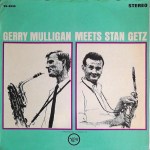
There’s a Very Good Chance We Were Wrong about Mulligan Meets Getz

More of the Music of Stan Getz /More of the Music of Gerry Mulligan

This is an album that we were probably wrong about in 2021 when the following Hot Stamper two-pak pressing went up for sale on the site. (The pressings we liked at the time are long gone by now.) Here is what we wrote back then:

Mulligan and Getz’s 1957 collaboration arrives on the site with this superb 2-pack offering Nearly Triple Plus (A++ to A+++) sound on both sides – just shy of our Shootout Winner

Full, rich, and spacious with tons of Tubey Magic and, better yet, not the least bit dry, hard or transistory

Practically impossible to find in stereo with audiophile playing surfaces – it took two different pressings to get two good sides, and they are very good indeed

The reissues we discovered in 2025 trounced the originals (in both stereo and mono) as well as the early reissues (on the Verve T Label) we played in our shootout, as you can see from the stamper sheet notes below:

Our mistaken judgment is simply the result of ignorance. In 2021 we simply had no idea just how good this recording could sound on vintage vinyl. We hadn’t done our homework properly, and because of that we came up with the wrong answer.

We only discovered the right pressings, with the right stampers, pressed in the right era, and mastered by the right guy, sometime in 2024 or so. We bought a bunch of those and in 2025 did the shootout with all kinds of copies, just to keep everybody honest.


That was the year much better sounding reissue copies that look like the one you see on the left came along. As we noted in the listing:

  • Leave it to Better Records to figure out a complicated title with a long history such as this one – originals, reissues, monos, stereos, we had to play them all to find a copy that sounds as good as this one does.
  • Full, rich, and spacious with an abundance of Tubey Magic and, better yet, not the least bit dry, hard or transistory.

Some quick notes:

Bowtie Label Stereo

(more…)

These Kelly Blue Reissues from the 70s Are a Real Mess

Hot Stamper Pressings of the Music of Wynton Kelly Available Now

Sometimes the 70s reissues of vintage jazz recordings that were made in the fifties, sometimes released with different covers similar to the one you see pictured, have excellent sound.

We know that for a fact because we’ve played some very good ones.

In the case of Kelly Blue, we felt we were obligated to play a few to make sure we were hearing as wide a range of different pressings as possible. We wanted to be sure we were hearing the best sounding pressings regardless of what era they were pressed in. (We’re very open minded that way.)

Here are our notes for the Black Label Riverside Stereo pressing with “1971” stampers:

  • Thin,
  • Dry,
  • Honky,
  • Veiled.
  • Severe stereo spread. (Hard left and right, unmusical this way, players are disconnected.)
  • Grade: 1+ on both sides

The other copy we had was even worse:

  • NFG on side one, side two never played.

The Riverside originals we’ve played in the past, like a lot of other Riverside originals from the 50s, such as those by Thelonious Monk, were uniformly terrible.

And trying to find one in audiophile playing condition is as easy as it sounds.


We’ve auditioned countless pressings like this one in the 38 years we’ve been in business — buying, cleaning and playing them by the thousands. This is how we find the best sounding vinyl pressings ever made.

Not the ones that should sound the best. The ones that actually do sound the best.

If you’re an audiophile looking for top quality sound on vintage vinyl, we’d be happy to send you the Hot Stamper pressing guaranteed to beat anything and everything you’ve heard, especially if you have any pressing marketed as suitable for an audiophile. Those, with very few exceptions, are rarely better than mediocre, and some of them are just awful, with many of the newest releases being the most awful of them all!

(more…)

The Dreadful Sound of the Heavy Vinyl Reissues Doug Sax Mastered in the 90s

Hot Stamper Pressings of the Music of Sonny Rollins Available Now

Longstanding customers know that we have been relentlessly critical of so-called “audiophile” LPs for years, especially in the case of these Analogue Productions releases from back in the early-90s. A well-known reviewer loved them, I hated them, and he and I haven’t seen eye to eye on much since.


(Old) Newflash!

Just dug up part of my old commentary discussing the faults with the original series that Doug Sax cut for Acoustic Sounds. Check it out.

In the listing for the OJC pressing of Way Out West we wrote:

Guaranteed better than any 33 rpm 180 gram version ever made, or your money back! (Of course I’m referring to a certain pressing from the early 90s mastered by Doug Sax, which is a textbook example of murky, tubby, flabby sound. Too many bad tubes in the chain? Who knows?

This OJC version also has its problems, but at least the shortcomings of the OJC are tolerable. Who can sit through a pressing that’s so thick and lifeless it communicates none of the player’s love for the music they’re making?

If you have midrangy transistor equipment, go with the 180 gram version (at twice the price).

If you have good equipment, go with this one.


UPDATE 2015

We are no longer fans of the OJC of Way Out West, and would never sell a record that sounds the way even the best copies do as a Hot Stamper. It’s not hopeless the way the Heavy Vinyl pressing is, but it’s not very good either. It’s yet another example of a record we was wrong about.

Live and learn, right?


(more…)

Waiting For Columbus Gets the Bernie Treatment Care of Rhino Records

Hot Stamper Pressings of the Music of Little Feat Available Now
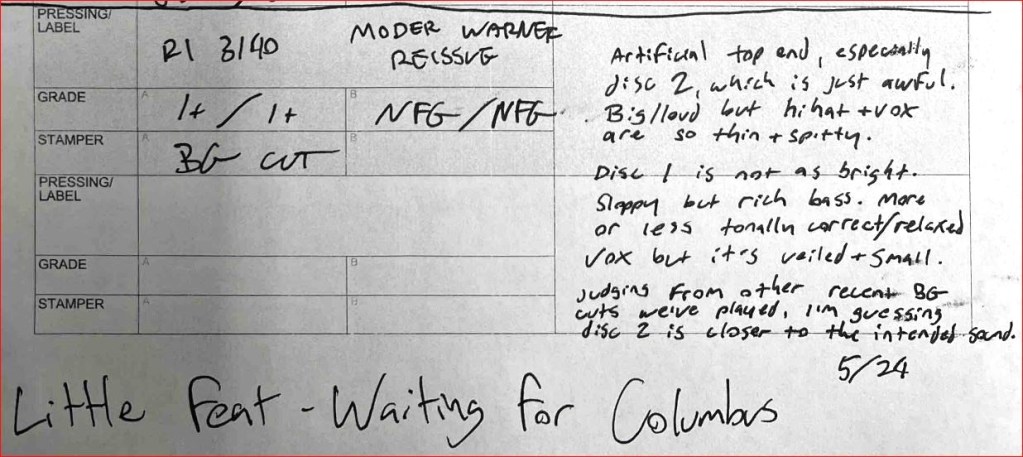

A Hot Stamper pressing of this amazing sounding album, a title we regret to say we have in stock only rarely, might be described this way:

Some of the best sounding live rock and roll sound you will ever hear outside of a concert venue. If you want to understand the unique appeal of the band, there’s no better place to start than right here.

It’s one of our all-time favorite live recordings and their single best release – a true Masterpiece.

I have lately been listening to this album in its entirety at the gym (playing the standard cassette over headphones) and enjoying the hell out of it. As good as their best studio albums are, and I count myself as big a fan of the band as there is, Waiting for Columbus is surely the pinnacle of their recorded output. It is as close to perfect as any live album I know.

(The Last Record Album is my personal favorite of their studio albums, but since nobody seems to want to buy it at the prices we charge, I regret to say we had to stop doing shootouts for it years ago. We were losing too much money that way.)

But Bernie Grundman’s version is just another one in a very long line of disastrous recuts, the kind of crap he has been churning out for the last thirty years. It’s all but unplayable on modern high quality equipment. (If it’s not on your system, you might consideer the idea that you still have plenty of work left to do, audio-wise.)

As you can see from the notes below, record one may be passable, but record two is NFG. How is it possible to turn such a wonderful recording into such a ridiculously bad sounding pressing? Even Mobile Fidelity did a better job with the album, and they’re one of the most incompetent remastering outfits that the audiophile world has even known.

We’re frankly at a loss to understand any of it.Bernie Grundman used to make good sounding records. We know that for a fact, having played them by the hundreds. Apparently those days are gone, and, based on this album and plenty of others, there is very little chance of them returning.

Notes on the Sound

(more…)

A Disappointing OJC of Swinging With The Mastersounds

Hot Stamper Pressings of Top Quality Jazz Recordings Available Now

UPDATE 2025

We did a shootout for this Mastersounds title many years ago. It didn’t sell very well so we decided to give it a rest for a while, something in the range of a decade or so.

Recently we got another couple of copies in, including their other album we used to like on OJC, A Date with the Mastersounds, and found none of the copies we played to be nearly as impressive as we thought they were back in the day. Some quick notes:

  • A Date with the Mastersounds

Vibes are dry and glassy. Not much Tubey Magic.

  • Swinging With The Mastersounds

Rich but veiled sound. Just OK, not great.

With that said, we still like the music, so if you see one of these pressings for cheap and you like vibes-based jazz from the 50s, pick it up and discover the music of The Mastersounds for yourself.

(more…)

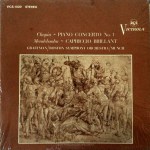
VICS-1030 Can Have Passable Sound for Chopin’s Piano Concerto No. 1

Hot Stamper Pressings of Living Stereo Recordings Available Now

Our favorite recording for performance and sound is the Living Stereo from 1961, LSC 2575, with Rubinstein at the piano and Skrowaczewski conducting the New Symphony Orchestra of London.

This Victrola pressing, VICS-1030, with Graffman performing, had good, not great sound. We’ve played them before and none of them was ever better than middling.

Some specifics we noted in the sound:

  • The piano was loud and clear, close-miked.
  • Boxy sound, could be richer
  • Orchestration not too compressed but veiled and small.
  • Not a standout performance.

A decent-enough record I suppose, but lacking in too many of the qualities our customers are looking for, especially at the prices we charge.


This is what we had to say about the sound of our Shootout Winner for LSC 2575:

We love the huge, solid and powerful sound of the piano on this recording. This piano has weight and heft. As a result, it sounds like a real piano.

For some reason, a great many Rubinstein recordings are not capable of reproducing those seemingly all-important qualities in the sound of the piano.

Those are, as I hope everyone understands by now, the ones we don’t sell. If the piano in a piano concerto recording doesn’t sound solid and powerful, what is the point of playing such a record?

Or, to be more accurate, what is the point of an audiophile playing such a record? (Those of you who would like to avoid bad sounding vintage classical and orchestral records have come to the right place. We’ve compiled a very long list of them for precisely that purpose, and we add to it regularly, a public service from your friends here at Better Records.)

(more…)