thin-piano

The reproduction of the piano on these pressings was thin. If you have full range speakers and a revealing system, these are records you will want to avoid.

Don’t Waste Your Money on this RCA from 1961

Hot Stamper Pressings of Living Stereo Recordings Available Now

These Beethoven “Appassionata” And “Funeral March” sonata recordings have never impressed us sonically.

On the Shaded Dog pressings of LSC 2545 that we’ve auditioned, the piano is too thin.

Who likes a thin sounding piano?

If you have big speakers that can move air with authority, the kind needed to reproduce the size and power of a concert piano, then check out some of the titles we’ve found to have especially weighty piano reproduction.

The sound is not awful — you could certainly do worse — but we do not see the value in this title considering it will be neither cheap nor quiet.

We say pass.

Lewis Layton is clearly one of our favorite engineers, but this album does not seem to be up to his usual standards, or ours.


There are quite a number of other vintage classical releases that we’ve run into over the years with noticeable shortcomings.

For fans of vintage Living Stereo pressings, here are some to avoid.

Some audiophiles may be impressed by the average Shaded Dog pressing, but I can assure you that we here at Better Records are decidedly not of that persuasion.

Something in the range of five to ten per cent of the major label Golden Age recordings we play will eventually make it to the site. The vast majority just don’t sound all that good to us. (Many have second- and third-rate performances and those get tossed without ever making it to a shootout.)

(more…)

Michael Fremer Says You Should Own the Classic 45 of Time Out

Hot Stamper Pressings of the Music of Dave Brubeck Available Now

Michael Fremer spends two hours and ten minutes on his site going through a list of 100 All Analog In Print Reissued Records You Should Own.

On this list is the 45 RPM Bernie Grundman cutting of Time Out. Fremer apparently liked it a whole lot more than we did. We think it is just plain awful.

The MoFi Kind of Blue is on this same list, another pressing that is astonishingly bad, or, at the very least, really, really wrong.

If you’re the kind of person who might want to give Michael Fremer the benefit of the doubt when it comes to All Analog records he thinks sound good, ones he thinks you should own, try either one of them. If you think they sound just fine, you sure don’t need me to tell you that they’re completely and utterly awful.

There might be some decent records on the list, but if it has two massive failures that I just happened to come across in the five minutes I spent watching the video — I have very little tolerance for the sort of amateurishness he displays — I would suspect the winners are few and the losers many.

As a practical rule, if you want good sounding vinyl, you should avoid anything on his list.

And if you do try some and do like them, let me know which ones you think sound good and I will try to get hold of some copies and listen to them for myself.

Here is what we had to say about the Brubeck that Mikey recommends. We called it:

An audiophile hall of shame pressing and another Classic Records jazz LP poorly mastered for the benefit of audiophiles looking for easy answers and quick fixes. Sonic Grade: F.

Our story:

Not long ago we found a single disc from the 45 RPM four disc set that Classic Records released in 2002 and decided to give it a listen as part of a shootout. My notes can be seen below, but for those who have trouble reading my handwriting, here they are:

  • Big but hard
  • Zero (0) warmth
  • A bit thin and definitely boring
  • Unnatural
  • No fun
  • No F***ing Good (NFG)

Does that sound like a record you would enjoy playing? I sure didn’t.

(more…)

The Original Mercury Pressings Don’t Sound Good on this Title, But Why?

Hot Stamper Pressings of Mercury Classical Recordings Available Now

For Mercury classical and orchestral recordings, the original FR pressings (when there are such pressings) on the plum label are the way to go, right? 

In some cases, yes. We talk about how much better the FR pressings for The Firebird are compared to the much more common, and still quite good, M2 reissue pressings here.

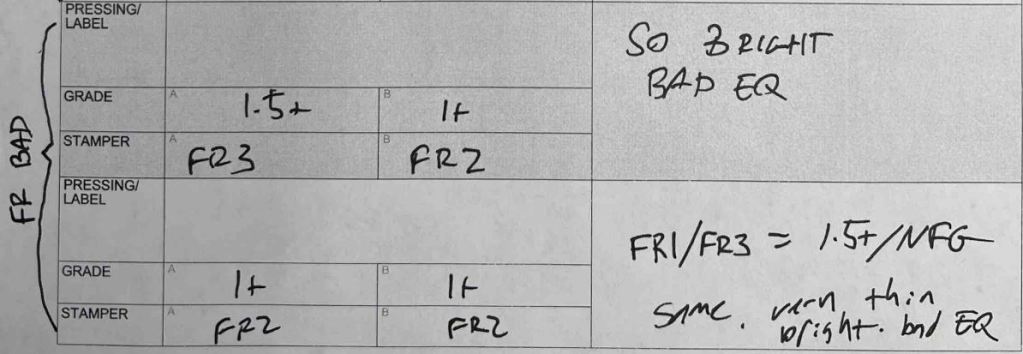
And the FR pressing of the Rachmaninoff record you see pictured above may indeed have the best sound.

The stamper numbers you see below belong to a different album.

(We’ve lately been giving out much more stamper information than we used to, but for now we are keeping this title closer to the vest.)

Note that we had FR1, FR2 and FR3, all originals, yet none of them could be considered good enough to offer our customers.

It’s just another one of a number of rules of thumb collectors use (“A method or procedure derived entirely from practice or experience, without any basis in scientific knowledge; a roughly practical method.”), one that will sometimes lead you astray if what you are trying to find are not just good sounding pressings of albums, but the best sounding pressings of albums.

Same with reissue versus original. Nice rule of thumb, but it only works, to the extent that it works at all, if you have enough copies of the title to know that you’re not just assuming the original is better. You actually have the data — gathered from the other LPs you have played — to back it up.

Who knew the recording would sound so much better on the right reissue pressings?

(more…)

Can’t Buy Much of a Thrill – Now with Notes!

Hot Stamper Pressings of the Music of Steely Dan Available Now

At least some of the thrills are here, and for any record on Chad’s label, that is really saying something.

Sonic Grade: B+ to A-

A few comments for the UHQR have been added since this went up on 4/4, now that I’ve had a chance to see the notes in full. I’ve noted the additions in brackets and sectioned some off as well.

Word from the listening panel is in, and they say the new Bernie Grundman mastered UHQR is actually not bad! [Not good, but not bad.]

The tonality is much closer to correct than a lot of the Heavy Vinyl LPs we’ve played recently. Oddly enough, instead of the EQ being overly smooth, in the way that appears to be all the rage these days, the tonality instead errs on the side of somewhat thinner and brighter than ideal. (One could also use the term “correct.”)

This should not be especially surprising. Bernie Grundman has been remastering Heavy Vinyl records since the mid-’90s. Overly smooth titles that he cut are hard to find, on the hundreds of titles he did for Classic Records or anywhere else. The more of his recent work I play, the more I have come to see his disastrously dull Giant Steps as an outlier.

The instruments where these tonality issues are most easily recognized are two that we have written a great deal about on this blog: pianos and snare drums.

The snare sound on the Brothers in Arms that Chris Bellman cut at Bernie Grundman Mastering has the same problem as this new Can’t Buy a Thrill. (Review with specifics coming, sorry for the delay, it has only been two years and I’ve been busy with other things.)

The thin sounding piano on the Cisco pressing of Aja is likewise a common shortcoming we notice on many of the modern recuts we play.

With links to 29 titles to test for a correct piano sound, and 13 for the snare test, the critical listener should be able to find some records in his own collection that will shed light on the problems we heard on Chad’s UHQR.

If your system errs on the side of fat and dark, Chad’s repress has what you need to “fix” the sound of the album. Instead of a murky piano, now you have a clear one. Instead of a too-fat snare getting lost in the mix, now you have a clear snare that you can more easily separate out from the other instruments.


Added 4/5

Note that we did not play all four sides. We felt sides one and three were enough to get an idea of how thrilling this pressing was going to be. We don’t get paid to play Heavy Vinyl pressings. We play them to help audiophiles understand their strengths and weaknesses. We hope that some audiophiles will hear what we have described and perhaps consider that there is a better way. That other way can be found in the bins of their local record store or, for those with deeper pockets, on our site. Either way, settling for the kind of sound found on these modern reissues is the one choice no one should be making.

We played the following four songs, and heard the sonic qualities described below:

(more…)

Rachmaninoff / Concerto No. 3 / Janis – Wrong Again?

More of the music of Sergei Rachmaninoff (1873-1943)

In 2007 we raved about this title:

Outstanding! Sounds just like the already very good shaded dog, in many ways better. (I don’t have that one around to compare anymore but this LP has that same natural, smooth sound, while being cut a bit cleaner.) 

We have two copies of this Victrola, both with the same stamper numbers, and this is definitely the better of the two sonically. It has more presence, more transparency and better dynamics.

In preparation for our latest big shootout, we decided to give the Victrola another listen, and the one copy we had on hand was not impressive to say the least. It was dark, thin and flat.

Three strikes and it was out. Seems as though we were wrong.

Did we have better copies in 2007? Perhaps.

Our advice: skip it. If you do buy one, buy it for cheap.

(more…)

The D4/D5 Stereo Pressings Are Just Awful on My Fair Lady

Hot Stamper Pressings Featuring Shelly Manne Available Now

In our experience, the Black Label stereo originals with D4/D5 stampers are terrible sounding.

With those stampers, My Fair Lady is undoubtedly a hall of shame pressing, as well as another early pressing we’ve reviewed and found wanting.

Both sides graded “No,” our not-especially-technical term for a record that sounds really bad.

Notes for Side One:

Track one is bright and unnatural up top. Track two is not very musical.

Notes for Side Two:

Track one is very weird sounding, thin and small.

(Obviously there was no need to play a second track.)

As you may have read elsewhere on the site, some Contemporary label originals are very poorly mastered, which should put paid to the idea that Hot Stampers are only, or even usually, original pressings.

In our most recent shootout, the second-best sounding pressing was on the early Black Label. We would love to give out the stampers for that one, but we don’t do that.

Here is the description of our current Shootout Winning pressing. We didn’t even give out the label of that one because it seems that copies with that label do very well and we want to be able to find more of them.

(more…)

Ray Charles & Betty Carter – DCC Clear Vinyl Pressing

More Soul, Blues and R&B Albums with Hot Stampers

This Dunhill Compact Classics LP pressed on CLEAR VINYL is one of DCCs earliest forays into analog production from way back in 1988.

Unfortunately it sounds like a bad CD.

Screechy, bright, shrill, thin and harsh, it’s hard to imagine worse sound for this music.

NO warmth.

NO sweetness.

NO richness.

NO Tubey Magic. In other words,

NO trace of the original’s analog sound. I have to wonder how records this awful get released.

You can be sure that Hoffman’s Gold CD murders it in every way.

(more…)

Andre Previn – These Two OJC Pressings Didn’t Make the Grade

Hot Stamper Pressings on Contemporary Available Now

The mastering choices of the cutting engineers for these two recordings did them no favors.

Like so many of the early OJC pressings we’ve played over the years, we found that both of these reissues tended to be somewhat thin tonally, with a brittle top end, which can clearly be heard in the tizzy quality of the cymbals.

This is not remotely the right sound for a vintage Contemporary recording.

When doing the shootouts for these albums, warmth turned out to be key to the sound of the best copies.

When the piano sounds warm and smooth, everything else in the recording seems to fall into place.

(more…)

Bill Evans – Live and Learn

Hot Stamper Pressings of the Music of Bill Evans Available Now

A classic case of live and learn. Many years ago we had played copies of the record and thought the sound was fine, shootout material in fact.

Flash forward to 2015 or 2016.  Now it sounds thin, flat and opaque.

Worse, it’s actually in mono.

On today’s modern stereos it leaves a lot to be desired, and for that reason we say skip it.

A stereo recording reissued in mono for no apparent reason?

What were they smoking over there at Milestone? 

(more…)

Time Out Is a Classic Case of Live and Learn

More of the Music of Dave Brubeck

Reviews and Commentaries for Time Out

Another example of We Was Wrong

When we did a shootout for this album way back in October of 2007, we took the opportunity to play the Classic Records 200 gram pressing. Maybe we got a bad one, who knows, but that record did not sound remotely as good as the real thing. (6 eye or 360, both can be quite good. Skip the Red Label ’70s reissues.)

The piano sounded thin and hard, which was quite unexpected given the fact that we used to consider the Classic LP one of their few winners and actually recommended it.

As we said in our shootout: “We dropped the needle on the Classic reissue to see how it stacked up against a serious pressing. Suffice it to say, the real Time Out magic isn’t going to be found on any heavy vinyl reissue!”

If I were in charge of the TAS Super Disc List, I would not have put this record on it.

Here are some others that we think do not qualify as Super Discs.

(more…)