 Hot Stamper Pressings Featuring the Violin Available Now
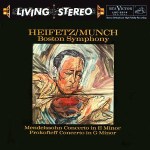
Our review for LSC 2314, with both the Mendelssohn and Prokofiev Violin Concertos, described the wonderful sound we heard on some of the better copies as follows:
As usual for a Living Stereo Heifetz violin concerto recording, he is front and center, with his fingering and every movement of his bow clearly audible, without being hyped-up in the least. (Well, maybe just a bit.)
No violin concerto recording can be considered to have proper Living Stereo sound if the violin isn’t right, and fortunately we found the violin on this copy to be very, very right, with the kind of rosiny texture and immediacy that brings the music to life right in your very own listening room.
Audiophiles who cannot hear what is wrong with the Classic Records repressings of Heifetz’s RCA recordings by the greatest composers who ever lived, including:
- Tchaikovsky,
- Beethoven,
- Bruch,
- Mendelssohn (pictured), and
- Sibelius
may want to seek out a nice — maybe even one that’s not so nice — vintage RCA Shaded Dog of any of his albums, if only to see just how poorly the Classics stack up (with the exception of the LSC 2734, which we have to say, against all odds, is very good).
Anyone has ever attended a classical music concert should recognize that the violin on any of the Heavy Vinyl pressings of these famous works sounds almost nothing like a violin performing in a concert hall sounds.
And to be clear, I mean ever.
No matter where you sit.
No matter how good or bad the hall’s acoustics.
Solo violins in live performance are clear, clean and present. You have no trouble at all “seeing” them clearly.
Our vintage Hot Stamper pressings have that kind of clear and present sound for the violin. If they didn’t, they would not qualify as Hot Stamper pressings.
We haven’t sold a violin concerto record with sound as bad as the typical Classic Records pressing since 2011, the year we stopped selling Heavy Vinyl. Since then we have dedicated ourselves to offering our customers pressings with audiophile quality sound. We believe that makes us unique in the world of audiophile record dealers.
All record dealers, when you stop to think about it.
Here is what we typically have to say about a Classic Records violin recording:
The Classic pressing of this album does not present the listener with the sound of a real, wood instrument, bowed by horsehair, in a physical space.
It is an airless fraud, a cheap fake reproduction that’s incapable of fooling anyone currently in possession of two good ears, a properly set up hi-fi system and a decent collection of Golden Age violin concerto recordings.
The fact that a great many writers identifying themselves as audiophiles embraced Classic’s mediocre-at-best reissues tells me that they were lacking some or all of the above.
Bernie Grundman’s low-rez, crude, smeary cutting system did this wonderful Living Stereo recording no favors.
Falling Apart
As an aside, many of the vintage orchestral recordings we’ve auditioned over the years did a good job of capturing the lead instrument in a concerto — for example, the piano or violin — but fell apart completely when the orchestra came in, with obvious and unacceptable levels of congestion and distortion.
Here are some titles that can have congestion problems when they get loud. If you play your orchestral recordings at moderate levels, you may not be as bothered by this problem as we are, because we do not have the luxury of listening at moderate levels.
We have to put the records through the ringer, and one of the ringers they must go through is they must sound right at loud levels, because live music gets loud.
Rarely Seen
Congestion and distortion are problems for practically all the titles you rarely see on our site, such as the Golden Age recordings put out by labels such as EMI, DG, Philips, Columbia, as well as dozens of others.
We discussed the problem here in more detail.