must-do-shootouts

Shootouts revolutionized my ability to pursue audio at the highest levels and find the best sounding pressings ever made.

If you put in the time and effort, there’s no reason they can’t do the same for you.

Letter of the Week – “The same in what sense?”

beatlessgtHot Stamper Pressings of Sgt. Peppers Available Now

A potential customer asked about some Beatles pressings he saw on our site:

  Hey Tom, 

I have the Beatles collection UK box set from the time frame you mentioned. [Most of our Beatles albums are from the 70s and early 80s.] The albums have the black Parlophone EMI label. Do you think they are the same as the album that is for sale?

Edward

Edward,

The same in what sense? No two records have the same sound, so in that sense, no, they cannot ever be the same. They can have the same labels, even the same stamper numbers, but they will always sound different on very good equipment, and when properly cleaned they will sometimes sound VERY different.

And the better your system, the more different they will sound.

If you absolutely love your Pepper from the box set and have played five or ten other pressings and found that it is the best sounding of them all, then you probably don’t need ours. You’ve already done a shootout and you’ve already found a winner. If that is the case, congratulations are in order.

But if you did not do a shootout, did not clean and play five or ten other copies, then our pressing should be quite a bit better, maybe even night and day better. No one can know until you play our copy against yours.

Your judgment is the final say on the matter, but you need a bunch of cleaned copies in order to make that judgment, and it looks like you do not have more than the one Pepper from the box.

At this point you really don’t know how good your Sgt. Pepper sounds, because you need other copies to play against it in order to know that.

(more…)

Thick as a Brick Marked a Milestone in 2007

jethrthick_1410_3_1192056381

Hot Stamper Pressings of the Music of Jethro Tull Available Now

Until about 2007, Thick as a Brick was the undiscovered gem (by me anyway) in the Tull catalog. The pressings we’d heard up until then were nothing special, and of course the average pressing of this album is exactly that: no great shakes.

With the advent of better record cleaning fluids and much better tables, phono stages, room treatments and the like — taking full advantage of the remarkable number of revolutions in audio that have occurred over the last two or three decades –some copies of Thick As A Brick have shown themselves to be truly amazing sounding. Even the All Music Guide could hear how well-engineered the album was.

Marking Two Milestones from the Past

The 2007 commentary you see below discusses the pros and cons of both the British and Domestic original pressings. With continuing improvements to the system, room, etc., it would not be long before we realized that the British pressings were simply not competitive with the best domestic ones.

You might say this record helped us mark two important milestones in the developing history of Better Records.

The first, around 2007, was recognized by the fact that we had improved our playback to a very high level, one high enough to reproduce the album with all the clarity, size and energy we were shocked to hear at the time.

The second milestone would result from the audio changes we continued to make for the next couple of years, from 2007 to 2010, which allowed us to recognize that the best British pressings, as good as they might be, were not in the same league as the best domestic ones. We broke down in detail exactly what we were listening for and what were hearing in this commentary, and the Brits were clearly not cutting it at the highest levels by 2010.

If you find yourself with one of more British copies of the album that you think have superior sound — any copies of the album, really — we would love to send you one of our Hot Stampers so you can hear what you are missing.

(more…)

Thoughts on Hearing an Amazing Copy of Thriller in the 80s

Hot Stamper Pressing of the Music of Michael Jackson Available Now

The killer copy of Thriller that we discovered in our 2006 shootout gave us a whole new appreciation for just how good the album could sound. It was a real breakthrough, and proof that significant progress in audio is just a matter of time and effort, the more the better.


Our review from 2006

I remember twenty years ago (that would be 1986) playing Thriller and thinking the sound was transistory, spitty, and aggressive.

Well, I didn’t have a Triplanar tonearm, a beautiful VPI table and everything that goes along with them back then. (More here.)

Now I can play the record.

I couldn’t back then.

All that spit was simply my table, arm, cartridge and setup not being good enough, along with all the garbage downstream from them feeding the speakers.

The record is no different, it just sounds different now. Which is what makes the record a great test. If you can play this record, you can probably play practically any pop and rock record. (Orchestral music is quite another matter.)

This Pressing Changes Everything

This pressing has a side two that’s so amazing sounding that it completely changed my understanding and appreciation of this album. The average copy is a nice pop record. This copy is a Masterpiece of production and engineering.

(more…)

Letter of the Week – “…so much more engaging and rich than I was used to.”

Hot Stamper Pressings of the Music of Charles Mingus Available Now

This posting on an audiophile forum was made by our good customer ab_ba who authorized me to print it here. (It started out on Hoffman’s forum but was quickly taken down as the subject of Hot Stampers is verboten. I have added some bolding and italics.)

The title is the author’s.

Better Records Hot Stampers: Or, how I learned to stop collecting and love listening

We are witnessing an absolute explosion in vinyl. It’s thrilling, but it has also become frankly overwhelming.

What matters? The experience of listening, of course. But, how do we know, I mean, how do we really know, what listening experiences are going to be sublime?

Too often, collectability becomes our proxy for listening. We’ve all done it – chasing a near mint early pressing, a Japanese or German pressing, a re-press from a label we trust. We all end up with multiple copies of our favorite records, but only listen to one or two of them. And whether we sell them or not, it brings us some comfort to see their going rates on Discogs continue to climb. For me at least, FOMO was a strange driver of my buying habits. I regretted records I didn’t purchase, far more often than I regretted purchases I did make, even as I have about a year’s worth of listening in records still sealed on the shelf. I’m even afraid to open some of them because I can see their value is rising. Isn’t that silly?

My Philosophy Was Off-Base

I love records. Listening to them, curating a collection, is a joyful hobby. It gets at some need I can’t quite name. But, of course, records shouldn’t be only for collecting. They are for the pleasure of listening. My philosophy was pretty off-base. I didn’t even perceive it that way, and here’s what got me to realize it, and get out of it.

Last summer, I came across an original mono pressing of Mingus Ah Um in one of my local shops. It was labelled as a “top copy” and the surface looked pretty good. The price was a little absurd, and considering I had the [MoFi] OneStep and the Classic Records pressings, I wasn’t sure I needed it. But, this is an album I loved, even as a kid, even on digital, and a first pressing held a lot of allure. I took some time to think about it, do some online comparison shopping, and by the time I got back to the shop, it was gone.

In a fit of pique, I bought the copy Better Records was selling.

It was listed as a Super Hot Stamper, and it was slightly cheaper than the copy the shop was selling. With a 30-day no-questions-asked return policy, it seemed a safe bet.

An Initially Disappointing Hot Stamper Reissue Pressing

Well, you can imagine my disappointment when it arrived a few days later. Nicely boxed for shipping, I unsleeved what was clearly a later pressing. My disappointment magnified when the needle dropped and the first thing I heard was surface noise. I’ve been conditioned by the heavy vinyl renaissance to equate surface noise with a bad-sounding record.

But then, the instruments kicked in, and from the first notes I could tell I was listening to something really different.

It was clear, forward, and dynamic. Nothing harsh, even in the horns, but so much more engaging and rich than I was used to. It was the drum solo partway through the first track that convinced me I was hearing something special in this pressing. I sat and listened to the entire record without doing anything else, and for me, something that holds my attention to where I don’t want to grab my phone or a book is part of what defines a peak listening experience.

(more…)

Jazz Giant and Tube Versus Transistor Tradeoffs

Hot Stamper Pressings of Contemporary Jazz Albums Available Now

In a commentary from more than ten years ago we weighed the tradeoffs in the sound of the originals versus the reissues.

This superb sounding original Black Label Contemporary pressing of Benny Carter’s swingin’ jazz quartet is the very definition of a top jazz stereo recording from the late ’50s recorded and mastered through an All Tube Chain.

There’s good extension on the top end for an early pressing, with TONS of what you would most expect: Tubey Magic and Richness. If that’s what you’re looking for, this copy has got it!

We prefer the later pressings in most ways, but this record does something that no later pressing we have ever played can do — get Benny’s trumpet to sound uncannily REAL.

If you want to demonstrate to your skeptical audiophile friends what no CD (or modern remastered record) can begin to do, play side two of this copy for them. They may be in for quite a shock.

The sound of the muted trumpet on side two is out of this world. 

It’s exactly the sonic signature of good tube equipment — making some elements of a recording sound shockingly real.

(more…)

An Extraordinary Recording of the Carmen Fantasie – This Is Why You Must Do Shootouts

It has been years since a Whiteback pressing on the later label won a shootout. Some reissue copies of CS 6165 have earned Nearly White Hot Stamper grades, but we would be very surprised if one of the Blueback originals we play in the next shootout does not come out on top. They are just too good.


This London Whiteback LP has DEMO DISC sound like you will not believe, especially on side two, which earned our coveted A Triple Plus rating. The sound is warm, sweet and transparent; in short, absolutely GORGEOUS. We call it AGAIG — As Good As It Gets!

As this is one of the Greatest Violin Showpiece Albums of All Time, it is certainly a record that belongs in every right-thinking audiophle’s collection. (If you’re on our site and taking the time to read this, that probably means you.) Ruggiero Ricci is superb throughout.

And side one was just a step below the second side in terms of sound quality, with very solid A++ sound. To find two sides of this caliber, on quiet vinyl no less, is no mean feat. You could easily go through ten copies without finding one as consistently good sounding as this one.

A True Demo Disc, Or Was It?

Ricci’s playing of the Bizet-Sarasate Carmen Fantasie is OUT OF THIS WORLD. There is no greater perforrmance on record in my opinion, and few works that have as much Audiophile Appeal.

Which is why I’ve had a copy of this record in my own collection for about fifteen years marked “My Demo Disc.” But this copy KILLED it. How could that be?

It just goes to show: No matter how good a particular copy of a record may sound to you, when you clean and play enough of them you will almost always find one that’s better, and often surprisingly better.

Shootouts are the only way to find these kinds of records. That’s why you must do them.

Nothing else works. If you’re not doing shootouts (or buying the winners of shootouts from us) you simply don’t have top quality copies in your collection, except in the rare instances where you just got lucky. In the world of records luck can only take you so far. The rest of the journey requires effort.

(more…)

These Pink Label Pressings Can Sound Good, But Great? Not a Chance

Hot Stamper Pressings of Music on Island Records Available Now

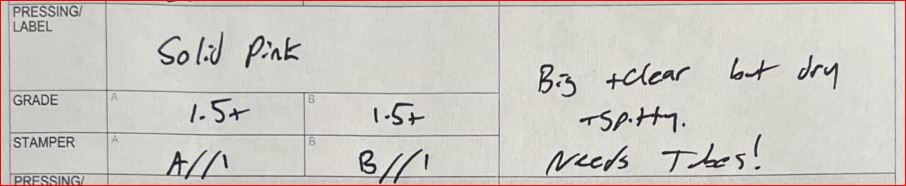
Below you will see the bottom part of the stamper sheet for a shootout we did recently.

Please note that the album you see pictured is not the one we are discussing here.

It very well could have been been a Jethro Tull album, but all we can say for sure is that it was definitely an album on Island, which just happens to be one of our favorite labels, for sound and music.

The earliest pressings for many records on the Island label are not very good. This one — again, not for This Was, for some other record — is not a bad sounding pressing.

With grades of 1.5+ on both sides, it fits comfortably in our section for good, not great sounding LPs — but the right reissues from the 70s are a big step up in class sonically. They’re the ones that win shootouts, not these Pink Label LPs.

It’s big and clear but dry and spitty and badly needs tubes in the cutting chain.

Do the record collectors who prize the Pink Label pressings above all others notice these things?

Do the audiophiles who play them?

Been There, Done That

We’ve run into so many sonically-flawed Pink Label Islands by now that hearing one sound lackluster if not actually awful doesn’t phase us in the least. Some of the other Pink Labels that never win shootouts can be found here.

(more…)

What to Listen For on Birds of Fire

Hot Stamper Pressings of Jazz-Rock Fusion Albums Available Now

Birds of Fire as a recording is not about depth or soundstage or ambience.

It’s about immediacy, plain and simple.

All the lead instruments positively jump out of the speakers — if you are lucky enough to be playing the right pressing.

This is precisely what we want our best Hot Stampers to do. In most cases, the better they do it, the higher their grade will be.

The main problem with this record is a lack of midrange presence. If the keyboards, drums and guitars are not front and center, your copy does not have the presence it should. On the best copies the musicians are right in the room with you. We know this for a fact because we heard the copies that could present them that way, and we heard it more than once.

Which of course gets to the reason shootouts are the only real way to learn about records.

The best copies will show you qualities in the sound you had no way of knowing were there. Without the freakishly good pressings you run into by chance in a shootout you have no way to know how high is up. On this record up is very high indeed.

A True Demo Disc

Birds of Fire is one of the top two or three Jazz/Rock Fusion Albums of All Time. In my experience, few recordings within this genre can begin to compete with the Dynamics and Energy of the best pressings of the album — if you have the Big Dynamic system for it.

(more…)

Even In The Quietest Moments and Your 1977 Ears – There’s No Going Back

supereveni_1506_1x

Hot Stamper Pressings of the Music of Supertramp Available Now

By 1977 I was a huge fan of the band, having first discovered their music on Crisis (1975) and Crime (1974), in which order I honestly can’t remember.

I played their albums all the time, especially Crisis.

The first Supertramp album I bought on audiophile vinyl would have been Crime of the Century by Mobile Fidelity, which came out in 1978.

Every right-thinking audiophile had that one — MoFi sold over a hundred thousand of them (along with a hundred thousand of Aja, Touch and one or two others).

And why not? The sound was killer on the systems of the day. Lots of slam down low (but not really that low, although it seemed plenty low at the time), lots of extra top up high, lots of phony detail, just what the old school stereos of the day, like mine, needed.

Crisis? What Crisis? followed in 1975. It was the Supertramp album that sent me over the top. I played that album relentlessly. Before long Art Rock was at the top of my list anytime I wanted to have an immersive musical experience, and that, for an obsessive audiophile like myself, meant almost every day.

Supertramp, Yes, Roxy Music, 10cc, Eno, Crack the Sky, ELO, Bowie – it’s all I wanted to listen to back then, and it encouraged me to keep upgrading my equipment whenever I had the money, although I admit to being completely clueless about all of that at the time. More on that subject here.

A year and a half later EITQM followed. It too became a staple of my musical diet. Man, I played that record till the grooves were worn smooth.

I thought the sound of my domestic pressing was killer at the time, too. Crisis was a demo disc at my house and this was right up there with it. Now the obvious question is, did I have a good sounding copy, or did my stereo not reveal to me the shortcomings of my LP? Or maybe my ears were not well enough trained to hear what was wrong.

Those of you who have been doing this for a long time know the answer: any or all of the above, probably all, and nobody can know just how much of each.

And there is no way to find out because you are not that person anymore.

Your 1977 Ears… and Mine

Even if you could recreate your old stereo and room, and find your original copy, there’s one thing you can’t do, and that’s listen to it with your 1977 ears.

Every time you play a record and listen to it critically, your ears get better at their job.

(more…)

How Wide and Tall Is Your Copy of Little Queen? Compared to What?

Hot Stamper Pressings of the Music of Heart Available Now

Little Queen is yet another recording that only truly comes alive when you turn up your volume.

On the right system, this is a classic rock Demo Disc to beat practically anything you could ever throw at it.

Love Alive and Barracuda on this copy will deliver the full rock and roll power your system is capable of.

If you’ve got The Big Sound, this is the record that will show you just how big it is.

You get huge meaty guitars, big bass, a smooth top end, full-bodied vocals, powerful rock energy and dynamics, loads of richness and incredible transparency.

Wide and Tall

A key quality we look for in Hot Stamper copies of Little Queen is wide and tall presentation.

What exactly does that mean you ask? The best copies, the ones that really jump out of the speakers, tend to present some (usually high frequency) information higher and more forward than others. This is not hard to miss.

When you’re playing ten or fifteen copies of the same side of the same album and suddenly a cymbal crashes higher and more clearly than the others did in the part of the track you are testing, you can’t help but notice it. Wow! How did that get there?

Once you hear it you start to listen for it, and sure enough the next copy won’t do it, nor will the next. Maybe the one after that gets about halfway there: the cymbal crashes are higher than most, but not as high as the one that really showed you how high is up.

This is why we do shootouts, and why you must do them too, if owning the highest quality pressings is important to you.

Progress in Audio

And of course it all ties in with our revolutionary changes in audio commentary. If you’ve been making steady improvements to your system, or have better cleaning technologies, or better room treatments, or cleaner electricity, maybe ALL the Little Queen pressings do it now. They might ALL do something they never did before, and in fact they SHOULD be doing most things better now. 

Our last shootout was a while back. Since then many, many parts of the chain have undergone improvement. During this shootout we heard things in the recording we’d never heard before. This is the point of all this audio fooling around. It pays off, if you do it right. You have musical information waiting to be unlocked in your favorite recordings. It isn’t going to free itself. You have to do the work to set it free. Do it our way or do it some other way, but do it. You, more than anyone else, will be the one to get the benefit.

Problems Noted More Recently

(more…)