con-wis

Many audiophiles are inclined to believe the conventional wisdom they receive from other enthusiasts.

Some of it is right, some of it is wrong, but if you don’t know how to critically listen to records for yourself, you will never be able to tell which is which.

You’ll be stuck with the approaches most audiophiles use — guessing and assuming. Neither are a reliable method for getting at the truth.

In 2008 We Discovered the Best Sound for this Album

Hot Stamper Pressings of Top Quality Jazz Albums Available Now

In the early 2000’s we auditioned an amazing sounding cheap reissue pressing of this album. By 2008 we finally had enough copies to do a shootout.

The fact that we were not able to find a copy with two killer sides tells me a few different things about what may or may not have been true at the time. (2008 was early days in the world of Hot Stamper shootouts.)

One, that we may not have had a big enough pile of copies to play. This is before Discogs made it easy to find a record like this, so chancing upon copies locally was very much a hit or miss deal, or

Two, we couldn’t clean them as well as we can now, or

Three, we couldn’t play them as well as we can now, or

Four, some or all of the above, to one degree or another. (This is of course how audio works, which, for those of us who have been in it for a long time, is best described as mysteriously.)

(more…)

Straight Up – Porky Not So Prime Cut

Hot Stamper Pressings of the Music of Badfinger Available Now

UPDATE 2025

This commentary has been updated multiple times, most recently in 2025.


British band, British pressing… right?

Nope. It’s just another mistaken idea.

We evaluated an original British pressing in our shootout, unbeknownst to me as it was playing of course. And guess where it finished: dead last.

The most thick, congested, crude, distorted, compressed sound of ALL the copies we played.

We love the work of Porky, Pecko, et al. in general, but once again this is a case where a British Band recorded in England sounds best on domestic vinyl. (McCartney’s first album on Apple is the same way.)

Just saw this today (11/29/2021)

On November 18, 2019, a fellow on Discogs who goes by the name of Dodgerman had this to say referencing the original UK pressing of Straight Up, SAPCOR 19:

So Happy, to have a first UK press, of this lost gem. Porky/Pecko

Not sure what those two commas are doing there. Pausing for emphasis? Sure, why not? This is a big deal.

Like many record collectors, he is happy to have a mediocre-at-best, dubby-sounding original pressing, poorly mastered by a famous mastering engineer, George Peckham, a man we know from extensive experience to be responsible for cutting some of the best sounding records we’ve ever played. He is truly one of the greats.

Is Dodgerman an audiophile? He might be, or at least he might choose to describe himself as one.

Many audiophiles employ this kind of mistaken audiophile thinking, believing that a British band’s albums must sound their best on British vinyl for some reason, possibly a cosmic one.

(more…)

What Can You Learn from a Mercury Shootout Like This One?

Hot Stamper Pressings of Mercury Classical Recordings Available Now

The short answer is that you can’t learn much from this shootout, because we’re not telling you which title the stampers you see below belong to.

Be that as it may, in the case of this mystery title the conventional wisdom turns out to be correct — the earlier numbered pressings did better than the later numbered pressings, and the early labels did better than the later labels.

That happens a lot, and we are happy to admit that it does. Why? Because the experimental evidence — the data — say that is what happened.

As usual for posts in which the stamper sheet from a shootout is reproduced in its entirety, the stamper numbers shown below will belong to a different album than the one you see pictured.

These can be found under the heading of Mystery Stampers. Most of these posts will illustrate something to be learned from a Hot Stamper shootout, but because the information reveals the shootout winning stampers, the actual title of the record is rarely revealed.

Much more useful stamper information can be found using this link, which includes plenty of stamper numbers for specific titles that are best avoided by audiophiles looking for top quality sound. In addition, we post the winning and losing stampers for some titles that are an unreliable guide to good sound. Unreliable stampers are also quite common.

(more…)

What Are the Best Stampers for Led Zeppelin’s Albums?

Hot Stamper Pressings of the Music of Led Zeppelin Available Now

What are the best sounding stampers for Led Zeppelin’s albums?

As if we would tell you!

This is a reworked excerpt from a much longer piece entitled record collecting for audiophiles – the limits of expert advice

In it we discussed the various stampers for some of Led Zeppelin’s albums and what role they play in our Hot Stamper shootouts.

Please to enjoy.

There is no way to know whether a record is any good without playing it, early stamper, late stamper or any other stamper.

First pressings (A, 1A, A1) don’t always win shootouts.

If they did we would simply buy only first pressings with those early stampers and only sell copies with those early stampers, since they are the best.

But this ignores the inconvenient fact that a great many other things go into the production of a record that have nothing to do with how early the stamper is.

A single copy of an album with stampers numbered (or lettered) A, when compared to B, when compared to C, has no definitive meaning for stampers A, B, C, or any others, because of the tremendous variation in the sound of all the pressings with A,B,C and other stampers.

Example Number One

There is a hot stamper for a certain Zep album that always wins the shootouts, [redacted].

It beats the hell out of the early stampers, A and B. In fact, we don’t even go after A and B anymore because they are expensive and rarely sound good enough to recoup our investment of the time and money we would spend buying, cleaning and auditioning them in a shootout.

A and B can be good, but why pay top dollar for them when they have never been any better than “good?”

We’re looking for “great” so that we can charge a premium price for them. This accomplishes three things that are obviously of great importance to any business:

  1. It pleases the hell out of our customers.
  2. It covers our costs, and
  3. It lets us pay our staff good wages and bonuses for their hard work, skill and knowledge.

(more…)

RCA Produced this Amazing Budget Reissue in 1976

Hot Stamper Pressings of the Music of Tchaikovsky Available Now

This review was written in 2011 shortly after our first Hot Stamper shootout for the work.

It still holds up though — I wouldn’t change a thing, other than to add a few links to help audiophiles and record collectors gain a better understanding of the shortcomings of received wisdom when it comes to finding that small subset of pressings capable of offering significantly higher sound quality.

Conventional record collector thinking generally works fine most of the time, but Monteux’s recording of the 6th Symphony in 1955 is a good example of the standard advice for finding better pressings turning out to be completely wrong.

For more on this subject, including the solution we came up with to fix the problem, click here.


Our Original Review

Presenting a first for Better Records: a White Hot Stamper copy of this CORRECTLY remastered version of LSC 1901, which just happens to be a recording from the earliest days of stereo, 1955! It’s guaranteed to KILL any and all original Shaded Dogs, as well as the more common reissues; White Dogs, Red Seals, Victrolas, Classic Heavy Vinyl, you name it, this pressing will beat the pants off of it and in the process show you precisely what is wrong with each and every one of them.

Over the past twenty years we’ve played hundreds of early RCAs and we have sure never heard one sound like this, with so much richness, Tubey Magic, LIFE and CLARITY.

(more…)

There’s a Very Good Chance We Were Wrong about Mulligan Meets Getz

More of the Music of Stan Getz /More of the Music of Gerry Mulligan

This is an album that we were probably wrong about in 2021 when the following Hot Stamper two-pak pressing went up for sale on the site. (The pressings we liked at the time are long gone by now.) Here is what we wrote back then:

Mulligan and Getz’s 1957 collaboration arrives on the site with this superb 2-pack offering Nearly Triple Plus (A++ to A+++) sound on both sides – just shy of our Shootout Winner

Full, rich, and spacious with tons of Tubey Magic and, better yet, not the least bit dry, hard or transistory

Practically impossible to find in stereo with audiophile playing surfaces – it took two different pressings to get two good sides, and they are very good indeed

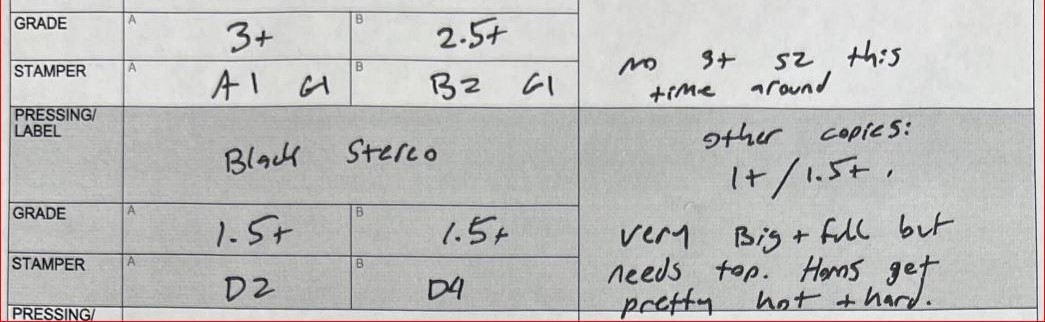
The reissues we discovered in 2025 trounced the originals (in both stereo and mono) as well as the early reissues (on the Verve T Label) we played in our shootout, as you can see from the stamper sheet notes below:

Our mistaken judgment is simply the result of ignorance. In 2021 we simply had no idea just how good this recording could sound on vintage vinyl. We hadn’t done our homework properly, and because of that we came up with the wrong answer.

We only discovered the right pressings, with the right stampers, pressed in the right era, and mastered by the right guy, sometime in 2024 or so. We bought a bunch of those and in 2025 did the shootout with all kinds of copies, just to keep everybody honest.

That was the year much better sounding reissue copies that look like the one you see on the left came along. As we noted in the listing:

  • Leave it to Better Records to figure out a complicated title with a long history such as this one – originals, reissues, monos, stereos, we had to play them all to find a copy that sounds as good as this one does.
  • Full, rich, and spacious with an abundance of Tubey Magic and, better yet, not the least bit dry, hard or transistory.

Some quick notes:

Bowtie Label Stereo

(more…)

So You Actually Think an OJC Can Beat an Original Black Label Contemporary?

Hot Stamper Pressings of Contemporary Jazz Albums Available Now

Yes, we think that, because that’s what the evidence from our most recent shootout in 2025 showed us.

As you can see from the stamper sheet below, the A1/B2 stampers of our OJC, in a blinded test, came out on top.

Better mastering equipment? Better mastering skills? Better vinyl? Better pressing methods?

Who the hell knows?

Better yet, what audiophile or record collector with a lick of sense would even pretend to know?

Not us, that’s for sure. At this point we are very comfortable not having answers for the unanswerable questions we posed above.

But don’t rush off to buy the OJC of the Sonny Rollins record you see pictured. This commentary has nothing to do with that record. (more…)

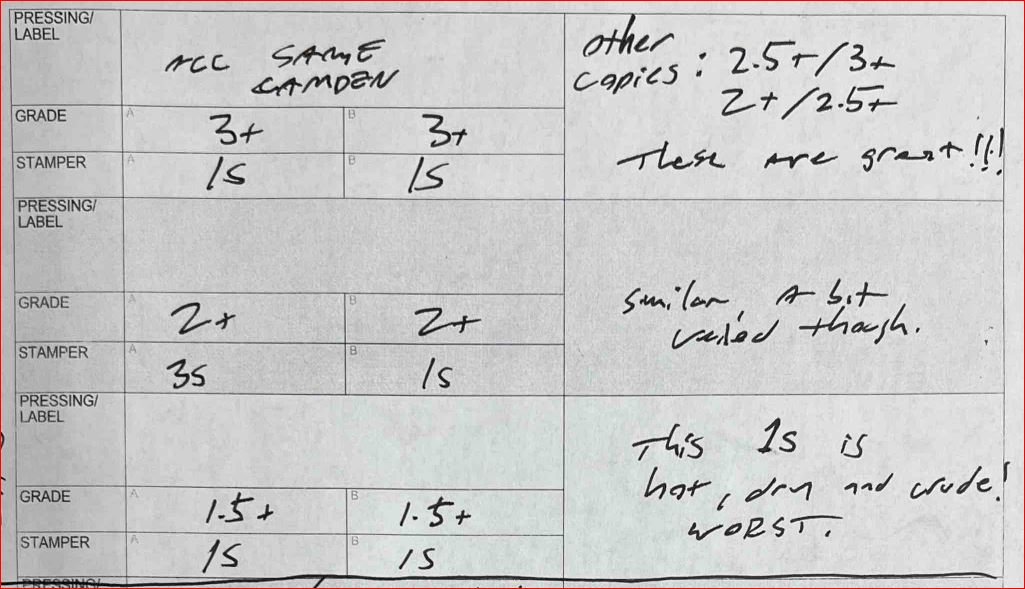
Does 1s Sound Great or Does It Sound Good (but Hot, Dry and Crude)?

Hot Stamper Pressings of Living Stereo Recordings Available Now

Below you will see the complete stamper sheet for a shootout we did recently.

Note that the album you see pictured is not the record we did the shootout for.

We are not revealing what record had these stampers and earned these grades for the simple reason that we rarely if ever give out the specific information that identifies the best sounding pressing of any album.

As I’m sure you can understand, we want you to buy the copy with the Hottest Stampers from us, not find one on your own! We’re happy to be moderately helpful, but naturally we find it necessary to draw the line somewhere, and giving out “the shootout winning stampers” is where we choose to draw it.

(more…)

How Much Tubey Magic Is Too Much?

Hot Stamper Pressings of Living Stereo Recordings Available Now

UPDATE 2023

We have stopped buying the original LSC 2400 for the simple reason that it is not competitive with the budget VICS 1206 reissue from 1960 that replaced it in the RCA catalog.

The review we wrote for the Shaded Dog is probably close to twenty years old. There was a time when the shortcomings of the original RCA were not nearly as easy for us to recognize, but that time has long since past.

If any copy of the original, or any remastered version from the modern era sounds good to you, we can almost guarantee that you are mistaken about the quality of the sound, and, even better, we can offer you the pressing that makes our case better than any review can.


Our Old Review

The hall is HUGE — so transparent, spacious and three-dimensional it’s almost shocking, especially if you’ve been playing the kind of dry, multi-miked modern recordings that the 70s ushered in for London and RCA. (Many of Solti’s recordings from the decade are not to our liking, for reasons we lay out here.)

EMI recordings may be super spacious but much of that space is weird, coming from out-of-phase back channels folded in to the stereo mix. And often so mid-hall and distant. Not our sound, sorry.

We strongly believe that there will never be a modern reissue of this record that even remotely captures the richness of the sound found on the best of these Living Stereo original pressings.

Here are some of the strengths and weaknesses we noted on a copy we played way back when.

Side One

Big and lively. The Tubey Magical colorations are a bit much for us, with too much tube smear on the strings and brass to earn more than a single plus. 

Side Two

Even bigger and more spacious, with some smear caused by the serious amounts of tube compression being used, of course, but the quiet passages are magical. [Which is precisely what heavy tube compression is designed to accomplish.]

The Victrola Reissue

We much prefer the sound of the Victrola reissue, VICS 1206, which came out in 1966.

As for the Victrola pressing, we’re guessing — how could we possibly know for sure? — that less tube compression was used in the mastering.

It’s still plenty tubey, but more to our taste for not being overly tubey.

(more…)

Sometimes the Earliest Stampers Just Cannot Be Beat

Hot Stamper Pressings on Decca & London Available Now
We recently posted a lengthy commentary about conventional wisdom in an attempt to make the case that, although the most common record collecting approaches are more often right than wrong, there is simply no way to know what approach will produce the best results for any given title.

Rather than post one exception after another — easily done, since we know literally hundreds of them — we are happy to admit that the generally accepted record collecting rules of thumb* work well for most records, with the definition of “most” being “more than half the time.”

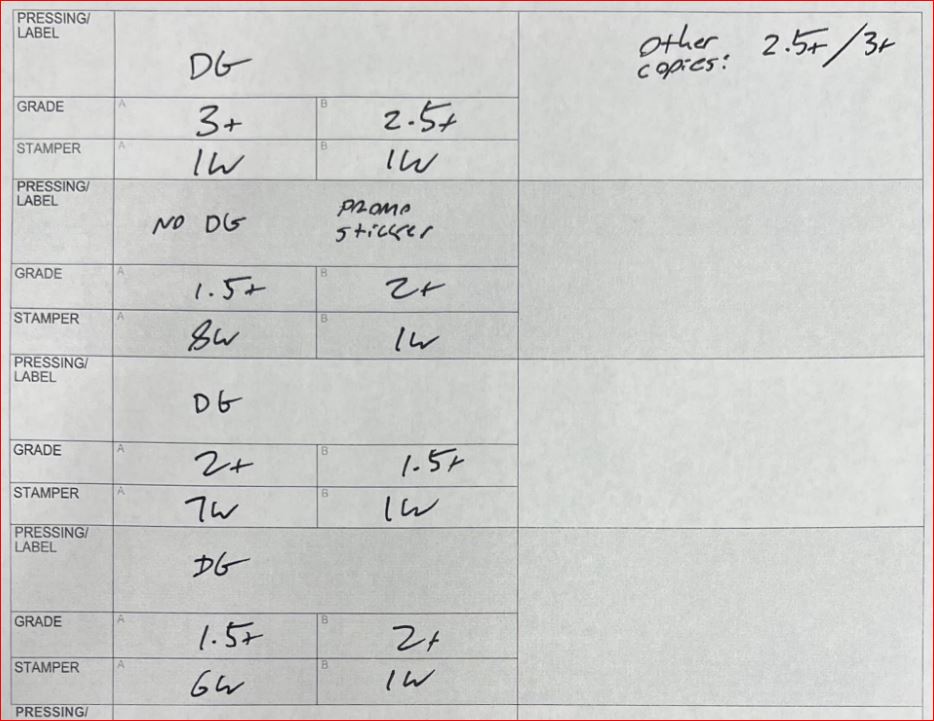
In the case of this Mystery London, the received wisdom turns out to be right on the money. (As per our policy, please note that the Mahler album you see pictured is not the record we are discussing in this post.)

What conclusions can we draw from this information?

We would be very surprised if the earlierst pressings cut by Harry Fisher (1W/1W) can be beaten for sound. It’s possible, of course, and we will naturally continue to buy pressings with other stampers, if for no other reason than the fact that they are far more plentiful than the first pressings.

(more…)