con-wis

Many audiophiles are inclined to believe the conventional wisdom they receive from other enthusiasts.

Some of it is right, some of it is wrong, but if you don’t know how to critically listen to records for yourself, you will never be able to tell which is which.

You’ll be stuck with the approaches most audiophiles use — guessing and assuming. Neither are a reliable method for getting at the truth.

How Do the Early Pressings of The Poll Winners Sound?

Hot Stamper Pressings of Contemporary Jazz Albums Available Now

A recent Shootout Winning copy with the early stereo badge cover was described this way:

Stunning sound throughout this vintage Black Label Stereo Records pressing, with both sides earning Shootout Winning Triple Plus (A+++) grades or close to them

Roy DuNann always seems to get the real sound out of the sessions he recorded – amazingly realistic drums in a big room; Tubey Magical guitar tone; deep, note-like bass, and on and on

4 1/2 stars: “The choice of material, the interplay between the three players, and the lead work all meld together beautifully on The Poll Winners, making it a classic guitar album in a small-group setting.”

Musically, all true. Sonically, not so much. The early D1/D2 stampers on the early Black Label might be passable on side one (1+), but side two was just a mess (NFG).

Side One

Track Two

  • A bit bright and flat

Track One

  • Very clear but lacking richness, weight and depth
  • Thin, and bright up top
  • 1+

Side Two

Track One

  • Narrow stereo field
  • Weird tape hiss
  • Metallic top end
  • Very recessed and weird
  • Nope

A different Stereo Badge Cover copy sporting a Black Label won the shootout by the way. Go figure.

(more…)

How Good Are the Robert Ludwig-Mastered Pressings of Alchemy?

Hot Stamper Pressings of the Music of Dire Straits Available Now

The best domestic pressings we played, the ones cut by Robert Ludwig at Masterdisk, were simply not competitive with any of the early British LPs.

The evidence is pretty clear that the master tapes stayed in England and that only the British pressings are made from them. If you’ve played as many records as we have, it’s not hard to recognize dubby sound when you hear it.

As a general rule, this domestic pressing will fall short in some or all of the following areas when played head to head against the imported pressings we offer. Much like the records linked here:

(more…)

Most of the Time the Conventional Wisdom Turns Out to Be Right

Hot Stamper Pressings of Contemporary Jazz Albums Available Now

Recently we conducted a shootout for yet another superb Contemporary title. We’d played quite a collection of copies of this particular album over the years, on every label, starting back in the 90s when we first discovered how amazing sounding Contemporary records could be when you get hold of a good one.

We felt we had a solid understanding of both the music and the key aspects of the sound we might expect to hear — Tubey Magic, space, dead-on tonality, top end extension, all the stuff we’ve come to love in these live-in-the-studio, all-tube-chain Contemporary jazz recordings from their heydey throughout the 50s and 60s.

However, it’s not the record you see pictured. For now, the title of this album will have to remain a mystery, along with a great many others for which we’ve been reprinting our shootout stamper sheets so as to discuss their meaning on the blog.

As you can see, the original first pressings earned White Hot Stamper grades and were declared the winner of our shootout. With Nearly White Hot Stamper grades, the early Green second label did very well, followed by an OJC with respectable sound overall.

We recently posted a lengthy post discussing the pros and cons of conventional wisdom. In it we attempted to make the case that, although the most common record collecting tenets are more often right than wrong, there is simply no way to know which standard approach will work for the specific title at hand.

Rather than post one exception after another — easily done, since we have documented literally hundreds of them — we are happy to admit that the standard record collecting rules of thumb work well for most records, with the definition of “most” being “more than half the time.”

That leaves a lot of room for misses, and if those misses happen to be favorite albums of yours, tough luck. Unless…

Unless you know how to test records properly.

(more…)

How Good Are the UK Original Unboxed Deccas of Satanic Majesties?

Hot Stamper Pressings of the Music of The Rolling Stones Available Now

How good are the original Unboxed Deccas on Satanic Majesties?

They can be very good.

But they are never as good as the right later pressings with the Decca in a box label, the ones produced from about 1970 on.

The Unboxed Decca pressing earned a Super Hot Stamper grade (A++). The later pressing, with the right stamper, showed us just how good the album can sound.

Since the originals are pricey and hard to find, and, as a rule, noisier than the later pressings, we don’t pick them up unless we find them for cheap, which rarely happens. They have not won any shootouts, and that is very unlikely to change.

There is one set of stampers for this album that always wins, and those stampers are not found on the early label.

(more…)

How Does the Heavy Vinyl Rubber Soul Sound?

Hot Stamper Pressings of Rubber Soul Available Now

This review was originally written in 2015.


We are so excited to tell you about the first of the Heavy Vinyl Beatles remasters we’ve played! As we cycle through our regular Hot Stamper shootouts for The Beatles’ albums we will be of course be reviewing more of them*. I specifically chose this one to start with, having spent a great deal of time over the last year testing the best vinyl pressings against three different CD versions of Rubber Soul.

The short version of our review of the new Rubber Soul vinyl would simply point out that it’s awful, and, unsurprisingly, it’s awful in most of the ways that practically all modern Heavy Vinyl records are: it’s opaque, airless, energy-less and just a drag.

I was looking forward to the opportunity to take Michael Fremer, the foremost champion of thicky vinyl, to task in expectation of his usual rave review, when to my surprise I found the rug had been pulled out from under me — he didn’t like it either. Damn!

MF could hear how bad it was. True to form, he thinks he knows why it doesn’t sound good:

As expected, Rubber Soul, sourced from George Martin’s 1987 16 bit, 44.1k remix sounds like a CD. Why should it sound like anything else? That’s from what it was essentially mastered. The sound is flattened against the speakers, hard, two-dimensional and generally hash on top, yet it does have a few good qualities as CDs often do: there’s good clarity and detail on some instruments. The strings are dreadful and the voices not far behind. The overall sound is dry and decay is unnaturally fast and falls into dead zone.

It strikes me as odd that the new vinyl should sound like a CD. I have listened to the newly remastered 2009 CD of Rubber Soul in stereo extensively and think it sounds quite good, clearly better than the Heavy Vinyl pressing that’s made from the very same 16 bit, 44.1k remixed digital source.

If the source makes the new vinyl sound bad, why doesn’t it make the new CD sound bad? I can tell you that the new CD sounds dramatically better than the 1987 CD I’ve owned for twenty years. They’re not even close. How could that be if, as MF seems to believe, the compromised digital source is the problem?

Lucky for me I didn’t know what the source for the new CD was when I was listening to it. I assumed it came from the carefully remastered hi-rez tapes that were being used to make the new series in its entirety, digital sources that are supposed to result in sound with more analog qualities.

Well, based on what I’ve heard, they do, and those more analog qualities obviously extend to the new Rubber Soul compact disc. At least to these ears they do.

It’s possible my ignorance of the source tape allowed me to avoid the kind of confirmation bias — hearing what you expect to hear — that is surely one of the biggest pitfalls in all of audio and a pit that Fremer falls into regularly.

(more…)

Another Knockout for Indianapolis, and It Was Rarely Even Close

Hot Stamper Pressings of Living Stereo Recordings Available Now

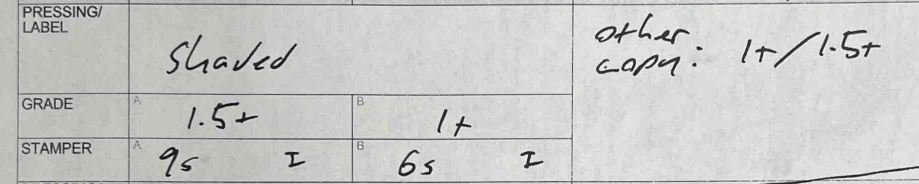
Below you will see the complete stamper sheet for a shootout we did in 2024.

Note that the album you see pictured is not the record we did the shootout for.

For RCA classical and orchestral recordings, many collectors think that the earliest pressings on the Shaded Dog label, in stereo, pressed in Indianapolis, tend to be the best sounding. 

More often than not, a rule of thumb like that one turns out to be right, which is how it got to be a rule of thumb in the first place. In this shootout, it turned out to be as right as rain.

The best pressingss with 1s stampers beat the 2s which beat the3s. Indianapolis was once again the pressing plant that produced the best sounding copies.

In fact, in this case the differences were even starker than we would have imagined going in. No copy not pressed in Indianapolis was even saleable, since a record that does not earn a grade of at least 1.5+ on both sides can qualify as a Hot Stamper pressing.

Fortunately, even though we were buying them randomly, we managed to luck out to some degree by finding many more 1s pressings than later-numbered ones.

Key Takeaways

  • 1s/1s is by far the best stamper for this mystery title, as collector wisdom would have predicted.
  • Indianapolis produced the best sounding pressings in this shootout, again, as predicted.
  • At some point collector wisdom fails us, as the Shootout Winning stampers (3+) and the good, not great stampers (1.5+) turned out to be the same stampers. This means that:
  • 1s is no guarantee of top quality sound. It follows that:
  • 1s might be the hot ticket, the 3/3 winner, but the odds, four to one, are against it. Again, it follows that:
  • As is almost always the case, the 1s pressing is most likely to be one of a bunch of potentially hot tickets.

(more…)

Bernie Finds the Right Sound for The Genius After Hours

charlgeniusHot Stamper Pressings of Titles that Sound Better in Mono Available Now

This commentary was written about ten years ago has been updated with the latest information from the shootout we did in 2025.


Proof positive that there is nothing wrong with remastering vintage recordings if you know what you’re doing. These sessions from 1956 (left off of an album that Allmusic liked a whole lot less than this one) were remastered in 1985 and the sound — on the better copies mind you — is correct from top to bottom.

The highest compliment I can pay a pressing such as this is that it doesn’t sound like a modern remastered record.

It sounds like a very high quality mono jazz record from the 50s or 60s.

Unlike modern recuts, it doesn’t sound EQ’d in any way.

It doesn’t lack ambience the way modern records do.

It sounds musical and natural the way modern records rarely do.

If not for the fairly quiet vinyl, you would never know it’s not a vintage record. The only originals we had to play against it were too noisy and worn to evaluate critically. They sounded full, but dark and dull and somewhat opaque.


UPDATE 2025

The originals on the Atlantic Plum and Red Label are not the way to go on this album. Our shootout notes below make that clear. Take our friendly and helpful advice and steer clear of them.

(more…)

Seems as Though the Shaded Dogs Pressed in Indianapolis Actually Do Sound Better

Hot Stamper Pressings of Living Stereo Recordings Available Now

As painful as it may be for us to admit it, sometimes the conventional wisdom turns out to be right!

For RCA classical and orchestral recordings, collectors have long held that the earliest pressings on the Shaded Dog label, in stereo, pressed in Indianapolis, tend to be the best sounding. That qualifier “tend” may not be necessary — plenty of audiophiles think they simply are better sounding, no question about it.

Maybe. If we tallied all the copies we’ve played and created a very large spreadsheet using the data, perhaps we could give you a better answer than “maybe,” but we’ve definitely never tallied them up and have no plans to do so. It sounds like a lot of work.

We are not revealing what record had these stampers and earned these grades for the simple reason that we rarely if ever give out the specific information that identifies the best sounding pressing of any album.

As I’m sure you can understand, we want you to buy the copy with the Hottest Stampers from us, not find one on your own! We’re happy to be somwhat helpful, but naturally we find it necessary to draw the line somewhere, and giving out “the shootout winning stampers” are where we choose to draw it.

You can be sure, based on our most recent shootout for this mystery RCA title, that in future we will focus our efforts on the Indianapolis pressings and avoid the Richmond pressings unless they are cheap and minty.

When the conventional wisdom turns out to be correct, in other words, when it comports with reality, at least for the seven copies of this album that we played, we are happy to temporarily put aside our skepticism and learn from what this title is trying to tell us.

Why? Because the experimental evidence supports it.

The reality is that most of the time we are not able to predict which stampers will win a shootout before we actually sit down to play all our copies.

(more…)

Today’s Rock Record Mystery – How Can Stampers 3, 4 & 6 Beat 1 & 2?

Hot Stamper Pressings of the Music of Tom Petty Available Now

The earliest stampers for this mysterious Tom Petty album — not the one you see pictured — were some of the worst sounding in our shootout.

Most audiophiles, when given a choice between earlier stampers and later stampers, all other things being equal, would take the early ones, right?

As a matter of fact, so would we. Most of the stamper sheets we put up on this blog show the early numbers beating the later numbers.

As a rule of thumb it’s not a bad one, but unless you actually do a shootout, how would you know that your SS1/SS2 copy isn’t the best?

How could you possibly know that the SS4/SS3 murdered it?

The promo cover might be helpful, but lots of promo pressings don’t win shootouts, or even do all that well in them.

Like so many realities of the world of records, these are all mysteries, ones that are very unlikely to be solved.

The winners of the next shootout could have the exact same stampers as the record that did the worst in this one. It happens!

One of the best reasons mysteries such as this have little chance of being solved is that no one with any real expertise, using methodologies that are reliable and reproducible in any serious way, is taking on this kind of work — other than us.

We actually like testing records, and over the many years we have been in business we’ve refined* a method for doing it that is as reliable and reproducible as any method can be in the world of audio: the record shootout.


*As far as I know, my friend Robert Pincus was the one who invented the record shootout. He would evaluate each side of a record independently against other copies of the same album, taking notes that described the strengths and weaknesses he heard on each copy he played.

He assumed nothing, and neither do we. Our rigorous controls, blinded experiments and use of the scientific method to arrive at reproducible results are simply advances on his original approach.

(One of the most important differences between his shootouts and ours is that we have someone whose only job is to play the records, and another person to do the listening and take the notes. When the listener has no idea what pressing is being played, there is little chance of the kinds of psychological biases that are the scourge of the record shootout.)

(more…)

Reposted in Honor of Ozzy’s Passing — Import or Domestic on Paranoid?

Hot Stamper Pressings of the Music of Black Sabbath Available Now

The domestic copies we’ve played over the years for all the Black Sabbath titles are clearly better sounding than any import we’ve ever auditioned. It may be counterintuitive, but these are exactly the kinds of things you find out when doing blinded shootouts.

We have little use for intuitions (UK recording, UK pressing) and rules of thumb (original = better sound). We call that way of approaching the search for better sounding pressings mistaken audiophile thinking. 

Hard data — the kind you get from actually playing the records — trumps them all.

(We recently posted a lengthy commentary about conventional wisdom, attempting to make the case that, although the most common record collecting approaches are more often right than wrong, there is simply no way to know when any given approach will work for any given title.)

Want to find your own killer copy?

Consider taking our moderately helpful advice for how to find your own shootout winners.

(more…)