pettyhardp

Tom Petty – Hard Promises

More of the Music of Tom Petty
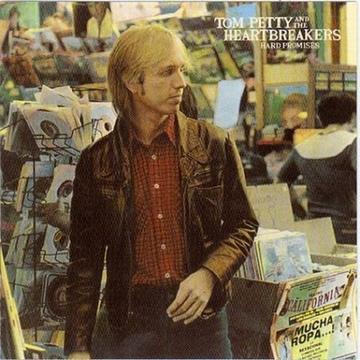
  • A Hard Promises like you’ve never heard, with solid Double Plus (A++) grades from top to bottom – exceptionally quiet vinyl too
  • Recorded at Sound City, home to some of the greatest analog sound ever recorded, this 1981 Backstreet pressing still has plenty of analog magic in its grooves
  • 4 1/2 stars: “…filled with great songwriting, something that’s as difficult to achieve as a distinctive sound… ‘The Waiting’ became the best-known song on the record, but there’s no discounting ‘A Woman in Love,’ ‘Nightwatchman,’ ‘Kings Road,’ and ‘The Criminal Kind,’ album tracks that would become fan favorites… it has a tremendous set of songs and a unified sound that makes it one of Petty’s finest records.”
  • If you’re a fan of Tom Petty and his hard-rockin’ bandmates, this is a classic from 1981 that belongs in your collection

The album tends to be bright, thin, edgy, pinched and gritty — radio friendly, maybe, but not especially audiophile friendly.

We hate that sound but we are happy to report that some copies manage to avoid it, and this is one of them.

Is that richer, fuller sound the sound of what’s on the master tape or did the mastering engineer “fix” it?

We’ll never know, obviously. How could we?

What we do know is the sound of the pressings we actually have to play, and this one is killer.

Recorded by Shelly Yakus at Sound City, Van Nuys and at Cherokee Studios, Hollywood, CA, this vintage Backstreet pressing has the kind of Tubey Magical Midrange that modern records can barely BEGIN to reproduce. Folks, that sound is gone and it sure isn’t showing signs of coming back. If you love hearing INTO a recording, actually being able to “see” the performers, and feeling as if you are sitting in the studio with the band, this is the record for you. It’s what vintage all analog recordings are known for — this sound.

(more…)

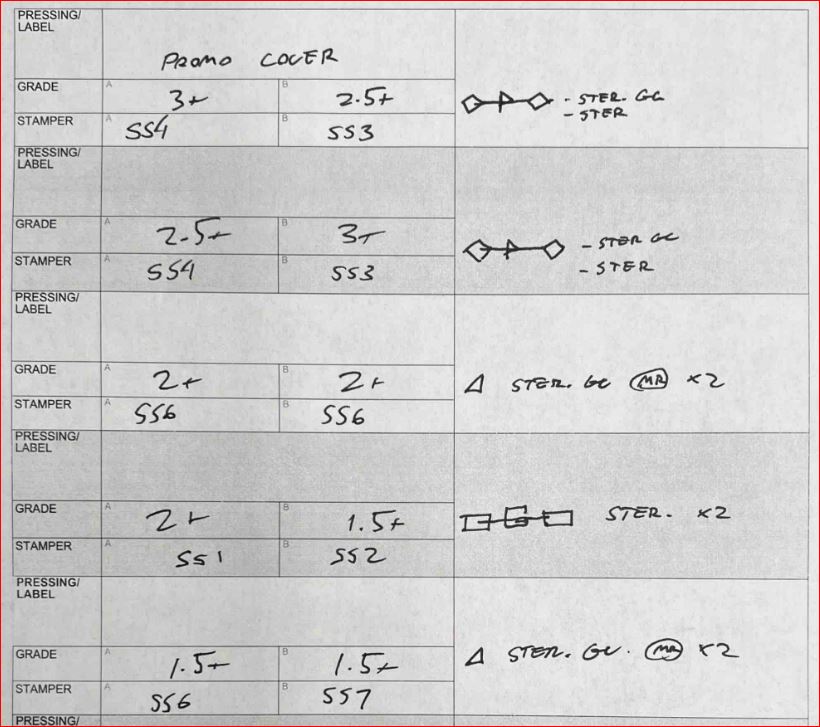
Today’s Rock Record Mystery – How Can Stampers 3, 4 & 6 Beat 1 & 2?

Hot Stamper Pressings of the Music of Tom Petty Available Now

The earliest stampers for this mysterious Tom Petty album — not the one you see pictured — were some of the worst sounding in our shootout.

Most audiophiles, when given a choice between earlier stampers and later stampers, all other things being equal, would take the early ones, right?

As a matter of fact, so would we. Most of the stamper sheets we put up on this blog show the early numbers beating the later numbers.

As a rule of thumb it’s not a bad one, but unless you actually do a shootout, how would you know that your SS1/SS2 copy isn’t the best?

How could you possibly know that the SS4/SS3 murdered it?

The promo cover might be helpful, but lots of promo pressings don’t win shootouts, or even do all that well in them.

Like so many realities of the world of records, these are all mysteries, ones that are very unlikely to be solved.

The winners of the next shootout could have the exact same stampers as the record that did the worst in this one. It happens!

One of the best reasons mysteries such as this have little chance of being solved is that no one with any real expertise, using methodologies that are reliable and reproducible in any serious way, is taking on this kind of work — other than us.

We actually like testing records, and over the many years we have been in business we’ve refined* a method for doing it that is as reliable and reproducible as any method can be in the world of audio: the record shootout.


*As far as I know, my friend Robert Pincus was the one who invented the record shootout. He would evaluate each side of a record independently against other copies of the same album, taking notes that described the strengths and weaknesses he heard on each copy he played.

He assumed nothing, and neither do we. Our rigorous controls, blinded experiments and use of the scientific method to arrive at reproducible results are simply advances on his original approach.

(One of the most important differences between his shootouts and ours is that we have someone whose only job is to play the records, and another person to do the listening and take the notes. When the listener has no idea what pressing is being played, there is little chance of the kinds of psychological biases that are the scourge of the record shootout.)

(more…)