con-wis

Many audiophiles are inclined to believe the conventional wisdom they receive from like-minded enthusiasts.

Some of it is right, some of it is wrong, but if you don’t know how to critically listen to records for yourself, you will never be able to tell which is which.

You’ll be stuck with the approaches most audiophiles use — guessing and assuming. Neither are a reliable method for getting to the truth.

Pin-Ups – Forget the Original British Pressings

Hot Stamper Pressings of the Music of David Bowie Available Now

UPDATE 2026

This commentary was written sometime in 2019 or just before.

Since that time we have done many shootouts for Pin-Ups and all of them were won by the reissues we discovered all those years ago.


We just finished our biggest-ever shootout for this fun Bowie album and this one was DRAMATICALLY better than most other copies. We played copies from all over the world — England, Germany, France, Canada, and the good ol’ USA — and heard all kinds of bad sound.

So what were the worst copies we heard? Hands down it was the British Originals, believe it or not. They tend to be dull, thick, and lifeless — not a good match for this punky, energetic material. [We have since found some very good sounding Brit originals but, that said, to date they have never won a shootout.]

On the other side, many of the other copies we heard were bright and grainy. It’s very tough to find a copy that strikes a balance, but we finally managed to dig up a handful that did the job. (more…)

An Overview of Beatles Oldies But Goldies

Hot Stamper Pressings of the Music of The Beatles Available Now

This is a Beatles album we think we know well.

We’ve done a number of shootouts for A Collection of Beatles Oldies over the last ten years or so, and our experimental approach using many dozens of copies provides us with strong evidence to support the following conclusions regarding the sound of the originals vis-a-vis the reissues:

  1. The best of the early pressings always win our shootouts. No reissue has ever earned our top grade of A+++ and it is unlikely any reissue ever will.
  2. The reissues can be quite good however. The best of them have earned grades of Double Plus (A++).
  3. The worst of the early pressings also earned grades of Double Plus (A++).
  4. Conclusion: if you have a bad original and a good reissue, you might be fooled into thinking the sound quality was comparable.

(more…)

The Wrong Early Pressings of Mad Dogs and Englishmen Have Horrendous Sound

Hot Stamper Pressings of Classic Rock Albums Available Now

If you get the wrong stampers on this record, you will discover, as we did, that it’s clearly been mastered from a badly made dub. The “cassette-like” sound quality will not be hard to recognize. If you have stumbled onto one of those pressings, give up on it and try your luck elsewhere, making sure to note the bad stampers.

Most copies have a tendency to get smeary and congested when loud.

Listen for good transients and not too much compression.

Most copies are opaque, as well as dull up top; try to find the ones with some degree of transparency and as much top end extension as you can (the percussion will be helped most of all by the extended top).

And of course you need to find a copy that rocks, as this is a definitely a Rock Concert, although what it most reminds me of is Ray Charles doing a choice set of modern classics, mixing it up by off-handedly mixing in a few of his own. See how they all fit together? That’s how the pros do it. (The main pro in this case is Leon Russell, the mastermind of the whole operation. He clearly knows what he is doing.)

All tracks were selected and mixed by none other than the legendary Glyn Johns.

(more…)

Could This Be the Sound Audiophiles Complain About with Vintage Pressings?

Hot Stamper Pressings of the Music of Red Garland Available Now

A rare and expensive (!) early stereo pressing that we played in a recent shootout for Bright and Breezy was passable at best.

As you can see from the notes reproduced below, we found the sound to be “sweet, relaxed, but badly veiled and lacking weight and bass.” (Note that records without a 1.5+ grade or better on both sides are not considered Hot Stamper pressings.)

In other words, it sounded too much like an old record, and not a very good one at that. The world is full of them. (For this album, clearly the best sound is found on the right OJC.)

(more…)

Thick as a Brick Marked a Milestone in 2007

jethrthick_1410_3_1192056381

Hot Stamper Pressings of the Music of Jethro Tull Available Now

Until about 2007, Thick as a Brick was the undiscovered gem (by me anyway) in the Tull catalog. The pressings we’d heard up until then were nothing special, and of course the average pressing of this album is exactly that: no great shakes.

With the advent of better record cleaning fluids and much better tables, phono stages, room treatments and the like — taking full advantage of the remarkable number of revolutions in audio that have occurred over the last two or three decades –some copies of Thick As A Brick have shown themselves to be truly amazing sounding. Even the All Music Guide could hear how well-engineered the album was.

Marking Two Milestones from the Past

The 2007 commentary you see below discusses the pros and cons of both the British and Domestic original pressings. With continuing improvements to the system, room, etc., it would not be long before we realized that the British pressings were simply not competitive with the best domestic ones.

You might say this record helped us mark two important milestones in the developing history of Better Records.

The first, around 2007, was recognized by the fact that we had improved our playback to a very high level, one high enough to reproduce the album with all the clarity, size and energy we were shocked to hear at the time.

The second milestone would result from the audio changes we continued to make for the next couple of years, from 2007 to 2010, which allowed us to recognize that the best British pressings, as good as they might be, were not in the same league as the best domestic ones. We broke down in detail exactly what we were listening for and what were hearing in this commentary, and the Brits were clearly not cutting it at the highest levels by 2010.

If you find yourself with one of more British copies of the album that you think have superior sound — any copies of the album, really — we would love to send you one of our Hot Stampers so you can hear what you are missing.

(more…)

You Say Your Shaded Dog Just Sounds Like an Old Record?

Hot Stamper Pressings of the Music of Tchaikovsky Available Now

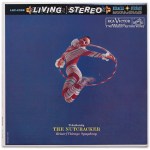
The better pressings of LSC 2328 have some of the best sound we have ever heard for The Nutcracker. We’ve played recordings of the work by the dozens, on the greatest Golden Age labels of all time, including the likes of Mercury, RCA and London. (Our current favorites of both the suites and the complete ballet are those conducted by Ansermet for Decca.)

The CSO, as one might expect, plays this work with more precision and control than most others. They also bring more excitement and dynamic contrasts to their performance, adding greatly to our enjoyment of the music.

Some may find the performances a bit rushed. That was our experience during our most recent shootout.

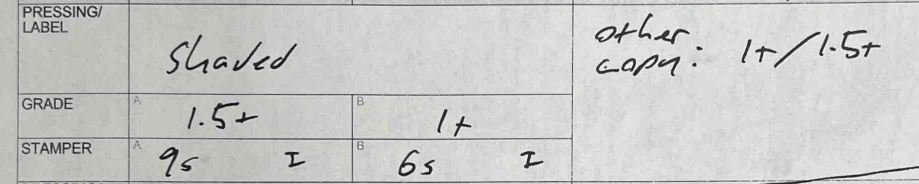
But skip 9s/6s. We had two copies and both of them sounded too much like an old record.

Pressings with those stampers might be passable, even to some degree enjoyable, especially when played on an old school system, but they would not be worth bothering with on the high quality modern equipment we use.

There are quite a number of other records that we’ve run into over the years with a catalog of obvious shortcomings — obvious to us but not necessarily to others — and we’ve broken them down into the three major labels that account for most of the best classical and orchestral titles we’ve had the pleasure to play.

(more…)

Always wanted to have a Plum and Orange pressing? Here’s your chance!

Hot Stamper Pressings of the Music of Led Zeppelin Available Now

We should have titled this one “here was your chance,” since this pressing sold very quickly.

Over the years most Plum and Orange pressings were disposed by us of on ebay for the benefit of collectors and those audiophiles who might be ill-informed enough to think that early British pressings would have the best sound for Led Zeppelin III.

They do not. They can, however, sound reasonably good in some cases with the proper cleaning.

However, they are not even Double Plus (A++) good, which sounds like something from the novel 1984 but is in fact a Very Good grade and guaranteed to trounce any and all copies of the album you have ever heard.

No, the best Zeppelin album we have played to date with the early label in this case earned a grade of Single Plus to Double Plus, which we describe as “[a] wonderful sounding side with many impressive qualities, notably better than a Single Plus copy. A big step up from the typical pressing.”


UPDATE:

We do not even offer Single Plus copies on the site anymore. Although their faults would be less obvious to anyone who went through the shootout process with the album, such faults are much too bothersome to us precisely because we did go through that process.

Once you know what is right, it’s very easy to spot what is wrong.

This is the foundational principle of Hot Stampers.

(more…)

Good Digital Beats Bad Analog Any Day

Hot Stamper Pressings of the Music of Sonny Rollins Available Now

And this is some very bad analog indeed!

We here present our 2010 review of the Sonny Rollins Plus 4 album, the one remastered on two slabs of 45 RPM Analogue Productions Heavy Vinyl.

It has everything going for it, right?

Steve Hoffman, Kevin Gray, 45 RPMs, Heavy Virgin Vinyl, fancy packaging — clearly no expense was spared!

The ingredients may have been there, but the cake they baked was not only not delicious, it was positively unlistenable — I mean, inedible.

I cannot recall hearing a more ridiculously thick, opaque and unnatural sounding “audiophile” pressing than this Rollins record, and believe me, I’ve heard plenty. (And it seems the bad news will never stop.)

As I noted in another commentary “Today’s audiophile seems to be making the same mistakes I was making as a budding enthusiast more than thirty forty years ago. Heavy Vinyl, the 45 RPM 2 LP pressing, the Half-Speed limited edition — aren’t these all just the latest audiophile fads, each with a track record more dismal than the last one?”

It reminds me of the turgid muck that Doug Sax was cutting for Analogue Productions back in the 90s. The CD has to sound better than this. There’s no way could it sound worse.


CD Update:

I managed to track down a copy of the CD and it DOES sound better than this awful record, and by a long shot. It’s not a great sounding CD, but it sure isn’t the disaster this record is.

Buy the CD, and whatever you do, don’t waste money on this kind of crap vinyl.


This is a very bad sounding record, so bad that one minute’s play will have you up and out of your chair trying to figure out what the hell is wrong with your system. But don’t bother. It’s not your stereo, it’s this record.

It has the power to make your perfectly enjoyable speakers sound like someone wrapped them in four inches of cotton bunting while you weren’t looking.

(more…)

What Can You Learn from a Mercury Shootout Like This One?

Hot Stamper Pressings of Mercury Classical Recordings Available Now

The short answer is that you can’t learn much from this shootout, because we’re not telling you which title the stampers you see below belong to.

Be that as it may, in the case of this mystery title the conventional wisdom turns out to be correct — the earlier numbered pressings did better than the later numbered pressings, and the early labels did better than the later labels.

That happens a lot, and we are happy to admit that it does. Why? Because the experimental evidence — the datasay that is what happened.

As usual for posts in which the stamper sheet from a shootout is reproduced in its entirety, the stamper numbers shown below will belong to a different album than the one you see pictured.

These can be found under the heading of Mystery Stampers. Most of these posts will illustrate something to be learned from a Hot Stamper shootout, but because the information reveals the shootout winning stampers, the actual title of the record is rarely revealed.

Much more useful stamper information can be found using this link, which includes plenty of stamper numbers for specific titles that are best avoided by audiophiles looking for top quality sound. In addition, we post the winning and losing stampers for some titles that are an unreliable guide to good sound. Unreliable stampers are also quite common.

The right stampers are only one of the many reasons some copies win our shootouts and others don’t, but in the case of this rare Mercury, a record that we only had four copies of, the RFR-2/2 stampers were clearly the best, with no other set of stampers coming close. The best of the others earned grades no better than 2+/2+.

One lesson that was clear was that the best stampers were, to quote our reviewer, “a step up!”

(more…)

RCA Produced this Amazing Budget Reissue in 1976

Hot Stamper Pressings of the Music of Tchaikovsky Available Now

This review was written in 2011 shortly after our first Hot Stamper shootout for the work.

It still holds up though — I wouldn’t change a thing, other than to add a few links to help audiophiles and record collectors gain a better understanding of the shortcomings of received wisdom when it comes to finding that small subset of pressings capable of offering significantly higher sound quality.

Conventional record collector thinking generally works fine most of the time, but Monteux’s recording of the 6th Symphony in 1955 is a good example of the standard advice for finding better pressings turning out to be completely wrong.

For more on this subject, including the solution we came up with to fix the problem, click here.


Our Original Review

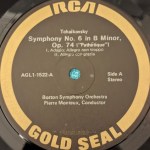
Presenting a first for Better Records: a White Hot Stamper copy of this CORRECTLY remastered version of LSC 1901, which just happens to be a recording from the earliest days of stereo, 1955! It’s guaranteed to KILL any and all original Shaded Dogs, as well as the more common reissues; White Dogs, Red Seals, Victrolas, Classic Heavy Vinyl, you name it, this pressing will beat the pants off of it and in the process show you precisely what is wrong with each and every one of them.

Over the past twenty years we’ve played hundreds of early RCAs and we have sure never heard one sound like this, with so much richness, Tubey Magic, LIFE and CLARITY.

(more…)