compression-tradeoffs-classical

Compression tends to bring out ambience and low-level detail in a recording.

Of course it’s a matter of tradeoffs, a subject which we discuss in more detail in this group of listings.

Verdi, et al. / Ballet Music From The Opera

Hot Stamper Pressings of Living Stereo Recordings Available Now

UPDATE 2026

This review was written many, many years ago, so many years ago that I don’t think I knew that the Victrola reissue had consistently better sound than any Shaded Dog we had ever played.

But one thing I did know was that the sound had obvious and rather serious shortcomings, shortcomings that the fans of vintage vinyl never seemed to notice. The conventional wisdom according to which so many record collectors and record reviewers operate, including the vast majority of those who identify as audiophiles, may have blinded them to the reality of its defects.

It’s also rare and sells on the collector market for a lot of money. Those facts often blind record lovers too.

Someone with the original in his collection might pull it off the shelf where it has been sitting for years and show such a rare and valuable and therefore impressive record to you. I suspect that such a collector would be much less likely to play it for you.

Having to sit down and actually play the records we sell means that biases and prejudices of these kinds can have no effect on our judgments. The records get played against other pressings and we simply call them as we hear them.

Contrary to the conventional wisdom, the original is not that good of a record.

And the best news is that the reissue is a true Demo Disc of the highest order.


Our Old Review

This copy of LSC 2400 has vintage RCA Golden Age sound, for better and for worse. Even though the album was recorded by Decca, it’s got a healthy dose of Living Stereo Tubey Magic.

There will never be a reissue of this record that even remotely captures the richness of the sound found here.  

And the hall is HUGE — so spacious and three-dimensional it’s almost shocking, especially if you’ve been playing the kind of dry, multi-miked modern recordings that the 70s ushered in for London and RCA.
(more…)

Sometimes Tubey Magic Comes at a Fairly Steep Price

Living Stereo Hot Stamper Orchestral Titles Available Now

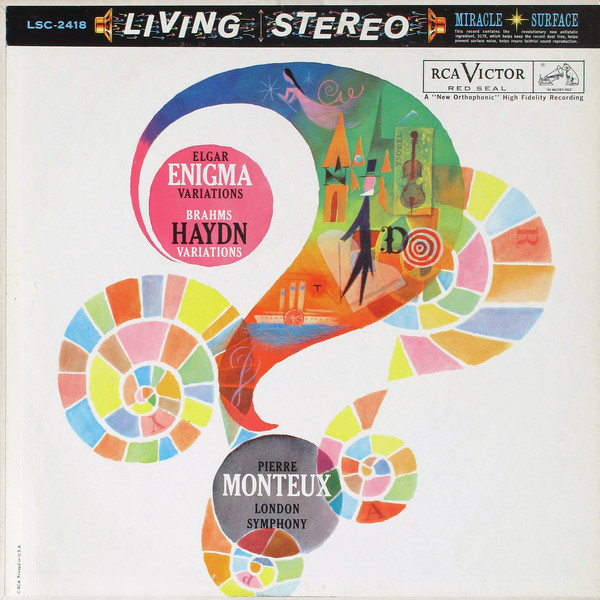
This famous Shaded Dog, containing two superb performances by Monteux and the LSO, has many of the Golden Age strengths and weaknesses we know well here at Better Records, having auditioned hundreds upon hundreds of these vintage pressings over the last twenty years or so. 

The wonderful sounding tube compressors that were used back in the day result in quieter passages that are positively swimming in ambience and low-level orchestral detail. Tube compression is often a large part of what we mean when we use the term Tubey Magic.

If you want to know what zero Tubey Magic sounds like, play some Telarcs or Reference Recordings from the 70s and 80s. Or a modern digital recording on CD.

But all that sweet and rich Tubey Magic comes at a price when it’s time for the orchestra to get loud.

It either can’t, or the louder passages simply distort from compressor overload.

Fortunately, on this copy the orchestra does not distort, it simply never gets as loud as it would in a real concert hall, clearly the lesser and more preferable of the two evils.

(more…)

On Ballet Music From The Opera, How Much Tubey Magic Is Too Much?

Hot Stamper Pressings of Living Stereo Recordings Available Now

UPDATE 2023

We have stopped buying the original LSC 2400 for the simple reason that it is not competitive with the budget VICS 1206 reissue from 1960 that replaced it in the RCA catalog.

The review we wrote for the Shaded Dog is probably close to twenty years old. There was a time when the shortcomings of the original RCA were not nearly as easy for us to recognize, but that time has long since past.

If any copy of the original, or any remastered version from the modern era sounds good to you, we can almost guarantee that you are mistaken about the quality of the sound, and, even better, we can offer you the pressing that makes our case better than any review can.


Our Old Review

The hall is HUGE — so transparent, spacious and three-dimensional it’s almost shocking, especially if you’ve been playing the kind of dry, multi-miked modern recordings that the 70s ushered in for London and RCA. (Many of Solti’s recordings from the decade are not to our liking, for reasons we lay out here.)

EMI recordings may be super spacious but much of that space is weird, coming from out-of-phase back channels folded in to the stereo mix. And often so mid-hall and distant. Not our sound, sorry.

We strongly believe that there will never be a modern reissue of this record that even remotely captures the richness of the sound found on the best of these Living Stereo original pressings.

Here are some of the strengths and weaknesses we noted on a copy we played way back when.

Side One

Big and lively. The Tubey Magical colorations are a bit much for us, with too much tube smear on the strings and brass to earn more than a single plus. 

Side Two

Even bigger and more spacious, with some smear caused by the serious amounts of tube compression being used, of course, but the quiet passages are magical. [Which is precisely what heavy tube compression is designed to accomplish.]

The Victrola Reissue

We much prefer the sound of the Victrola reissue, VICS 1206, which came out in 1966.

As for the Victrola pressing, we’re guessing — how could we possibly know for sure? — that less tube compression was used in the mastering.

It’s still plenty tubey, but more to our taste for not being overly tubey.

(more…)

Compression Works Its Magic on The Christmas Eve Suite

Hot Stamper Pressings of the Music of Rimsky-Korsakov Available Now

Some notes about the compression effects we heard on side two of a Blueback pressing of The Christmas Eve Suite album back in 2012. We wrote:

Side two is even more transparent and high-rez than side one. The texture on the strings and the breathy quality of the woodwinds make this a very special pressing indeed.

The horns are somewhat smeary and do get a bit congested when loud.

There is more compression on this side two than there was on the best copy we played, and that means low level detail is superb, but louder parts, such as when the more powerful brass instruments come in, can present problems.

Note how good The Flight of the Bumble Bee sounds here.

Compression is helping bring out all the ambience and detail in the recording, and there’s no downside because the orchestra is playing softly, unlike the piece that precedes it.

A classic case of compression having sonic tradeoffs.

(more…)

Pros and Cons from a Long-Ago Shootout for Everything But the Beer

Living Stereo Titles Available Now

This shootout was probably done about ten years ago.

This VERY RARE 2 LP Shaded Dog pressing has Super Hot Stamper sound. Much of what’s good about Golden Age recordings is heard here, with side one for example having the sound of a HUGE hall and that Three-Dimensional quality that the best vintage recordings are able to convey so well.

We constantly knock Heavy Vinyl here at Better Records for the simple reason that we play vintage recordings such as this by the score every month and can hear what they do so well.

Unfortunately the huge hall and the 3-D soundstaging they effortlessly reproduce cannot be found on any Heavy Vinyl pressing we know of.

Such qualities allow this record to sound — in some ways, to be sure not all — like live music.

Side One

Pomp and Circumstance March No. 1 – Elgar
Mignon Overture – Thomas
Largo from Xerxes – Handel
Prelude to Act III of Lohengrin – Wagner

Sound

A++, with the huge hall and 3-D sound we mentioned above. Very clear, especially when quiet. There’s a big bass drum on one of these tracks that is killer. A little more Tubey Magic would have been nice. As it is, this side sounds REALISTIC, like a real live concert.

(more…)

Tchaikovsky / An Old Review Holds Up for Once

Hot Stamper Pressings of the Music of Tchaikovsky Available Now

UPDATE 2024

Rereading this review, we felt it wise to add the following:

This review is from many years ago. I cannot say we would still feel the same way about the reissue reviewed here.

Turns out that in 2024 we still feel the same way about the reissues of this album. They’re the ones that win shootouts, and they have been winning them for more than ten years. Here is a recent listing.


Our Old Commentary

This RCA reissue pressing of LSC 2328 has some of the BEST SOUND we have ever heard for The Nutcracker, and we’ve played them by the dozens, on the greatest Golden Age labels of all time, including, but not limited to, the likes of Mercury, RCA and London.

In a somewhat (but not too) surprising turn of events, the reissue pressing we are offering here beat all the originals and early reissues we could throw at it.

Finally, this legendary Mohr/Layton production can be heard in its full glory!

If you like your Nutcracker exciting and dynamic, this is the copy for you.

Don’t buy into that record collecting / audiophile canard that the originals are better.

We like our recordings to have as many Live Music qualities as possible, and those qualities really come through on a record such as this when reproduced on the full-range speaker system we use.

For our shootout we played Ansermet’s performance of the Suites on London, as well as pressings by Reiner and Fiedler, both of whom opted against using the Suites as Tchaikovsky wrote them, preferring instead to create a shorter version of the complete ballet with excerpts of their own choosing (shown below).

The CSO, as one might expect, plays this work with more precision and control than any other. They also bring more excitement and dynamic contrasts to their performance, adding greatly to our enjoyment of the music.

(more…)

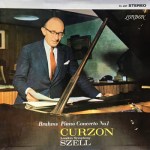
Brahms / Piano Concerto No. 1 – What to Listen For

Hot Stamper Pressings of of the Music of Brahms Available Now

Our general notes for the recording seen below explain why the typical copy in our shootout fell short.

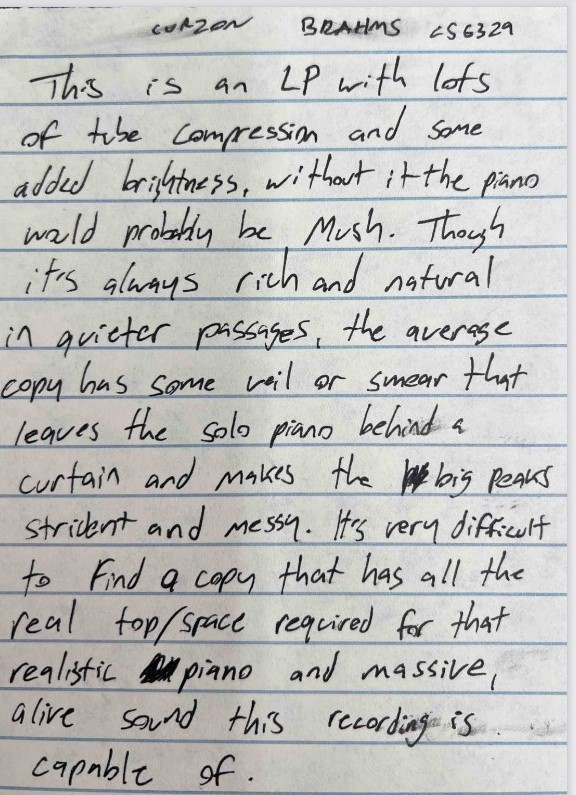
This is an LP with lots of tube compression, and some added brightness.

Without the added brightness, the piano would probably be mud.

The added brightness and compression results in a piano that always sounds rich and natural in the quieter passages.

The average copy also has some veiling or smearing that make the solo piano parts sound like they are coming fom behind a curtain. On these copies, the big peaks can often get strident and very messy.

It’s difficult to find a copy that has all the top end extension and space required to reproduce both a realistic piano and the massive live sound the orchestra is capable of.


All of which adds up to a difficult shootout in which relatively few copies had the sound we were looking for.

Production and Enginneering

(more…)

Strauss / Don Quixote / Reiner on Soria Living Stereo

More of the music of Richard Strauss

6S/5S. RCA Soria pressing in like new condition, which means it plays about M–, maybe a little better.

This is the best sounding copy of this album I have ever heard.

Far from the best RCA Living Stereo has to offer, this copy is not nearly as dreadful as I remember the last one sounded.

The quieter passages are especially lovely.

The climaxes are strained as usual, but I’ve never heard a copy of this record that didn’t have that problem.

A classic case of compression causing sonic tradeoffs.

The record comes with a gorgeous heavyweight slipcase and the 12-page libretto complete with custom artwork.


This is an Older Classical/Orchestral Review

Most of these older reviews are for records that did not go through the shootout process, the revolutionary approach to finding the best sounding pressings we started developing in the early 2000s. We found the records you see in these listings by cleaning and playing a pressing or two of the album, which we then described in the listing and priced according to how good the sound and surfaces seemed to us at the time.

We were often wrong back in those days, something we have no reason to hide. Audio equipment and record cleaning technologies have come a long way since then.

Nowadays, 99% (or more!) of the records we sell are cleaned, then auditioned under rigorously controlled conditions along with a number of other pressings, awarded sonic grades, then carefully condition checked for surface noise.

As you may imagine, this approach requires a great deal of time, effort and skill, which is why we currently have a highly trained staff of about ten. No individual or business without such a committed group could possibly dig as deep into the sound of records as we have, and it is unlikely that anyone, besides us, would ever be able to do the kind of work we do.

Every record we offer is unique, and 100% guaranteed to satisfy or your money back.

Bizet / Carmen for Orchestra / Gould – A Demo Disc for Size and Space

DEMO QUALITY SOUND, if what you’re demonstrating is the three dimensional quality of Living Stereo recordings. Amazing depth and width can be heard on this record. And the music is sublime.

I confess I somewhat misjudged this title. Yes, the opening is compressed, which led me to think that the entire record was compressed, but that’s not true. In some ways it’s quite dynamic. The quiet portions are very quiet; in a couple of places there are just horns playing off in the deep distance, followed by some flutes, and they sound very natural, just as you would hear them in a concert hall.

This record has one quality that sets it apart, and that is a tremendous sense of depth and a wide soundstage. Because so much of the music is quiet, and seems to be coming from so far back in the hall, you really get drawn into it, and lose the sense of being in your own living room. There are a couple of exciting climaxes, but for the most part this is fairly quiet music the way Gould has orchestrated it. I find it enchanting.

This is not the Power of the Orchestra. These are the Colors of the Orchestra.

This 1S copy is the best I’ve heard. This record looks brand new and plays about as good as one would expect from the RCA vinyl of the day, which is slightly ticky. I’ve never heard a quieter copy.


This is an Older Classical/Orchestral Review

Most of these older reviews are for records that did not go through the shootout process, the revolutionary approach to finding the best sounding pressings we started developing in the early 2000s. We found the records you see in these listings by cleaning and playing a pressing or two of the album, which we then described in the listing and priced according to how good the sound and surfaces seemed to us at the time.

We were often wrong back in those days, something we have no reason to hide. Audio equipment and record cleaning technologies have come a long way since then.

Nowadays, 99% (or more!) of the records we sell are cleaned, then auditioned under rigorously controlled conditions along with a number of other pressings, awarded sonic grades, then carefully condition checked for surface noise.

As you may imagine, this approach requires a great deal of time, effort and skill, which is why we currently have a highly trained staff of about ten. No individual or business without such a committed group could possibly dig as deep into the sound of records as we have, and it is unlikely that anyone, besides us, would ever be able to do the kind of work we do.

Every record we offer is unique, and 100% guaranteed to satisfy or your money back.

Prokofiev / Romeo and Juliet – Our Killer Copy from 2009

More of the music of Sergei Prokofiev (1891-1953)

Reviews and Commentaries for the Music of Sergei Prokofiev

Superb Sound on this Victrola pressing, with TRANSPARENCY, spaciousness and low level detail you will not believe.

And plenty of Living Stereo COLOR.  

DEMO QUALITY SOUND, if what you’re demonstrating is the three dimensional quality of Living Stereo recordings. Amazing space, depth and width can be heard on this side one. And the music is sublime.

The low level detail in the opening and the amount of ambience heard in the quieter sections is shockingly realistic Yes, the recording is compressed, which led me to think that the entire record was compressed, but that’s not completely true. In some parts it’s quite dynamic. The quiet portions are very quiet; in a couple of places there are just horns playing off in the deep distance, followed by some flutes, and they sound very natural, just as you would hear them in a concert hall. (more…)