bright-sound

Below you will find a small sampling of records we played that we found to be too bright.

Keep in mind that the modern Heavy Vinyl reissue consistently has the opposite problem. They are almost always overly smooth and dull, displaying a frustrating and irritating lack of presence and clarity in the upper-midrange. The new Beatles remasters are the perfect example of just what a bad idea it was to boost the bass and cut the highs on their albums. They sound nothing like the ones we offer as Hot Stampers.

Our Hot Stamper Beatles pressings are as tonally correct as any that have ever been produced, yet they do not lack for clarity and presence in the least. Correct tonality is fundamental to the sound of our Hot Stamper LPs.

Sterling Cut By Far the Best Sounding Pressings of I’m Ready

Hot Stamper Pressings of Soul, Blues, R&B, etc. Available Now

Forget the reissue copies that come in the cover you see to the left, the one with a thin black border.

If you want to hear this album right, a Hot Stamper early domestic pressing is the only way to go.

And take it from us, you need to see the Sterling mark in the dead wax of your pressing to have any hope of hearing audiophile-quality sound.

As you can see from the notes above, the two reissue non-Sterling copies we played had hopelessly bad sound.

One was smeary, hard and hot.

The other was the brightest and most spitty.

Note that we didn’t deem it necessary to play side two of either copy. A one plus side one rules out the possibility of it being a Hot Stamper pressing.


Consider taking our moderately helpful advice concerning the pressings that consistently win our shootouts.

Based on our experience, I’m Ready sounds its best:

(more…)

How Good Are the Domestic Originals of City to City Cut by Artisan?

Hot Stamper Pressings of the Music of Gerry Rafferty Available Now

The original domestic pressings may be cut by Artisan, but they are brighter and dramatically more congested and distorted than the better UK imports, and should be avoided at any price.

They are clearly made from dubbed tapes, and there is no getting around what that does to the sound.

However, as good a cutting house as Artisan may be, it’s shocking how bad the sound is on most of the domestic copies of the album they mastered.

Atrocious, to be honest.

When it comes to stampers, labels, mastering credits, country of origin and the like, we make a point of rarely revealing any of this information on the site, for a number of good reasons we discuss in some depth here.

We will happily make an exception in this case. Stick with UK imports. Or buy a Hot Stamper pressing from us.

If you’re a Gerry Rafferty fan, or perhaps a fan of mid-70s British folk pop, this title, a personal favorite of mine since 1978, is surely a Must Own.

In our opinion, City to City is the man’s best sounding album, and probably the only Gerry Rafferty record you’ll ever need. Click on this link to see more titles we like to call one and done.

The sound, at least on some tracks, Baker Street amoung them, may be too heavily processed for some, making the album fairly difficult to reproduce, but the best sounding pressings — played at good, loud levels on big dynamic speakers in a large, heavily-treated room, as god intended — are a truly powerful listening experience.

1978 was a good year for music on vinyl — we have some excellent pressings of well-recorded albums available now for those who want the best and are willing to pay a premium price to get it.

(more…)

We Were Way Off the Mark with this Rodrigo Recording in 2010

More of the music of Joaquín Rodrigo (1901-1999)

In 2010 we did a shootout for this title and thought we had found a good one. We wrote:

A good side one backed with a lovely side two! We shot out a stack of these recently and side two of this copy was one of the few sides that really impressed us. The sound is transparent and full of energy. Side one is pretty good but a bit crude in the louder passages.

This is a wonderful record. The performance here by the first family of guitar is legendary. More importantly, the music is delightful and belongs in any serious classical collection.

RFR-1 stampers. What the best originals like this one give you is immediacy. The attack of the guitar is more real.

Comparing this with the Golden Import shows you that some of the transients are smoothed over on that pressing.

If you’ve got the front end that can deal with the Mercury upper midrange and transient attack, the strings will sound textured and clear, not harsh or shrill. (A badly mastered version of this record would make your ears bleed.)

More importantly, this copy captures the sounds of the guitars perfectly. I doubt if anybody could do it as well as Mercury.

Recently we did the shootout again and came up with very different findings:

Now those same stampers are tubey and weighty, but the strings are too hot (bright and shrill) and flat (lacking richness).

We can sum up the sound of these stampers — on a different copy of course, something to keep in mind — in one word:

Ouch.

Please allow us to help you avoid making the same mistakes we did:

  • More records with bright sound can be found here
  • More records with flat sound can be found here

What’s So Golden About These Imports Anyway?

And by the way, we would never even bother to reserve the studio time to play a Golden Import pressing these days. I can count on one hand the titles that actually sound good to me and it’s just not worth the labor to find the one out of fifty that has hi-fidelity sound as we currently define it.

This commentary gets at our disappointed feelings about the label.

(more…)

Audiophiles Should Give Monteux’s Surprise and Clock Symphonies a Miss

Hot Stamper Pressings of the Music of Joseph Haydn Available Now

None of the pressings we played of this RCA (LSC 2394) were remotely competitive with Fjelstad’s recording for RCA from 1959.

The sound of the RCA Shaded Dog we played was consistently compressed and veiled, a case of the “old record” sound we find on far too many vintage pressings.

The world is full of old records that just sound like old records. We’ve suffered through them by the tens of thousands.

Our website, as well as this blog, are devoted to helping audiophiles find pressings that don’t sound anything like the millions of run-of-the-mill LPs that have been stamped out for the last seven decades.

Even a million dollar stereo can’t make the average record sound good, and the more accurate and revealing the system, the more limited and lifeless the average record will show itself to be.

The White Dog pressing was even worse. It was hot, dry and flat. Who wants to play a record that sounds like that?

Only an old school audio system can hide the faults of pressings such as these. The world is full of those too, even though they might comprise all the latest and most expensive components.

(more…)

Do All the Early Stamper Shaded Dog Pressings of this Title Sound Good?

Hot Stamper Pressings of Living Stereo Recordings Available Now

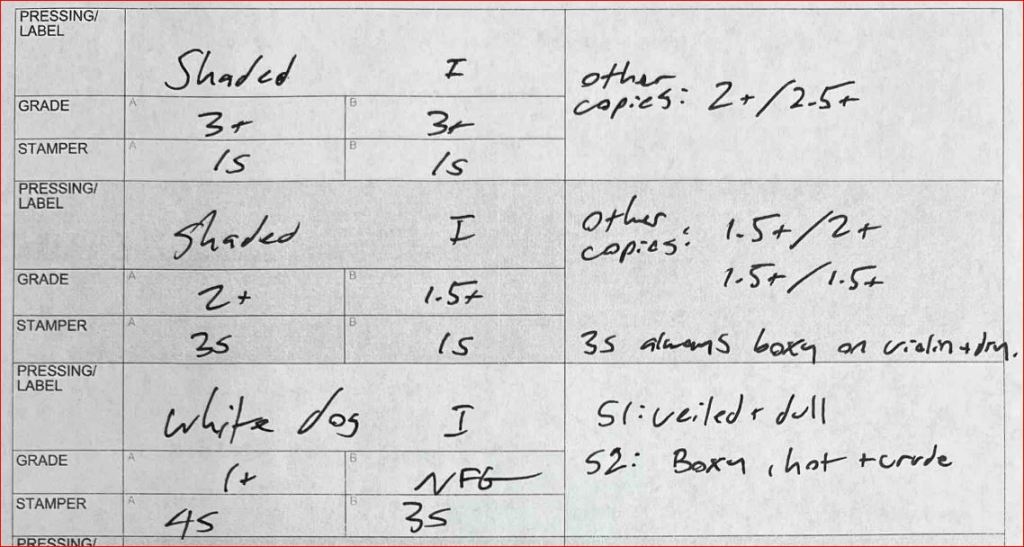
Below you will see the complete stamper sheet for a shootout we did recently.

Note that the album you see pictured — LSC 2265 — is not the record we did this particular shootout for.

We are not revealing what record had these stampers and earned these grades for the simple reason that we rarely if ever give out the specific information that identifies the best sounding pressing of any album.

As I’m sure you can understand, we want you to buy the copy with the Hottest Stampers from us, not find one on your own! We’re happy to be somwhat helpful, but naturally we find it necessary to draw the line somewhere, and giving out “the shootout winning stampers” are where we choose to draw it.

One set of stampers for the mystery Shaded Dog pressings we played in our most recent shootout sounded consistently subpar.

The sound on 3s was boxy and the violin was dry. This was surprising as the stampers are quite low: 3s/1s.

Many RCA chamber recordings can be dry, and if one owned a nice early stamper pressing of the album with boxy, dry sound, one might conclude that this RCA is just another chamber recording with those shortcomings.

But one would be wrong, because the 1s stamper shootout winner sounded amazing, not dry or boxy in the least.

How Come?

Since, as we discovered recently, 1s wins, and handily, why does 3s/1s do so much worse?

Who knows?

And why is the White Dog barely passable on side one and just awful on side two?

Your guess is as good as mine.

More of the Same

Below you will find links to other records we’ve played that had the same problems as our mystery RCA here.

(more…)

How Good Are the Later Reissues of The Bridge?

When we did a shootout for The Bridge about ten years ago, we thought the reissues with the cover you see to the left actually sounded better than the original pressings, but we were wrong and we have to admit it, as painful as that may be.

True, we never cared much for the later reissues described below — the tan labels can be passable but fall well short of the standards we set now.

However, even the best orange label pressings from 1975 don’t sound as good to us now as we thought they did ten years ago.

They can be good, but in our experience they can never be great. Great is the sound that can only be found on the best originals, and they win all the shootouts now.
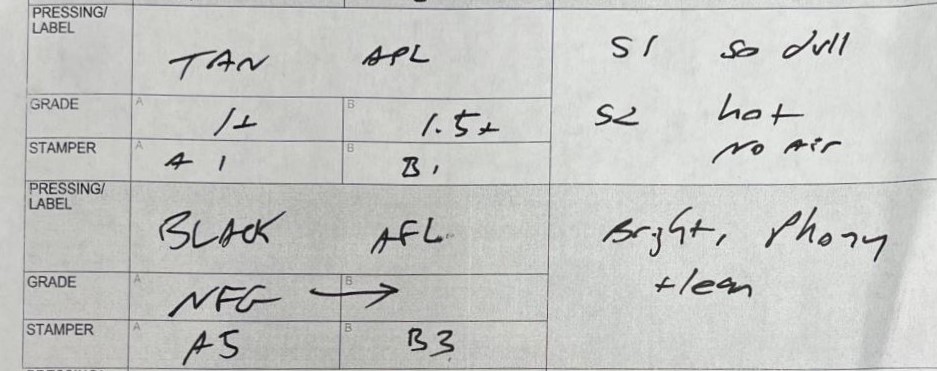
The notes for the AFL pressing with the black label describe it as bright, phony and lean.

This is the kind of sound better suited to the stone age stereos of the past.

I should know. I had a stereo all the way up until the late-90s — not exactly stone age quality, but far from the sound we have now — that prevented me from hearing my records with the highest quality reproduction.

As a result of the shortcomings of my system, I was wrong about a lot of records. (I loved DCC back in those days. Not that many years later I would undergo a “deconversion” as my stereo and critical listening skills improved.)

Of course, I was convinced my stereo was fantastic. It sure sounded better to me than any other system I’d ever heard, and by a long shot.

I had been working with expensive stereo equipment for more than twenty years at that point. The system I had put together by then cost a lot of money, played at loud levels with great energy, was in a dedicated room, et cetera, et cetera.

Are the audiophiles of today making the same mistakes I made back then?

Probably, if not almost certainly, and the one test we can use to determine which audiophiles have made the least amount of progress in this hobby are those who play records like the ones on this list and find nothing wrong with them. Their defense? “They sound just fine to me and who are you to say otherwise?”

Well, we’re the guys who say “you don’t know what you’re missing, and we have the superior-sounding pressing to prove it.”

Which, of course, almost always falls on deaf ears, pun intended.

Bottom Line

As of 2024, it’s clear to us that the early pressings have the potential for the best sound, but that the reissues can still sound very good, certainly quite a bit better than any Heavy Vinyl reissue is likely to.

Want to find your own top quality copy?

Consider taking our moderately helpful advice concerning the pressings that tend to win our shootouts.

In our experience, this record sounds best this way:

Our Old Review

We found STUNNING sound for Sonny Rollins’ classic LP The Bridge this week, and as you might have guessed from the image above, it wasn’t on an original pressing! It’s beyond tough to find copies of this album on any label these days, but we had a big stack of pressings from different eras and auditioned them in a big shootout. We’ve paired up our best side one with our best side two to create this killer White Hot Stamper 2-pack.

The originals we had on hand didn’t come close to the sound we heard on the A+++ sides of this 2-pack. The later pressings are a mixed bag, but the killer sides we’re offering here completely blew our minds. It’s been years since we heard this album sound anything like this. Let me tell you, it was a thrill to hear The Bridge with such big, natural sound.

Both of the White Hot sides boast superb, Demo Quality sound: super clean and clear; amazing size; serious immediacy; excellent clarity and transparency; real texture to the instruments; tons of energy; lots of depth to the soundfield and so forth. The sax sounds just right, played loud enough it’s almost as if you’re hearing the real instrument and not just a record.

The flipsides of the White Hot sides in this 2-pack were actually pretty good, each earning about an A+ grade. We probably could make more money selling the two copies separately, but we think this music is best enjoyed as a complete album. We imagine someone’s going to be thrilled to do that with White Hot Stamper A+++ sound throughout.


Further Reading

Jimmy Page’s Houses of the Holy Needed Tubes and Didn’t Get Them

Hot Stamper Pressings of the Music of Led Zeppelin Available Now

We did not care for the newly remastered version of Houses of the Holy. It badly lacks the kind of mastering that Robert Ludwig brought to the sound, and by that we mean lots of lovely tubes in the mastering chain.

What tube equipment he used and how he used it is something we have been researching for years now, but rather than go down that rabbit hole for the moment, let’s just say the Tubey Magic that is all over the original cuttings of the album is hard to find on the new one, and that means it’s missing a quality that makes Houses of the Holy one of the most luscious audiophile listening experiences one can have, even for those of us who long ago gave up on tube equipment.

The notes for side one, track one (The Song Remains the Same) and track three (Over the Hills and Far Away), read:

  • Blary, but not as awful as I expected
  • Dry, top end is bright, big though

The notes for side two, tracks one (Dancing Days) and three (No Quarter), read:

  • A bit thick, tonally OK
  • Less space around the low end

Tubes are what the doctor ordered, precisely the medicine that was needed to cure many of this pressing’s problems, but tubes are not what Jimmy Page and his engineer, John Davis, brought to the project, and more’s the pity. Any good domestic original will show you exactly what is wrong with the sound of this version in under two minutes.

(more…)

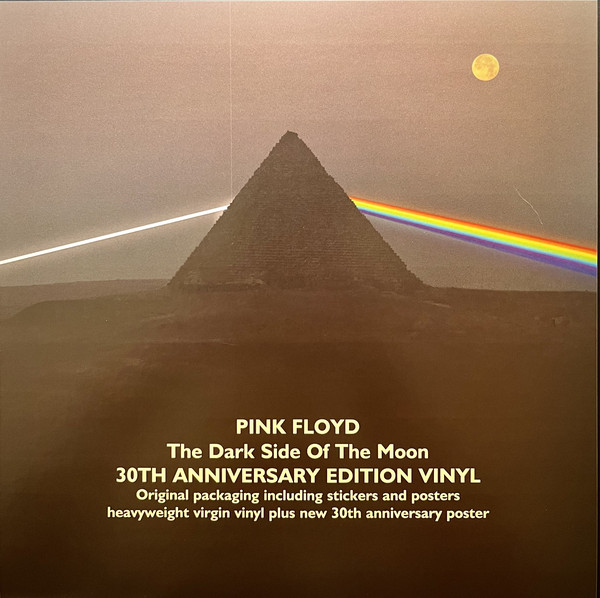
The Dark Side of the Moon – 2003 Heavy Vinyl Reviewed

Pink Floyd Hot Stamper Pressings Available Now

An audiophile hall of shame pressing and a Heavy Vinyl disaster if there ever was one (and oh yes, there are plenty).

The 30th Anniversary Heavy Vinyl pressing is too bright. There is a boost in the top end, probably in the 12K region, that appears to be a poor mastering choice the late Doug Sax made, one that is surely not doing this recording any favors.

In fact, in the case of this new pressing, it’s positively ruinous, assuming you have set your VTA correctly and have the properly functioning tweeters to show you how bright this record is. If you like the phony detail a boosted top end provides, this record should be right up your alley. However, you would do well to recognize that this is a blind alley, and the best way forward is to turn around and start heading in the opposite direction.  

Some audiophiles revere a record like this (last time I checked, the average selling price on Discogs was $149.50) because they need it to wake up their sleepy stereos. My stereo hasn’t been sleepy enough to play this 2003 recut for a very long time, and I hope you can say the same.

As a service to the audiophile community, please click on the link below to find other records that your system should be able to make clear are too damn bright.

(more…)

Gorgeous Cover, Bad Sound

Hot Stamper Pressings of the Music of Felix Mendelssohn Available Now

UPDATE 2025

Our favorite recording of the work can be found here.


Awful sound. It’s bright, dry and flat, with strident strings.

The sound is much too unpleasant to be played on high quality modern equipment.

If your system is dull, dull, deadly dull, the way older systems tend to be, this record has the hyped-up, bright and aggressive sound that is sure to bring it to life in no time.

There are scores of commentaries on the site about the huge improvements in audio available to the discerning (and well-healed) audiophile. It’s the reason Hot Stampers can and do sound dramatically better than their Heavy Vinyl or audiophile counterparts: because your stereo is good enough to show you the difference.

With an Old School system, you will continue to be fooled by bad records, just as I and all my audio buds were fooled thirty and forty years ago. Audio has improved immensely in that time. If you’re still playing Heavy Vinyl and other audiophile pressings, there’s a world of sound you don’t know you’re missing.

(more…)

Led Zeppelin II on Classic Records – Seriously, What Could Be Sadder?

Hot Stamper Pressings of the Music of Led Zeppelin Available Now

An unmitigated disaster — ridiculously bright and ridiculously crude.

In short, a completely unlistenable piece of garbage, and, along with the MoFi pressing from 1982, one of the worst sounding versions of the album ever made.

Over the years we have done many Led Zeppelin shootouts, often including the Classic Heavy Vinyl Pressings as a “reference.” After all, the Classic pressings are considered by many — if not most — audiophiles as superior to other pressings.

What could be sadder?

In fact, you will find very few critics of the Classic Zep LPs outside of those of us (me and the rat in my pocket) who write for this Better Records, and even we used to recommend three of the Zep titles on Classic: Led Zeppelin I, IV and Presence when they first came out.

Wrong on all counts.

Since then we’ve made it a point to review most of the Classic Zeps, a public service of Better Records. We don’t actually like any of them now, although the first album is still by far the best of the bunch.


Below you will find our reviews of the more than 200 Heavy Vinyl pressings we’ve played over the years.

(more…)