best-worst

How Can the Best Stampers Also Be Some of the Worst?

Hot Stamper Pressings of Vintage Columbia Albums Available Now

Recently we conducted a shootout for a favorite Columbia recording, one that we had auditioned a couple of times before and one for which we knew the music and the general quality of the sound well.

It’s not the record you see pictured. For now we’re keeping the title a mystery, consistent with the idea that we give out lots of bad stampers on this blog, but almost never do we give out the good ones. (When we do give out the best stampers, we keep the title under wraps. We are not the least bit interested in putting ourselves out of business.)

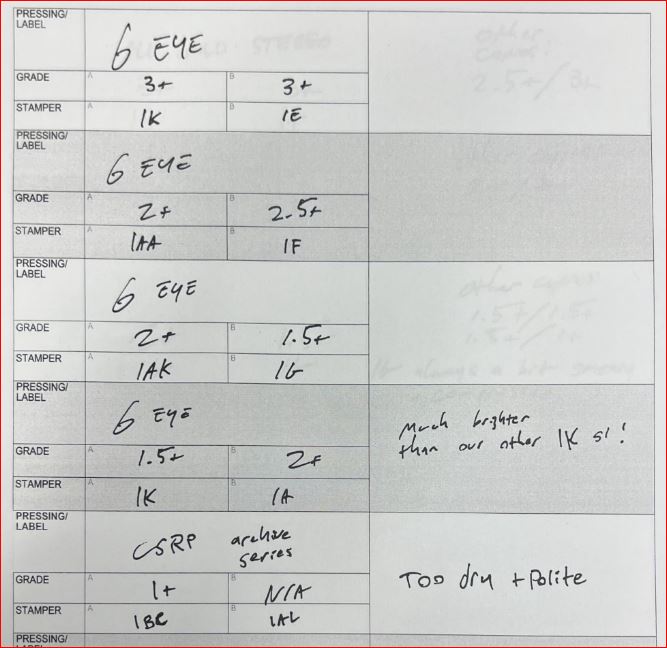
The discussion for today revolves around the idea held by a great many audiophiles that the 6-Eye pressings are going to be the best sounding of almost any album they might happen to run across.

And, to be fair, in the case of this mysterious album, they’re right.

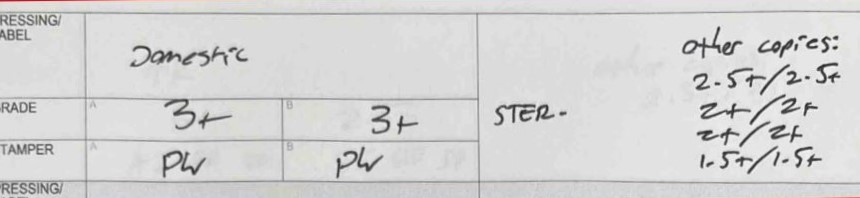
What interests me in these findings is that the stampers for a shootout winning copy, the top one, are almost identical to the one that came in close to last in the shootout outside of the Columbia Special Products reissue, with decent, respectable but far from shootout winning grades of 1.5+ and 2+.

One of the 1K side ones was the best we played, and one was very bright.

If an audiophile collector were to go to Discogs, find the IK pressings, he could either find himself with a top quality copy, or a not-nearly-as-good copy, depending on his luck.

Why one set of stampers sounds so much better than another set, or the same or similar set on a different pressing, is a mystery, and it’s one that we confidently predict will never be solved.

Does anyone have a practical way to get around the unfortunate reality that allows one set of stampers to sound great and the same or a similar set of stampers to sound no better than very good, if that?

Well, we can’t say there is a practical way, but we do know of an impractical one. We’ve been practicing and refining that one for more than twenty years.

We just play lots and lots of copies of the albums to find out how they sound.

(more…)

How Can the Best Stampers Also Be the Worst Stampers?

Hot Stamper Pressings of Contemporary Jazz Available Now

Recently we conducted a shootout for a superb Contemporary recording, one that we had auditioned a couple of times before and one which we felt we knew the music and the quality of the sound well.

It’s not the record you see pictured. For now we’re keeping the title a mystery, consistent with the idea that we give out lots of bad stampers on this blog, but almost never do we give out the good ones.

Why, you ask?

The cost of discovering the right stampers is usually high, can take decades, and is fundamentally at the heart of how we make our money: by finding amazing sounding pressings with stampers we know to be good, cleaning them up, playing them, and offering those that, for whatever mysterious reasons that no one has figured out, including us, tend to have the best sounding grooves.

This time around we kept track of the stamper numbers for all the pressings we played, something we are making a habit of doing these days and using to highlight discoveries in the sound of the records we play.

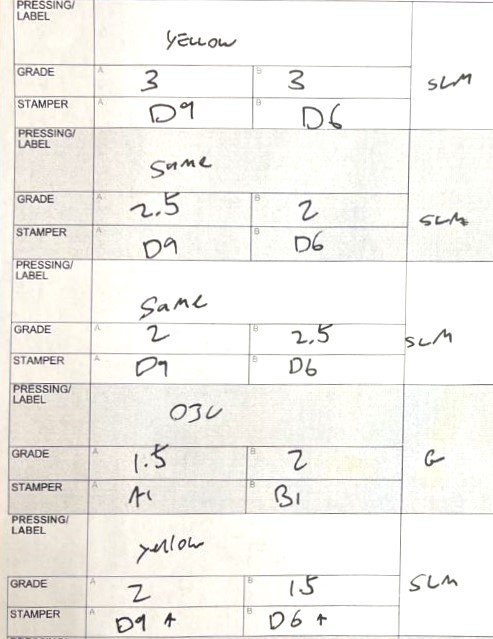
In this case, we discovered an anomaly we thought we would bring to the audiophile world’s attention: the fact that the stampers for the best souding pressing were also the stampers for the worst sounding pressing, because they were the stampers for all the pressings.

One copy earned our White Hot Stamper grade, our highest, for its clearly superior sound, and another one earned our lowest Hot Stamper grade of 1.5+. The rest were quite good, in between those two, which is a very common outcome for most of our shootouts: lots of records in the middle of the distribution, some winners at the top and some losers at the bottom.

Note that the OJC of this title is one we have liked in the past. It didn’t do so well this time around, and that is mostly because we found out about some stampers we like even better. We will probably not being buying the OJC anymore; it’s probably more trouble than it’s worth.

However, the key takeaway from this stamper sheet is the fact that it beat one of the real Contemporary label pressings in the shootout.

So the question an audiophile record collector might ask himself is this one: is the OJC better or worse than the real Contemporary pressing with D9/D6 stampers?

(more…)

Heavy Vinyl Quality Control? We Put That Proposition to the Test

bellcurve500

Important Lessons We Learned from Record Experiments

Part one of this commentary concerns the random nature of record making processes. It can be found here.

A Heavy Vinyl Shootout

A number of years ago (2011?) the opportunity to crack open two brand new sealed copies of a recently remastered Heavy Vinyl pressing came our way.

At the time, we were told that with this pressing every effort was made to produce the highest quality product and to maintain the utmost in quality control throughout the production process. They were adamant that every copy produced, from first to last, would be indestiguishable from any other. Not just in terms of surfaces, but sound quality too.

To accomplish this feat, the producer used the real master tapes (we were told, no reason to doubt him), had a well known mastering engineer do the mastering at a highly-regarded studio, then had a well-known audiophile pressing plant in Germany make the record, using the finest vinyl compounds available, in presses that meet the highest standards in the industry, operated by skilled individual of the utmost professionalism.

Any stamper would be replaced long before it could possibly be showing any wear.

All the metal mothers and stampers would be made in a way designed to eliminate all variation.

One and only one complete run would be made. If another was needed at some later date the whole process would have to be started over from scratch using the same strict quality controls.

(more…)

Shootout Winning Stampers for Schubert’s Ninth Revealed!

More of the Music of Franz Schubert

Looking to pick up a Hot Stamper on your own?

Easy — all the best Decca copies in our shootout were mastered by Ted Burkett and were incribed with the stampers 5G/7G.

I suppose it’s only fair to point out that all the worst copies had those same stampers.

There were a few others as well — it was quite a big shootout — but most of those ended up in the middle of the pack.

And here you thought I was actually being helpful.

But we are being helpful. We’re sharing with you an important truth.

Stamper numbers only tell part of the story, and they can be very misleading, in the same sense that a little knowledge is sometimes a dangerous thing.

To know what a record sounds like you have to play it.

This is a subject near and dear to us here at Better Records, and that has been the case for many decades.

We discuss it at length in a commentary you may have seen on the site called the book of Hot Stampers.

(more…)

The Music of Leonard Bernstein – White Hot Stampers Revealed!

More Stamper and Pressing Information

Looking to pick up a Hot Stamper locally on your own? Easy — all the best Decca and London copies (British only of course) are 1L on both sides.

I suppose it’s only fair to point out that all the worst copies have 1L on both sides, the reason being that all the copies are 1L on both sides, regardless of how they sound.

And here you thought I was actually being helpful. But we are being helpful. We’re sharing with you an important truth.

Stamper numbers only tell a part of the story. They can be very misleading, in the sense that a little knowledge can be a dangerous thing. To know what a record sounds like you have to play it.

This is a subject near and dear to us here at Better Records, and has been for many decades. We discuss it at length in a commentary you may have seen on the site called The Book of Hot Stampers.

This London Phase 4 British import has some of the most SPECTACULAR sound I have ever heard reproduced from disc. The sound is so BIG and BOLD that it handily puts to shame 95% or more of all the Golden Age Shaded Dogs, London Bluebacks, Mercury Living Presence’s, EMI’s and Decca’s we’ve ever played. If we had a Classical Top 100 list, this record would belong in a Top Ten taken from it, right near the top judging by what I heard when I played it.

If you have a system with the speed, power, and size to play this record properly (yes, you will need all three and a whole lot more), it’s hard to imagine it would not qualify as the best-sounding orchestral recording you’ve ever heard.

Demo Disc barely begins to do it justice. What sound. What music. What a record!

(more…)

Our First and Only Shootout for the DCC Pressing of Pet Sounds

Hot Stamper Pressings of the Music of The Beach Boys Available Now

Sonic Grade: D to C+

Not long ago [2014 or so, time flies!] we pulled out the three copies we had in our leftover stock of DCC vinyl and gave them a spin. They weren’t awful, but they weren’t very good either. They sounded like most Heavy Vinyl we’ve played over the years: airless, blurry, smeary, two-dimensional, dull and opaque.

Not surprisingly (to us anyway) one copy was quite a bit better than the other two. I would say that the sound of the three copies would plot on a curve from about a D to maybe a C+, so let’s figure the average would be around a C- or so.

I’d be surprised if the DCC Gold CD didn’t sound better.

More often than not it does. (Kevin Gray’s lousy cutting system would not be involved and that is almost a guarantee that the sound would improve and markedly. We discuss that subject in more depth here.)

If you own the DCC vinyl, buy the CD and find out for yourself if it isn’t better sounding.

The no-longer-surprising thing about our Hot Stamper pressings of Pet Sounds is how completely they trounce the DCC LP. Folks, it’s really no contest. Yes, the DCC is tonally balanced and can sound decent enough, but it can’t compete with the best “mystery” pressings that we sell. It’s missing too much of the presence, intimacy, immediacy and transparency that we’ve discovered on the better Capitol pressings.

As is the case with practically every record pressed on Heavy Vinyl over the last twenty years, there is a suffocating loss of ambience throughout, a pronounced sterility to the sound. Modern remastered records just do not BREATHE like the real thing. Good EQ or Bad EQ, they all suffer to one degree or another from a bad case of audio enervation. Where is the life of the music? You can try turning up the volume on these remastered LPs all you want; they simply refuse to come to life.

(more…)