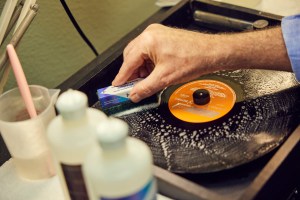
Proper Record Cleaning Can Help You Find Your Own Hot Stamper Pressings
One of our customers wrote to us about cleaning his collection not long ago, and we advised him how he should go about it. He seems to have taken much our advice to heart and has quieter, better sounding records as a result. He did not spring for the pricey Keith Monks style machine we use, but felt that his efforts produced excellent results regardless. Best to hear it from him:
Hey Tom,
Just did three records, in all different conditions, and this one Eddie Palmieri, the Latin Salsa pioneer. And I had been meaning to get some famous albums in that genre, and I looked through Discogs.com and this guy wanted $40 for an album called Mozambique. Even though it looked great, it had so much noise from years of build up.
It played beautifully after all the steps. There was a huge jump in fidelity, just the tiniest, tiniest surface noise between songs. You wouldn’t notice if you weren’t listening for it.
From the other two records which had different issues, I don’t think it’s very hard to understand what else a Keith Monk type machine might add to other more difficult records, in combination with the Prelude stuff and a VPI. But for this one, and I think a lot of other records I own, the Prelude and VPI are all I needed.
I know there’s going to be a huge learning curve and I don’t expect things to be so simple. But it was just cool and kind of a treat, my first time out, to know that it’s possible.
Anyway, I just wanted to share that for what it’s worth. Thanks,
Andrew
Dear Andrew,
Glad to hear you were able to get your records cleaner and make them better sounding to boot. What could be better?
Well, there actually is an answer to that rhetorical question, and we supplied it right here on the blog in a listing with step by step instructions using the Prelude Record Cleaning System and two record cleaning machines. You asked me to write it all out so that’s what I did.
It does not surprise me in the least that you got great results with your VPI. That is the very machine we had been using since the early-90s to clean all our records. Sometime later in the decade we discovered the Disc Doctor fluids and switched to them. I wrote a long piece in my paper catalog (this was in our pre-internet days) discussing how much quieter and better sounding all of our vintage classical records sounded when cleaned with DD fluids, and that I was therefore going to reclean them all and reevaluate every last one for sound and surfaces. It was that big a difference.
In 2007, when I first heard a record cleaned with the Prelude System, everything changed radically, a story I tell using the record I was testing at the time, Meddle. It was one of the biggest breakthroughs we had experienced up to that time.
This is the kind of difference you have now heard with Prelude and your 16.5. You are operating at a different level now.
But there was more to come for us when an audio friend invited me to bring a record over that he would clean with Prelude on his Keith Monks machine. I brought over a killer copy of Meddle as I recall. Imagine my shock when it sounded even better than it had when first cleaned with Prelude. I immediately ordered up a industrial-strength threaded-pickup machine, the Odyssey, made in Germany, and started offering Hot Stamper pressings that were quieter and had better sound than I had ever heard before. (We are currently on our third unit. We clean a lot of records.)
This is leap you have yet to take. It might not make as much difference as your cleaning has to date, but, once you do it, you will find that there is a clearly audible “before and after” quality to the sound of your records. No doubt you will want to reclean all your personal favorites using Prelude and whatever Keith Monks type machine you end up with.
We Get Letters
Many of our customers have written to us to tell us that the Hot Stamper pressing they received had exactly the same stampers as the one they already owned, but for some reason sounded noticeably better.
Our Hot Stampers sound better for two reasons: they are cleaned better, which improves the sound quality by means of the superior cleaning machines, methods and fluids we use.
More importantly, as a rule one pressing with one set of stampers will sound similar, but slightly better or worse, compared to a different pressing with those same stampers.
Here is a wonderful illustration of what I am talking about.
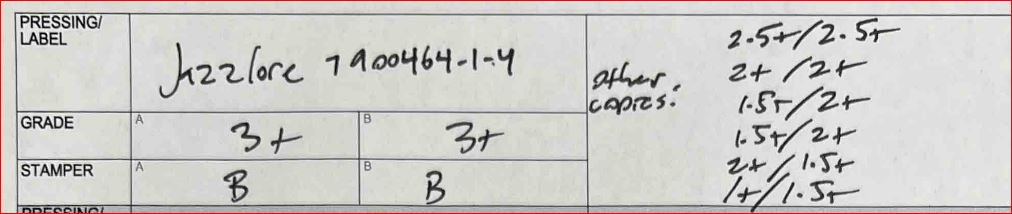
Note that all the copies shown have the same stampers, yet the sound is all over the place, including the fact that there was only one White Hot Stamper winner with a 3+ grade on either side.
Only two copies out of the seven we played earned the same grades on both sides.
The worst copy — with identical stampers mind you — had sub-Hot Stamper sound of 1+/1.5+.
How Big a Difference?
Andrew, the cleaning regimen you are following should be good for one half plus to one full plus improvement in the sound quality of the records you clean, and of course they will also have quieter vinyl.
Adding the Keith Monks-style machine should kick the sound up a comparable amount.
Yes, we know it is a pain, but the gain is real. For some of the most highly-prized records in your collection, you might want to keep it in mind.
Best, TP
For more record cleaning tips and tricks, click here.
To order the Prelude Record Cleaning System, exclusively available from Better Records and 100% guaranteed to be the best record cleaning fluid you have ever used or your money back, please click here.
Once you hear that every record you have cleaned now sounds better than it ever has, not to mention quieter, we think you will be more than glad you did.
Further Reading
Hi Tom,
Keith Monks” new machine, which does not use string, is not suitable for suctioning ultra-pure water used for rinsing. This is because pure water has strong surface tension, making it impossible to apply evenly to the record surface, and therefore impossible to suction evenly. Can the Odyssey, which is now out of production, do this? With #4 liquid, suction is smooth. Should I look for a machine that uses string?
Dear Sir,
How did you come by this information about the new machine not being able to suction ultra-pure water? Does Keith Monks hold that view?
Also, by #4 liquid, do you mean Prelude Step Four?
Please get back to me at your earliest.
TP
Hi Tom,
Thank you for your reply. First, I purchased Prelude last year and cleaned it with my favorite OKKI NOKKI machine, and was surprised by the improvement in sound quality. Of course, I followed the instructions included with Prelude and used two suction nozzles, one for pure water and one for cleaning solutions #1 and #2. However, in order to further improve the sound quality, I purchased Keith Monks’ new model (Keith Monks Prodigy Light).
First, I cleaned the Prelude using cleaning solutions #1 and #2 with the OKKI NOKKI, then transferred it to the Keith Monks while the foamy cleaning solution was still present and performed suction. Next, I returned it to the OKKI NOKKI, applied pure water, and performed suction using the pure water suction rod. I repeated this process twice, and finally performed the final finish using Prelude #4.
This greatly improved my psychological satisfaction, but after reading your article a little while ago, I realized that my method was in reverse order.
So, following your method, I first processed the first two steps with Prelude #1 and #2 using OKKI NOKKI (VPI-16.5), and then vacuumed the vinyl surface with Keith Monks (Odssey) after applying pure water.
However, due to the strong surface tension of the pure water, it did not spread uniformly across the vinyl surface. On the wet surface, the Keith Monks suction thread moved along the grooves, but on the dry surface, it did not follow the grooves, causing unstable movement and unsatisfactory results.
On the other hand, when using Prelude #4 Liquid, the machine was able to suck up almost everything, but it accompanied by some unnatural movements.
Since the Keith Monks Prodigy Light does not use a string as an aid for liquid suction, I speculated that this might have affected the results. That is why I asked you the previous question.
However, this may be a problem unique to my Keith Monks Prodigy. I have not contacted the retailer regarding this matter.
I hope this answers your question.
Best Regards,
Nobu
HI Nobu,
Have you tried using a little photoflow in the rinse water? That might do the trick, and you should test to make sure it doesn’t degrade the sound of course.
We are not fans of Step 4 and do not recommend its use.
And of course Keith Monks might have some ideas about fixing the problem.
Please keep me posted.
P.S.
This confuses me:
However, due to the strong surface tension of the pure water, it did not spread uniformly across the vinyl surface. On the wet surface, the Keith Monks suction thread moved along the grooves, but on the dry surface, it did not follow the grooves, causing unstable movement and unsatisfactory results.
Why is the suction thread being used on a record with a dry surface?
In other words, if the record is dry, why are you continuing to dry it?
Best, TP