rev-x

This reviewer — it won’t take you long to figure out who it is — comes in for a lot of criticism on this blog, and for good reason: he’s been leading audiophiles astray for more than thirty years.

Our best advice is simply this: whatever record he recommends, don’t waste your money. It is practically guaranteed to be awful.

1A, or Is 1B Better on Parsley, Sage, Rosemary and Thyme? Your Guess Is As Good As Mine

Hot Stamper Pressings of the Music of Simon and Garfunkel Available Now

UPDATE 2024

Speaking of 1A and 1B, the evidence is in. We have now confirmed that one of these sets of stampers (one for each side) can win shootouts. Which of the two it is we will leave to you to discover, as we make it a point never to give out the shootout winning stampers except under the rarest of circumstances. We give out plenty of stamper information, just not the stampers of the winners.


We now return to our commentary from many years ago:

Before we go any further, I have one question:

Why are we guessing?

I received an email recently from a customer who had gone to great pains to do his own shootout for a record; in the end he came up short, with not a lot to show for his time and effort. It had this bit tucked in toward the end:

Some of [Better Records’] Hot Stampers are very dear in price and most often due to the fact that there are so few copies in near mint condition. I hate to think of all the great Hot Stampers that have ended up in piles on the floor night after night with beer, Coke, and seeds being ground into them.

Can you imagine all the 1A 1B or even 2A 2B masters that ended up this way or were just played to death with a stylus that would be better used as a nail than to play a record!

To be clear, it’s extremely unlikely than any Hot Stampers have ever ended up in piles on the floor. Hot Stampers are not just originals or good sounding records.

They are pressings that have been cleaned, gone through the shootout process and found to be superior to their competition. Until they prove themselves, records like the ones whose unfortunate fate this reviewer fantasizes about are just old records that had the potential to sound good but never got the chance to demonstrate they had better sound than other pressings.

As it so happens, shortly thereafter I found myself on Michael Fremer’s old website of all places, where I saw something eerily similar in his review for the (no doubt awful) Sundazed vinyl. I quote below the relevant paragraphs.

(more…)

You Mean to Say You Don’t Have the Nautilus Half-Speed in Your Collection?

Hot Stamper Pressings of the Music of The Cars Available Now

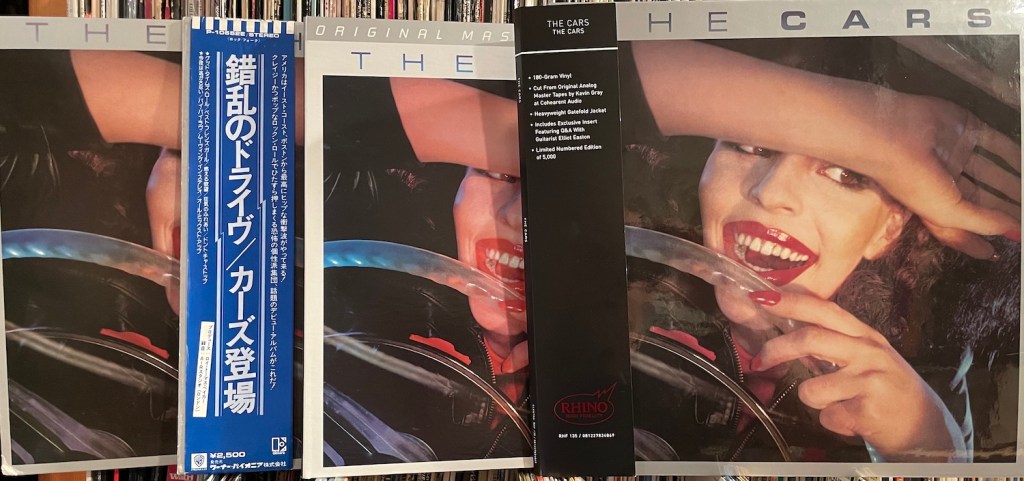
A well-known audiophile reviewer posted pictures of the Cars albums you see below.

As would be expected, it looks like he has rounded up the usual suspects from his collection:

  • A domestic pressing (probably), perhaps even an early one.
  • A Japanese pressing.
  • A Mobile Fidelity pressing (notice how contrasty the jacket photo is), and
  • The Rhino Heavy Vinyl pressing, which we reviewed recently here.

What are the chances that any of these pressings are any good?

Let me guess. One out of four?

(more…)

Songs in the Key of Life – Is This a Well-Engineered Album?

Hot Stamper Pressings of the Music of Stevie Wonder Available Now

Full disclosure: This commentary was written more than ten years ago and probably updated a bit here and there since then.


I’ve just gone to this reviewer’s website to make sure the quote below is accurate, and everything you need to see is still up and as misguided as ever.

Some audiophiles never learn, and a great deal of this blog is devoted to helping audiophiles avoid the errors this reviewer and others like him have been making for decades. In the mid-90s I wrote my first commentary about the awful audiophile records this person had raved about in his review in one of the audiophile rags.

In the years since it seems that nothing has changed. Bad sounding audiophile pressings make up the bulk of this person’s favorable reviews to this day. Here are 157 of them.

How it is possible to spend so much time doing something, yet learn so little in the process? It is frankly beyond me.

I put the question to you again:

Is this a well-engineered album?

The first question that comes to mind is:

How on Earth could anyone possibly know such a thing?

Some background. Years ago our first Hot Stamper shootout for Songs in the Key of Life had us enthusiastically singing its praises:

Hot Stampers discovered for one of the funkiest and most consistent double albums of all time! It’s beyond difficult to find great sounding Stevie Wonder vinyl, but here’s a copy that proves it’s possible if you try hard enough. So many copies are terrible in so many different ways — we should know, we played them. And just to be clear, this copy is far from perfect as well, but it did more things right in more places than we ever expected it would or could. And that means it showed us a great sounding Stevie Wonder record we never knew existed.

But a well known reviewer says it’s a bad recording. Does he know something we don’t?

(more…)

Letter of the Week – “After playing a few very smooth and quiet bands I put on my excellent vintage copy of Aja that proceeded to destroy the Cisco.”

More of the Music of Steely Dan

One of our good customers had this to say about some Hot Stampers he purchased recently (bolding added):

Hey Tom,   

It’s amusing that even Golden Ears who have the attention of large readerships can miss and misunderstand so much. You don’t have to understand the technical why of the variability of LPs to appreciate just how profound the audible differences can be from stamper to stamper. Even in acknowledging that differences are present, they do not seem to appreciate the extreme degree of the variation in sound among LPs from different stampers.

As so many of us have learned from you, a “hot stamper” LP is simply in a whole different league in sound quality. A good sound system is necessary to realize just how big that difference is and the more optimized that system is the better.

Beyond the audible reality and the technical issues, it is the subject of value that is not understood or appreciated. The ability to simply find a nice playable copy of a vintage LP is a major task. So many LPs have suffered the gouging of what must have been a rusty nail used as a stylus as well as all the other sins that can be wreaked on the plastic disc. Then the incredible task of assembling enough different copies to be able to do the “shoot-out” would seem impossible.

I have, as many now may have tried, done a simple “shoot-out” of a few copies of a favorite LP. Among those I have always found the “better” of the bunch. Now and then and just by luck (since the statistics of not having enough samples was not working in my favor) I have found what must indeed be a “hot stamper). And WOW …..what a difference!

The number of times this has occurred fits on less than one hand yet when you hear an LP that has been mixed and mastered really well and then “transferred” with care and quality via an excellent stamper, there is an epiphany. Suddenly you hear what you often refer to as “master tape” sound. As I have said before, this is really a sad statement about the quality and consistency of record production throughout its history.

The “Audiophile” Half-Speed thing only piles it on top of this with the way mastering at half speed seems to extract the dynamic life and frequency response from an album in contrast to a standard copy.

The logical intention that mastering at half speed would allow the cutting lathe tool to have “more time” to lay down more of the music signal just never really worked.

You would think the “Golden Ears” that developed this idea would have compared the result with real-time cutting speed (not brain surgery). I never wanted all this to be the way it is and didn’t even know it until I stumbled upon Better Records one day. But it is the way it is!

(more…)

Michael Fremer Says You Should Own the Classic 45 of Time Out

Hot Stamper Pressings of the Music of Dave Brubeck Available Now

Michael Fremer spends two hours and ten minutes on his site going through a list of 100 All Analog In Print Reissued Records You Should Own.

On this list is the 45 RPM Bernie Grundman cutting of Time Out. Fremer apparently liked it a whole lot more than we did. We think it is just plain awful.

The MoFi Kind of Blue is on this same list, another pressing that is astonishingly bad, or, at the very least, really, really wrong.

If you’re the kind of person who might want to give Michael Fremer the benefit of the doubt when it comes to All Analog records he thinks sound good, ones he thinks you should own, try either one of them. If you think they sound just fine, you sure don’t need me to tell you that they’re completely and utterly awful.

There might be some decent records on the list, but if it has two massive failures that I just happened to come across in the five minutes I spent watching the video — I have very little tolerance for the sort of amateurishness he displays — I would suspect the winners are few and the losers many.

As a practical rule, if you want good sounding vinyl, you should avoid anything on his list.

And if you do try some and do like them, let me know which ones you think sound good and I will try to get hold of some copies and listen to them for myself.

Here is what we had to say about the Brubeck that Mikey recommends. We called it:

An audiophile hall of shame pressing and another Classic Records jazz LP poorly mastered for the benefit of audiophiles looking for easy answers and quick fixes. Sonic Grade: F.

Our story:

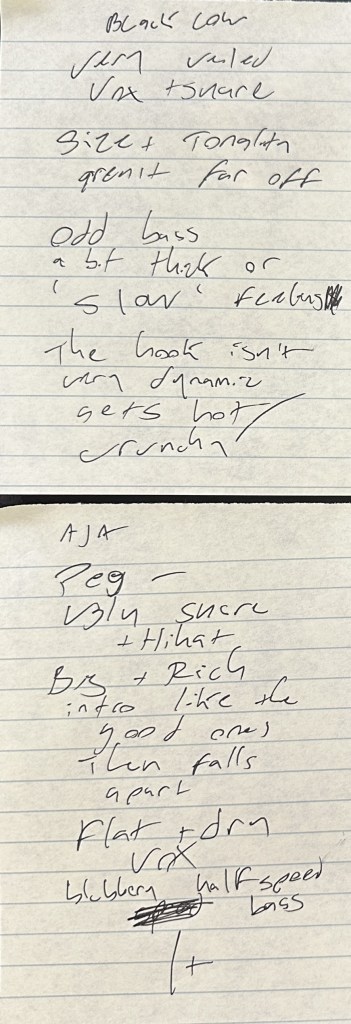
Not long ago we found a single disc from the 45 RPM four disc set that Classic Records released in 2002 and decided to give it a listen as part of a shootout. My notes can be seen below, but for those who have trouble reading my handwriting, here they are:

  • Big but hard
  • Zero (0) warmth
  • A bit thin and definitely boring
  • Unnatural
  • No fun
  • No F***ing Good (NFG)

Does that sound like a record you would enjoy playing? I sure didn’t.

(more…)

Aja Gets the UHQR Treatment Good and Hard

Hot Stamper Pressings of the Music of Steely Dan Available Now

It’s been almost one full year since we reviewed our first Steely Dan UHQR, Can’t Buy a Thrill. If you have a few minutes to kill, you can read about it here.

One whole year. Time flies!

Some folks chide us for constantly beating up on one Heavy Vinyl release after another, as if we actually like doing it. We don’t think that’s fair (the “constantly beating up” part, not the “like doing it” part. We actually do like doing it. If we didn’t, we wouldn’t do it. It costs us money and time, and obviously doesn’t put a penny in our pockets, since we would never sell you a record that sounds as wrong as most of them do).

Contrary to what some folks believe, and as we try to make clear in the following paragraphs, we’re actually quite far behind on our Heavy Vinyl reviews. The reality of our situation is that we simply cannot keep up with all the bad records being made these days.

Let’s take stock. The Electric Record Company’s Heavy Vinyl pressing of Quiet Kenny is still waiting for a review after three years. The Kind of Blue on Mofi at 45 RPM? That one I played at least three years ago. Still no review. I know what I want to say about it, I just haven’t found the time to say it.

Other bad records still waiting to be written up include the Craft pressings of Born Under a Bad Sign and Lush Life; the Britten Young Person’s Guide to the Orchestra on Cisco; Mingus’ Blues and Roots; Dire Straits’ first album, Tapestry and Blue on MoFi; the AP Plow that Broke the Plains; Black Sabbath’s Paranoid; Weaver of Dreams on Classic; LeGrand Jazz on Impex; the 2018 remix of Pink Floyd’s Animals; the Abbey Road Half-Speed mastered pressing of Sticky Fingers (shocker: it could be worse!); Tina Brooks on Music Matters (not that bad, actually); Led Zeppelin’s first album and Houses of the Holy remastered by Jimmy Page; and there are bound to be plenty of others that I’ve simply lost track of.

I have the records here in Georgia with sonic notes attached, and one of these days I will dig them out and make listings for them.

There is an overwhelming, seemingly inexhaustible supply of collectible, out-of-print Heavy Vinyl available to the credulous audiophile with a computer and a credit card.

In addition, there are hundreds of new titles being released every year, far more than a cottage operation such as ours could ever hope to find the time and money it would take to buy, clean, play and review them all.

Keep in mind that we don’t get paid to do any of that. We play and review these records to help audiophiles — customers and non-customers alike — better understand their strengths and weaknesses relative to the amazing sounding vintage pressings we offer as Hot Stampers.

(more…)

“Tom, what about the argument that the engineers had to make the records sound good on the equipment of the day?”

More Letters from Customers and Critics Alike

OK, what about it?

Let’s dig in.

One of our good customers had some questions about a commentary we wrote entitled a kinder, gentler approach to record reviewing.

Tom, what about the argument that the engineers had to make the records sound good on the equipment of the day? Now that we have better gear, these guys can make the record sound the way it was originally intended. I think Chad said this about Rudy Van Gelder at some point in the video.

For the benefit of the reader, the video in question can be found on youtube under the title “Michael Fremer, Chad Kassem, Geoff Edgers: A Journey Back to Vinyl.”

Edgers was invited, apparently under pretext as it turns out, to talk about his article, but instead he was pressed into defending me most of the time. Kassem and Fremer — two individuals whose talents, such as they are, could not be more ill-suited to the work they have chosen for themselves — beat up on Edgers for about two hours.

As an aside, Geoff is a good guy and he certainly didn’t deserve this kind of mistreatment. Fremer and Kassem won’t apologize to him — that’s not something they are known to do — so please allow me to apologize to Geoff on their behalf.

I’m sure he has trouble understanding to this day why he was forced into acting as a spokesman for Better Records. Regardless of how he feels about it, we thank him for his service to the cause. (To be clear, he didn’t exactly take my side, which is the right thing for a reporter to do. He wanted to know why our disagreements upset them so much.)

For those of you who like to watch bickering and sniping from a couple of thin-skinned egomaniacs who can’t stand the fact that someone doesn’t think the records they like — or in the case of Chad, produce and sell — are any good, have I got a video for you. If you want to undertand how seriously you should take these two guys, both at the top of their respective mountains, watch the video and make your own judgments.

Our letter writer continues:

Suppose, that the RL cut of Zeppelin 2 had never existed, because Ludwig knew better than to cut it that way, knowing that most stereos couldn’t play it? And then Chad released something that sounded like that. Or, the argument that albums were engineered for listening to on the AM radio.

I think these guys believe they are improving on the mastering, and giving it the sound it should have had all along.

Dear ab_ba,

Yes, you are correct, this is indeed their position. They think these newly remastered pressings are a big improvement over earlier editions, and on quieter vinyl to boot!

Allow me to quote Michael Fremer, a man who apparently cannot get enough of the new records, even though his shelves are stuffed.

(more…)

The Best Policy for Any Label that Sells Bad Sounding Records

More of the Music of Stevie Ray Vaughan

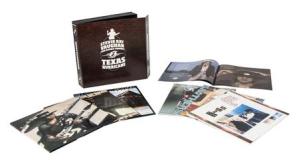
A good customer, initials CF, bought some SRV Hot Stampers from me a while back. He then told me he was going to spend $400 on the AP SRV Box Set in the hopes that the rave reviews from audiophile reviewers were justified.

The complete story of his disappointment can be found here. An excerpt:

What do you do with the Box Set if you find out these reviewers are full of horse pucky and it sounds as awful as our friend CF say it does? Can you send it back to Acoustic Sounds?

Oh, sorry, you can’t.

Within 30 days of purchase, we will accept returns of any physically or audibly defective or damaged item. We do not guarantee that you will like the music or recording quality of a LP or CD, and personal taste does not qualify as a reason for return.
There is a reason they have that policy. They sell bad sounding records.

We have the opposite policy. You can return any record for any reason within 30 days and get 100% of your money back.

We can do that because we sell good sounding records.

PS from CF

Great stuff, love it. Someone’s gotta keep this industry as a whole accountable. It’s like we’re in the dark ages with just a few devoted monks scouring the libraries and preserving the truth of what once was. Hopefully due to your lifetime’s commitment to this we’ll one day see a renaissance of quality, but it’s looking pretty bleak currently.

Ain’t that the truth.


We leave you with this comment from Michael Fremer, a man who apparently cannot get enough of this crap.

With all of the reissues coming from questionable sources or proudly proclaiming their ‘digital-ness’ ala The Beatles Box, we’re fortunate to have labels like Analogue Productions, Mobile Fidelity, ORG, IMPEX, Rhino and the others cutting lacquers from analog tapes. Acoustic Sounds’ Chad Kassem sent this image of the master tape box from Couldn’t Stand the Weather one of the many Stevie Ray Vaughan albums his reissue label is currently readying for release, pressed at his Quality Record Pressings pressing plant in Salina, Kansas. That’s a form of vertical integration we like! I have heard some truly miserable vinyl reissues from labels like Vinyl Lovers and ZYX some of which didn’t even sound like the same music when compared to original pressings. I’ve also heard test pressings of these SRV albums and they will rock your world! So, we are lucky to have these companies that are doing things correctly lavishing vinyl goodies on us all year long. Sometimes we wish they’d stop long enough for us to catch up, but then we come to our senses and say “more please!” even when the shelves are stuffed.

Lucky to Have Analogue Productions Around?

If you think his pressing of Tea for the Tillerman sounds good, it’s a near certainty you will want to be the first on your block to collect all the newly remastered Steely Dan Heavy Vinyls (the first of which has been reviewed here).

The same goes for this pressing of Stand Up. If this is the sound you are looking for, you can be sure Chad will give it to you, good and hard (apologies to H.L. Mencken). Here are some of the other titles of theirs we’ve reviewed:

Do these records sound fine to you? You’re happy with them, are you?

Then you have much to look forward to with the release of the complete Steely Dan LP collection!

These Analogue Productions releases will no doubt share many of the sonic characteristics of the above-mentioned titles.

How could they not? They are guaranteed to sound the way Chad wants them to sound. Chad is the customer, and the customer is always right.

If you’re Bernie Grundman, it might take you seven runs at it until you find that indescribable and elusive “Chad” sound, but you will have to keep at it until you do, assuming you plan on getting paid.

(more…)

Is the Heavy Vinyl from 2012 the Best Sounding Sgt. Pepper?

beatlessgtHot Stamper Pressings of Sgt. Peppers Available Now

You might agree with some reviewers that EMI’s engineers did a pretty good job with the new stereo pressing of Sgt. Pepper mastered by Sean Magee from the 2009 digitally remastered tapes.

In the March 2013 issue of Stereophile Art Dudley weighed in, finding little to fault on this title but being less impressed with most of the others in the new box set. His reference disc? The MoFi UHQR! Oh, and he also has some old mono pressings and a domestic Let It Be.

Now there’s a man who knows his Beatles. Fanatical? Of course he is! We’re talkin’ The Beatles for Chrissakes.

When I read the reviews by writers such as these, I often get the sense that I must’ve fallen through some sort of Audio Time Warp and landed back in 1982. How is it that our so-called experts evince so little understanding of how records are made, how variable the pressings can be, and, more importantly, how absolutely crucial it is to understand and implement rigorous protocols when attempting to carry out comparisons among pressings.

Critically comparing LPs is difficult and time-consuming. It requires highly developed listening skills. I didn’t know how to do it in 1982. I see no evidence that the audiophile reviewers of today are much better at it now than I was in 1982.

Just to take one example: They all seem to be operating under the same evidence-free conceit: that the original is the benchmark against which other pressings must be compared.

To those of us who have played Beatles pressings by the hundreds, this is patent nonsense. To cite just one instance, a recent Hot Stamper listing notes [inaccurately as it turns out, see below]:

We defy any original to step into the ring with it. One thing we can tell you, it would not be a fair fight. The cutting equipment to make a record of this quality did not exist in 1967, not at EMI anyway.

We had the opportunity not long ago to audition a very clean original early pressing of the album and were frankly taken aback by how AWFUL it was in virtually every respect. No top end above 8k or so, flabby bass, murky mids — this was as far from Hot Stamper sound as one could imagine. If it were a Heavy Vinyl or Audiophile pressing we would surely have graded it F and put it in our Hall of Shame.

To be fair we have played exactly one early copy of the record on our current system. (Played a copy or two long ago but on much different equipment, so any judgments we might have made must be considered highly suspect.) Perhaps there are good ones. We have no way of knowing whether there are, and we are certainly not motivated to find out given the price that original Sgt. Pepper’s are fetching these days.

We can tell you this much: no original British pressing of any Beatles album up through Pepper has ever impressed us sonically. We’ve played plenty and have yet to hear one that’s not congested, crude, distorted, bandwidth-limited and full of tube smear. (The monos suffer from all of these problems and more of course, which is only natural; they too are made with the Old School cutting equipment of the day.)

If that’s your sound more power to you. It’s definitely not ours. The hotter the stamper, the less congested, crude, distorted, bandwidth-limited and smeary it will be. (Or your money back.)


UPDATE 2023

There is a copy of a Beatles album on the original label that was competitive with our best 70s pressings, this one. We explained why it’s not a problem to admit we were wrong about the album in question, For Sale, this way:

This finding about For Sale is precisely why live and learn is our motto.

We don’t know it all, and we’ve never claimed that we did. We constantly learn things about pressings in our daily shootouts. That should not be too surprising, as record shootouts are the only way to learn anything about the sound of records that’s actually worth knowing.

Start doing your own experiments and your record knowledge might just take off the way ours has. 99% of what we think we know about the sound of records we’ve learned in shootouts over the course of the last twenty years.

Here is our advice on getting started.

Before this, the only Beatles record we would sell on the Yellow and Black Parlophone label was A Collection of Oldies… But Goldies. That title does have the best sound on the early label. In numerous shootouts, no Black and Silver label pressing from the ’70s was competitive with the best stereo copies made in the ’60s.

Until now, it was clearly the exception to our rule. From With the Beatles up through Yellow Submarine, the best sounding Beatles pressings would always be found on the 70s reissue label.


The Best Pepper Pressings

How did we come to find the best Sgt. Peppers pressings? Our recent commentary about a wonderful Benny Carter record on the original Contemporary Black Label may serve to shed some light on the process.

(more…)

The Graceland Remastering Disaster, Part 2

Hot Stamper Pressings of the Music of Paul Simon Available Now

Click on the link below to read the story behind an interview conducted by a well-known reviewer of an engineer who was tasked (by whom I wonder?) with remastering Graceland on Heavy Vinyl.

He apparently had never played an original Sterling-mastered copy of Graceland. Either that, or this  engineer thought the original “needed improvement,” the kind supplied by taking a hatchet to the sound of the original tape.

Analogplanet Visits Sterling Sound and Interviews Mastering Engineer Ryan K. Smith

The interviewer apparently does not know how bad the new version sounds, but we had no trouble recognizing its awfulness here at Better Records. As a public service, we soon set about describing what we heard when we put this remastered piece of junk to the test.

Up against a properly-mastered, properly-pressed early pressing, it earned a failing grade.

Is it the worst version of the album ever pressed on vinyl? Hard to imagine it would have much competition. 

The title of our review gives away the game:

The reviewer who interviewed the remastering engineer responsible for this and no doubt many other awful sounding records has never been able to tell a good record from a bad one, and he carries on that tradition with Graceland.

Ryan Smith, the hack who cut this album, has done quite a lot of work for Analogue Productions. We can’t say we’ve played many of his recuts, but the ones we have played are hopelessly bad, with the overly smooth sound so much in vogue today.

We played his recut of Scheherazade, and rather than just give it the failing grade it deserved, we explained how any audiophile could go about using its mistaken EQ in order to recognize what is wrong with it, and of course, others like it.

(Contrary to popular opinion, it is no better than Bernie Grundman’s bad sounding version from the 90s, the one he cut for Classic Records.)

One of my good customers read this rave review from this same reviewer for the Texas Hurricane Box Set and made the worst mistake any audiophile can make: he believed it.

“His overdriven Stratocaster sound is one that guitar aficionados never tire of hearing live or on record, especially when it’s well recorded. … Yet again, Chad Kassem sets high the box set reissue bar delivering a “must have” package for SRV fans, every bit the equal of the one Doors fans have come to cherish. …every one of these records betters the originals and by a considerable margin. It is not even close…You’ve never heard these albums sound like this. That is a 100 % guaranty. …this is an impeccably produced box set physically and especially sonically. It’s the best these albums have ever and probably will ever sound.” — Music = 9/11; Sound = 10/11 — Michael Fremer

Sure, he’s out $400, but on the bright side he’s now learned a lesson he is very unlikely to forget.

(more…)