1-2024

A Big Group of Musicians Needs Big Speakers to Sound This Big

Hot Stamper Percussion Records Available Now

At times this record really sounds like what it is: a bunch of guys in a big room beating the hell out of their drums and singing at the the top of their lungs. You gotta give RVG credit for capturing so much of that energy on tape and transferring that energy onto a slab of vinyl.

Of course this assumes that the record in question actually does have the energy of the best copies. It’s also hard to know who or what is to blame when it doesn’t, since even the good stampers sound mediocre most of the time. Bad vinyl, worn out stampers, poor pressing cycle, it could be practically anything.

Fingers is one of our all time favorite records, a real desert island disc to be sure. I’ve been playing this album for more than thirty years and it just keeps getting better and better. Truthfully, I have to admit it’s the only Airto record I like. I can’t stand Dafos, and most of the other Airto titles leave me cold.

I think a lot of the credit for the brilliance of this album has to go to the Fattoruso brothers, who play keyboards, drums, and take part in the large vocal groupings that sing along with Airto. 

We Love Fingers

Fingers checks off a number of important boxes for us here at Better Records:

(more…)

What to Listen for on Time Further Out

Hot Stamper Pressings of the Music of Dave Brubeck Available Now

The best copies demonstrate the big-as-life Fred Plaut Columbia sound at its best (even better than Time Out in our opinion).

These vintage recordings are full-bodied, spacious, three-dimensional, rich, sweet and warm in the best tradition of an All Tube Analog recording.

If you want to hear big drums in a big room, these Brubeck recordings will show you that sound better than practically any records we know of. 

The one standout track on this album for audiophiles is surely Unsquare Dance, with its uncannily real sounding handclaps in 7/4. The copies that did the best job of reproducing that “flesh on flesh” sound of actual human hands clapping scored very well in our shootout.

More to Listen For

For starters, listen for a fat snare and rich piano on the first track of side one. When you hear that, assuming you do, you should know you are in for a treat. Our best copies captured those two sounds brilliantly.

On the second track the clarity of the brushed snare is key to how resolving and transparent any copy is. The rich, smooth sound of Desmond’s sax balanced against the clarity of the brushes will help you make sure that the overall sound is tonally correct from top to bottom.

On side two the first track has the Wall to Wall Big Drums in a Big Room sound that positively blows our minds. If you’re a fan of  with jump out of the speakers sound, this is the album for you.

Note that in some places it sounds like the piano is overdriving its mic. We heard that sound on practically every copy we played, so we’re pretty sure it’s on the tape that way.

(more…)

Letter of the Week – “Expectations met and exceeded!”

Hot Stamper Pressings of the Music of Steely Dan Available Now

One of our good customers had this to say about some Hot Stampers he purchased recently:

Hey Tom,   

Expectations met and exceeded! This Royal Scam sounds amazing. Granted, my current copy was an MCA repressing, but this one totally crushes it and THEN SOME.

Thanks, Tom. I will be a return customer. I’m a believer!!

-kj

Dear kj,

And then some is right.

The MCA pressings are not worth the vinyl they are made from.

No early Dan album has ever sounded particularly good on that label with the exception of Gaucho, which originally came out on MCA after ABC merged with MCA.

Consider taking our moderately helpful advice regarding which pressings tend to win our shootouts.

Royal Scam should sound its best this way:

(more…)

Letter of the Week – “It’s crazy that once upon a time I thought it sounded really great.”

Hot Stamper Pressings of the Music of Peter Gabriel Available Now

One of our good customers had this to say about a Hot Stamper pressing he purchased recently:

Hi Tom,
Just a note. I forgot I had Red Rain/Sledgehammer on a 45 rpm clarity vinyl from Classic.

So I compared them. What the fuck! It was absolutely, completely lifeless. I was amazed at how lifeless it was.

It’s crazy that once upon a time I thought it sounded really great.

The journey continues to amaze.

Take Care,
Michel

Michel,

Thanks for your letter. You are not the first person to notice that Heavy Vinyl and Half-Speed mastered records do not hold up well when played head to head with the Hot Stamper pressings we offer.

Bernie Grundman has a fairly spotty record in the modern era. Starting with the work he did for Classic Records in the 90s, it’s hard to think of too many BG-mastered titles that sounded all that good to us. If pressed, I might be able to name five, but please don’t press me, coming up with five would be more work than I’d want to do.

The record you played probably sounded a lot like the pressing of So he remastered for Classic in 2002. We didn’t like it then and we doubt it has gotten better with age. Flat as a pancake and dead as a doornail are our go-to descriptions for the mostly irritating records that the various audiophile labels were putting out in those days, and not too surprisingly, the records they are making now are no better.

(To be honest, we were fooled plenty of times ourselves and have the embarrassing catalog entries to prove it.)

You were amazed by how lifeless it was, yet you used to like it.

Aren’t other audiophiles in exactly the same boat you were in until just a few days ago? Until you paid all that money to us for a copy that blew your Classic right out of the water?

Without knowing it, what you actually bought was a copy that sounded the way the Classic should have.

You thought you were getting top quality sound with Classic’s releases, especially when it has the advantage of being one song on a 12″ disc mastered at 45RPM. That record should have been killer, a Demo Disc of a great song guaranteed to blow your own as well as your audiophile friends’ minds.

Maybe it would have. Maybe, like you, they would think the Classic sounds amazing.

What’s amazing most of the time is just how relative “amazing” can be.

So, now you own the record that is a true Demo Disc, and one that can demonstrate not just top quality sound, but how inferior these modern-mastered titles really are up against the real deal — the real deal being a plain old mass-produced record that everybody and his uncle could have bought for relatively cheap in 1986. No fancy packaging, no high price tag, no virgin vinyl, just a record properly-pressed and properly-mastered. The world is full of them.

Audiophiles may be incredulous at the thought, but all it would take to show them how wrong their approach to collecting better pressings has been is the right pressing. Those are the ones we sell.

(more…)

Focus Is the Hidden Driver of Excellence

More on Developing Your Critical Listening Skills

Every day Delanceyplace sends me email book excerpts, and the one that came today struck me as particularly relevant to the devilishly difficult audio hobby many of us have been engaged in for most of our adult lives. Some of their excerpts are seen below. (Italics added by me.)

I myself wrote a commentary back in 2006 about the 10,000 hour rule, which I have linked below delanceyplace’s piece, along with other commentaries I think you might enjoy.


Focus: The Hidden Driver of Excellence by Daniel Goleman.

“The ‘10,000-hour rule’ — that this level of practice holds the secret to great success in any field — has become sacrosanct gospel, echoed on websites and recited as litany in high-performance workshops. The problem: it’s only half true.

“If you are a duffer at golf, say, and make the same mistakes every time you try a certain swing or putt, 10,000 hours of practicing that error will not improve your game. You’ll still be a duffer, albeit an older one.

“No less an expert than Anders Ericsson, the Florida State University psychologist whose research on expertise spawned the 10,000-hour rule of thumb, told me, “You don’t get benefits from mechanical repetition, but by adjusting your execution over and over to get closer to your goal” .

“Apart from sports like basketball or football that favor physical traits such as height and body size, says Ericsson, almost anyone can achieve the highest levels of performance with smart practice. …

“Ericsson argues that the secret of winning is ‘deliberate practice,’ where an expert coach takes you through well-designed training over months or years, and you give it your full concentration.

“Hours and hours of practice are necessary for great performance, but not sufficient.

How experts in any domain pay attention while practicing makes a crucial difference.

For instance, in his much-cited study of violinists — the one that showed the top tier had practiced more than 10,000 hours — Ericsson found the experts did so with full concentration on improving a particular aspect of their performance that a master teacher identified.

Smart practice always includes a feedback loop that lets you recognize errors and correct them — which is why dancers use mirrors. Ideally that feedback comes from someone with an expert eye and so every world-class sports champion has a coach. If you practice without such feedback, you don’t get to the top ranks.

“The feedback matters and the concentration does, too — not just the hours. …

(more…)

Cognitive Dissonance, or, I Just Paid $600 for This LP – Was That Too Much?

New to the Blog? Start Here

This letter came to us when we first started selling Hot Stamper pressings on our website way back in 2004-2005. Since that time we have received many other letters like it. Apparently, charging a lot of money for used records upsets people. Who knew?

Don, who wrote us the following letter, applauds us for being able to convince our customers to pay forty times the going rate for some of the records we sell — and like it!

The subject line of Don’s letter is Music.

What a great example of free market capitalism at it’s [sic] finest. Your web site is truly a unique example of marketing. You’ve taken a medium that [sic] completely relative and you can convince someone to pay upwards of 40X the going rate because….well, you said so. That doesn’t mean that the record will sound the same to them or that their experience of music is the same as yours as a reviewer. I guess if someone decides to spend $600 on a record they damn well better find a reason why it’s worth it even if they’re not completely convinced. (I took the time to read some of the other comments on your site.)

Don’t understand why someone would be upset about that or how they could argue that the records aren’t worth the price. They’re worth whatever someone is willing to pay for them as I see it. Maybe because they didn’t think of it first or they have some misplaced sense of ethics….who knows. I know it’s not worth it to me and thankfully there are plenty of other resources available for buying music. Another great example of capitalism…..

Sincerely,

Don L.

Don, honestly, I’m positively blushing at the thought that my “say so” is what gets people to pay the ridiculously high prices we charge for what appear to be fairly common rock records, the kind that might be worth roughly, oh, I don’t know, 1/40th of what we are asking? (Truth be told, probably even less.)

Ah, but here’s the kicker: there’s actually a scientific explanation for it!

It’s called cognitive dissonance, and it works like this. Let’s say someone decides to spend $600 on a record — sound familiar? — yet for some reason they’re not completely convinced it’s worth it — ring any bells? — so they find a way to justify the purchase to themselves by rationalizing one of two things: their actions or their perceptions.

In this case, although the actual record may not sound all that good when they get it home, because it costs so much they must find a way to make it somehow seem better than it really is. Failing to do so, this person, demonstrably $600 poorer, would have to conclude that he, like an idiot, has just let himself get ripped off, in this case by us.

Twisted Logic

The logic at work here is pretty straightforward. The buyer says to himself: I am not an idiot. Only an idiot would pay $600 for a record that doesn’t sound amazingly good, especially one that can easily be had for one-fortieth the amount of money I have paid, therefore the record must sound better than my ears tell me it does.

Which — let’s be honest here — may in fact be happening. I don’t know what these records sound like in my customer’s homes. How could I? They live all over the world. I have certainly taken some of my best sounding pressings with me while visiting customers, and they sure sounded good on their systems. But I can’t vouch for systems I have never heard and people I have never met. That would be silly.

You Are Correct Sir

You are certainly correct in pointing out that musical values are relative. The famous Latin proverb “De gustibus non est disputandum,” roughly translated “There’s no accounting for taste,” is one with which I am very familiar. (When somebody pays $600 for The Hunter on vinyl, you don’t have to tell me there’s no accounting for taste.)

As a skeptic I require evidence for what I believe in order to believe it. Although it’s certainly possible that our customers are willing to pay our admittedly high prices on nothing more than our say so, I see no evidence that this is in fact the case. All things being equal I think they must really like our records. They tell us so all the time, and they keep buying them week after week, so if they really are just fooling themselves, they apparently can’t stop doing it.

Occam’s Razor

The scientist’s and skeptic’s best friend, Occam’s razor, comes into play here. It holds that “the explanation of any phenomenon should make as few assumptions as possible.” It’s often paraphrased as “All other things being equal, the simplest solution is the best.” In other words, when multiple competing theories are equal in other respects, the principle recommends selecting the theory that introduces the fewest assumptions…”

Why assume people who buy expensive records are crazy? Why assume that the records they buy aren’t every bit as good as advertised, if not better? Why assume that the “other resources available for buying music” are even remotely as good, absent any evidence?

People assumed that the CD was going to be a cheap and easy resource for their music, and look where that got them.

Assumptions? Us?

(more…)

Maybe We SHOULD Start Buying Blue Notes on the Early Labels

Hot Stamper Pressings of Blue Note Albums Available Now
If there are record companies whose fans are extremely particular about the labels of the pressings they prefer, Blue Note has to be right at the top of that list.

The consensus among record collectors seems to be that the early label Blue Notes are practically guaranteed to have the best sound. In top condition they often sell for many thousands of dollars, far more than we have ever charged for any Hot Stamper Blue Note pressing

We are on record as not favoring early labels over later ones absent evidence to support such bias, but perhaps there actually are some records you should be buying based on their labels. This one, for example.

If all the stampers of a title are the same and they’re all cut by Rudy Van Gelder — early labels, middle labels and later labels alike — what do you use to guide you when trying to find the best sounding pressings?

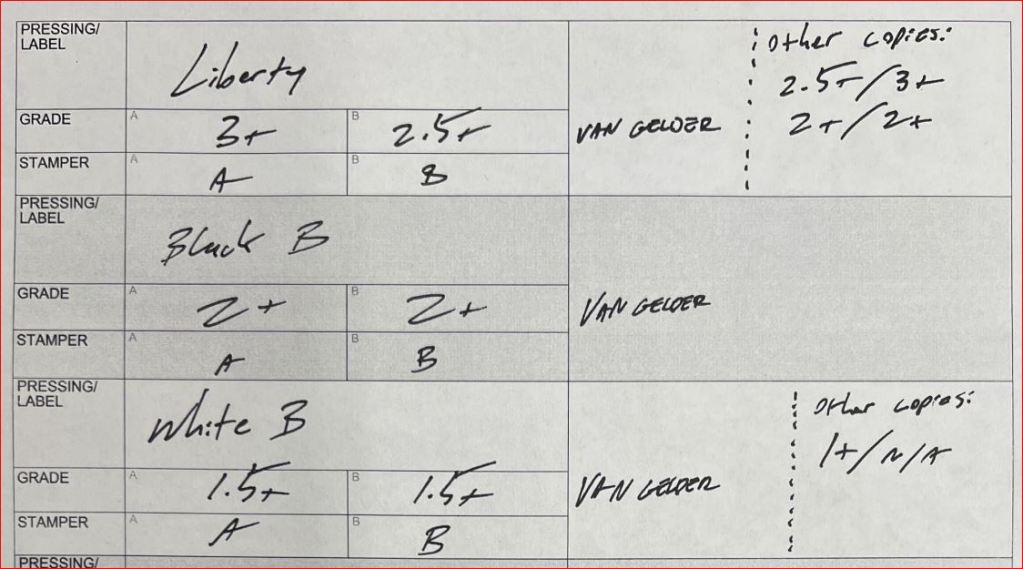
This is precisely the conundrum that an audiophile would be faced with as he goes about trying to find the best sounding pressings of the Blue Note album whose stamper sheet you see below.

This stamper sheet reflects a fairly typical shootout for a Blue Note pressing. It’s hard to find six clean copies no matter what the title is. We probably returned or gave up on half the copies we bought, so we might have had to buy nine in order to shootout six.

(Note that there is nothing on any label after the White B from the 70s. We have never heard any title with an 80s label or later sound worth a damn so we stopped buying them a long time ago.)

Drawing Conclusions

Let’s look at some of the conclusions the typical record collector/audiophile might draw from the information above.

For example:

1.) I have a Blue Note with Van Gelder stamps and it’s decent sounding but I like [fill in the blank with some other pressing] better. Since all the pressings are cut by him, he must not have done a very good job. Thank goodness modern mastering engineer X came along to finally bring out the sound of the master tape that he was not able to do.

That’s an easy one to rebut. The later pressings cut by Rudy are consistently worse sounding than the earlier ones in the case of this title. If you don’t have a big batch to work through, however, you simply have now way of knowing that fact, and therefore whatever conclusions you choose to draw from a too-small pool of pressings are suspect at best.

(more…)

Shaded Dogs with 12s Stampers Are Not the Way to Go on LSC 2566

Hot Stamper Pressings of the Music of Edvard Grieg Available Now

One set of stampers for the Shaded Dogs we played in our most recent shootout sounded consistently subpar, 12s/12s.

The sound was blary on both sides. (More records with blary sound can be found here.)

Although the Shaded Dog originals with the right stampers will always win our shootouts, the White Dog reissues still sound quite good to us, just not as good.

This Shaded Dog might be passable on an old school audio system, but it was too unpleasant to be played on the high quality modern equipment we use.

There are quite a number of other vintage classical releases that we’ve run into over the years with similar shortcomings. For fans of vintage Living Stereo pressings, here are some to avoid.

Some audiophiles may be impressed by the average Shaded Dog pressing, but I can assure you that we here at Better Records are decidedly not of that persuasion.

Something in the range of five to ten per cent of the major label Golden Age recordings we play will eventually make it to the site. The vast majority just don’t sound all that good to us. (Many have second- and third-rate performances and those get tossed without ever making it to a shootout.)

(more…)

Led Zeppelin II – An Overview

Hot Stamper Pressings of the Music of Led Zeppelin Available Now

Below you will find the story of my first encounter with an amazing sounding copy of Zep II back in 1995 or thereabouts.

I had a friend who had come into possession of a White Label Demo pressing of the album and wanted to trade it in to me for the Mobile Fidelity pressing that I had played for him once or twice over the years, and which we both thought was The King on that album.

To my shock and dismay, his stupid American copy killed the MoFi. It trounced it in every way. The bass was deeper and punchier. Everything was more dynamic. The vocals were more natural and correct sounding. The highs were sweeter and more extended. The whole pressing was just full of life in a way that the Mobile Fidelity wasn’t.

The Mobile Fidelity didn’t sound bad. It sounded not as good. More importantly, in comparison with the good domestic copy, in many ways it now sounded wrong.

Let me tell you, it was a defining moment in my growth as a record collector. I had long ago discovered that many MoFi’s weren’t all they were cracked up to be. But this was a MoFi I liked. And it had killed the other copies I’d heard in the past.

So I learned something very important that day.

I learned that hearing a better pressing is clearly the surest way to appreciate what’s wrong with the pressing I thought sounded right.

(more…)

Listening in Depth to Taking Tiger Mountain by Strategy

More of the Music of Brian Eno

More Arty Rock Records

Presenting another entry in our extensive listening in depth series with advice on what to listen for as you critically evaluate your copy of Taking Tiger Mountain.

Here are some albums currently on our site with similar track by track breakdowns.

This album is all about sound, pure sound itself if you will: the sound of the instruments, their textures, and the textures of the soundscape Eno has created for them.

With the subtle harmonics of Eno’s treated sounds captured onto vinyl intact, the magic of the experience far exceeds just another batch of catchy songs with clever arrangements. It truly becomes an immersive experience; sounds you’ve never heard in quite that way draw you into their world, each sound more interesting than the next.

Only these British originals sound like they are made from fresh master tapes on rich, sweet tubey-magical, super high resolution cutting equipment.

Engineering

Rhett Davies was behind the board for Tiger Mountain. He’s one of our favorite producers and recording/mixing engineers. Click on the link to find our in-stock Rhett Davies engineered or produced albums, along with plenty of our famous commentaries.

The man may be famous for some fairly artificial sounding recordings — Eno’s, Roxy Music’s and The Talking Heads’ albums come to mind — but it’s obvious to us now, if it wasn’t before, that those are entirely artistic choices, not engineering shortcomings.

Rhett Davies, by virtue of the existence of this album alone, has proven that he belongs in the company of the greatest rock and pop engineers of all time, right up there with the likes of Bill Porter, Ken Scott, Stephen Barncard, Geoff Emerick, Glyn Johns and possibly one or two others found on this list.

Side One

(Which, by the way, is BRILLIANT from the opening guitars of Burning Airlines to the never-ending chirping crickets of The Great Pretender. I mean that literally: on these early British pressings the run-out groove has the sound of the crickets embedded in it so that the crickets chirp until you pick up the arm, much in the same way that Sgt. Pepper has sound in the run-out groove at the end of A Day In The Life.)

Burning Airlines Give You So Much More

Pure Pop for Now People. Listen to all those multi-layered harmonies! They’re sweet as honey, and only the best British copies get them to sound that way. You can make out practically every voice. This is what we mean by Midrange Magic.

Back in Judy’s Jungle

This track has a BIG BASS DRUM that will rattle the walls and threaten to bring your house crashing to the ground if you are not careful with the volume. Love that whistling too — genius!

The Fat Lady of Limbourg

This song is so good I found the lyrics on the web and have included them for your edification below. Once you fit the words to the melody you will no doubt be as convinced as I am as to the brilliance of Eno’s songwriting skills.

Mother Whale Eyeless

The high pitched chorus about the man without his raincoat in the body of the whale can be a bit much on the copies that are not cut cleanly. Those kinds of high frequencies at loud levels are hard to cut and hard for your arm/cart to track.

The Great Pretender

Pure Eno magic to finish out the side on a high point; it doesn’t get much better than this! Listen to those sustained lower piano notes — on the best copies they are deep and powerful and keep resonating seemingly forever. It’s one of the most interesting sounds on an album that’s full of NOTHING BUT interesting sounds.

Side Two

Note that on most copies side two is cut a db or two lower than side one. Please increase your volume level accordingly when playing side two.

(more…)