These Are Just Some of the Stampers to Avoid on Catch Bull at Four

More of the Music of Cat Stevens

The domestic pressings of Catch Bull at Four with the stampers shown below, and others similar to them, have not done well in our shootouts for years now. If you own a copy with these stampers, or ones like them, the good news is that we can get you a much better sounding copy of Catch Bull at Four than you have ever heard.

Stamper numbers are not the be-all and end-all in the world of records, a subject we discuss below, but after hearing too many copies with these stampers and decidedly mediocre sound, from now on we are going to focus our attention on the stampers that do well and leave copies with these markings sitting in the bins.

When it comes to stampers, labels, mastering credits, country of origin and the like, we make a point of revealing very little of this information on the site, for a number of good reasons we discuss here.

The idea that the stampers are entirely responsible for the quality of any given record’s sound is a mistaken idea, and a rather convenient one when you stop to think about it. Audiophiles, like most everybody else on this planet, want answers.

(more…)

The Faces – A Nod Is As Good As A Wink…

More Rod Stewart

More British Blues Rock

  • Two excellent WB Green Label sides, both with Double Plus (A++) sound from start to finish – The Faces are rockin’ their asses off on this copy
  • Punchy, solid and rich through and through, with driving energy like nothing you’ve ever heard from the band
  • Impossibly quiet vinyl for a Green Label original – good luck finding one that plays this well (and sounds anything like this)
  • 5 stars: “[It] doesn’t feel cobbled together and it serves up tremendous song after tremendous song… It’s another classic — and when you consider that the band also had Long Player to their credit and had their hands all over Every Picture in 1971, it’s hard to imagine another band or singer having a year more extraordinary as this.”

(more…)

Taking Tiger Mountain – A Big Speaker Tour De Force

Hot Stamper Pressings of the Music of Brian Eno Available Now

If you have a big speaker and the kind of high quality playback capable of unraveling the most complex musical creations, with all the weight and power of live music, this is the record that will make all your audio effort and expense worthwhile.

Repeat As Necessary

Like Roxy Music’s first album, Taking Tiger Mountain is a powerhouse that not only rewards repeated listenings but requires them. Music like this simply cannot be digested at one sitting. Like the Beatles said, It’s All Too Much. But the more you hear it the more you will be able to understand it and appreciate it and, if you’re like me, really start to love it (I hope).

I’ve been listening to this album since the mid-70s and in all that time I have never tired of it. To me it’s the very definition of a Desert Island Disc: a record that knocks me out every time I play it and never wears out its welcome. It’s still fresh and “cutting edge” (if I can use that term) forty odd years after its release. (801 Live from 1976 is the same way.)

The Sound

This album is all about sound, pure sound itself if you will: the sound of the instruments, their textures, and the textures of the soundscape Eno has created for them. Much of that information is lost or perverted on the LP reissues and of course the CD. Only these British originals sound like they are made from fresh master tapes on rich, sweet tubey-magical, super high resolution cutting equipment.

With the subtle harmonics of Eno’s treated sounds captured onto vinyl intact, the magic of the experience far exceeds just another batch of catchy songs with clever arrangements. It truly becomes an immersive experience; sounds you’ve never heard in quite that way draw you into their world, each more interesting than the next.

Brian Eno and other Art Rockers of the period were clearly dedicated to making higher quality recordings, recordings that could only come to life in the homes of those with the most advanced audio equipment. Credit the work of the amazing Rhett Davies for some of the best albums of the 70s: this one, 801 Live, Diamond Head, Dire Straits’ first album, and more.

My system was forced to evolve in order to reproduce the scores of challenging recordings issued by Eno in the 70s. The love you have for your favorite music has to be the driving force of your progress in audio if you want to achieve world class sound.

(more…)

Stephen Stills / Manassas

More of the Music of Stephen Stills

Reviews and Commentaries for the Music of Stephen Stills

  • Manassas is back on the site for the first time in years, here with KILLER Shootout Winning Triple Plus (A+++) grades or close to them on all FOUR sides of these vintage Atlantic pressings – fairly (and unusually) quiet vinyl too
  • The sound is big and rich and Tubey Magical, the vocals breathy and immediate
  • And you will not believe all the space and ambience – which of course are all qualities that Heavy Vinyl records have far too little of, and the main reason we have lost all respect for most of them
  • 4 1/2 stars: “A sprawling masterpiece, akin to the Beatles’ White Album, the Stones’ Exile on Main St., or Wilco’s Being There in its makeup, if not its sound.”

Most copies we played were a disaster: grungy, veiled, with no real top end, grainy, stuck in the speakers, with tubby bass — these and other problems were all too common. When a double album sounds like this it makes for a very long day.

What were we listening for exactly? An absence of all the bad qualities mentioned above would be the easiest answer. Once you find a copy without the nasty grit and the grain so many of them have, you quickly key into the lovely ambience that the better copies have, and then you start to notice the Tubey Magic, the richness and sweetness, the extension up top, the kind of transparency that lets you hear into the soundfield and pick out all the players — pretty much the same kinds of things you’re always looking for in a Hot Stamper pressing, except in this case you just had to be willing to look a lot harder.

(more…)

Is It All About the Music or Is It All About the Sound?

Top Quality Audio Is Key to Finding Good Records 

There is a truism (a statement that is obviously true and says nothing new or interesting) that frequently pops up in the comments section commonly found on audiophile forums.

Working similarly to Godwin’s law, the longer an audiophile thread goes on, the more likely it is to be said. A quick recap of Godwin’s law:

“Godwin’s law, short for Godwin’s law (or rule) of Nazi analogies, is an Internet adage asserting: “As an online discussion grows longer, the probability of a comparison involving Nazis or Hitler approaches 1.”

The truism I’m talking about is commonly phrased, “It’s the music, stupid,” an echo of James Carville’s “It’s the economy, stupid,” from Bill Clinton’s presidential campaign of 1992. (I prefer not to use the word “stupid” when discussing my fellow audiophiles’ comments, but the play on words does not work without it, so there it is.)

Who would be foolish enough to take up the other side of this “argument,” if we can call it that?

Allow me to have a go at it.

So, if I understand correctly, it’s all about the music, right? Not the sound?

What about other kinds of art? What is it about with respect to them?

Christopher Nolan shoots on IMAX film, which in its current iteration is either 65 or 70mm.

If his movies are about a story and its characters, why not shoot them on 35mm? Or 16mm. Or Super 8? Or, gasp, HD-digital?

Same story, same characters.  But it sure wouldn’t be the same experience.

And nobody has trouble understanding that. Here’s Nolan on 70 mm.

“[The] sharpness and the clarity and the depth of the image is unparalleled. The headline, for me, is by shooting on IMAX 70 mm film, you’re really letting the screen disappear. You’re getting a feeling of 3-D without the glasses. You’ve got a huge screen and you’re filling the peripheral vision of the audience. You are immersing them in the world of the film.“

But music is different for some reason? To paraphrase Joe Pesci, different how?

Music is nothing but sound, so without good sound, what do you really have?

(more…)

Letter of the Week – “While the loud parts rock in an unbelievable way, the quiet bits reveal the magic…”

More of the Music of Led Zeppelin

One of our good customers had this to say about some Hot Stampers he purchased recently:

Hey Tom,   

Wanted to say thanks for the Led Zep III, fantastic and beyond expectation. While the loud parts rock in an unbelievable way the quiet bits reveal the magic, the surreal presence, space and uncanny realism. Brilliant!

I have an OK copy of Led Zep IV and the first section of Stairway to Heaven is similar in that I love hearing the acoustic guitar and then the breathy recorders (oh those recorders) and then Plant’s voice seems to appear from nowhere right before your ears.

I am so lucky to have the Zep III so thanks again.

(more…)

Eddie Money – One and Done

A Well Recorded Album that Should Be More Popular with Audiophiles

More Debut Albums of Interest

This is clearly Eddie Money’s best sounding album. Roughly 100 other listings for the Best Sounding Album by an Artist or Group can be found here.

In our opinion, his debut is the only Eddie Money record you’ll ever need. Click on this link to see more titles we like to call One and Done

The average copy is way too compressed, which kills the top end (by making the cymbals aggressive) and the vocals too midrangy. When you’ve got a copy of Eddie Money’s debut that’s doing what it’s supposed to do, you know pretty quickly. The highs are sweet and extended, the vocals are present, but without any spit or strain, and there is solid bass and low end propelling everything forward.

Eddie Money has only made one good record in our opinion — this one. Fortunately, it’s a GREAT one and we don’t have to play any of his others. This guy had so much promise, based solely on his debut here. He lost his brilliant guitarist and arranger, Jimmy Lyon, soon after this first album was made, and that may account for his slide into mediocrity.

But this record is outstanding from first note to last. If at the end of the second track — a cover of You Really Got A Hold On Me — you are not rockin’ out, then Eddie Money is just not for you. I love this album and I played it countless times back in the day.

This album checks off a few of our favorite boxes:

(more…)

Some Questions Just Don’t Have Good Answers

Yes, that is indeed a real puzzler all right!


Further Reading

To learn more about records that sound dramatically better than any Half-Speed mastered title ever made (with one exception, John Klemmer’s Touch), please go here.

People sometimes ask us how come we don’t like Half-Speed mastered records?

Below you will find our breakdown of the best and worst Half-Speed mastered records we have auditioned over the years.

(more…)

Beethoven / ‘Appassionata’ – Kamiya

More of the music of Ludwig van Beethoven (1770-1827)

More Direct-to-Disc Recordings

  • This rare and wonderful TAS-approved Japanese import LP boasts INSANELY GOOD Shootout Winning Triple Plus (A+++) Demo Disc sound on both sides
  • You will have a hard time finding a better recording of the piano than this – it’s one of the all time great Direct-to-Discs
  • It’s simply bigger, more transparent, less distorted, more three-dimensional and more REAL than all of what we played
  • A famous resident of the TAS list, this album offers excellent music, performed with feeling, and recorded properly, the best of all possible worlds for us audiophiles
  • A friend of ours tells me that Kamiya plays this piece exactly the way Horowitz did, and that’s probably a good thing – good luck finding a Horowitz recording that sounds like this

(more…)

Some Stereo Systems Make It Difficult to Find Better Sounding Pressings

Hot Stamper Pressings on Decca & London Available Now

Many London and Decca pressings lack weight down low, resulting in an overall thinning of the sound and lower strings that get washed out.

On some sides of some copies of some titles the strings are dry, lacking Tubey Magic. This is decidedly not our sound, although it can easily be heard on many London pressings, the kind we’ve played by the hundreds over the years.

If you have a rich sounding cartridge, perhaps with that little dip in the upper midrange that so many moving coils have these days, you will not notice this tonality issue nearly as much as we do.

Our 17Dx is ruler flat and quite unforgiving in this regard. It makes our shootouts much easier, but brings out the flaws in all but the best pressings, exactly the job we require it to do.

Here are some other records that are good for testing string tone and texture.

If you have vintage tube equipment, or modern equipment that is trying to mimic the sound of vintage tubes, you never have to worry that the strings on your London orchestral recordings will sound too dry.

You haven’t solved the problem, obviously.  You’ve just made it much more difficult — impossible even — to hear what is really on your records.

Some audiophiles have gone down this road and may not even realize what road they are on, or where it leads. Assuming you want to make progress in this hobby, it is, from our point of view, a dead end.

If you want to find Better Records, you need equipment that can distinguish good records from bad ones.

Vintage tube equipment is good for many things, but helping you find the best sounding records is not one of them.

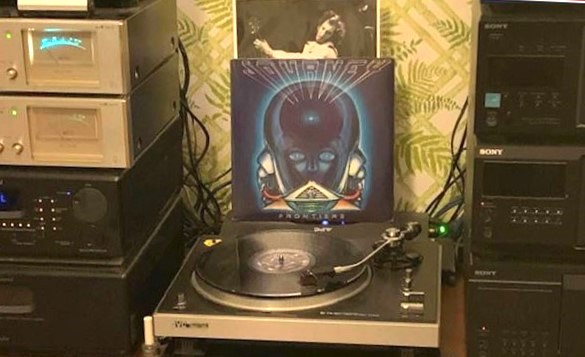
A rack full of equipment such as the one shown here — I suspect it is full of transistors but it really doesn’t matter whether it is or not — is very good at eliminating the subtleties and nuances that distinguish the best records from the much more common second- and third-rate pressings that often look identical to them.

If you have this kind of audio firepower, Heavy Vinyl pressings and Half-Speed mastered LPs don’t sound nearly as irritating as they do to those of us without the kind of filtering you get from the electronic overkill you see.

In my experience, this much hardware can’t help but create a barrier between you and the music you love.

It may be new and expensive, but the result is the kind of old school stereo sound I have been hearing all my life (and was perfectly happy with myself before the early 2000s.)

(more…)