bizetcarme-suites

Bizet / L’arlesienne And Carmen Suites – Ansermet

More of the Music of Georges Bizet

  • An early London pressing that was doing just about everything right, earning solid Double Plus (A++) grades from first note to last
  • This is a spectacular recording — it’s guaranteed to put to shame any Heavy Vinyl pressing of orchestral music you own
  • Vibrant orchestrations, top quality sound and scratch-free surfaces combine for an astounding listening experience
  • Some old record collectors (like me) say classical recording quality ain’t what it used to be – here’s all the proof anyone with two working ears and top quality audiophile equipment needs to make the case
  • If you’re looking to demonstrate just how good ’50s All Tube Analog can be, this killer copy should be just the record to do it
  • Recorded in 1958 using the amazing Decca Tree mic setup, it’s yet another remarkable disc from the Golden Age of Vacuum Tube Recording
  • 1958 just happens to be one of the truly great years for analog recordings, as evidenced by this amazing group of albums, all recorded or released in that year
  • This is a Must Own album, along with these other entries in our core classical/orchestral collection

Production and Engineering

James Walker was the producer, Roy Wallace the engineer for these sessions from 1958 in Geneva’s glorious Victoria Hall. It’s yet another remarkable disc from the Golden Age of Vacuum Tube Recording.

The gorgeous hall the Suisse Romande recorded in was possibly the best recording venue of its day, possibly of all time; more amazing sounding recordings were made there than any other hall we know of. There is a richness to the sound that exceeds all others, yet clarity and transparency are not sacrificed in the least. It’s as wide, deep and three-dimensional as any, which is of course all to the good, but what makes the sound of these recordings so special is the weight and power of the brass and the timbral accuracy of the instruments in every section.

This is the kind of record that will make you want to take all your heavy vinyl classical pressings and put them up for sale. None of them, I repeat not a single one of them, can ever begin to sound the way this record sounds.

Quality record production is a lost art, and it’s been lost for a very long time.

Famous in its Day

The Carmen Ballet Suite was deservedly famous in audiophile circles back in the ’70s. Even with the dubious equipment that a high-end stereo store might be running, this record would still sound shockingly good. It has so much “life” to it, so many interesting colors, and above all such three-dimensional spaciousness, it can make even bad transistor equipment, which is pretty much all there was back then, sound good.

The store I frequented carried the classic tube Audio Research electronics — that’s where I bought mine — but most stores were all-transistor, and high-power transistors at that, not a sound I care to revisit. Would love to hear my SP3-A-1 again though!

(more…)

Some Stereo Systems Make It Difficult to Find Better Sounding Pressings

Hot Stamper Pressings on Decca & London Available Now

Many London and Decca pressings lack weight down low, resulting in an overall thinning of the sound and lower strings that get washed out.

On some sides of some copies of some titles the strings are dry, lacking Tubey Magic. This is decidedly not our sound, although it can easily be heard on many London pressings, the kind we’ve played by the hundreds over the years.

If you have a rich sounding cartridge, perhaps with that little dip in the upper midrange that so many moving coils have these days, you will not notice this tonality issue nearly as much as we do.

Our 17Dx is ruler flat and quite unforgiving in this regard. It makes our shootouts much easier, but brings out the flaws in all but the best pressings, exactly the job we require it to do.

Here are some other records that are good for testing string tone and texture.

If you have vintage tube equipment, or modern equipment that is trying to mimic the sound of vintage tubes, you never have to worry that the strings on your London orchestral recordings will sound too dry.

You haven’t solved the problem, obviously.  You’ve just made it much more difficult — impossible even — to hear what is really on your records.

Some audiophiles have gone down this road and may not even realize what road they are on, or where it leads. Assuming you want to make progress in this hobby, it is, from our point of view, a dead end.

If you want to find Better Records, you need equipment that can distinguish good records from bad ones.

Vintage tube equipment is good for many things, but helping you find the best sounding records is not one of them.

A rack full of equipment such as the one shown here — I suspect it is full of transistors but it really doesn’t matter whether it is or not — is very good at eliminating the subtleties and nuances that distinguish the best records from the much more common second- and third-rate pressings that often look identical to them.

If you have this kind of audio firepower, Heavy Vinyl pressings and Half-Speed mastered LPs don’t sound nearly as irritating as they do to those of us without the kind of filtering you get from the electronic overkill you see.

In my experience, this much hardware can’t help but create a barrier between you and the music you love.

It may be new and expensive, but the result is the kind of old school stereo sound I have been hearing all my life (and was perfectly happy with myself before the early 2000s.)

(more…)

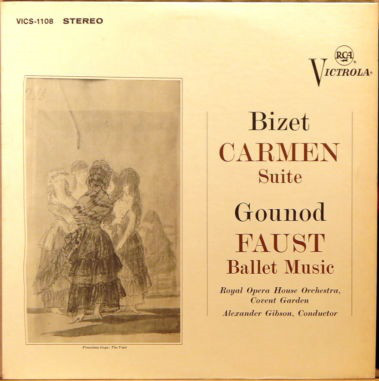
Gounod / Faust – A Wonderful Victrola Pressing from 1965

Hot Stamper Living Stereo Orchestral Titles Available Now

This RCA Plum Label Victrola LP has many shortcomings, but its strengths more than compensate for them.

The MIDRANGE is pure MAGIC. The sweet, textured strings, the back of the stage percussion, the placement of the orchestral sections in the soundstage, the performance itself — all combine to make you forget you are listening to an old, somewhat flawed record.

What has been captured in the grooves of the vinyl allows the listener to do what few recordings can — suspend his disbelief.

It’s not an old record. It’s living, breathing music being performed in the present, at this very moment. It’s happening — one is under the sway of Gounod’s music just as if one were attending the live event. The mind has somehow lost track of the fact that its owner is sitting at home.

The listener is transported by the sound, mentally, not physically, to a plane where the real world has no meaning, where music is the only reality.

I played this record and made critical notes for a while. At some point I lost interest in that activity.

I simply began to marvel at what the Decca engineers had managed to do, which was to draw me in completely.


(more…)

Bizet / Saint-Saens / Gounod, et al. – Ballet Highlights From French Opera

More of the Music of Georges Bizet

    • With top grades on both sides, this original Mercury stereo pressing of these renowned ballet works features some of the BEST sound we’ve heard from Paray
    • Listen to the lush strings and the weighty, rich sound on the Massenet piece on side two – that is the sound of a shootout winning pressing
    • The Ballet Music from Faust may just give the impossibly rare RCA (LSC 2449) a run for its money in terms of sound and performance
    • Vibrant orchestrations, top quality sound and scratch-free surfaces combine for an astounding listening experience
    • This spectacular Demo Disc recording is big, clear, rich, dynamic, transparent and energetic – HERE is the sound we love
    • If you’re a fan of delightful orchestral showpieces such as these ballet highlights, this LP from 1961 belongs in your collection
    • The complete list of titles from 1961 that we’ve reviewed to date can be found here.

(more…)

Bizet – Carmen and L’Arlesienne Suites / Gibson / Morel

More of the music of Georges Bizet (1838-1875)

More Classical and Orchestral Recordings

  • A superb UK Decca pressing of these lively orchestral showpieces with Double Plus (A++) sound from start to finish
  • It’s also fairly quiet at Mint Minus Minus, a grade that even our most well-cared-for vintage classical titles have trouble playing at
  • Vibrant orchestrations, top quality sound and reasonably quiet surfaces combine for an astounding listening experience
  • This is a spectacular recording – it’s guaranteed to put to shame any Heavy Vinyl pressing of orchestral music you own
  • Speaking of Heavy Vinyl, Alexander Gibson conducts two of the most sought-after and valuable RCA Living Stereo titles of them all, LSC 2225 and LSC 2449. We have not been able to find either for about ten years at anything under $1000, and that is too pricey for records that may not sound the way we want them to

(more…)

Gounod / Faust – Does Your Copy Have Clipped Bass?

This RCA Plum Label Victrola LP, the budget reissue of the incredibly rare LSC 2449, has some of the best and worst Golden Age sound I’ve ever heard. It has most of the magic of the better VICS copy I rave about.

When a cutting amplifier runs out of juice, the bass simply “clips.” The beginning of the bass note is heard, and then it just stops.

A fair number of RCA Shaded Dog originals have this problem. The cutting amplifiers of the day were often not up to the job. They ran out of power.

It’s amazing to me that so few collectors of these records even know what I’m talking about when I mention this shortcoming. They just assume it’s something in the recording perhaps. But it’s not. Oftentimes it is simply stamper variations that separate the clipped records from the unclipped records.

The more compression that is used, the less likely it is that the amplifiers will clip at all. But that’s obviously not the solution. And of course if you play records like this back on say, Quads, a notoriously compressed and bass-shy speaker to begin with, you’ll never notice any of this.

You also won’t hear it on this system.

Ah, but here is a wonderful recording that, on the better pressings at least, has deep, powerful, unclipped bass that can rattle the walls and sound like your flooring is in danger of being warped. But you need big woofers to get that effect, and lots of them.

But side two actually sounds quite good. Not as good as the best Shaded Dog copies possibly, but since those are $1000 and up, this has to be considered a good alternative at a fair price.

Lots of Living Stereo magic and a wonderful performance by Gibson make this record easy to recommend.

Carmen – Dry Strings on One Side, Rich on the Other

More of the music of Georges Bizet (1838-1875)

My notes for side two on a copy we recently auditioned read:

Could use more tubes.

Strings could be a bit smoother.

Needs a bit more weight down low.

My notes for side one:

Side one had all of this and more!

Some Common Issues with Londons and Deccas

Many London and Decca pressings lack weight down low, which thins out the overall sound and washes out the lower strings.

On some sides of some copies the strings are dry, lacking Tubey Magic. This is decidedly not our sound, although it can easily be heard on many London pressings, the kind we’ve played by the hundreds over the years.

If you have a rich sounding cartridge, perhaps with that little dip in the upper midrange that so many moving coils have these days, you will not notice this tonality issue nearly as much as we do.

Our 17Dx is ruler flat and quite unforgiving in this regard. It makes our shootouts much easier, but brings out the flaws in all but the best pressings, exactly the job we require it to do.

Here are some other records that are good for testing string tone and texture.

(more…)

Gounod / Ballet Music from Faust – Classic Records Reviewed

More of the music of Georges Bizet (1838-1875)

Reviews and Commentaries for Guonod / Faust Ballet Music

Sonic Grade: C

Classic Records did a passable job with LSC 2449, one of their better efforts, but of course it has almost none of the sweetness, richness and ambience that the best RCA pressings have, and they have them more often than not in abundance.

Their version is not awful, like most of the classical recordings they remastered, and considering that the original goes for many, many hundreds of dollars, might be worth picking up at a reasonable price.

Most audiophiles (including audiophile record reviewers) have never heard a classical recording of the quality of a good original. If they had Classic Records would have gone out of business immediately after producing their first three Living Stereo titles, all of which were dreadful and labeled as such by us way back in 1994, as soon as we had a chance to play them.

I’m not sure why the rest of the audiophile community was so easily fooled (HP, how could you?), but I can say that we weren’t, at least when it came to their classical releases. (We admit to having made plenty of mistaken judgments about their jazz and rock, and we have the We Was Wrong entries to prove it.)

And the fact that so many of them are currently on the TAS List is a sad comment on how far the mighty have fallen.


Classical Living Stereo Titles Available Now

(more…)