Top Studios and Concert Halls

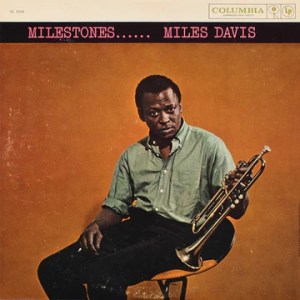
Miles Davis – Milestones

More Miles Davis

  • Milestones appears on the site for only the second time ever, here with solid Double Plus (A++) sound or close to it throughout this vintage MONO 2-Eye pressing – exceptionally quiet vinyl too
  • Huge amounts of three-dimensional space and ambience, along with boatloads of Tubey Magic (particularly on side two) – here’s a 30th Street recording from 1958 that demonstrates just how good Columbia’s engineers were back then
  • Davis partners here with jazz greats, including John Coltrane, Cannonball Adderley and others
  • Although the right 6-Eye mono originals will always win our shootouts, the 360 mono reissues still sound quite good to us, just not as good
  • And don’t waste your money on most of the copies in clean enough condition to please an audiophile, meaning the reprocessed stereo pressings — they’re awful
  • 5 stars: “What is immediately noticeable upon listening to Miles Davis’ classic first – and only – album with his original sextet is how deep the blues presence is on it. Though it’s true that the album’s title cut is rightfully credited with introducing modalism into jazz, and defining Davis’ music for years to come, it is the sole selection of its kind on the record. The rest is all blues in any flavor you wish you call your own.”

(more…)

The Greatest Beethoven Ninth on Vinyl – Ansermet in 1960

Hot Stamper Pressings of the Music of Beethoven Available Now

The legendary Ansermet recording from 1960 you see to the left is the best sounding Beethoven 9th we have ever had the pleasure to play here at Better Records.

Ansermet’s performance is clearly definitive to my ear as well. The gorgeous hall the Suisse Romande recorded in was possibly the best recording venue of its day, possibly of all time. More amazing sounding recordings were made there than in any other hall we know of.

Both sides are big, rich and clear, and both were showing us pretty much everything that’s good about a vintage symphonic recording.

There is a solidity and richness to the sound beyond all others, yet clarity and transparency are not sacrificed in the least.

It’s as wide, deep and three-dimensional as any, which is of course all to the good, but what makes the sound of these recordings so special is the weight and power of the brass, combined with unerring timbral accuracy of the instruments in every section of the orchestra.

The Chorus — Always a Tough Test

To get the chorus to play cleanly right to the very end is difficult for any pressing and this one is no exception. The chorus should play mostly without distortion or congestion even in the loudest parts, but we can’t say there won’t be a trace of one or both.

A good test of your turntable setup!

Production and Engineering

James Walker was the producer, Roy Wallace the engineer for these sessions from April of 1959 in Geneva’s glorious Victoria Hall.

The album came out in 1960, along with a great many other exceptional titles from the Golden Age of vacuum tube recording.

(more…)

Who Can Explain Why This Cheap Reissue Sounds So Good?

Hot Stamper Pressings of the Music of Claude Debussy Available Now

This Decca reissue is spacious, open, transparent, rich and sweet.

Roy Wallace was the engineer for these sessions from 1955 to 1962 in Geneva’s glorious sounding Victoria Hall. His work here is superb in all respects.

It’s yet another remarkable disc from the Golden Age of Vacuum Tube Recording, with the added benefit of mastering using more modern, but apparently still good, cutting equipment from the ’70s, 1972 to be exact.

We are of course here referring to the often amazing modern mastering of 40+ years ago, not the mediocre-at-best modern mastering of today.

The combination of old and new works wonders on this title as you will surely hear for yourself on both of these superb sides.

We were impressed with the fact that it excelled in so many areas of reproduction. The illusion of disappearing speakers is one of the more attractive aspects of the sound here, pulling the listener into the space of the concert hall in an especially engrossing way.

Thread It Up and Just Hit Play Already

What might be seen as odd — odd to some audiophiles but not to us — was how rich and Tubey Magical the reissue can be on the best copies.

This leads me to think that most of the natural, full-bodied, smooth, sweet sound of the album is on the tape, and that all one has to do to get that vintage sound on to a record is simply to thread up the master on a good machine and hit play.

The fact that nobody seems to be able to make an especially good sounding record these days makes clear that in fact I’m wrong to think that this approach would work. It seems to me that somebody should be able to figure out how to do it. In our experience that is simply not the case today, and has not been for many years.

Old Tapes, New Tapes

The master tapes were about fifteen years old when this record was mastered.

Compare that to a current cutting which would be made from approximately fifty year old tapes.

Perhaps that explains it.

Or maybe it doesn’t.

(more…)

Mozart – Clarinet and Horn Concertos / Maag

More of the music of Wolfgang Amadeus Mozart (1756-1791)

  • This wonderful classical release returns to the site for only the second time in twenty months, here with two killer Nearly Triple Plus (A++ to A+++) sides – just shy of our Shootout Winner
  • Big, clear, present and transparent, with a huge bottom end, you better believe that this is some Demo Disc sound
  • Both sides are open, high-rez, and spacious, with depth like you will not believe and some of the least shrill string reproduction we have ever heard for this music (which is the main problem we ran into on the album)
  • These wonderful concertos — some of the greatest ever composed — should be part of any serious classical collection.
  • Others that belong in that category can be found here.
  • Kenneth Wilkinson was (probably) the engineer for these sessions in glorious Kingsway Hall. It’s yet another remarkable disc from the golden age of vacuum tube recording.

(more…)

This Tchaikovsky 4th with Argenta Didn’t Make the Grade

Hot Stamper Pressings of the Music of Tchaikovsky Available Now

This vintage London Blueback pressing of CS 6048 was released in 1958.

(1958 just happens to be one of the best years for analog recording, as evidenced by this amazing group of albums, all recorded or released in that year.)

CS 6048 seemed to have a lot going for it so we thought we would get one in and give it a spin.

For starters, just take a look at that cover!

Roy Wallace was the engineer and many of his recordings are superb. (As of this posting there are fifteen available on our site.)

Recorded in Geneva’s world-renowned Victoria Hall with L’Orchestre De La Suisse Romande performing, many of of the best sounding records we’ve ever played boast these three elements.

Unfortunately, this London has a case of the “old record” sound we find on far too many vintage pressings, even those with credentials as promising as this one.

All the right people worked on it. How did it all go so wrong?

Who the hell knows?

The world is full of old records that just sound like old records. We’ve suffered through them by the tens of thousands in the 38 years we’ve been in the business of selling premium vinyl to audiophiles.

Our website, as well as this blog, are devoted to helping audiophiles find pressings that don’t sound anything like the millions of run-of-the-mill — and sometimes just awful, as was the case here — LPs that were stamped out over the last seven decades or so.

Even a million dollar stereo can’t make the average record sound good, and the more accurate and revealing the system, the more limited and lifeless the average record will show itself to be.

(more…)

Miles Davis – Sorcerer

More Miles Davis

More of Our Best Jazz Trumpet Recordings

  • Outstanding sonics throughout this vintage Stereo 360 pressing, with both sides earning solid Double Plus (A++) grades
  • Sorcerer demonstrates the big-as-life, spacious and unerringly accurate 30th Street Studio sound Fred Plaut was justly famous for
  • 4 1/2 stars: “The emphasis is as much on complex, interweaving chords and a coolly relaxed sound as it is on sheer improvisation, though each member tears off thoroughly compelling solos. Still, the individual flights aren’t placed at the forefront the way they were on the two predecessors — it all merges together, pointing toward the dense soundscapes of Miles’ later 60s work.”

Drop the needle anywhere and listen to how open, transparent and spacious this early pressing is. The soundfield is HUGE — big, wide and deep.

Everything sounds natural, balanced and correct. The bass has good tone, the piano has weight, the brass has the right amount of bite, and so on.

We had a big stack of copies for this shootout, including a bunch of 360 originals and some later Red Label pressings. You can find great sound on either label but it will probably take you quite a few copies to get there, and you’d need a serious stack to have any hope of finding two sides this good on vinyl that plays well.

And by the way, copies of classic Miles Davis albums from the ’60s are neither easy to find nor are they cheap. Hit the jazz bins at your local store and I’m sure you’ll have the same experience we’ve been having — tons of pricey modern reissues but not too many clean vintage pressings. (more…)

Pictures at an Exhibition – Uncannily Natural Piano Reproduction

More of the music of Modest Mussorgsky (1839-1881)

In a recent listing for a shootout winning pressing, we noted:

This original London pressing of the solo piano version of Pictures at an Exhibition has uncannily natural piano reproduction, which is why we are awarding this side one our highest sonic grade, A Triple Plus.

The fact that the recording takes place in Kingsway Hall in 1967 no doubt plays a large part in the natural sound. The hall is bigger here than on other copies, the piano even more solidly weighted, yet none of this comes at the expense of the clarity of the playing.

The piano has no smear, allowing both the percussive aspects of the instrument and the extended harmonics of the notes to be heard clearly and appreciated fully.

Side two has Mehta’s performance of the orchestrated work squeezed onto side two, which is never a good idea if one is looking for high quality orchestral sound. The performance itself is mediocre as well.

We are not, and never haver been, big fans of Mehta’s work with the Los Angeles Philharmonic on London.

The exceptionally rare copy of Mehta’s Planets can sound good, but 90% of them do not — just don’t make the mistake of telling that to the average audiophile who owns one. Harry told him it was the best, he paid good money for it, and until someone tells him different it had better be “the one Planets to own.” (Our favorite performance of The Planets can be found here.)

We see one of our roles here at Better Records as being the guys who actually will “tell you different,” and, more importantly, can back up our opinions with the records that make our case for us. (more…)

Lady in Satin – What It Takes to Hear It Right

Robert Brook runs a blog called The Broken Record, with a subtitle explaining that the aim of his blog is to serve as:

A GUIDE FOR THE DEDICATED ANALOG AUDIOPHILE

Here is Robert’s latest posting.

LADY IN SATIN: What it Takes to HEAR it RIGHT

Robert writes:

A few years ago, Better Records founder Tom Port told me something that I’ve never forgotten. I had just demoed my system for an industry guy, and while relaying the experience to Tom, he asked me what records I had played for him. I mentioned a few, including Charles Mingus‘s Ah Um.

Tom said (paraphrasing here) “Not a good choice. You want to play records that can only sound good one way. Ah Um can sound good a lot of different ways.”

At the time I didn’t fully understand what Tom was getting at. Ah Um, or at least the copy of it I had, always sounded great. Wasn’t it therefore a great record to demo my system with?

Since then I’ve come to understand that this was exactly Tom’s point. If you really want to show someone what your system can do, by all means, play a great sounding record, but also one that requires your turntable and your system as a whole be at their best to reproduce it.

Lately I’ve come to understand something that I feel every audiophile, analog audiophiles in particular, would do well to recognize and come to terms with. When we play a record, each of us is listening for different things, and these things are very often not the things that we should be listening for if we want to determine if our system is sounding its best.

Robert continues:

But a pretty steady diet of Ah Um for a number of years now has taught me that the right copy will sound good, even with the most basic turntable setup, and even on a system that’s not performing its best.

Meanwhile, it would seem that Lady In Satin is a record that only sounds good, great even, one way and one way only. It needs us to attend to all the little details in our system before it will reveal its magic.

(more…)

Kind of Blue – Our Shootout Winner from 2013 on the 70s Label

Hot Stamper Pressings of the Music of Miles Davis Available Now

UPDATE 2024: As good as the best 70s Red Label pressings may be, it’s unlikely that any copy other than the Six-Eye original will win a shootout these days.

In other words, in 2013 we still had a lot to learn about Kind of Blue even after we had been doing shootouts for the album for the eight years starting in 2005.

Doing shootouts for the album about twice a year, over the next eleven years and roughly 22 shootouts with every Columbia label represented, the data are in, and the right originals win every time, with no exceptions to that rule in a very long time. As you may have read elsewhere on the blog:


We don’t know it all and we’ve never pretended we did. All knowledge is provisional. We may not be the smartest guys in the room, but we’re sure as hell smart enough to know that much.

We regularly learn from our mistakes and we hope you do too.

But we learn things from the records we play not by reading about them, but by playing them. Our experiments, conducted using the shootout process we’ve painstakingly developed and refined over the course of the last twenty years, produces all the data we need: the winners, the losers, and the ranking for all the records in-between.

We’ve learned to ignore everything but the sound of the records we’ve actually played on our reference system.

This approach allows us to have a unique, and, to our way of thinking, uniquely valuable service to offer the discriminating audiophile. When you’re tired of wasting your time and money on the ubiquitous mediocrities that populate the major audiophile dealers’ sites and take up far too much space in your local record store, let us show you just how much more real handpicked-for-quality recordings can do for your enjoyment of music.

Our Commentary from 2013

This is one of the very best copies we’ve ever heard, and we have literally played more than a HUNDRED copies of this album over just the last five years.

(more…)

Letter of the Week – “I will spare you the time to comment on my 1992 Analogue Productions Reissue…”

Hot Stamper Pressings of Sonny Rollins’s Albums Available Now

One of our good customers had this to say about some Hot Stampers he purchased recently:

Dear Tom and Fred

After having had the opportunity to listen to the next batch of 7 more records, here are my observations on the now 40 records I bought from you.
First to my listening experience. After receiving the CSNY 4 Way Street and looking for my own record, I thought was a German press easy to beat I realized it was a white label promo first press and thought, oh, did I make a mistake to buy this for this kind of money from you guys, this may be a tough one to crack?

Not so, your SH Stamper clearly beat the WL promo, check!

Next up was the Miles Davis Sketches of Spain White Hot Stamper, one of my very top Miles favorites.

I did not recall that I had the six eye first press, and on side 2, with identical stampers (when your 3/3 WH show up, you do not have the time to check this but hurry :-since your WH 3/3s sell like hot cakes!).

So even more difficult to beat?? Promising start: your WH was clearly better on side 1, now to the identical stampers side 2: not as clearly but still just more transparent, better drums, less shrill on track 2, check!

But it certainly cannot get better than this 3/3 WH stamper, can it?

Next up is Sonny Rollins 3/3 WH Stamper [of Way Out West]. Hard to believe, but yes, even better than the great Miles 3/3 WHS, and I will spare you the time to comment on my 1992 Analogue Productions reissue which I always thought was quite decent.

And so it goes on…

Christian

Christian,

In less than a year you have acquired a large number of simply amazing sounding records. Congratulations.

As you point out about the stampers, you may have a pressing with the right stampers, but our copy will still beat it. How it was pressed and how it was cleaned are critical to the sound, and that is not something the stamper numbers can tell you. It’s a subject we discuss all over this blog. Here is a good place to start.

As for your 1992 Analogue Productions Heavy Vinyl remaster, I honestly don’t know how anyone can listen to a record with sound like that and consider it acceptable, or, in your words, “quite decent.” I went into the long story of the album in this commentary.

(more…)