*Developing More Skepticism

Skeptical thinking is key to finding higher quality pressings.

Speakers Corner Ruins a Classic Mercury, Part One

More of the Music of Sergei Rachmaninoff (1873-1943)

This commentary was written in 2004.

We carried Heavy Vinyl back then, and for that, knowing what I know now, I can only apologize.

Back then, I thought I knew a great deal more about records and  how to reproduce them than I actually did.  Yes, I have to admit it: I suffered from the Dunning-Kruger effect.

On the bright side, there is one very powerful benefit that I gained from being so mistaken. Having failed to recognize my own shortcomings, the signs that someone thinks they know more than they do are easy for me to spot. Here is one of my favorite examples. I link to it a lot.

If you want to see the effect played out in the cyber world, go to any audiophile forum and start reading any thread about records you find there. The D-K effect is hard to miss. Some of the experts on these forums have even convinced themselves that they know things that cannot be known, which is always a sure sign they know a great deal less than they think they do.  

Our Old Commentary

Some thoughts on the new 180 gram Mercury reissues by Speakers Corner and a bunch of other record related stuff.

The Absolute Sound weighed in with their view of the series:

Speakers Corner has given these recordings the respect they deserve. The packaging is gorgeous: a black album titled “The Living Presence of 20th Century Music” and displaying the Mercury logo holds the three records with their original covers and liner notes. In addition, there are informative annotations on the music and Dorati, and a history of Mercury Living Presence…They sound at least as good and in some ways better than the originals…There are no negatives and not enough superlatives to describe these magnificent reissues. It’s rare that performance, sound, and musical value combine at this level in a recording.

Arthur B. Lintgen, The Absolute Sound, February/March 2004

Let me start by saying that I have not listened to a single one of the new Mercury titles.

Now that that’s out of the way, let me state for the record that the chances of the above statements being true are so close to zero that they cannot be calculated by anything but the latest Cray computer.

Has Speakers Corner produced a single classical record that’s better than a well-mastered, properly-pressed vintage pressing? One or two. Maybe. [These days we would say zero is the right number.]  So what are the chances they did so with these? Almost none I would say.

The above review reminds me of the nonsense I read in TAS and elsewhere in the mid-’90s regarding the supposed superiority of the Classic Living Stereo reissues. After playing their first three titles: 1806, 1817 and 2222, I could find no resemblance between the reviews I read and the actual sound of the records I heard.

The sound was, in a word, awful. To this day I consider them to be the Single Worst Reissue Series in the History of the World. [Presently there are too many contenders for that title to hold that view anymore.]

(more…)

The Science of Hot Stampers – Incomplete, Imperfect, and (Gulp!) Provisional

Important Lessons We Learned from Record Experiments 

We have a section on the blog you may have seen called live and learn.

It’s devoted to discussing the records we think we we were wrong about.

Oh yes, it’s true. But it’s not really a problem for us here at Better Records. We see no need to cover up our mistakes. The process of learning involves recognizing and correcting previous errors.

Approached scientifically, all knowledge — in any field, not just record collecting or music reproduction — is incomplete, imperfect, and must be considered provisional.

What seems true today might easily be proven false tomorrow. If you haven’t discovered that for yourself yet, one thing’s for certain, you haven’t been in this hobby for very long.

We’re so used to the conventional wisdom being wrong, and having our own previous findings overturned by new ones, that we gladly go out of our way in listing after listing to point out just how wrong we were. (And of course why we think we are correct now.)

A common misperception among those visiting the site is that we think we know it all. Nothing could be further from the truth.

We learn something new about records with practically every shootout.

Each time we go back and play a 180 gram or Half-Speed mastered LP we used to like (or dislike), we gain a better understanding of its true nature. (The bulk of those “audiophile” pressings seem to get worse and worse over time, a subject that has been thoroughly discussed on the blog.)

Record cleaning gets better, front ends get better, electronics get better, tweaks get better, rooms get better — every aspect of your playback system should be improving on a regular basis, allowing you to more correctly identify the strengths and weaknesses of every record you play.

I almost forgot: your ears get better too, whether you like it or not. If that’s not happening, you’re probably not doing some very important things right. (Maybe some of your records are holding you back.)

What follows is a typical excerpt from a recent listing.

(more…)

On Heroes, It Took Us Ages to Break the Sound Barrier

More of the Music of David Bowie

Because the conventional wisdom turned out to be so wrong.

Our intuition that the British originals would sound the best was incorrect.

The experiments we carried out falsified that prediction.

In the audiophile record collecting world, intuitions have a bad track record, but more than a few audiophiles — many of whom are addicted to sharing their “record knowledge” on audiophile forums — seem unaware of this reality.

Taking a page from one of the greatest minds of the 20th century, we’ve opted to use a more scientific approach to discovering the best sounding record pressings, and we encourage you to do likewise. 

We pioneered the evidence-based approach to finding the best sounding pressings, and, like all good scientists, we shared it with everyone. Some in the audiophile community have taken it to heart, but most have chosen to put their faith in reviewers, forum posters, common sense and logic.

None of these produce consistently good results, but those who use these methods are loathe to doubt them and only rarely if ever learn the error of their ways.

Once a decision has been made and a specific pressing acquired — you could call it door number three I suppose — cognitive dissonance and confirmation bias immediately kick in to justify the result, and soon enough the game is over. The prize has been won. It’s the best prize ever. It does everything right, everything you’d hoped for.

But the best sounding copy of the record was not behind door number three.

You don’t have the best sounding pressing (well, you might, but if you did it would be entirely the result of chance, since you have no experimental evidence), but as long as you think you do, and, like most audiophiles, you play records only for yourself, and purely for enjoyment, you have no way of  discovering where on the spectrum of best to worst your record sits.

As long as you think you have the best, you have the best. How could there ever be any evidence offered to the contrary?

(more…)

Is The Pink Label The Hot Ticket for Jethro Tull’s Brilliant Stand Up Album?

Hot Stamper Pressings of the Music of Jethro Tull Available Now

Well, it certainly can be, but sometimes it isn’t, and failing to appreciate that possibility is a classic case of misunderstanding a crucially important fact or two about records. Audiophile analog devotees would do well to keep these facts in mind, especially considering the prices original British pressings are fetching these days.

Simply put: Since no two records sound alike, it follow that the right label doesn’t guarantee the right sound.

A shootout years ago illustrated both of these truths.

We had a number of Pink Island British pressings to play — if you hit enough record stores often enough, in this town anyway, even the rarest pressings are bound to show up in clean condition from time to time — along with Sunrays (aka Pink Rims), later Brits, early Two Tone domestics and plain Brown Label Reprise reissues. All of them can sound good. (We do not waste time with German and Japanese pressings, or any of the later Chrysalis label LPs. Never heard an especially good one.)

What surprised the hell out of us was how bad one of the Pink Label sides sounded. It was shockingly thin and hard, practically unlistenable.

Keep in mind that during our shootouts the listener has no idea which pressing is being played, so imagine hearing such poor reproduction on vinyl and then finding out that such bad sound was coming from a copy that should have been competitive with the best, on the legendary Pink Island label no less. (Of course the other Pinks were all over the map, their sides ranging from good to great.)

Hearing one sound this bad was completely unexpected, but hearing the unexpected is what we do for a living, so I suppose it shouldn’t have been. Having dubious looking reissues and the “wrong” pressings beat the originals and the so-called “right” pressings from the “right” countries is all in a day’s work here at Better Records.

The audiophiles who collect records by label are asking for trouble with Stand Up.

Assuming they want the best sound, that is.

(more…)

Dopey Record Theories – Putting Bad Ideas to the Test

Hot Stamper Pressing of the Music of Joni Mitchell Available Now

The discussion below was prompted by a stunning White Hot Stamper 2-pack that had just gone up on the site..

I implored the eventual purchaser to note that side two of record one has Joni sounding thin, hard and veiled. If you look at the stampers you can see it’s obviously cut by the same guy (no names please!), and we’re pretty sure both sides were stamped out at the same time of the day since it’s impossible to do it any other way.

What accounts for the amazing sound of one side and the mediocre sound of its reverse?

If your theory cannot account for these huge differences in sound, your theory is fatally flawed. 

Can anything be more ridiculous than the ad hoc, evidence-free theories of some audiophile record collectors desperately searching for a reason to explain why records — even the two sides of the same record — sound so different from one another?

The old adage “the proof of the pudding is in the eating” couldn’t be more apt. If you want to know if a pudding tastes good, a list of its ingredients, the temperature it was cooked at, and the name of the person stirring it on the stove is surely of limited value. To know the taste one need only take a bite.

If you want to know the sound of a record, playing it is the best way to find out, preferably against other pressings, under carefully controlled conditions, on good equipment, while listening critically and taking notes.

The alternative is to… Scratch that. There is no alternative. Nothing else will ever work. In the world of records there are no explanatory theories of any value, just as there are no record gurus with all the answers. There are only methods that will help you find the best pressings, and other methods that will not.

The good news is that these methods are explained in detail on this blog, free of charge.

We’ve made it clear to everyone how to go about finding better sounding LPs. Once you see the positive results our methods produce, we suspect you will no longer be wasting time theorizing about records.

You will have learned something about them, at least about some of them, and that hard-won knowledge is the only kind that counts for much in the world of records.

Scientific Thinking – A Short Primer

Some approaches to this audio hobby tend to produce better results than others. When your thinking about audio and records does not comport with reality, you are much less likely to achieve the improvements you seek.

Without a good stereo, it is hard to find better records. Without better records, it is hard to improve your stereo.

You need both, and thinking about them the right way, using the results of carefully run experiments — not feelings, opinions, theories, received wisdom or dogma — is surely the best way to acquire better sound.

(more…)

John writes: “The only problem I have with my evaluations is that I never heard his records.”

More Commentaries Prompted by Forums, Videos and Comments Sections

If you haven’t had a chance yet, please check out the interview Wired conducted with me a few years back.

If you have some time on your hands, maybe too much time on your hands, go to the comments section and read the 300 plus postings that can be found there, the writers of which seem to be offended by the very idea of Hot Stampers. They also decry the obvious shortcomings of analog vinyl itself, as well as the ridiculously expensive equipment some “credulous, misguided audiophiles,” their terms, use to play vinyl records, as if you didn’t know already!

Here is one that I found to be especially interesting, from a psychological perspective if not from an audio one: 

Bad, mismatched system setup. Customer base probably has the same. Also evaluation process is questionable. Uses a mediocre solid state amp and looks for “tubey magic” because of some misplaced concept of “accuracy” as I discussed before. [Man, this guy has got our number all right, ouch!]

Yes, there is a lot of bad stuff out there, and it does give the stereo industry as a whole a bad name. I have heard some pretty crappy, expensive setups in my day.

I was listening to Phoebe Snow’s “Second Childhood” on my best system last night. Boy, I love my new turntable!

The only problem I have with my evaluations is that I never heard his records. My comments are probably correct, but it would be interesting to audition a few of his “golden” albums just to confirm he hasn’t really found anything. The reason I am confident that he probably does not have anything is because virtually every repressing I’ve heard is better than the original. Claiming otherwise hurts his credibility.

John

There is one sentence in the paragraphs above that should raise a giant red flag and help you to appreciate how reliable John’s analysis of our stereo and methods might turn out to be. If you didn’t catch it the first time through, give it another shot. Okay, here goes:

The reason I am confident that he probably does not have anything is because virtually every repressing I’ve heard is better than the original.

That’s so strange! Virtually every repressing I’ve heard is worse than the original.

What gives?

If I may paraphrase our writer: the reason I am confident that he probably does not know anything about records or audio is that he thinks repressings are always better than vintage pressings.

We’ve critically auditioned tens of thousands of records, including many hundreds of repressings, admittedly on our “bad, mismatched system setup,” and I guess we must have gotten it all wrong over the 38 years we’ve been in the audiophile record business. The shame of it all!

Obviously, John knows he does not need to try one of our Hot Stampers. You can see him talking himself into the wisdom of doing nothing with every succeeding paragraph.

It’s easy for him to be right by simply pretending to know something he cannot possibly know.

(Knowledge that is not backed up by empirical findings [1] comes in for a lot of criticism here at Better Records, and for good reason. Guessing, speculating and assuming are poor approaches to separating the good pressings from the bad ones.)

And if he did ever order one, and had at least a halfway decent stereo to play it on, it would turn his world upside down so fast it would make his head hurt, and the possibility of that happening would be very, very upsetting. It makes no sense for John to risk such an outcome.

Even if our records were as cheap as the ones he is buying, even the superior sound would not justify the psychological damage that would result. He would basically have to start his collection over again, as this good customer did.  A few hundred others just like him have done the same, and they’re the ones that will be keeping us in business for years to come. To paraphrase another famous saying, “They’ve heard the future, and it works!”

Better for John to follow the path he is on. It’s working for him. Why would he want to rock his own boat?

(more…)

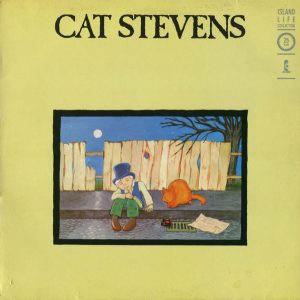
Lee Hulko Cut All the Best Sounding Cat Stevens Albums, Regardless of Label

Hot Stamper Pressings of the Music of Cat Stevens Available Now

UPDATE 2020

This commentary was written many years ago, circa 2005 I would guess.

Way back then, doing Hot Stamper shootouts was much more difficult than it is now. We didn’t have the right cleaning machine, and we hadn’t discovered the Prelude Record Cleaning System.


Is the Pink Label Island original pressing THE way to go? That’s what Harry Pearson — not to mention most audiophile record dealers — would have you believe.

But it’s just not true. And that’s good news for you, Dear (Record Loving Audiophile) Reader.

Hot Stamper Commentary for John Barleycorn

Since Barleycorn is a Lee Hulko cutting just like Tea here, the same insights, if you can call them that, apply.

Here’s what we wrote:

Lee Hulko, who cut all the Sterling originals, of which this is one, cut this record many times and most of them are wrong in some way. A very similar situation occurred with the early Cat Stevens stuff that he cut, like Tea & Teaser, where most copies don’t sound right but every once in a while you get a magical one.

Lee Hulko cut all the original versions of this album, on the same cutter, from the same tape, at the same time.

(more…)

Beware of Fooling Yourself with Pseudo Shootouts

Record Shootouts Are Tricky – Here Are Some of the Lessons We’ve Learned

We encourage any audiophile who wants to improve the quality of his record collection to start doing his own shootouts.

Freeing up an afternoon to sit down with a pile of cleaned copies of a favorite LP (you won’t make it through any other kind) and playing them one after another is by far the best way to learn about records and their mysterious pressing variations.

Be sure to take extensive notes.

Shootouts are a great deal of work if you do them right.

If you have just a few pressings on hand and don’t bother to clean them carefully, or follow rigorous testing protocols, that kind of shootout anyone can do. We would not consider that a real shootout.

Art Dudley illustrates this approach, but you could pick any reviewer you like — none of them have ever undertaken a shootout worthy of the name to our knowledge.

With only a few records to play – a woefully inadequate sample size — you probably won’t learn much of value and, worse, you are unlikely to find a top copy, although you may be tempted to convince yourself that you have.


Further Reading

Hot Stampers and Occam’s Razor

Skeptical Thinking Is Critical to Achieving Better Sound

This is an excerpt from a commentary I wrote many years ago in reply to a letter writer who thought our records were ridiculously overpriced. (The original letter is here.)

When people ask us how our records can possibly be worth the prices we charge, this is our answer.

As a skeptic, I require evidence to support what I believe in order to believe it. Although it’s certainly possible that our customers are willing to pay our admittedly high prices on nothing more than our say so, I see no evidence that this is the case.

Absent evidence to the contrary, I think they must really like our records.

They tell us so all the time, and they keep buying them week after week, so if they really are just fooling themselves, they apparently can’t stop doing it.

Occam’s Razor

The scientist’s and skeptic’s best friend, Occam’s razor, comes into play here. It holds that “the explanation of any phenomenon should make as few assumptions as possible.” It’s often paraphrased as “All other things being equal, the simplest solution is the best.” In other words, when multiple competing theories are equal in other respects, the principle recommends selecting the theory that introduces the fewest assumptions…”

Why assume people who buy expensive records are crazy? Why assume that the records they buy aren’t every bit as good as advertised, if not better? Why assume that the “other resources available for buying music” are even remotely as good, absent any evidence?

People assumed that the CD was going to be a cheap and easy source for their music, and look where that got them.

Assumptions? Us?

I could go on for days about assumptions. We try very hard to make as few as we have to around here. We bend over backwards to let the pressings speak for themselves. Most of the time when we’re doing our shootouts we have no idea what pressing is on the table. All we have to go on is the sound.

It may be relative — everything is — but people seem to be able to replicate our findings in their own homes pretty well. Well enough anyway. When they write to us, they really don’t sound all that crazy. In fact they seem fairly rational to us.

More than anything they seem to be enthusiastic about the great sound they’re finally hearing on a favorite album of theirs, courtesy of Better Records. After having played the records ourselves, we don’t think it’s the least bit crazy to believe them.

Some of the assumptions we really do take issue with are these:

(more…)

Letter of the Week “I have often found myself listening to things on your albums that I never imagined would be captured on vinyl!”

More of the Music of Sly & The Family Stone

Reviews and Commentaries for the Music of Ry Cooder

One of our good customers had this to say about some Hot Stampers he purchased recently:

Hey Tom, 

Please accept my apology. This email has been written in my head many times before now. However, life, and its many responsibilities have forced their own priority and delayed the composition of this message.

I have long been a skeptical person. My personality, and profession encourage skepticism. That skepticism was high when I first purchased a Ry Cooder album from you in 2014. Prior to that first purchase, I had been conducting research to discover what album pressings were likely to contain the best sound. I do not recall where I initially viewed your banner advertisement (possibly stevehoffman.tv, [not a chance!] or audiokarma.org? [maybe]).

Either way, I clicked on the ad for your site and noticed a Ry Cooder album that I have always loved, and I took a chance. Boy was I surprised!

Since then I have purchased many albums from you, and I have been extremely happy with nearly all of them (even 95% accuracy is rare in the physical word, and you have easily achieved accuracy beyond that point). I have often found myself listening to things on your albums that I never imagined would be captured on vinyl!

Just as a side note, I want to thank you for including Sly Stone (a personal favorite), and War in your catalog of albums. Most audiophiles are not focused on those genres, but they are missing some interesting music. Thank you for your excellence!

Justin

Justin,

No apology needed, thanks for joining in the Hot Stamper fun.

Ry Cooder is popular with many audiophiles, but Sly and the Family Stone and War? Not so much.

And both artists are personal favorites of mine.

We created a special section for artists who don’t get the respect from audiophiles that we think they deserve, and we named it Well Recorded Albums that Should Be More Popular with Audiophiles so that there can be no confusion as to what kinds of records are compiled within it: great sounding ones with excellent music.

(more…)