*Developing More Skepticism

Skeptical thinking is key to finding higher quality pressings.

What Lessons Can We Take from this Columbia Shootout?

Hot Stamper Pressings of Vintage Columbia Albums Available Now

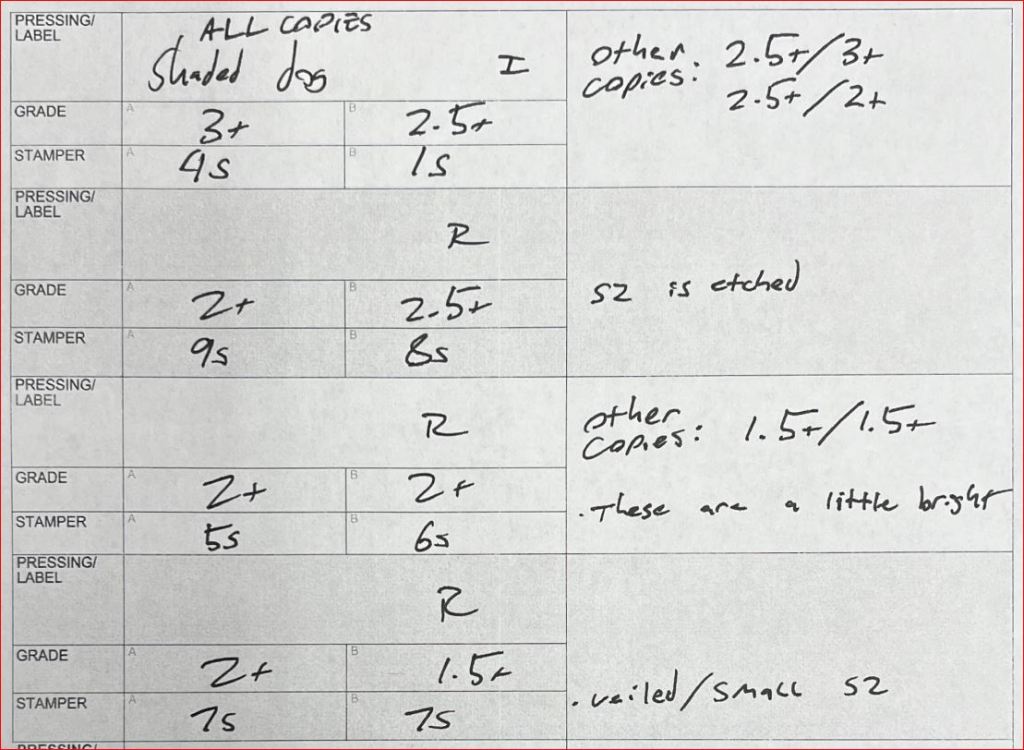
Recently we conducted a shootout for one of our favorite Columbia recordings, one that we had auditioned many times before and for which we knew the music and the general quality of the sound well.

It’s not the record you see pictured.

For now we’re keeping the title a mystery, consistent with the idea that we give out plenty of stamper information on this blog, including some of the worst ones we’ve had the misfortune to run into, but rarely do we feel the need to give out the really good ones. After decades of doing this kind of work, the time and effort that has gone into finding them is beyond calculation.

When we do give out the best stampers, as is the case here (3BA baby!), we make a point of keeping the title under wraps.

We are not the least bit interested in putting ourselves out of business.

The discussion for today revolves around the idea held by a great many audiophiles that the original White Print 360 label pressings are going to be the best sounding for any title that was made starting with that label in the early-60s.

(The Black Print 360 mono is an example of the mono labels being a bit behind the times as far as I can tell.)

Note that we did not bother to put any of the 70s Red Label Columbia pressings in the shootout. We’ve been down that road with this title before, and we have yet to hear one worth the vinyl wasted on it.

Columbia, like most labels, seems to have made very little effort with the sound quality of their reissues. Perhaps it was the result of all the bad transistor equipment in the studios by the time the 70s rolled around, but that would be speculation on my part, as well as something that would be very hard to find evidence for one way or the other.

We did find one Monk record that sounded better on the Red Label reissue, and readers of this blog should easily be able to find out which one it is by reading our many reviews for Monk’s recorded output.

We have two new lists for those who would like to know which Columbia labels win shootouts — one for 6-Eye winners and one for 360 Label winners.

What interests me in these findings is the following:

  • Both of our shootout winning copies had the same stampers. Can that really be a coincidence?
  • The shootout winner for side one is 3BA.
  • Two copies with stampers very similar to that one, 3AB, did noticeably worse, 2+ and 1.5+.
  • And the worst of the White Print 360 Label pressings barely earned a Hot Stamper grade at all.
  • They are on the same original label as the other copies, but for some reason they don’t sound as good. Why is that?

If an audiophile collector were to go to Discogs, find a nice clean copy on the early label and buy it, he might find that he know owns a top quality sounding copy, a pretty good sounding copy, or a not-nearly-as-good sounding copy as he’d hoped for, depending on his luck.

And what would he know about the quality of the recording? About that thing that audiophiles and record collectors seem to reference so often, “the master tape,” as if they have any way of knowing about the sound of a tape they have never come into contact with.

Just Assume

If he had a killer 3BA, wouldn’t he just assume that for some reason the recording must be amazing and consider himself lucky to find such a wonderful record to play.

Why one set of stampers sounds so much better than another set, or the same or a similar set on a different pressing, is a mystery, and it’s one that we confidently predict will never be solved.

Does anyone have a practical way to get around the reality that allows one set of stampers to sound great and the same or a similar set of stampers to sound no better than very good, if that?

Well, we can’t say there is a practical way, but we do know of an impractical one. We’ve been practicing and refining that one for more than twenty years.

We just play lots and lots of copies of the albums to find out how they sound.

(more…)

Labels, Patterns and Reasoning in a Circle

Hot Stamper Pressings of Orchestral Music Available Now

This commentary was written more than ten years ago. It seems to be holding up just fine though, especially considering just how bad some of the Heavy Vinyl pressings we’ve played recently sounded.


RFR1/ 2This pressing has DEMONSTRATION QUALITY SOUND.

Here is the sound that Mercury is famous for: immediate, dynamic and spacious. This record lives up to the Mercury claim: You immediately feel as though you are in the Living Presence of the orchestra.

This is precisely the kind of record that Speakers Corner would not have a clue how to master. I’d stake my reputation on it, for what that’s worth.

As you may know, I am a critic of the new [now long in the tooth] Speakers Corner Mercury series, and I can tell you without ever hearing their version of this recording that there is NO CHANCE IN THE WORLD they will ever cut a record that sounds like this.

It’s alive in a way that none of their pressings would even begin to suggest.

If you don’t believe me, please buy this record and play it for yourself. If you don’t agree, I will refund your money and pay the domestic shipping back.

This record also gives the lie to those who think that Vendor pressings are inferior. This is a Vendor and I would be surprised if there’s a better sounding copy than this one. I’ve certainly never heard one.

People who like to read labels and find some sort of pattern or connection between the label and the sound of the record are living in a world of their own making.

A world that exists solely in their heads.

The stamper numbers are the only thing that can possibly mean anything on a record, and even those are subject to so much variation from pressing to pressing that they become little more than a vague, general guide.

This LP is a good example of a record that a certain kind of record collector might pass up, hoping to find a better sounding non-Vendor pressing.

Of course, the circular reasoning that would result is that such a collector would buy the non-Vendor pressing, possibly with the exact same stamper numbers, hear how good it sounded, and congratulate himself on the fact that the non-Vendor pressings always sound so much better.

All without ever having done a comparison. A good way to never be wrong.

(more…)

Advice for Testing So-Called “Hot Stampers”

What Are Hot Stamper Pressings and How Can I Find My Own?

UPDATE 2025

You might find the comments at the end of this one interesting.


Contemplating trying a money-back-guaranteed Hot Stamper pressing? Our good customer ab_ba has some advice on one of the best ways to go about it. He writes:

Pick out a Hot Stamper on the better-records site. (Choose something you know well, that you already have a few copies of. Pick a Super Hot Stamper, so it’s not absurdly expensive.)

First, see how it compares to your other copies. If it’s not as good, send it back, full refund, no questions asked.

Next, look at the matrix number on the Hot Stamper, and buy three copies on discogs in NM or VG+ condition with the same matrix. Or, go hunt around your local shop for same.

Then, once you get them, clean them to the best of your ability and then do another shootout. Just do it quick – you’ve got 29 days.

If you prefer one to your Hot Stamper, send back the Hot Stamper. No questions asked, and thank Tom for the matrix number.

I’ve done this a couple of times, and every time, I’ve kept the Hot Stamper. Wasted my time and money is all I did. That, and convinced myself Tom’s records are worth what he charges, in that I can’t get records that sound that good for less money.

Dear ab_ba,

Good advice, let’s hope some audiophiles take it. They might just find the world of better sound that’s waiting for them the way you did.

And if not, then they get their money back, no harm, no foul.

Thanks for writing,

TP

(more…)

Neil Young and the Limits of Expert Advice

Hot Stamper Pressings of the Music of Neil Young Available Now

Richard Feynman gave a series of lectures concerning the workings of the scientific method. Here is an excerpt from one of them that I would like you to keep in mind as you read the discussion that follows. [Bolding added by me.]


Now I’m going to discuss how we would look for a new law. In general, we look for a new law by the following process. First, we guess it (audience laughter), no, don’t laugh, that’s the truth. Then we compute the consequences of the guess, to see what, if this is right, if this law we guess is right, to see what it would imply and then we compare the computation results to nature or we say compare to experiment or experience, compare it directly with observations to see if it works.

If it disagrees with experiment, it’s wrong. In that simple statement is the key to science.

It doesn’t make any difference how beautiful your guess is, it doesn’t matter how smart you are who made the guess, or what his name is … If it disagrees with experiment, it’s wrong. That’s all there is to it.


Back in 2015, a mastering engineer by the name of Phil Brown contacted me in reference to a Hot Stamper pressing of Neil Young’s  Zuma he had seen in our mailer. (Apologies in advance for not giving out the stamper numbers; we tend to frown on that sort of thing around here.) He wrote:

  Hey Tom,   

I see it’s a featured disc in the newsletter. I’m curious what the matrix numbers are since I mastered it.

I replied as follows.

Phil, you did a great job, we love the sound of Zuma!

The top copy has sold so we don’t know the numbers, but the next best copy is 1[redacted], 1[redacted]. For side one we have also liked 1[redacted] in the past, and we had a 1[redacted] side.

Of course, all these numbers are just as likely to sound bad, or mediocre, as to sound good. We buy any clean Zuma original we can find and let the sonic chips fall where they may. Anyway, once again, good job!

He then offered this:

I can explain the numbering system for you if you like.

[Three numbers and letters, redacted] are from the original run of lacquers and [redacted] would have been from the first recuts so I did those as well.

I replied:

Sure, would love to learn more.

He continued:

Well, what would you like to know? For instance, Zuma was pressed by Columbia. Dash numbers 1A and 1B were pressed at Pitman, F was pressed at Santa Maria, the best plant CBS had at the time. C and D would have been pressed at Terre Haute. H would be a recut and could go anywhere. I worked for CBS and Warners and know all about those companies.

My point is that the only masters that you can be sure were cut from the original master is the first run of lacquers. And in my opinion, and I started cutting in 1971, only masters cut from the original tape, not a copy as is common with recuts, are worth listening to.

This is where I take issue with him on how helpful the information he provided may or may not be.

Phil, interesting stuff but probably not of much use to us in our work. Any of those stampers can sound good or bad and we have to play them all to know which are which so the pressing plants are not really much of a concern, unless of course one plant were to be exceptionally good or bad, and we have not found that to be the case.

Thanks for writing.

He replied:

How can you tell if you don’t know the matrix numbering systems and how they worked? At any rate, I’m not a customer so it doesn’t really matter and your model of selling records that you’ve verified sound good works.

I countered:

Phil, point well taken, but we don’t sell copies made from dubs, there are plenty of good originals around.

Then added:

Phil, there is no way to know whether a record is any good without playing it, early stamper, late stamper or any other stamper. First pressings (A, 1A, A1) don’t always win shootouts. If they did we would simply buy only those stampers.

(more…)

Acoustic Sounds Was Selling This Ridiculously Bad “TAS List” Record Back in the Day

Hot Stamper Pressings of the Music of Cat Stevens Available Now

This commentary was written circa 2001. 

I remember 15 years ago when Acoustic Sounds was selling the then in-print 25th Anniversary Island pressing (with 7U stampers as I recall) for $15, claiming that it was a TAS List record. If you’ve ever heard the pressing, you know it has no business going anywhere near a Super Disc List. It’s mediocre at best and has virtually none of the magic of the good originals.

NEWSFLASH: Just looked it up on Discogs, a site that did not exist when I wrote this commentary. My memory is apparently better than I thought it was. The 25th Anniversary Island Life Collection pressing came out in 1986.

    • Matrix / Runout (Runout side A, variant 1): ILPM 9154 A-1 ILPM•9154•A1
    • Matrix / Runout (Runout side B, variant 1): ILPM 9154 B-7U-1-1-3
    • Matrix / Runout (Runout side A, variant 2): ILPM 9154 A-8U-1- G10
    • Matrix / Runout (Runout side B, variant 2): ILPM 9154 B-7U-1-

By the way, I am not aware of any of these pressings from the 80s being especially good sounding. I remember playing some of them but I don’t remember liking any of them. They were cheap reissues that satisfied those looking for import vinyl, not audiophile quality sound.

I refused to sell it back in those days, for no other reason than the fact that it’s far from a Better Sounding Record. I don’t like misrepresenting records and I don’t like ripping off my customers. It’s bad for business.

That pressing was a fraud and I was having none of it.

Chad probably didn’t even know the difference.

When you don’t know much about records, you can say all sorts of things and not get called out for them. Audiophiles are a credulous bunch and always have been. They still believe the same nonsense that I foolishly fell for back in the 80s. (And I admit that even as late as 2006 I was still a fan of certain Heavy Vinyl pressings.)

(more…)

Cognitive Dissonance Defined

More Basic Concepts and Realities Explained 

Wikipedia’s entry for cognitive dissonance:

Cognitive dissonance is a psychological term describing the uncomfortable tension that may result from having two conflicting thoughts (cognition) at the same time or engaging in behavior that conflicts with one’s beliefs. In simple terms, it can be the filtering of information that conflicts with what one already believes, in an effort to ignore that information and reinforce one’s beliefs. In detailed terms, it is the perception of incompatibility between two cognitions, where “cognition” is defined as any element of knowledge, including attitude, emotion, belief, or behavior.

The theory of cognitive dissonance states that contradicting cognitions serve as a driving force that compels the mind to acquire or invent new thoughts or beliefs, or to modify existing beliefs, so as to reduce the amount of dissonance (conflict) between cognitions. Experiments have attempted to quantify this hypothetical drive. Some of these have examined how beliefs often change to match behavior when beliefs and behavior are in conflict.

In popular usage, it can be associated with the tendency for people to resist information that they don’t want to think about, because if they did it would create cognitive dissonance, and perhaps require them to act in ways that depart from their comfortable habits. They usually have at least partial awareness of the information, without having moved to full acceptance of it, and are thus in a state of denial about it.

This guy was comfortable with his penchant for Mobile Fidelity pressings, a sad story if ever I’ve heard one, but one we can all learn from. (And I have to admit I was every bit as clueless myself back in the my nascent audiophile days.)

Empiricism

Some approaches to this audio hobby tend to produce better results than others. When your thinking about audio and records does not comport with reality, you are much less likely to achieve the improvements you seek.

Without a good stereo, it is hard to find better records. Without better records, it is hard to improve your stereo.

You need both, and thinking about them the right way, using the results of carefully run experiments — not feelings, opinions, theories, received wisdom or dogma — is surely the best way to acquire better sound.

An empirically-based approach to audio will surely result in notable improvements to the quality of your playback.

This will in turn make the job of recognizing high quality pressings — the ones you find for yourself, or the ones we find for you — much, much easier.

(more…)

Are You an Audiophile Soldier or an Audiophile Scout?

More Entries from Tom’s Audiophile Notebook

The guy you see pictured to the left has spent much of the last forty years wandering around used record stores looking for better records. Before that he wandered around stores selling new records because he didn’t know how much better used records could be.

Here are some of the things he’s learned since he started collecting at the age of ten a mere sixty years ago. (First purchase: She Loves You on 45, still in the collection, although it cracked long ago and is no longer playable.) 

Click on the picture to make it easier to read.

As you may have read on the site elsewhere, the three most important words in the world of audio are compared to what?

No matter how good a particular copy of a record may sound to you, when you clean and play enough of them you will almost always find one that’s better, and often surprisingly better.

You must keep testing all the reissues you can find, and you must keep testing all the originals you can find.

Shootouts are the only way to find these kinds of very special records. That’s why you must do them.

Nothing else works. If you’re not doing shootouts (or buying the winners of shootouts from us), you simply don’t have top quality copies in your collection, except in the rare instances in which you just got lucky.

In the world of records luck can only take you so far. The rest of the journey requires effort.

(more…)

Should We Follow George Martin’s Expert Advice?

Hot Stamper Pressings of the Music of The Beatles Available Now

Scroll down to the bottom and click on the lighter text for “2 Comments” to read someone’s defense of the mono mixes, followed by our reply.


One of our good customers had this to say about the new Revolver pressing and The Beatles in mono:

Hey Tom,

I think the Revolver new thing doesn’t sound terrible. It’s just what you’re comparing it with. Most people are going off original pressings maybe and the acclaimed mono and stereo box stuff that came out in the last 10 years. IF you don’t try one of those Harry Moss records or a 1970s pressing, you probably think the new Revolver is fine or even good. That’s my theory. Who knows.

And as far as mono vs. stereo… you know the answer to this but I’m not sure. Were those earliest records meant to be mono or recorded as if they would be put out as mono and later records – maybe Rubber Soul on – meant to be stereo? I don’t know the answer to that. But maybe that’s why people are so loyal to mono. They feel like “this is how it was meant to be heard by the artist.”

George Martin was very clear about that, the first two albums for sure and really, the first four are, for him, better heard in mono than stereo.

Dear Sir,

I disagree. I think George heard the playback on studio monitors stuck on a wall five feet from his head.

Who cares what that sounds like?

Nobody who isn’t mixing a record would ever listen to music that way, certainly not in this day and age.

More importantly, who are you going to believe, your lying ears or George Martin?

This is fundamental to understanding everything to do with audio and records.

Richard Feynman summed it up beautifully:

Science is the belief in the ignorance of experts.

Watch the Let It Be documentary produced by Peter Jackson, especially the last part where they play the album back for everyone who was involved in the making of it.

With four crappy monitor speakers lined up left to right and shoved up against a wall.

This is how they listened to the album in order to approve Glyn Johns’ mix and the takes he chose to use?

(more…)

I Knew This Guy Was Full of Sh*t, But I Had to Be Sure

Skeptical Thinking Is Critical to Achieving Better Sound

Recently a fellow named Jared tried to correct our assertion that Rod Stewart’s early albums from the US are made from dubbed tapes, as is our contention.

Here is his letter:

Hey there. Just wanted to point out some errors on your listing for Rod Stewart’s “An Old Raincoat…” LP. The UK pressings are the ones made from dupes.

The first generation masters for all of Rod’s Mercury albums are in the US. All vinyl vintage pressings, UK or US, are made from EQ dupes.

The original US Polygram CDs mastered by Dennis Drake are straight off the original masters.
Thanks!

Naturally this information took us by surprise. We replied:

Jared,

Can you refer me to the source of your information?

Thanks,

TP

There was no answer to my query. Nor was I able to find any source for this information.

I hadn’t played a domestic copy of The Rod Stewart album, the title Old Raincoat was released under in the states, in at least twenty years, probably more like thirty. It had sure sounded dubby to me back then. I stopped buying them a long time ago.

Was I remembering the sound right? The odds were very high that I was, but I had to know for sure, even though I had no idea who Jared was or where his information came from.

I asked my main man Fred to get one in and give it a listen. Here is his report:

We played The Rod Stewart Album (domestic Old Raincoat) we got in and it sounds absolutely terrible. Super spitty and bright.

Are they all this bad? Who can say?

Could my UK pressing be made from copy tapes?

I suppose it’s possible. It doesn’t sound dubby to me, but it is not an especially good sounding record, unlike Rod’s third album, which is about as good sounding a rock record as is possible to make. (In the case of Every Picture, it’s the imports that are made from dubs. Go figure.)

Maybe Dennis Drake actually did get hold of the real master tapes when making his CD. He is a very talented engineer; I have many compact discs mastered by him and I don’t know of any that aren’t at least good sounding. For those of you who play CDs, you are free to give his version of An Old Raincost a try. Please let me know what you hear.

What’s that Smell?

But the reason Jared letter is being published is that it reeks of information that has not been verified by anyone’s ears. Certainly not Jared’s.

If, like Jared, you read something that sounds plausible, that you think might be true, why would you be so willing to believe it without any real evidence to back it up?

Even worse, the comments Jared makes weren’t even prefaced with “I’ve read that…” or “People seem to agree that…” No, Jared leaves no room for doubt. The information is presented as true.

Can anyone who has played both versions of Old Raincoat not hear how much better the UK pressing is?

We couldn’t. Nothing could have been more obvious to us than that one version is made from good tapes and one version is made from bad tapes.

(more…)

Arrogant and Elitist Skeptics – They’re the Worst!

Our Thoughts on Tubes in Audio

Below you will find a link to a reasonably fair and balanced look at the battle between transistors and tubes from Brian Dunning’s skeptoid website, worthwhile reading for those of us who favor a skeptical approach to life (and especially this hobby).

Thirty plus years ago, when I started my little record business, I knew that most records marketed to audiophiles offered junk sound (half-speed masters, Japanese pressings) or junk music (direct to discs by artists nobody ever heard of).

As our playback has improved, fewer and fewer of these “specialty” pressings have survived the test of time, a subject we write about endlessly on our site and here on this blog.

For the longest time our motto has been “Records for Audiophiles, Not Audiophile Records,” and we see no reason to change it.  If anything, the modern manufacturers of Heavy Vinyl pressings are making records that get worse sounding by the day. Many of the most egregious offenders can be found here.

More commentaries about Heavy Vinyl can be found here. We are not fans of the stuff, not because it’s our competition, but because it just doesn’t sound very good.

Here is the article.

I confess I sped through it quickly, barely skimming it, because I have heard plenty on the subject of  tubes versus transistors, most of it, in my opinion, misguided if I’m being honest.

This is my fifth decade in audio and I know where I stand on the subject. I offer it to those who might be interested in a less conventional view.

(more…)