Testing Midrange Tonality

The records linked here are good for testing midrange tonality.

Who Knew that Dylan Could Sound This Good in 1983?

Hot Stamper Pressings of the Music of Bob Dylan Available Now

This vintage copy of Infidels could not be beat. Big and rich, with correct tonality from top to bottom, strong bass and plenty of space, this copy sounded just right to us.

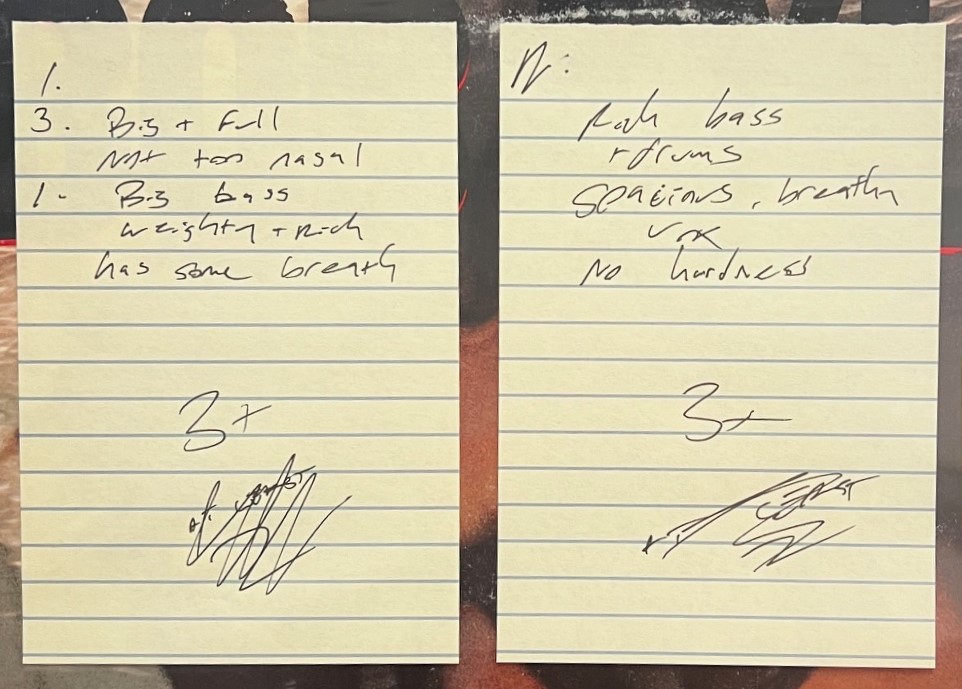
Our post-it notes tell the album’s story. (By the way, if you like reading our post-it notes, we’re putting more and more of them on the blog these days. We talk about the importance of taking notes  as part of the shootout advice we share. This post will help you with the basics.)

Side One

Track Three

    • Big and full
    • Not too nasal

Track One

    • Big bass
    • Weighty and rich
    • Has some breath

Side Two

Track One

    • Rich bass and drums
    • Spacious breathy vocals
    • No hardness

What We Learned

What do these notes have to tell us, other than this is a much better recording than it’s given credit for?

On side one, the vocals have a tendency to get nasally, sounding like Dylan is singing through his nose, not his mouth, a common problem with Dylan records from every era.

Also. when we say “has some breath, ” that basically means that most pressings on side one are not especially breathy in the mids, but this one is better in that department.

Not that the original grade was “at least 2,” and after going through all the copies, it turned out nothing could be beat this one. Some breath was probably more breath than any other side one we played.

On side two, the sound had “no hardness, ” and again, that simply means plenty of copies, maybe all the other copies, suffered from hardness in the vocals. “At least 2” turned into our Shootout Winner when no other copy could beat it.

Who Knew?

Has any other audiohile reviewer ever said a kind word about this album, other than us of course?

Not that I know of.

And we’re as guilty as any of them in assuming that 1983 was not a good year to be recording Dylan and expecting audiophile quality sound.

But we were proven wrong once again, by the only method that can possibly be relied upon to supply the truth: experimentation.

(more…)

A Fun and Easy Test for Abbey Road: MoFi Versus Apple

More of the Music of The Beatles

There is a relatively simple test you can use to find out if you have a good Mobile Fidelity pressing of Abbey Road. Yes, as shocking as it may seem, they actually do exist, we’ve played them, but they are few and far between (and never as good as the best Brits).

The test involves doing a little shootout of the song Golden Slumbers between whatever MoFi pressing you have and whatever British Parlophone pressing you have. If you don’t have both LPs, this shootout will be difficult to do.

The idea is to compare aspects of the sound of both pressings head to head, which should shed light on which one of them is more natural and which is more hi-fi-ish sounding.

The Golden Slumbers Test

I’ve come to realize that this is a Key Track for side two, because what it shows you is whether the midrange of your pressing — or your system — is correct.

At the beginning Paul’s voice is naked, front and center, before the strings come in.

Most Mobile Fidelity pressings, as good as they may be in other areas, are not tonally correct in the middle of the midrange.

The middle of the voice is a little sucked out and the top of the voice is a little boosted.

It’s really hard to notice this fact unless one plays a good British pressing side by side with the MoFi.

Then the typical MoFi EQ anomaly become obvious. It may add some texture to the strings, but the song is not about the strings.

Having heard a number of audiophile systems (especially recently) that have trouble getting this part of the spectrum right, it would not be surprising that many of you do not find the typical MoFi objectionable, and may even prefer it to the good British copies. The point I’m belaboring here is that when it’s right, it’s RIGHT and everything else becomes more obviously wrong, even if only slightly wrong.

The Heart of the Midrange

For a while in my record reviewing system many years ago I had a relatively cheap Grado moving magnet cartridge. The midrange of that cartridge is still some of the best midrange reproduction I have ever heard. It was completely free of any “audiophile” sound. It was real in a way that took me by surprise. I played Abbey Road with that cartridge in the system and heard The Beatles sound EXACTLY the way I wanted them to sound.

(more…)

Something Phony This Way Comes

Here’s what we learned from a shootout many years ago.

Some copies sounded like they were Half-Speed mastered by Mobile Fidelity.

(This is not a compliment. We hate that label’s phony sound and we don’t know why so many audiophiles would want to put up with the colorations MFSL’s records were notorious for.)

  • They had a little something phony added to the top of Linda’s voice.
  • They had a little bit of suckout right in the middle of the midrange, the middle of her voice, and
  • They had a somewhat diffuse, vague quality, with sound that lacked the solidity we heard on the best pressings.

These hi-fi-ish qualities that we heard on so many copies reminded us of the kind of audiophile sound we decry at every turn. We’ve played literally hundreds and hundreds of MoFi’s and other Half-Speed mastered records over the course of the last forty plus years, and one thing we know well is what they sound like.

But think about it. What if you only had one copy of the album — why would you have more than one anyway? — and it had that Half-Speed sound?

You would simply accept that the recording obviously had those qualities. (This assumes you could be expected to recognize them in the first place.)

Let’s face it, most audiophiles can’t, or all these companies would have gone out of business and stayed out of business, and their out of print records would sell for peanuts, not the collector prices they bring on ebay and audiophile web sites.

(more…)

What to Listen for on Time Further Out

Hot Stamper Pressings of the Music of Dave Brubeck Available Now

The best copies demonstrate the big-as-life Fred Plaut Columbia sound at its best (even better than Time Out in our opinion).

These vintage recordings are full-bodied, spacious, three-dimensional, rich, sweet and warm in the best tradition of an All Tube Analog recording.

If you want to hear big drums in a big room, these Brubeck recordings will show you that sound better than practically any records we know of. 

The one standout track on this album for audiophiles is surely Unsquare Dance, with its uncannily real sounding handclaps in 7/4. The copies that did the best job of reproducing that “flesh on flesh” sound of actual human hands clapping scored very well in our shootout.

More to Listen For

For starters, listen for a fat snare and rich piano on the first track of side one. When you hear that, assuming you do, you should know you are in for a treat. Our best copies captured those two sounds brilliantly.

On the second track the clarity of the brushed snare is key to how resolving and transparent any copy is. The rich, smooth sound of Desmond’s sax balanced against the clarity of the brushes will help you make sure that the overall sound is tonally correct from top to bottom.

On side two the first track has the Wall to Wall Big Drums in a Big Room sound that positively blows our minds. If you’re a fan of  with jump out of the speakers sound, this is the album for you.

Note that in some places it sounds like the piano is overdriving its mic. We heard that sound on practically every copy we played, so we’re pretty sure it’s on the tape that way.

(more…)

Donny Hathaway Lives On Through His Masterful Live Album from 1972

More of the Music of Donny Hathaway

Hot Stamper Pressings of Soul, Blues and R&B Albums Available Now

This live recording has YOU ARE THERE sound. The soundstage is wide and deep. It’s so natural, rich and transparent, what is there to fault? 

Within moments of the needle hitting the groove your speakers disappear and the music just flows into the room.

On the best original domestic pressings you can immediately understand and appreciate the honest, emotive quality of his singing that made Donny Hathaway the tremendous performer he was known to be.

I’ve been playing this record regularly since I first heard it back in the mid-’90s and even after twenty years it has never failed to thrill. If I could take only one soul album to my desert island, it would be this one, no doubt about it.

Listening Test — Don’t Be Fooled

Pay close attention to the audience chatter and clapping. Most copies, being compressed and veiled, have no hope of reproducing the handclaps and audience shout-outs correctly. Only those copies with transparency and presence let you “see” the crowd clearly.

But don’t be fooled by thinner, leaner sounding copies. There is tons of low end and lower midrange in this recording — it’s one of its prime strengths, and it’s what it would have sounded like if you were there — so make sure you have plenty going on in the lower frequencies before you start evaluating the audience participation.

Many audiophile recordings and remasterings are leaner and cleaner, producing a phony kind of transparency and detail at the expense of the fullness and richness of the original recording.

This is almost never a good thing.

Listening Test — Conga Energy

The copies where the congas are up-front, punchy and full-bodied were the ones where the rhythmic energy really carried the day. You know it when you hear it, that’s for sure. Most copies failed in this regard to some degree. If you have more than one copy, see if you don’t hear quite a bit more energy on the copies with more prominent, solid-sounding congas.

Congas, like drums and pianos, are good for testing specific pressings as well as stereo equipment.

If these instruments get lost in the mix, or sound smeary or thin, it’s usually fairly easy to hear those problems if you are listening for them. Most of what you will read on this blog is dedicated to helping you do that kind of listening.

The richness of analog is where much of its appeal lies. Lean drums, congas and pianos are what you more often than not get with CDs.

These three instruments are also exceptionally good for helping you to choose what kind of speakers to buy. (We recommend big ones with dynamic drivers.)

(more…)

The Up-Front Vocals on Bringing It All Back Home Can Be a Bit Much

Hot Stamper Pressings of the Music of Bob Dylan Available Now

It’s hard to find copies of this album that give you the tubey richness and warmth that this music needs to sound its best. We’ve done this shootout a number of times over the years, but I can count the number of Hot Stamper copies that have hit the site on one hand.

A lot of copies seem to be EQ’d to put the vocals way up front, an approach that makes the voice hard and edgy. Copies like that sound impressive at first blush (“Wow, he’s really IN THE ROOM!”) but get fatiguing after a few minutes. When you get a copy that’s smooth, relaxed and natural, the music sounds so good that you may never want it to stop.

Our Hot Stamper Pressings from Years Ago

Side one is lively and present with a punchy bottom end and real depth to the soundfield. It’s also open and transparent with lots of natural ambience. Compared to the A+++ side two here, there’s a touch of grit and grain at times, but dramatically less than you get on most copies. We rated side one A++, which means you get excellent sound for Subterranean Homesick Blues, Maggie’s Farm, She Belongs To Me and a few more classic Dylan tracks.

Side two was UNSTOPPABLE — it was clearly As Good As It Gets based on years of listening and scores of copies auditioned over the years. Everything sounds right — the vocals and guitar sound wonderfully natural and correct with superb clarity and lots of richness and warmth. 

(more…)

Two Minutes that Shook My World – “But I Might Die Tonight”

After building our new studio a few years ago, we soon found out we had a whole host of problems.

We needed to work on electrical issues. We needed to work on our room treatments. We needed to work on speaker placement.

We initially thought the room was doing everything right, because our Go To setup disc, Bob and Ray, sounded super spacious and clear, bigger and more lively than we’d ever heard it. That’s what a 12 foot high ceiling can do for a large group of musicians playing live in a huge studio, in 1959, on an All Tube Chain Living Stereo recording. The sound just soared.

But Cat Stevens wasn’t sounding right, and if Cat Stevens isn’t sounding right, we knew we had a huge problem.

Some stereos play some kinds of records well and others not so well. Our stereo has to play every kind of record well because we sell every kind of record there is. You name the kind of music, we probably sell it.

And if we offer it for sale, we had to have played it and liked the sound, because no record makes it to our site without being auditioned and found to have excellent sound.

But I Might Die Tonight

The one song we played over and over again, easily a hundred times or more, was But I Might Die Tonight, the leadoff track for side two. It’s short, less than two minutes long, but a lot happens in those two minutes. More importantly, getting everything that happens in those two minutes to sound not just right, but as good as you have ever heard it, turned out to be a tall order indeed.

I could write for days about what to listen for in the song, but for now let me just point the reader to one of the most difficult parts to reproduce.

At about 50 seconds into the track, Cat repeats the first verse:

I don’t want to work away
Doing just what they all say
Work hard boy and you’ll find
One day you’ll have a job like mine, job like mine, a job like mine

Only this time he now has a multi-tracked harmony vocal singing along with him, his own of course, and he himself is also singing the lead part louder and more passionately. Getting the regular vocal, call it the “lower part,” to be in balance with the multi-tracked backing vocal, call it the “higher part,” turned out to be the key to getting the bottom, middle and top of the midrange right.

When doing this kind of critical listening we play our records very loud. Live Performance level loud. As loud as Cat could sing, that’s how loud it should be when he is singing his loudest toward the end of the song for the final “But I might die tonight!” If he is going to sing loudly, I want my stereo to be able to reproduce him singing as loud as he is actually singing on the record.

No compression.

No distortion.

All the energy.

Yes, that’s the way I want to hear it!

The last fifteen seconds or so of the song has the pianist (Cat himself) banging out some heavy chords on the piano. If you have your levels right it should sound like there is a real piano at the back of the room and that someone is really banging on it, a powerful coda perfectly fitting for such an emotionally stirring song.

(more…)

The Long Run – The True Test for Side One

Hot Stamper Pressings of the Music of The Eagles Available Now

Want to know if you have a good side one on your copy? Here’s an easy test.

Timothy B. Schmit’s vocal on I Can’t Tell You Why rarely sounds right.

Most of the time he’s muffled, pretty far back in the soundstage, and the booth he’s in has practically no ambience.

On the good copies, he’s not exactly jumping out of the speakers, but he’s clear, focused, and his voice is breathy and full of emotional subtleties that make the song the heartbreaking powerhouse it is.

This is why you need a Hot Stamper. Most copies don’t let you FEEL the song.

And the rest of the band is cookin’ here as well. From the big, full-bodied bass to the fat, punchy snare, the best sides are doing practically everything we want them to.

You’re Gonna Get it – Spitty and Gritty? Too Lean and Clean?

More of the Music of Tom Petty

Notes from an early shootout. Scroll down to the bottom for our advice on what to look for when buying a copy of the album.

Big and punchy with great energy, this copy really rocks.

And rockin’ is what this album is all about — this is fun, high-energy music, but it takes a Hot Stamper copy like this to bring it life.

This is the classic first album, with two of their best songs: Breakdown and American Girl. It’s straight ahead rock and roll, with sonics to match.

The sound is a little spitty and transistory as a rule. But when you find a copy with Hot Stampers, the elements start to work together, and the good far outweighs the bad. If somebody tried to EQ this album differently, they’d probably end up taking away some of the Raw Rock Energy.

(By the way, American Girl never sounds all that great. That song needs more whomp! No copy had quite what we were looking on that song, but the Hot Stamper copies were at very least lively, musical, and not overly transistory.)

Breakdown is KILLER!

I mentioned above that Breakdown is one of the best songs on the album; fortunately, it’s also probably the best sounding song. On this great side one, it’s rich and full-bodied with real energy and presence. The overall sound is open and transparent, with more depth to the soundfield than we heard elsewhere. We were surprised how much these guys could sound like Steely Dan — just listen to the intro!

On many copies we played, Petty’s vocals were a bit lean for our tastes, and the guitars were a bit too clean — both of those elements really robbed the music of its power. Here, the voice is fuller, and you can really hear the meaty texture to the electric guitar; you can tell these guys were really rockin’ out! We didn’t hear sound this lively on any other side one we played, which made this our shootout champion at A+++.

(more…)

Lincoln Mayorga Volume 3 – Listen for Strained and Blary Brass

Hot Stamper Pressings of Direct-to-Disc Recordings Available Now

Most copies of this album are slightly thin and slightly bright.

They give the impression of being clear and clean, but some of the louder brass passages start to get strained and blary, or glary if you like.

The good copies are rich and full.  The sound is balanced from top to bottom.

The sound is smooth, which allows you to play the album all the way through at good loud levels without fatigue.

On the best pressings, the trumpets, trombones, tubas, tambourines, and drums all have the true tonality and the vibrancy of the real thing. The reason this record was such a big hit in its day is because the recording engineers were able to capture that sound better than anybody else around [not really, but that’s what it seemed like at the time].

That’s also the reason this is a Must Own record today — the sound and the music hold up.

Just listen to that amazing brass choir on Oh Lord, I’m On My Way. It just doesn’t get any better than that. If ever there was a Demo Disc for Brass, this is one!

I used to think the Tower label copies were not as good — that the later pressings were pressed better. Now I know that it doesn’t matter what era the pressing is from: the tonal balance is the key to the best sound.

(more…)