*Record Breakthroughs

Powerful People on MoFi – What Was I Thinking?

More Entries in the Mobile Fidelity Hall of Shame

UPDATE 2024:

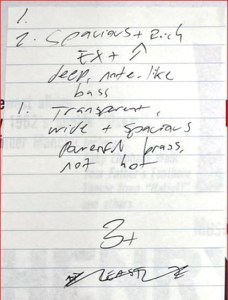
I just found my old review notes from 2014! They can be seen below. Please to enjoy.

At the time of our last shootout in 2014, I still had the MoFi pressing of Powerful People in my personal, very small (at that point) record collection.

Almost all the best sounding records from my collection had been sold off long before, going to good homes that I can only assume would play them more than I had in the last ten years.

If it’s a record you see on our site, chances are good I’d have listened to it until I’d practically turned blue in the face.

But I had kept my Powerful People Half-Speed these 30+ years because the domestic pressings I’d played were just too damn midrangy to enjoy.

At least the MoFi had bass, top end and didn’t sound squawky or hard on the vocals.

Well, let me tell you, played against the best domestic pressings, the MoFi is laughable. (In that respect it shares much with the current crop of audiophile reissues.)

It’s unbelievably compressed, a problem that is easily heard on the biggest, most exciting parts of the tracks. They never get remotely as big or as loud on the MoFi as they do on the lowly A&M originals.

It’s also sucked out in the midrange, like most MoFis, and, like most MoFis and Half-Speeds in general, the bass is not well-defined, punchy, and it never goes very deep.

There is also the issue of the MoFi 10k boost on the top end — it’s clearly audible and as bothersome as ever.

In summation, like most of the better audiophile records — from long ago as well as those being produced today — the most you can hope for from these reissues is that they can fix a few problems you might be saddled with on the particular pressing you own.

(more…)

Years Ago We Badly Misjudged the Recording Quality of Tull’s Debut

Hot Stamper Pressings of the Music of Jethro Tull Available Now

A clear case of live and learn.

We listed a White Hot copy of This Was in 2008 on the Island pink label and noted at the time:

Be forewarned: this ain’t Stand Up or Aqualung. I don’t think you’ll be using any copy of This Was to demo your stereo, because the recording has its share of problems. That said, this record sounds wonderful from start to finish and will make any fan of this music a VERY happy person. We guarantee you’ve never heard this album sound better, or your money back.

Now we know a couple of things that we didn’t back in 2008.

1). This album is a lot better sounding than we gave it credit for years ago. It’s not perfect by any means but it is much better than the above comments might lead you to believe.

We chanced upon an exceptional sounding copy of the album in 2017 or so, and that taught us something new about the record:

2). The Pink Label pressings are not the best way to go on this album.

Once we heard the exceptional copy alluded to above, we played it against our best Pink Label copies and it was simply no contest.

In 2008 we still had a lot to learn. We needed to do more research and development, which of course we are doing regularly with Classic Rock records, our bread and butter and the heart of our business.

We do them as often as is practical, considering how difficult it is to find copies with audiophile quality playing surfaces.

Nine years later, we felt we finally had a proper understanding on the various pressings of This Was. It goes like this:

The Pink Label original British pressings can be good, but they will never win a shootout up against copies with these stampers (assuming you have more than one copy — any record can have the right stampers and the wrong sound, we hear it all the time. Beware of small sample sizes).

(more…)

Waiting For Columbus – We Broke Through in 2017

Hot Stamper Pressings of the Music of Little Feat Available Now

Way back in 2009 we had this to say about a Hot Stamper pressing we listed:

This German import pressing of Waiting for Columbus is much better sounding than the typical Mastering Lab-mastered copy.

This German pressing is similar to one that came from my own personal collection, accidentally discovered way back in the early ’80s as I recall. It KILLED my domestic original, and got some things right that even my treasured Mobile Fidelity pressing couldn’t. We have been meaning to do a shootout for this album for at least the last five years, but kept running into the fact that in a head to head shootout the right MoFi pressing — sloppy bass and all — was hard to beat.

This is no longer the case, courtesy of that same old laundry list you have no doubt seen on the site countless times: better equipment, tweaks, record cleaning, room treatments, et cetera, et cetera. Now the shortcomings of the MoFi are clear for all to see, and the strengths of the best non-Half-Speed mastered pressings are too, which simply means that playing the MoFi now is an excruciating experience.

All I can hear is what it does wrong.

I was so much happier with it when I didn’t know better.

That same laundry list of improvements continued to pay big dividends, and right around 2017 or so the best original domestic Mastering Lab copies started to sound much more right to us than the German ones. 

The German pressings can be good, but the TML pressings are the only ones we would expect to win shootouts from now on.

But who knows? We might find something even better down the road. That’s what shootouts are for. (more…)

Discovering Reversed Polarity on Music for Bang, Baaroom and Harp Was a Breakthrough

schorymusic

Percussion Recordings with Hot Stampers Available Now

Music for Bang Baaroom and Harp is yet another one of the pressings we’ve discovered with reversed polarity on some copies. This happened many years ago, and as you can see from the commentary we wrote back then, it came as quite a shock to us at the time.

Are audiophile reviewers or audiophiles in general listening critically to records like this?

I wonder; I could not find word one about any polarity issues with this title, and yet we’ve played four or five copies with reversed polarity on side two. How come nobody is hearing it, apart from us?

We leave you, dear reader, to answer that question for yourself.

This listing has the latest information on the stamper numbers to avoid.

More stamper and pressing information can be found here.

(more…)

Side One Is Actually In Phase (Usually) and You Read It Here First (Probably)

Hot Stamper Pressings of Direct-to-Disc Recordings Available Now

This is a well recorded jazz album that should be able to find a home in any audiophile’s jazz collection.

It is also one of the pressings we’ve discovered with reversed polarity

According to the liner notes, this Dave Grusin album has reversed absolute phase. They tell you to switch the positive and negative at the speaker for the best transient response and spatial clarity. But get this: most side ones are NOT in reversed phase.

That out of phase quality is as plain as the nose on your face when you know what to listen for.

There’s an unpleasant hardness and hollowness to the midrange, a lack of depth, and an off-putting opaque quality to the overall sound.

With our EAR 324p phono stage, the click of a button reverses phase, also known as polarity. I can’t tell you how handy it is to have such a tool at your disposal. Checking the phase for Discovered Again couldn’t have been easier.

An Amazing Discovery

But get this: most side ones are NOT reversed phase. (All the side twos we played were however.) How about them apples! We could not have been more shocked. Here is the most famous out of phase audiophile recording in the history of the world, and it turns out most copies are not out of phase at all!

(more…)

After 40 Years, Waiting for the Sun Comes Full Circle

Hot Stamper Pressings of the Music of The Doors Available Now

This commentary was written in 2008, shortly after playing an amazingly magical Gold Label pressing in a shootout.

My favorite of the first three Doors album, Waiting for the Sun is imbued with more mystery and lyricism than previous efforts. The album shows them maturing as a band, smoking large amounts of pot and preparing for the wild ride of their next opus, the ambitious, controversial The Soft Parade.

Actually, as I listen to this album, it reminds me more and more of that one. Now that it sounds as good as The Soft Parade, I find I’ve gained a new respect for Waiting.

More to Come

I started playing these albums in high school on my 8-track tape player. My older stepbrother had the records and I probably played those too.

When I seriously got into audio sometime in the ’70s, I tried every kind of record I could get my hands on — Brits, Germans, Japanese, originals, reissues — but no matter what I did, I couldn’t find good sounding pressings of their albums. Everything I played sounded terrible and I just assumed the band, like so many other ’60s artists, had been poorly recorded.

Then in the early 80s, the MoFi pressing of the first album came out. It sounded amazing to me at the time.

Ten or so years later the DCC pressing on Heavy Vinyl came along and showed me how wrong I — and it — were.

Now we’ve come full circle — back to the right originals. (The operative word there is “right”; some early stampers are terrible. We know, we’ve played them.)

With better cleaning technologies and much better playback equipment, the tables have turned.

(more…)

Our Pines of Rome Shootout Was Twenty Years in the Making

Hot Stamper Pressings of Classical and Orchestral Music Available Now

We did a monster shootout for this music in 2021, one we had been planning for more than twenty years. On hand were quite a few copies of the Reiner on RCA; the Ansermet on London; the Maazel on Decca and London (the Decca being on the TAS List), the Kempe on Readers Digest, and quite a few others we felt had at least the potential to sound good.

Allow me to back up a bit.

When I first started paying attention to the TAS Super Disc list in the late-70s,  I read about the famous Pines of Rome RCA pressing with 1S stampers that was so dynamic that it had to be recut so that it would play on all turntables. I could never find one, and the Shaded Dogs and Red Seals that I did find never sounded all that good to me.

I know now that I did not have the stereo system back then (equipment, room, etc.) that could reproduce a recording of such difficulty.

In the 80s, the Mobile Fidelity pressing of the Pines of Rome came out, and it never sounded right to me either. This was true of all their classical releases, without exception. To me they epitomized the kind of bright, phony, “audiophile” sound commonly found in audio showrooms but rarely if ever heard in concert halls.

The Classic Records release from 1995 of the Reiner Pines was no better. That record was just too harsh sounding, with the shrill strings that Bernie Grundman was cutting on practically every title put out by that awful label.

I fell for some of them — I actually raved about Witches’ Brew on Classic back then, an endorsement that mortifies me to this day — but most of their classical records were junk that I was selling for cheap to the audiophiles who bought into the reviews written about them in the audio mags.

(more…)

In 2016 We Had to Raise the Bar for Wings at the Speed of Sound

Hot Stamper Pressings of the Music of Paul McCartney Available Now

Okay, we’re not too proud to admit it.

We was wrong about Wings at the Speed of Sound as a recording.

Yes, that kind of thing happens when you regularly play thousands and thousands of records year after year.

The right pressing can show you that your understanding of a given recording is, shall we say, incomplete.

The great thing about our business is that, whenever we have new data that serves to correct a past mistaken judgment, the result is that we are then able to offer even better sounding pressings to our customers.

That way everybody wins. We’ve never pretended to know it all, and there’s no reason for us to start now.

Back to Wings at the Speed of Sound. Previously we had written:

I can’t even begin to convey to you what a rough shootout this was. Copy after copy bored us to tears and most of them were too noisy. It was one of those shootouts that almost defeated us, but we persevered and managed to find a few Hot Stampers. They didn’t do miracles and turn Speed Of Sound into a stunning Demo Disc, but they sounded musical, correct and enjoyable, and that seems to be all you can ask for on this album. 

This is not true.

We played a copy that earned our very special grade of Four Pluses (on one side, two sides would have been too much to ask for) because it showed us an At the Speed of Sound that we had no idea could possibly exist, this after having played dozens of imports and domestic pressings over the previous twenty years or so.

It was DRAMATICALLY bigger and more transparent, with no sacrifice in richness or smoothness.

Here was a very different Wings at the Speed of Sound. Why did it take us so long to find it?

We had never managed to clean and play a copy with the right stampers that could show us the brilliance of the sound that must be on the master tape. We needed to do more research and development, which of course we are in the habit of doing regularly with Classic Rock records, our bread and butter and the heart of our business.

Before we did this shootout, we had no idea how high to set the bar. Which leads us to:

This Key Takeaway 

In that respect we were in exactly the same place as every record loving audiophile on the face of the Earth.

How good can the record sound? How high is up?

We discussed this all-too-common mystery [1] in a listing we wrote for an amazing sounding copy of Heart’s Little Queen album we discovered many years ago, linked here.

In our old listing, we noted: Now that we know what stampers to look for, future pressings are likely to be very, very good sounding, if everything goes the way we hope it will.

[Things did go our way, with plenty of Shootout Winning White Hot copies having been found since we made that breakthrough all the way back in 2016. The right stampers are about five times more rare than the wrong ones, but they can be found. You just have to know what to look for.] 

(more…)

Way Back in 2007 We Discovered the Hottest Meddle Stampers of Them All

Hot Stamper Pressings of the Music of Pink Floyd Available Now

UPDATE 2020

This review from 2007 describes our experience of having stumbled upon the right stampers for Meddle. To this day, only these stampers and no others have won the many shootouts we’ve done for the album in the ensuing years, perhaps as many as a dozen shootouts or more.

These stampers are also very hard to find, which is why you may not have seen a copy of Meddle hit the site in a while. If we could find them, believe me, we would have them up all the time, as this is one amazing sounding album.

To see more albums with one set of stampers that consistently win shootouts, click here.

Want to find your own shootout winner?

Scroll to the bottom to see our advice on doing just that.


This Harvest Green Label British Import pressing has a side one that goes FAR beyond anything we’ve ever heard for this album. We had no choice but to award this side one the very rare A with FOUR pluses. We’ve never given any side of any other Pink Floyd record such a high grade, so you can be sure that you’ve never heard them sound this amazing.

  • Our lengthy commentary entitled outliers and out-of-this-world sound talks about how rare these kinds of pressings are and how to go about finding them.
  • We no longer give Four Pluses out as a matter of policy, but that doesn’t mean we don’t come across records that deserve them from time to time.
  • Nowadays we often place them under the general heading of breakthrough pressings. These are records that, out of the blue, reveal to us sound that fundamentally changes what we thought we knew about these often familiar recordings.
  • When this pressing (or pressings) landed on our turntable, we found ourselves asking “Who knew?
  • Perhaps an even better question would have been “how high is up?”

(more…)

In 2014, This Was the Best Sounding Tom Petty Record We’d Ever Played

Hot Stamper Pressings of the Music of Tom Petty Available Now

In 2014 we wrote:

Damn the Torpedoes is the best sounding Tom Petty album we have ever played.

Credit must go to SHELLY YAKUS, someone who we freely admit, now with a sense of embarrassment, has never been one of our favorite engineers.

After hearing this beyond-White Hot Stamper side two and a killer copy of Animal Notes, we realized we’d seriously underestimated the man, and for that we can only apologize.

If your Damn the Torpedoes doesn’t sound good (and it probably doesn’t), you sure can’t blame him — the master tape is mind-boggling in its size, weight, power and rock n’ roll energy.

Our 2014 better than White Hot Stamper copy had the kind of sound we never expected to hear on Damn The Torpedoes, an album that’s typically bright, thin, pinched and transistory — radio friendly but not especially audiophile friendly.

Well folks, all that’s changed, and by “all” I don’t necessarily mean all to include the records themselves. This may very well be a record that sounded gritty and pinched before it was cleaned. And our stereo has come a long way in the last five or ten years, as I hope yours has too.

One sign that you’re making progress in this hobby is that at least some of the records you’ve played recently, records that had never sounded especially good to you before, are now sounding very good indeed.

In our case Damn the Torpedoes is one of those records. It’s the best sounding Tom Petty album we have ever played.

We wrote about another famous rock album that somehow got a whole lot better sounding here. An excerpt:

The recordings don’t change.

Our ability to find, clean and play the pressings made from them does, and that’s what the Hot Stamper revolution is all about.

You have a choice. You can choose to take the standard audiophile approach, which is to buy the record that is supposed to be the best pressing and then just consider the case closed.

You did the right thing, you played by the rules. You bought the pressing you were told to buy, the one you read the reviews about, the one on the list, the one they said was made from the master tape, the one supposedly pressed on the best vinyl, and on and on.

Cross that title off and move on to the next, right?

When — sometimes if but usually when — the sound of the record doesn’t live up to the hype surrounding it, you merely accept the fact that the recording itself must be at fault.

Prepare to allot a fair amount of time to complaining about such an unfortunate state of affairs. “If only they had recorded the album better…” you say to yourself as you toddle off to bed, ending your listening session prematurely, fatigued and frustrated with a record that — for some reason — doesn’t sound as good as you remember.

We did it too, more times than I care to admit.

(more…)