*Experiments

Experimenting with records is the only way to learn much about them of any real value.

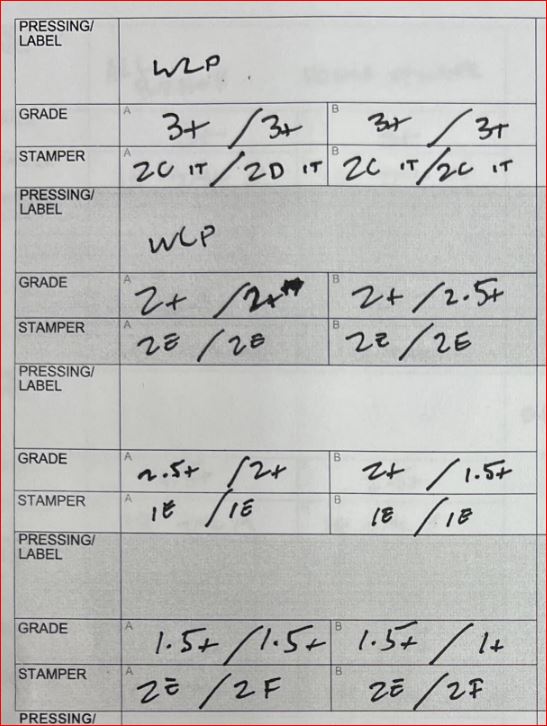
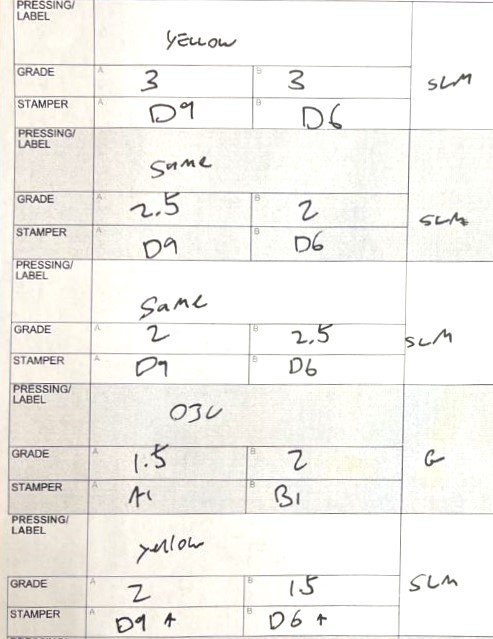
Hot Stamper shootouts are simply the name we came up with for the blinded experiments we do in order to find the best sounding pressings of albums.

If you want to find better sounding pressings, shootouts are the best way to go about it.

Chicago II – 360 Original or Red Label Reissue?

Hot Stamper Pressings of the Music of Chicago Available Now

Both can be good. I did the shootout and often tried to guess the label for the copy I was hearing, for fun more than anything else. I have to admit that my batting average was not much better than chance. 

The 360s tend to be a little fuller and smearier, but plenty of red label copies sound that way and some 360s don’t, so trying to match the sound to the label was even more pointless than usual.

When comparing pressings in a shootout it’s too late for the label to have any predictive value.

We’ve already bought the records, cleaned them up and now just want to know what they actually sound like — not which ones might be the best, but which ones are the best.

The time for guessing games has passed. Of course, if we do actually figure out what the right stampers are, this helps us next time around.

What Stampers Mean

Stampers mean something, but sometimes, as is the case here, they don’t mean much.

(If you don’t know that by now you probably haven’t done that many big shootouts on your own. Can’t blame you — without lots of helpers in the cleaning and needle-dropping departments, they’d be an even bigger pain than they already are. Even with three people involved it can still take almost all day, and that’s if you just happen to have ten or fifteen copies handy. It took us about two years to find that many, hitting multiple stores every week.)

(more…)

Tone Poets and One-Legged Tarzans

More Unsolicited Audio Advice

A tenet of conservatism is that we must all accommodate ourselves to living in the world that exists, not the world we might want to pretend exists, or the world we would like to exist.

The laws of physics are laws — not theories, not recommendations — and they operate independently of how convenient we may find them.

It follows from this — if you will allow me to make the case — that not everybody with a stereo can play Rudy Van Gelder’s recordings properly, and some people cannot play Tarzan at all. (More on that below.)

There is a fellow, rl1856, who made some comments on Robert Brook’s blog, addressing the Tone Poets pressings of RVG’s recordings vis-a-vis vintage pressings that RVG mastered. (Emphasis added.)

rl1856 writes:

An original RVG 1st or 2nd pressing has a visceral, “edge of the seat” feeling that is missing in the TP [Tone Poets] and BN [Blue Note] Classic reissues. The RVG has a tighter stereo spread, and is voiced so that the listener feels they are very close to the musicians. The TP and Classic remasters have a more distant perspective. The soundstage is wider, but the added apparent distance between musician and listener significantly reduces the impact of the music. OTOH, the reissues have greater extension at frequency extremes, and reproduce more micro detail than original pressings. We know that RVG used a surprising amount of EQ when mastering his LPs back in the day. So we need to ask ourselves, what do we want ? A better version of what we are familiar with, including EQ compromises, or a more accurate representation of what was actually captured on the master tape in RVG’s studio ? The answers may be mutually exclusive.

My system: Linn LP12 ITTOK LVII, SoundSmith Denon 103D, Audio Research SP10MKIII, Luxman MA 88 monoblocks, or Triode TRV 845PSE, or Mac 240, KEF LS50. Resolving enough to easily hear differences in LP quality.

When someone reveals that their equipment is simply not capable of reproducing the sound of live music, we can safely ignore whatever opinions they have offered about the records under discussion.

It’s obvious that they have played them with unacceptably low levels of fidelity. If they want to make the case that they in fact are able to reproduce music with acceptable fidelity, we would need to know more about their system and room in order to take such a claim seriously.

(more…)

Listening For the Spirit and Enthusiasm of the Musicians

Hot Stamper Pressings of Revolver Available Now

The discussion below, brought about by a Hot Stamper shootout we conducted for Revolver quite a number of years ago (2007!), touches on many issues near and dear to us here at Better Records.

Some of the things we learned about Revolver all those years ago are important to our Hot Stamper shootouts to this very day, including, but not limited to:

  • Pressing variations,
  • System upgrades,
  • Dead wax secrets,

and the quality we prize most in a recording:

  • LIFE, or, if you prefer, energy.

At the end of the commentary we of course take the opportunity to bash the MoFi pressing of the album, a regular feature of our Beatles Hot Stamper shootouts. We’re not saying the MoFi Beatles records are bad; in the overall scheme of things they are mostly pretty decent. What we are saying is that, with our help, you can do a helluva lot better.

Our help doesn’t come cheap, as anyone on our mailing list will tell you. You may have to pay a lot, but with us you get what you pay for, and we gladly back up that claim with a 100% money back guarantee for every Hot Stamper pressing we sell.


The Story of Revolver, Dateline October 2007

(Incidentally, 2007 turns out to have been a milestone year for us here at Better Records.)

White Hot Stampers for Revolver are finally HERE! Let the celebrations begin! Seriously, this is a very special day for us here at Better Records. The Toughest Nut to Crack in the Beatles’ catalog has officially been cracked. Yowza!

(more…)

Oliver Nelson’s Masterpiece – So Much Better Sounding on the (Right) Reissue

Hot Stamper Pressings that Sound Their Best on the Right Reissue

For those of you who still cling to the idea that the originals are better, this Hot Stamper pressing of the album should be just the ticket to set you straight.

Yes, we can all agree that Rudy Van Gelder recorded it, brilliantly as a matter of fact. Shouldn’t he be the most natural choice to transfer the tape to disc, knowing, as we must assume he does, exactly what to fix and what to leave alone in the mix?

Maybe he should be; it’s a point worth arguing.

But ideas such as this are only of value once they have been tested empirically and found to be true.

(more…)

60s 360 Vs. 70s Red Label on Je m’appelle Barbra

More Titles that (Potentially) Sound Their Best on the Right Reissue

For Barbra Streisand’s early albums, the original pressings on the 360 label just have to be better, right? 

Not in this case. It’s just another rule of thumb, one that will sometimes lead you astray if what you are trying to find are not just good sounding pressings of albums, but the best sounding pressings of albums.

Same with reissue versus original. Nice rule of thumb but only if you have enough copies of the title to know that you’re not just assuming the original is better. You actually have the data — gathered from the other LPs you have played — to back it up.

The best of the 360 pressings in our shootout did well, just not as well.

A classic case of compared to what? Who knew the recording would sound better on the Red Label Columbia reissue pressing from the ’70s? Certainly not us, not until we had done the shootout.

This is why we do shootouts, and why you must do them too, if owning the highest quality pressings is important to you.

Our good later label pressings had all the richness and Tubey Magic of the 360s — one really couldn’t tell which pressing was on the turntable by the sound — but had a bit more space, clarity and freedom from artificiality.

Watch your levels because she really gets loud on some of this material. The best copies, such as this side one, hold up. The lesser copies get congested, shrill and crude at their loudest, and of course get marked down dramatically when that happens.

Side two as very rich and smooth, yet clear and breathy – this is the right sound for ol’ Babs. The first track has tons of Tubey Magical reverb – check it out!

(more…)

Led Zeppelin II – An Overview

Hot Stamper Pressings of the Music of Led Zeppelin Available Now

Below you will find the story of my first encounter with an amazing sounding copy of Zep II back in 1995 or thereabouts.

I had a friend who had come into possession of a White Label Demo pressing of the album and wanted to trade it in to me for the Mobile Fidelity pressing that I had played for him once or twice over the years, and which we both thought was The King on that album.

To my shock and dismay, his stupid American copy killed the MoFi. It trounced it in every way. The bass was deeper and punchier. Everything was more dynamic. The vocals were more natural and correct sounding. The highs were sweeter and more extended. The whole pressing was just full of life in a way that the Mobile Fidelity wasn’t.

The Mobile Fidelity didn’t sound bad. It sounded not as good. More importantly, in comparison with the good domestic copy, in many ways it now sounded wrong.

Let me tell you, it was a defining moment in my growth as a record collector. I had long ago discovered that many MoFi’s weren’t all they were cracked up to be. But this was a MoFi I liked. And it had killed the other copies I’d heard in the past.

So I learned something very important that day.

I learned that hearing a better pressing is clearly the surest way to appreciate what’s wrong with the pressing I thought sounded right.

(more…)

Audiophile Wire Testing with Jethro Tull and His Friend Aqualung

Hot Stamper Pressings of the Music of Jethro Tull Available Now

… who seems to have a rather nasty bronchial condition…

[This commentary is from 2008 or so I’m guessing. Still holds up though.]

Like Heart’s Little Queen album, Aqualung presents us with a Demo Disc / Test Disc that really puts a stereo through its paces, assuming it’s the kind of stereo that’s designed to play an album like Aqualung.

Not many audiophile systems I’ve run across over the years were capable of reproducing the Big Rock Sound this album requires, but perhaps you have one and would like to use the album to test some of your tweaks and components. I used it to show me how bad sounding some of the audiophile wire I was testing really was.

Here’s what I wrote:

A quick note about some wire testing I was doing a while back. My favorite wire testing record at the time (2007)? None other than Aqualung!

Part One

Here’s why: Big Whomp Factor. Take the whomp out of Aqualung and the music simply doesn’t work, at all. To rock you need whomp, and much of Aqualung wants to rock.

(more…)

Recent Revolutions in Audio Can Make a Huge Difference on Familiar Recordings

This White Hot Stamper Ambrosia LP from some years ago had the kind of sound you would never expect to find in the grooves of this album. It was a THRILL to hear it, especially at the volumes at which we were playing the record.

The transparency and openness were off the charts, and unmatched by any other copy in our shootout. We’re big fans of this band here at Better Records — we love their take on complex, big production arty rock.

It’s also yet another example of the value of taking part in the myriad revolutions in audio.

If you never want your prized but sonically-challenged records to sound any better than they do right now, this minute, don’t bother to learn how to clean them better, play them back better or improve the acoustics of your room.

No one can make you do any of those things. The only reason you might have for doing them is so that you can enjoy more of your favorite music with much better sound. 

Is that a good enough reason? If you’re on this site I’m guessing it is.

That’s the reason we do it. We want records like this one, which didn’t start sounding good until about 2005, and now sound much better than I ever thought they could, to keep getting better and better. Why shouldn’t they? Because some people think we’ve reached the point of diminishing returns in audio? Those people do not know what they are talking about.

(There is a reference to racing cars in the WAPO article [1] which is pure poppycock, or at least those of us who have been in audio for a long time know it is. Lap times are not a good analogy. We need to be thinking about immersive experiences being ten times more immersive for a hundred times as many recordings as was possible when I started.)

And these improvements we talk about have allowed us to enjoy records we could never fully enjoy before because they never really sounded all that good to us.

Now they do, and they will keep getting better, as more and more developments come along in all areas of analog reproduction.

(more…)

How Can I Find My Own Hot Stampers?

Finding Hot Stampers is all about doing shootouts for as many different pressings of the same title as you can get your hands on.

This link will walk you through the process we’ve perfected over the last twenty years. If you’re an audiophile who wants to collect better sounding pressings, and learn a lot about records and audio in the bargain, doing shootouts is by far the best way to achieve your goals. As far as we’re concerned, it is the only sure way, since it helps take the unconscious biases and the guesswork out of the process.

(more…)

The Tapestry Shootout Video Is Here!

Geoff Edgers’ Washington Post article “The Search for the Perfect Sound,” in which he talks to lots of audiophiles and music lovers about his personal journey into the world of audiophile equipment and records, is now active on their website.

NEWSFLASH! This is currently the most popular story/video on the WAPO website! Number One with a bullet, baby. [Alas, no longer.]

Don’t miss the video below of yours truly doing a shootout for Tapestry.

It’s actually not a real shootout. For Tapestry we would typically play 8-10 early pressings and grade them for sound. This was more of a test, to see if I could spot the Hot Stamper among the pretenders, more What’s My Line than a shootout.

Part of the attraction of course is that I’m the guy they love to hate. Just check out the comments.

And please add some of your own. You are the only people on the planet qualified to talk about Hot Stampers because you are the only ones who have heard them on your own stereos with your own two ears.

Why should anyone care what somebody else has to say about something that that person has never experienced? The reason we stopped posting on the Hoffman website back in 2002 was simply the fact that I was tired of arguing with people that have strong opinions about the results of experiments they have never run.

Hot Stamper Shootouts are simply our way of doing blinded experiments on various pressings of records. We eschew theories and conjecture. We prefer observations and data. We write about these issues a lot here on the blog for those who would like to learn more about records. If you already know it all, this is probably not a blog you will find of much value.

I will be posting some comments soon, mostly about all the stuff that got left on the cutting room floor. We spent most of the time with some orange label Vertigo pressings of Dire Straits’ first album, finding a White Hot Stamper LP out of the batch we played, then comparing our records to the execrable Mobile Fidelity 45 RPM 2 disc pressings, pressings so bad they defy understanding. But that is another story for another day! (The MoFi was mastered by Krieg Wunderlich, so if you see his name in the credits of a record you may be interested in, don’t waste your money. He is hopelessly incompetent and can be counted on to produce some of the worst sounding audiophile records ever made.)

I had eye surgery on my right earlier on the day of the interview, so hopefully that accounts for some of my squinty appearance.

I have also been invited to participate in a Reddit Q&A sometime next week, discussing the issues raised in the article or video anyone would like to ask about, so stay tuned for that, and I hope you will participate as well.

Our customers have plenty of their own Hot Stamper stories to tell, and I hope to hear from some of you on that Reddit panel.

You are the only audiophiles with real, first-hand knowledge of what a Hot Stamper sounds like. Perhaps you will wish to share with other audiophiles what they don’t know they are missing.

And if you have any questions of any other kind, I hope you will give me a chance to answer them.

Just email tom@better-records.com

(more…)