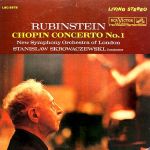
 Hot Stamper Living Stereo Classical and Orchestral Titles Available Now
We love the huge, solid and powerful sound of the piano on this recording. This piano has weight and heft. As a result, it sounds like a real piano.
For some reason, a great many Rubinstein recordings are not capable of reproducing those all-important qualities in the sound of the piano.
Those are, as I hope everyone understands by now, the ones we don’t sell. If the piano in a piano concerto recording doesn’t sound solid and powerful, what is the point of playing such a record?
Or, to be more accurate, what is the point of an audiophile playing such a record? (Those of you who would like to avoid bad sounding vintage classical and orchestra records have come to the right place. We’ve compiled a very long list of them precisely for that purpose, and we’ve been adding to it regularly.)
 No doubt Kenneth Wilkinson made sure the recording captured the weight of the piano he was listening to as it played all those years ago in the wonderful acoustics of Kingsway Hall.
The strings have lovely Living Stereo (Decca-engineered) texture as well.
As befits a Wilkinson recording from 1961, there is no shortage of clarity to balance out the Tubey Magical warmth and richness.
When you add in the tremendous hall space, weight and energy, this becomes a Demo Disc orchestral recording by any standard.
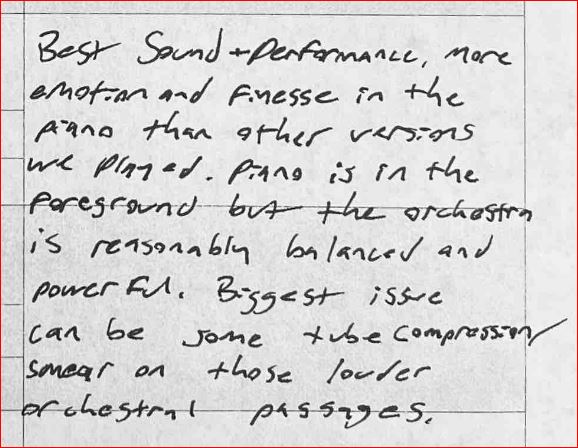
Notes from a 2024 Shootout
Our notes above point out that:
- This is the best combination of sound and performance for Chopin’s first piano concerto, with more emotion and finesse in the playing than other versions we auditioned.
- The piano is in the foreground, with the orchestra reasonably balanced and clearly more powerful than some of the other recordings we played.
- The biggest issue for the lesser pressings — which means the ones that did not win the shootout — is the possibility of some tube compressor smear and congestion on the loudest orchestral passages.
To read more about the tradeoffs found on classical recordings resulting from the use of tube compression, click here.
Other classical records that can get congested when loud are found here.
Our Hot Stamper reviews of piano concerto recordings can be found here.
Our commentaries and insights for various piano concerto recordings can be found here.
Other classical recordings with top quality piano reproduction can be found here.
There are about 150 orchestral recordings we think offer the best performance coupled with the highest quality sound. This Chopin recording is on that list, for all of the reasons we discuss above.
Testing
Lately we have been writing quite a bit about how pianos are good for testing your system, room, tweaks, electricity and all the rest, not to mention turntable setup and adjustment.
- We like our pianos to sound natural (however one chooses to define the term).
- We like them to be solidly weighted.
- We like them to be free of smear, a quality that is rarely mentioned in the audiophile record reviews we read.
Engineering
Kenneth Wilkinson engineered this album in Kingsway Hall for Decca in 1961.
His recordings were characterised by the producer Tam Henderson in an appreciation: “The most remarkable sonic aspect of a Wilkinson orchestral recording is its rich balance, which gives full measure to the bottom octaves, and a palpable sense of the superior acoustics of the venues he favored, among them London’s Walthamstow Assembly Hall and The Kingsway Hall of revered memory”.
On retiring, Wilkinson received a special gold disc produced by Decca with extracts of his recordings. He received three Grammys for engineering: 1973, 1975, and 1978. He also received an audio award from Hi-Fi magazine in 1981 and the Walter Legge Award in 2003 “…for extraordinary contribution to the field of recording classical music.”
Further Reading