pi-con-comm

Letters and commentaries on piano concerto recordings we’ve played.

Skip the Living Stereo of Rachmaninoff’s Piano Concerto No. 2 with Cliburn

Hot Stamper Pressings of Living Stereo Recordings Available Now

We recently dropped the needle on a copy of LSC 2601 — the first one we’ve played in years — and found a great deal to fault in the sound. Our copy with 3s/3s stampers was awful sounding.

Rachmaninoff’s Piano Concerto No. 2 is a wonderful piano concerto, one that belongs in any serious record collection, but the sound on the pressing we played was definitely not up to our standards.

The piano was cranky, the overall sound a dry mess overall. It just sounded much too much like an old record.

A Shaded Dog pressing such as this might be passable on an old school audio system, but it was too unpleasant to be played on the high quality (mostly) modern equipment we use.

There are quite a number of other vintage classical releases that we’ve run into over the years with similar shortcomings. For fans of vintage Living Stereo pressings, here are some to avoid.

Some audiophiles may be impressed by the average Shaded Dog, but I can assure you that we here at Better Records are decidedly not of that persuasion.

Something in the range of five to ten per cent of the major label Golden Age recordings we play will eventually make it to the site. The vast majority just don’t sound all that good to us. (Many have second- and third-rate performances and those get tossed without ever making it to a shootout.)

(more…)

The MHS Recording of Chopin’s First Piano Concerto Had the Most Natural Piano of Them All

Hot Stamper Pressings of the Music of Frederic Chopin Available Now

There are some wonderful Musical Heritage Society records sitting in the bins of your local record store or Goodwill, and this one is worth picking up just to hear how well recorded the piano is.

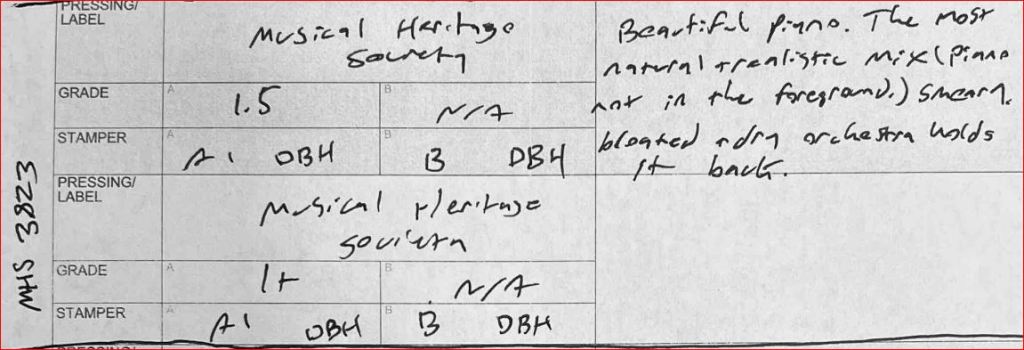
We described it this way:

Beautiful piano. The most natural and realistic mix with the piano not in the foreground.

But there is more to the recording than the sound of the piano.

Smeary, bloated and dry orchestra holds it back.

Well, at least we tried. (Note that side two was deemed not worth grading.)

Our favorite recording for performance and sound is the Living Stereo from 1961, LSC 2575, with Rubinstein at the piano and Skrowaczewski conducting the New Symphony Orchestra of London.

This is what we had to say about the sound of our Shootout Winner:

We love the huge, solid and powerful sound of the piano on this recording. This piano has weight and heft. As a result, it sounds like a real piano.

For some reason, a great many Rubinstein recordings are not capable of reproducing those seemingly all-important qualities in the sound of the piano.

Those are, as I hope everyone understands by now, the ones we don’t sell. If the piano in a piano concerto recording doesn’t sound solid and powerful, what is the point of playing such a record?

Or, to be more accurate, what is the point of an audiophile playing such a record? (Those of you who would like to avoid bad sounding vintage classical and orchestral records have come to the right place. We’ve compiled a very long list of them for precisely that purpose, and we add to it regularly.)

(more…)

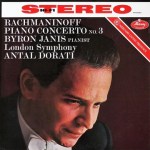
Van Cliburn’s Live Rachmaninoff Piano Concerto No. 3 Can Be Very Good But…

Hot Stamper Pressings of the Music of Rachmaninoff Available Now

The Shaded Dog pressings of Van Cliburn’s live performance of Rachmaninoff’s Piano Concerto No. 3 (LSC 2355) we’ve played recently tend to have very good sound.

The problem is that the famous Byron Janis recording of the work for Mercury (SR 90283) has the potential for amazingly good sound.

For a recent shootout winning copy, we had this to say:

The sound is rich and natural, with lovely transparency and virtually no smear to the strings, horns or piano. What an amazing recording! What an amazing piece of music.

The recording is explosively dynamic and on this copy, the sound was positively jumping out of the speakers. In addition, the brass and strings are full-bodied, with practically no stridency, an unusual feat the Mercury engineers seem to have accomplished while in Russia.

Big, rich sound can sometimes present problems for piano recordings. You want to hear the percussive qualities of the instrument, but few copies pull off that trick without sounding thin. This one showed us a piano that was both clear and full-bodied.

With huge amounts of hall space, weight and energy, this is Demo Disco quality sound by any standard. Once the needle has dropped you will quickly forget about the sound (and all the money you paid to get it) and simply find yourself in the presence of some of the greatest musicians of their generation, captured on the greatest analog recordings of all time.

The RCA recording, good as it is, is simply not in the same league as the better pressings of the Mercury.

For that reason we do not feel the need to offer any copies of the Living Stereo record to our customers.

(more…)

Heavy Vinyl Super Discs – “Nobody should have to listen to sound like that.”

More of the music of Sergei Rachmaninoff (1873-1943)

This entry links up a few of the commentaries I wrote as I went back through the Classic catalog, comparing their pressings to both originals and reissues.

We take to task Classic Records, The Absolute Sound, and Chesky, as you will see below.

This commentary was written in 2005, prompted at the time by a rave review in TAS for one of the new Speakers Corners Mercury reissues. I detested the sound of the first one I heard, and subsequent releases only confirmed that the mastering of the Mercury catalog for Speakers Corner was an abomination — an affront, in my none-too-humble opinion, to all right-thinking audiophiles.

As for my commentary, it should be obvious that these awful remastering labels have not gone out of business, but instead have prospered, making millions of dollars from audiophiles eager to lay down their hard earned money for one Heavy Vinyl pressing after another, often of the same title even.

When Harry Pearson — of all people! This is the guy who started the Living Stereo craze by putting those forgotten old records on the TAS list in the first place — gave a rave review to the Classic Records reissue of LSC 1806, I had to stand up (in print anyway) and say that the emperor clearly had removed all his clothing, if he ever had any to begin with. (And now he has a CD List? Ugh.)

This got me kicked out of TAS by the way, as Harry does not take criticism well. I make a lot of enemies in this business with my commentary and reviews, but I see no way to avoid the fallout for calling a spade a spade.

Is anybody insane enough to stand up for LSC 1806 today?

Considering that there is a die-hard contingent of people who still think Mobile Fidelity is the greatest label of all time, there may well be “audiophiles” with substandard audio equipment or weakened powers of observation and discrimination, or both (probably both, as the two go hand in hand), that still find the sound of that steely stringed Classic pressing somehow pleasing to the ear. Hey, anything is possible.

(more…)

Some Pressings of Tchaikovsky’s Piano Concerto No. 1 Can Sure Be a Letdown

Hot Stamper Pressings of the Music of Tchaikovsky Available Now

I don’t know of another recording of the work that gets the sound of the piano better. On the properly-mastered, properly-pressed copies, the percussive quality of the instrument really comes through.

But that quality (along with lots of others) is only heard on the better copies.

The reissues (one with the later Tulips label, one with the earlier Large Tulips label) described below are at best passable, and some of them were just awful.

The note to the left makes clear that even some of the early Large Tulips label pressings had very bad sound. Watch out especially for 18A/15B stampers. They’re NFG: No F***ing Good.

As you can see from the notes above for this particular recording in the Black and White cover, one side was passable, earning our 1.5+ grade. That makes it a decent sounding record, I suppose, but it’s a long, long, long way from the best.

1.5+ is four grades down from the top copy. That’s a steep dropoff as far as we’re concerned. 1.5+ only hints at how good a recording this DG can be on the best pressings.

To see more records that earned the 1.5+ grade, please click here. (Incidentally, some of them are even on Heavy Vinyl. The better modern pressings have sometimes, if rarely, been known to earn Hot Stamper grades, and two recently shocked the hell out of us by actually winning a shootout. Wouldn’t you like to know which two!)

One Plus (1+) is a sub-Hot Stamper grade. We do not sell records that do not earn a grade of at least 1.5+ on both sides.

For those who might be interested, there’s more on our grading scale here.

Our Favorite Performance with Sound to Match

A recent listing for the album can be found here.

Without question this is a phenomenal piano recording in every way.

On the best copies the rich texture of the strings is out of this world — you will have a very hard time finding a DG with better string tone. This record does not have the shortcomings of the average DG: it’s not hard, shrill, or sour.

DG made plenty of good records in the 50s and 60s, then proceeded to fall apart, like most labels did. This is one of their finest. It proves conclusively that at one time — 1962 to be exact — they clearly knew exactly what they were doing.

It’s amazing how many piano recordings have poorly-miked pianos. The badly recorded pianos are either too distant, lack proper reproduction of the lower registers, or somehow smear the pounding of the keys into a blurry mess.

Are they badly recorded?

Or is it a mastering issue?

Perhaps a pressing issue?

(more…)

The Grieg Piano Concerto – With a Correctly Sized Piano for a Change

More of the music of Edvard Grieg (1843-1907)

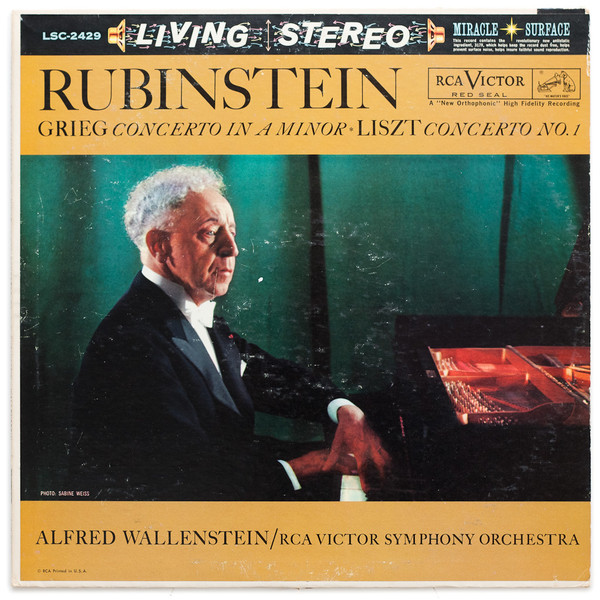
This Shaded Dog pressing has exceptionally lively and dynamic sound on side two, which earned an A++ grade and plays quietly to boot.

The sound is BIG and BOLD enough to fill up your listening room and then some.

The piano is clean and clear, the strings are rich and textured.

And his performance of this work is superb, as is his performance of the shorter coupling works on side two (which actually have the best sound here). 

This is wonderfully recorded music. It has a very natural orchestral perspective and superb string tone.

It also boasts a correctly-sized piano, which is quite unusual for Rubinstein’s recordings in our experience.

Some of the titles we’ve auditioned that had noticeably over-sized imaging can be found here.

(more…)

Brahms / Piano Concerto No. 1 – What to Listen For

Hot Stamper Pressings of of the Music of Brahms Available Now

Our general notes for the recording seen below explain why the typical copy in our shootout fell short.

This is an LP with lots of tube compression, and some added brightness.

Without the added brightness, the piano would probably be mud.

The added brightness and compression results in a piano that always sounds rich and natural in the quieter passages.

The average copy also has some veiling or smearing that make the solo piano parts sound like they are coming fom behind a curtain. On these copies, the big peaks can often get strident and very messy.

It’s difficult to find a copy that has all the top end extension and space required to reproduce both a realistic piano and the massive live sound the orchestra is capable of.


All of which adds up to a difficult shootout in which relatively few copies had the sound we were looking for.

Production and Enginneering

(more…)

Shaded Dogs with 12s Stampers Are Not the Way to Go on LSC 2566

Hot Stamper Pressings of the Music of Edvard Grieg Available Now

One set of stampers for the Shaded Dogs we played in our most recent shootout sounded consistently subpar, 12s/12s.

The sound was blary on both sides. (More records with blary sound can be found here.)

Although the Shaded Dog originals with the right stampers will always win our shootouts, the White Dog reissues still sound quite good to us, just not as good.

This Shaded Dog might be passable on an old school audio system, but it was too unpleasant to be played on the high quality modern equipment we use.

There are quite a number of other vintage classical releases that we’ve run into over the years with similar shortcomings. For fans of vintage Living Stereo pressings, here are some to avoid.

Some audiophiles may be impressed by the average Shaded Dog pressing, but I can assure you that we here at Better Records are decidedly not of that persuasion.

Something in the range of five to ten per cent of the major label Golden Age recordings we play will eventually make it to the site. The vast majority just don’t sound all that good to us. (Many have second- and third-rate performances and those get tossed without ever making it to a shootout.)

(more…)

Where Cheap Turntables Fall Flat – The Music of Franz Liszt

Hot Stamper Pressings of Classical Music Available Now

Classical music is unquestionably the ultimate test for proper turntable/arm/cartridge setup.

The Liszt Piano Concerto record you see pictured is a superb choice for making small adjustments to your setup in order to improve the playback of these very difficult to reproduce orchestral recordings.

Here are some other reviews and commentaries touching on these areas of turntable setup.

One of the reasons $10,000+ front ends exist is to play large scale, complex, difficult-to-reproduce music such as Liszt’s two piano concertos. You don’t need to spend that kind of money to play this record, but if you choose to, it would surely be the kind of record that could help you recognize the sound quality your tens of thousands of dollars has paid for.

It has been my experience that cheap tables more often than not collapse completely under the weight of a mighty record such as this.

(more…)

In 2005 We Were (Probably) Way Off the Mark for Brahms’ Piano Concerto No. 2

Hot Stamper Pressings of Living Stereo Titles Available Now

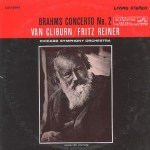
UPDATE 2024: This is a very old review. We would no longer agree with the assertion that the White Dog pressings are better sounding than the Shaded Dogs. In our recent shootout, the first one I can remember since 2005 — that was 19 years ago! — the White Dogs did not do nearly as well as the Shaded Dogs we have on hand.

This White Dog pressing is the best sounding copy I’ve ever heard, much better than the earlier pressings. The piano doesn’t break up like it does on those, especially in the second movement.

Finally the piano sounds right – solid and with the correct overtones. It goes without saying that this is an exceptionally good performance as well.

One of the best of the Cliburn recordings which, as you may know, are rarely any good, the worst of them being LSC 2252 and the best of them being, probably, LSC 2507.


This is an Older Classical/Orchestral Review

Most of the older reviews you see are for records that did not go through the shootout process, the revolutionary approach to finding better sounding pressings we started developing in the early 2000s and have since turned into a veritable science.

We found the records you see in these older listings by cleaning and playing a pressing or two of the album, which we then described and priced based on how good the sound and surfaces were. (For out Hot Stamper listings, the Sonic Grades and Vinyl Playgrades are listed separately.)

We were often wrong back in those days, something we have no reason to hide. Audio equipment and record cleaning technologies have come a long way since those darker days, a subject we discuss here.

Currently, 99% (or more!) of the records we sell are cleaned, then auditioned under rigorously controlled conditions, up against a number of other pressings. We award them sonic grades, and then condition check them for surface noise.

As you may imagine, this approach requires a great deal of time, effort and skill, which is why we currently have a highly trained staff of about ten. No individual or business without the aid of such a committed group could possibly dig as deep into the sound of records as we have, and it is unlikely that anyone besides us could ever come along to do the kind of work we do.

(more…)