Hot Stamper Mercury Pressings Available Now
This Mercury 35mm recording was released through Philips after they’d bought the Mercury label back in the 60s.
Philips would go on to release the mostly dreadful Golden Import pressings that were made from all the most famous Mercury recordings, but of course they sounded a great deal more like Philips recordings than Mercury recordings once they had been remastered.
Some things never change. Do you like the sound Steve Hoffman brought to the DCC vinyl releases? You can be sure you will get plenty of that sound and very little of any other. We call that My-Fi. Once we learned to recognize it, something we admit took us longer than it should have, we became ardently opposed to it.
If you think that the right way to remaster records is to make them sound more like you want them to sound and less like the scores of vintage pressings sounded before, you and I are clearly in different camps. (One listen to a Hot Stamper pressing may be all that it takes to get you to switch camps.)
This album was recorded by Robert Fine and Wilma Cozart, then mastered by George Piros, all members of the legendary Mercury team, revered by the audiophile cognoscentias as true giants , and with good reason. We count ourselves among Mercury’s biggest fans.
It is instructive to note that the Philips mastering in this case is dramatically superior to the mediocre Mercury mastering by Robert Fine, which may strike you as counterintuitive, but is nonetheless a fact that cannot be denied once you have played a sufficient number of copies of each version, as we have.
It’s precisely the reason we spend our days playing records here at Better Records. You can’t judge a record by its credentials. The only way to know how it sounds is to play it, and to really know how it sounds you must play it against a sizeable number of other copies.
Then, and only then, can you talk knowledgeably about the sound. (Note to forum posters: this means you.)
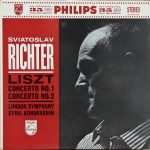
 The potentially right pressing comes in a cover very much like this one:
Wikipedia
The main themes of Liszt’s first piano concerto are written in a sketchbook dated 1830, when Liszt was nineteen years old. He seems to have completed the work in 1849, yet made further adjustments in 1853. It was first performed at Weimar in 1855, with the composer at the piano and Berlioz conducting. Liszt made yet more changes before publication in 1856. Bartók wrote of the work as being “the first perfect realisation of cyclic sonata form, with common themes being treated on the variation principle”. The movements of the piano concerto are played without a break, though some recordings do separate the piece into 2, 3, or 4 different sections.
Franz Liszt wrote drafts for his Concerto for Piano and Orchestra No. 2 in A Major, no. 125 in Humphrey Searle’s catalog of Liszt’s works, during his virtuoso period, in 1839 to 1840. He revised it in several stages, ending in 1861. This concerto typically lasts about 20 minutes. This concerto is one single, long movement, which divide into four sections connected by transformations of several themes. The opening theme is heard throughout the piece, and a version of the theme of the scherzo-like section in B-flat minor is heard as a march in E major later in the work, for instance. The work has not proven as popular as the composer’s first piano concerto but has stayed in the repertoire.
The largest and best known portion of Liszt’s music is his original piano work… Liszt’s piano works are usually divided into two classes. On the one hand, there are “original works”, and on the other hand “transcriptions”, “paraphrases” or “fantasies” on works by other composers…
Liszt also made piano arrangements of his own instrumental and vocal works. Examples of this kind are the arrangement of the second movement “Gretchen” of his Faust Symphony and the first “Mephisto Waltz” as well as the “Liebesträume No. 3” and the two volumes of his “Buch der Lieder”.
