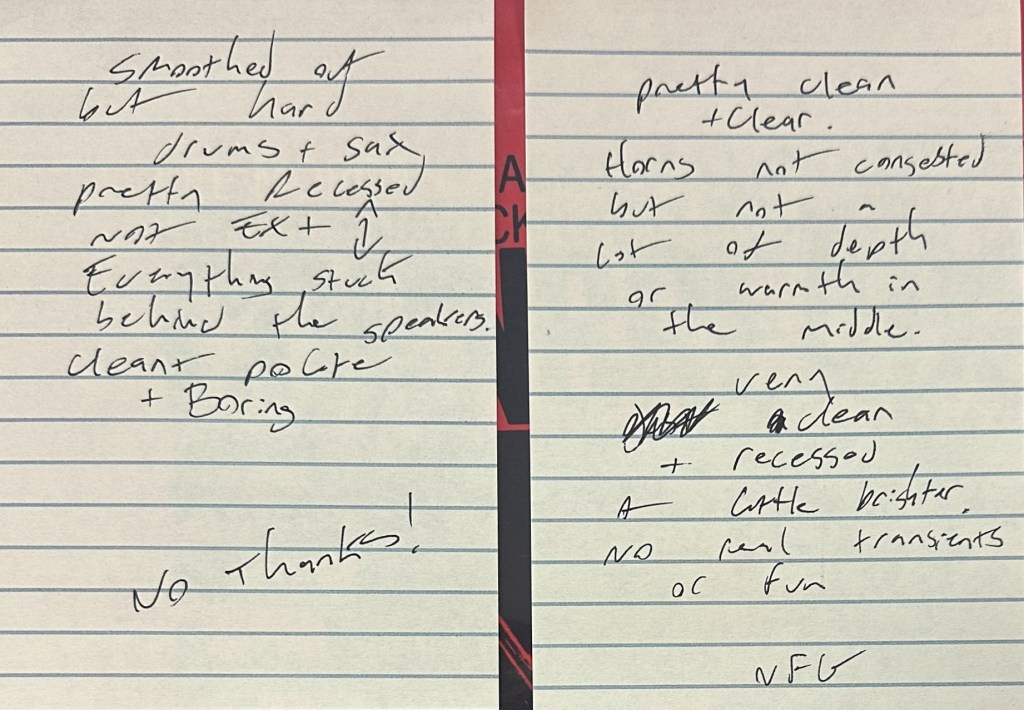
lacks-bass

Tommy on Classic Records

Hot Stamper Pressings of the Music of The Who Available Now

Sonic Grade: C

The Classic Tommy is bass shy. It could have had amazing bass, like Classic’s Who’s Next, but it doesn’t. Why, I have no idea.

The overall sound is thin, so thin that we immediately knew there was no point in carrying it (back in the old days when we carried Heavy Vinyl, pre-2008).

The only Classic Who record we ever carried was Who’s Next; the rest of them vary from mediocre to dreadful.


Remastering Out The Good Stuff

What is lost in the newly remastered recordings so popular with the record buying public these days?

Lots of things, but the most obvious and irritating is the loss of transparency.

Modern records tend to be small, veiled and recessed, and they rarely image well. But the most important quality they lack is transparency. Almost without exception they are opaque.

They resist our efforts to hear into the music and get lost in it.

(more…)

L.A. Woman Is a Disaster on German Heavy Vinyl, Part One

Hot Stamper Pressings of the Music of The Doors Available Now

There was a German 180 gram pressing of L.A. Woman that was so bad, I called this commentary from 2005 The Audiophile Apocalypse. [Minor edits have been made since then.]

The fact that some audiophiles and audiophile reviewers appeared to like this pressing was a sign that, to me at least, The End Is Near, or May Be. There is no hope for audiophiles if they can’t tell a good record from a bad one, and this is clearly a bad one.

If this isn’t a good example of a pass/not-yet record, I don’t know what would be.

As noted at the top, this commentary was written a long time ago. Much of our thinking about the recordings of The Doors has evolved since then, having played scores of their records in shootouts and learned something new from practically each one. Click here to read more.

Dateline: January, 2005

When I first played it I thought there must be something wrong with my stereo. There was no deep bass. (This recording has amazing deep bass.) The sound was upper midrangey and distorted. There was no extreme top at all.

This surprised me, as I had heard that this was supposed to be a good record.

What I heard coming off the copy that I was playing was pure garbage. I was confused.

So I grabbed a couple of DCC Doors pressings. The first one I played was Waiting For The Sun, my favorite on DCC. Ahh, that’s more like it. Sweet, open, plenty of bass, extended highs, Steve Hoffman’s beautifully liquid midrange — everything I expected to hear on his version was there just exactly the way it should be.

So I knew it wasn’t my stereo. Then I pulled out the DCC LA Woman. What’s the difference you ask? Well, the DCC has a top end. Listen to the cymbals. They ring sweetly and correctly. You can hear that the tape hiss sounds correct, a sure sign that the top end is accurate.

The midrange is a bit recessed compared to the German pressing. Steve says he took out a half DB in the upper mids. There’s distortion on the vocals and he was trying to soften the effect. It might have been better to leave it flat, but either way is preferable to the boosted, aggressive, edgy upper midrange to be found on the German pressing.

The German LP sounds like something playing over the radio. AM, not FM. Part of the problem is that there’s no lower midrange on the German pressing to properly balance out the vocals. Perhaps it’s not on the tape they used. I’m guessing it probably isn’t.

But any mastering engineer worthy of the name should know how to fix a problem like that. Steve did. Apparently this German fellow did not.

And worst of all, there is no deep bass on this record AT ALL. The whole lower octave is missing. Now to be fair, the DCC LP has the same problem. There’s no lower bass on it either. That’s why I don’t recommend that you listen to LA Woman on vinyl. I don’t know of any copy that sounds right.


UPDATE 2025

This was true in 2005 because we had yet to do the work it takes to find the right copies, the ones with plenty of bass and everything else too. I think it took us another ten years to find the pressings with the right stampers. Scroll to the bottom of this listing to see our notes for the copy that won our last shootout in 2024.

(more…)
The Early London Pressings Of Schubert’s 9th Are Awful

Hot Stamper Classical and Orchestral Imports on Decca & London

There are plenty of Deccas and Londons that we’ve cleaned and played over the years that were disappointing, and some of them can be found here.

What was most striking about this shootout was how poorly the original London Bluebacks (CS 6061) fared when going head to head with the best vintage reissues. In fact, they were so obviously inferior I doubt we would have even needed another pressing to know that they could not possibly be considered Hot Stampers.

The two we had were crude, flat, full of harmonic distortion, and both had clearly restricted frequency extremes.

In other words, it just sounded like an old record, and not a very good one at that. The world is full of them.

But I remember liking the Blueback pressings I played ten or twenty years ago.

Did I have better copies, or was my system not capable of showing me the shortcomings I so clearly heard this time around? Since this is a question that cannot be answered with any certainty, we’ll have to leave it there.

Our favorite performance of the work is this one with Krips and the LSO, but on a much later reissue pressing produced by Decca in the 70s. Imagine that!

(more…)

Today’s Half-Speed Mastered Mess Is Meddle on Mobile Fidelity

Hot Stamper Pressings of the Music of Pink Floyd Available Now

Sonic Grade: D

Same sonic shortcomings as the MoFi Thick As a Brick. Twenty years ago we wrote:

“The MoFi is TRANSPARENT and OPEN, and the top end will be lush and extended. If you prize clarity, this is the one.”

But if you prize clarity at the expense of everything else, you are seriously missing the boat on Meddle (and Thick As A Brick too).

The MoFi is all mids and highs with almost nothing going on below.

This is a rock record, but without bass and dynamics, the MoFi pressing doesn’t rock, so why would anyone want to own it or play it?

I suppose you could argue that on small speakers the shortcomings of this pressing would be much less bothersome, but on the reference system we use — including the one we had twenty years ago — the lack of low end is a real dealbreaker.

The One Thing They Do

The one thing these pressings have going for them is that they tend to be transparent in the midrange.

It sounds like someone messed with the sound, and of course someone did. They took out the bottom end so that the midrange would be clearer.

That’s one of the tricks these labels use to get their records to impress the audiophiles with small speakers, or ones that are pressed up against the wall, perhaps with a television screen mounted between them.

For some reason, some audiophiles like their records to sound pretty and lifeless with blurry bass.

That is not our sound here at Better Records. We don’t offer records with those qualities and we don’t think audiophiles should be paying good money for records that sound like that.

(more…)

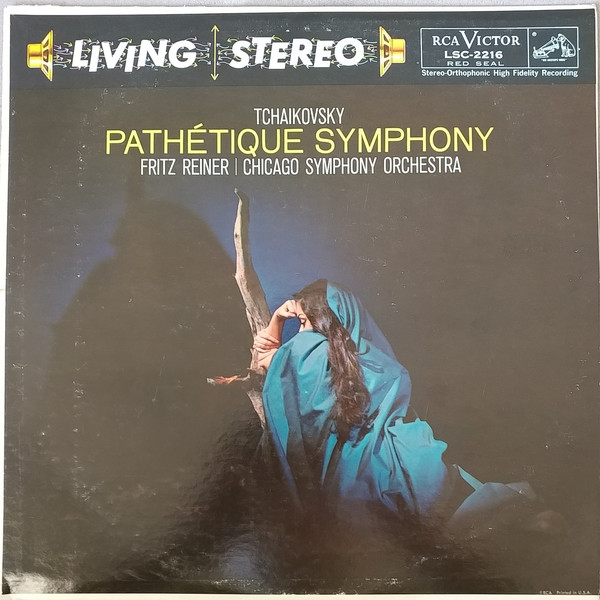
RCA Released this Awful Living Stereo Recording in 1958

Hot Stamper Pressings of the Music of Tchaikovsky Available Now

Some audiophiles buy albums based on their labels. For example, this pressing from the Golden Age of Living Stereo might appeal to a certain kind of audiophile who treasures LSC’s with the original Shaded Dog label.

More than that, he might limit himself to 1S Indianapolis pressings. Hoorah! What could be better?

However, many records from this era simply do not sound good, and this is one of them. We have never heard a good sounding copy of LSC 2216, and we’ve played quite a number of them over the decades we’ve been in the business of selling Golden Age classical records.

A copy came in just last week so I figured it was time to give it a spin and see if there was any reason to change my opinion. Hey, maybe this one had Hot Stampers! Can’t say it wouldn’t be possible. Unlikely, yes, impossible, no.

So here’s what I heard. No real top above 6k, hardly any bottom, dry and thin, but with a very wide stage – the textbook definition of “boxy sound.”

If you are a fan of Living Stereo pressings, have you noticed that many of them – this one for example – don’t sound good?

If you’re an audiophile with good equipment, you should have. But did you? Or did you buy into the hype surrounding these rare LSC pressings and just ignore the problems with the sound?

(more…)

Music from Big Pink on MoFi – Bad Bass Like This Is Just Annoying

Hot Stamper Pressings of Music by The Band Available Now

In 2012 the “new” MoFi put out another remastered Big Pink. Since their track record at this point is, to be honest, abysmal, we have not felt the need to audition it.

It’s very possible, even likely, that they restored some of the bass that’s missing from so many of the originals.

But bad half-speed mastered bass — poorly defined, never very deep and never punchy — is that the kind of bass that would even be desirable?

To us, it is very much a problem. Bad bass is just plain annoying.

Fortunately for all, it is a problem we have to deal with much less often now that we’ve all but stopped playing Half-Speed mastered records.

Here are some other records with exceptionally sloppy bass. If the bass on these records does not sound sloppy, you have your work cut out for you.

Some of our favorite records for testing bass definition can be found here.

Sucked Out Mids

The Doors first album was yet another obvious example of MoFi’s predilection for sucked-out mids. Scooping out the middle of the midrange has the effect of creating an artificial sense of depth where none belongs.

Play any original Bruce Botnick-engineered album by Love or The Doors and you will notice immediately that the vocals are front and center. 

(more…)

Hey Mr. Fantasy – Where’s the Bass?

Hot Stamper Pressings of the Music of Traffic Available Now

For our newest take on the sound of the various labels and stampers for Mr. Fantasy, please click here.

A long, long time ago, probably at the start of the 2000s, we put up this early UK pressing on the Island pink label.

Charged good money for it, too, justified by the fact that the early pink label pressing would be assumed to have the best sound for audiophiles in search of higher fidelity.

Back then we didn’t know what we know now, which is that the right reissues are dramatically better sounding.

In fact, they handily win our shootouts, something they have been doing for at least the last ten years or so.

The pink label pressing we review below is very unlikely to earn a grade high enough to qualify for Hot Stamper status.

Our Old Listing

This pink label original Island pressing has amazingly sweet, open, extended and transparent mids and highs.

It has two major shortcomings: a lack of bass, and a fair amount of surface noise.

If you can add a few — let’s say three — dB around 50 cycles and can put up with some surface noise and scratches, you are guaranteed to hear some wonderful sound in the best tubey Island tradition. 

Side two sounds better than side one. It has more bass and is more tonally correct overall.

Live and learn is our motto, and progress in audio is a feature, not a bug, of record collecting at the most advanced levels. (“Advanced” is a code word for having little to no interest in any remastered pressing marketed to the audiophile community. If you want to avoid the worst of them, we are happy to help you do that.)

(more…)

After the Gold Rush – Because Sound Matters?

Hot Stamper Pressings of the Music of Neil Young Available Now

I don’t know why I wasted so much time critiquing the sound of this remastered (2009) pressing. Frankly, it really wasn’t worth it.

However, since I listen to records for a living, I figured I might as well listen to this one, head to head with an excellent vintage pressing, of course. What other way to do it is there?

Since we do shootouts for this album regularly, we know just how good the best pressings of After the Gold Rush can sound, and this newly remastered vinyl is missing almost everything that makes the album essential to any right thinking music lover’s collection.

We can summarize the sound of this dreadful record in one word: boring.

Since some of you reading this review are no doubt fans of Chris Bellman, the engineer credited on the album, and a man apparently held in some esteem by a great many audiophiles, perhaps we owe it to his fans to break down the sonic strengths and weaknesses of this pressing in more detail.

What It Does Right

It’s tonally correct. Unlike many modern pressings, it is not overly smooth.

Uh, can’t think of anything else…

What It Does Wrong

Where to begin?

(more…)

Is the Heavy Vinyl from 2012 the Best Sounding Sgt. Pepper?

beatlessgtHot Stamper Pressings of Sgt. Peppers Available Now

You might agree with some reviewers that EMI’s engineers did a pretty good job with the new stereo pressing of Sgt. Pepper mastered by Sean Magee from the 2009 digitally remastered tapes.

In the March 2013 issue of Stereophile Art Dudley weighed in, finding little to fault on this title but being less impressed with most of the others in the new box set. His reference disc? The MoFi UHQR! Oh, and he also has some old mono pressings and a domestic Let It Be.

Now there’s a man who knows his Beatles. Fanatical? Of course he is! We’re talkin’ The Beatles for Chrissakes.

When I read the reviews by writers such as these, I often get the sense that I must’ve fallen through some sort of Audio Time Warp and landed back in 1982. How is it that our so-called experts evince so little understanding of how records are made, how variable the pressings can be, and, more importantly, how absolutely crucial it is to understand and implement rigorous protocols when attempting to carry out comparisons among pressings.

Critically comparing LPs is difficult and time-consuming. It requires highly developed listening skills. I didn’t know how to do it in 1982. I see no evidence that the audiophile reviewers of today are much better at it now than I was in 1982.

Just to take one example: They all seem to be operating under the same evidence-free conceit: that the original is the benchmark against which other pressings must be compared.

To those of us who have played Beatles pressings by the hundreds, this is patent nonsense. To cite just one instance, a recent Hot Stamper listing notes [inaccurately as it turns out, see below]:

We defy any original to step into the ring with it. One thing we can tell you, it would not be a fair fight. The cutting equipment to make a record of this quality did not exist in 1967, not at EMI anyway.

We had the opportunity not long ago to audition a very clean original early pressing of the album and were frankly taken aback by how AWFUL it was in virtually every respect. No top end above 8k or so, flabby bass, murky mids — this was as far from Hot Stamper sound as one could imagine. If it were a Heavy Vinyl or Audiophile pressing we would surely have graded it F and put it in our Hall of Shame.

To be fair we have played exactly one early copy of the record on our current system. (Played a copy or two long ago but on much different equipment, so any judgments we might have made must be considered highly suspect.) Perhaps there are good ones. We have no way of knowing whether there are, and we are certainly not motivated to find out given the price that original Sgt. Pepper’s are fetching these days.

We can tell you this much: no original British pressing of any Beatles album up through Pepper has ever impressed us sonically. We’ve played plenty and have yet to hear one that’s not congested, crude, distorted, bandwidth-limited and full of tube smear. (The monos suffer from all of these problems and more of course, which is only natural; they too are made with the Old School cutting equipment of the day.)

If that’s your sound more power to you. It’s definitely not ours. The hotter the stamper, the less congested, crude, distorted, bandwidth-limited and smeary it will be. (Or your money back.)


UPDATE 2023

There is a copy of a Beatles album on the original label that was competitive with our best 70s pressings, this one. We explained why it’s not a problem to admit we were wrong about the album in question, For Sale, this way:

This finding about For Sale is precisely why live and learn is our motto.

We don’t know it all, and we’ve never claimed that we did. We constantly learn things about pressings in our daily shootouts. That should not be too surprising, as record shootouts are the only way to learn anything about the sound of records that’s actually worth knowing.

Start doing your own experiments and your record knowledge might just take off the way ours has. 99% of what we think we know about the sound of records we’ve learned in shootouts over the course of the last twenty years.

Here is our advice on getting started.

Before this, the only Beatles record we would sell on the Yellow and Black Parlophone label was A Collection of Oldies… But Goldies. That title does have the best sound on the early label. In numerous shootouts, no Black and Silver label pressing from the ’70s was competitive with the best stereo copies made in the ’60s.

Until now, it was clearly the exception to our rule. From With the Beatles up through Yellow Submarine, the best sounding Beatles pressings would always be found on the 70s reissue label.


The Best Pepper Pressings

How did we come to find the best Sgt. Peppers pressings? Our recent commentary about a wonderful Benny Carter record on the original Contemporary Black Label may serve to shed some light on the process.

(more…)

If You Can’t Make a Good Record, Why Make Any Record At All?

Hot Stamper Pressings of the Music of Steely Dan Available Now

This Speakers Corner Heavy Vinyl pressing has to be one of the worst sounding versions of the album ever pressed.

You think the average ABC or MCA pressing is opaque, flat and lifeless, not to mention compromised at both ends of the frequency spectrum?

You ain’t heard nothin’ yet!

As bad as the typical copy of this album is, the Speakers Corner Heavy Vinyl is even worse, with not a single redeeming quality to its credit.

If this is what passes for an Audiophile Record these days, and it is, it’s just one more nail in the coffin for Heavy Vinyl.

But that’s not the half of it.

Go to Acoustic Sounds’ website and read all the positive customer reviews — they love it! Is there any heavy vinyl pressing on the planet that a sizable contingent of audiophiles won’t say something nice about, no matter how bad it sounds? I can’t think of one.

To sum up, this record is nothing less than an affront to analog itself. I guarantee you the CD is better, if you get a good one. I own four or five and the best of them has far more musical energy than this thick, dull, opaque and boring piece of audiophile analog trash.

It was probably made from a digital copy of the master, or more likely a digital copy of an analog dub of the master — three generations, that’s sure what it sounds like — but that’s no excuse.

If you can’t make a good record, don’t make any record at all. Shelve the project. The audiophile vinyl world is drowning in bad sounding pressings; we don’t need any more, thank you very much.

(more…)