 Hot Stamper Pressings of the Music of Tchaikovsky Available Now
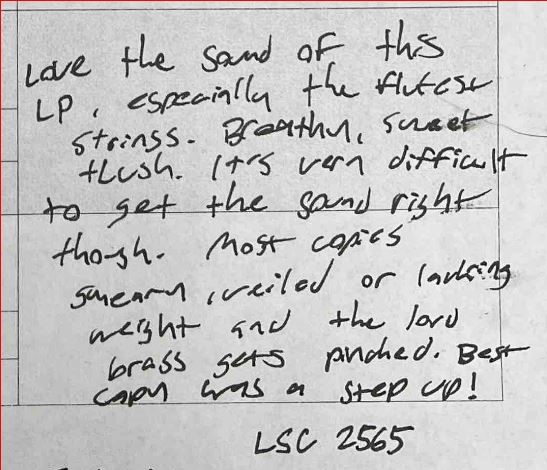
Our notes for LSC 2565 read:
Love the sound of this LP, especially the flutes and strings. Breathy, sweet and lush.
It’s very difficult to get the sound right, though. Most copies are smeary, veiled or lacking weight and the loud brass gets pinched. Best copy was a big step up!
We described the Top Copy from our 2023 shootout this way:
Wonderful Living Stereo sound throughout this original Shaded Dog pressing.
Our White Hot Shootout Winner was simply amazing sounding — some of the best orchestral sound we have heard lately, especially audible in exceptionally breathy flutes and sweet strings.
It was a quite a step up in sound quality over even the closest contender, which just goes to show how hard it is to come across these very special pressings no matter how many Shaded Dogs you play.
Our favorite performance of the Tchaikovsky — when you hear it played by the BSO, guided by the baton of the supremely talented Charles Munch, you know you are hearing the work performed with the greatest skill and interpreted as authentically as is humanly possible.
Spacious, rich and smooth – only vintage analog seems capable of reproducing all three of these qualities without sacrificing resolution, staging, imaging or presence.
Another amazing recording from the 60s, brought to you by your vinyl-loving friends at Better Records.
- The three-dimensional space and Tubey Magic are jaw-dropping on this copy.
- An amazing Living Stereo all analog recording from 1962 – nothing else sounds like it.
- When you’ve played as many Living Stereo titles as we have (250+ and counting), you’re bound to run into this kind of Demo Disc sound from time to time – it’s what makes record collecting fun.
- It’s the kind of record we live for here at Better Records.
Side One
Romeo & Juliet: Overture-Fantasy
Side Two
Till Eulenspiegel’s Merry Pranks
Romeo and Juliet (Tchaikovsky)
Romeo and Juliet, TH 42, ČW 39, is an orchestral work composed by Pyotr Ilyich Tchaikovsky. It is styled an Overture-Fantasy, and is based on Shakespeare’s play of the same name. Like other composers such as Berlioz and Prokofiev, Tchaikovsky was deeply inspired by Shakespeare and wrote works based on The Tempest and Hamlet as well.
Unlike Tchaikovsky’s other major compositions, Romeo and Juliet does not have an opus number.
Till Eulenspiegel’s Merry Pranks
Till Eulenspiegel’s Merry Pranks, Op. 28, is a tone poem written in 1894–95 by Richard Strauss. It chronicles the misadventures and pranks of the German peasant folk hero Till Eulenspiegel, who is represented by two themes. The first, played by the horn, is a lilting melody that reaches a peak, falls downward, and ends in three long, loud notes, each progressively lower. The second, for D clarinet, is crafty and wheedling, suggesting a trickster doing what he does best. (Till Eulenspiegel is a well-known Schnickelfritz.)
The music follows Till throughout the countryside, as he rides a horse through a market, upsetting the goods and wares, pokes fun at the strict Teutonic clergy (represented by the violas), flirts with and chases girls (the love theme is given to the first violins), and mocks the serious academics (represented by the bassoons).
The music suggesting a horse ride returns again, with the first theme restated all over the orchestra. The climax abruptly changes to a funeral march. Till has been captured by the authorities, and is sentenced to death for blasphemy. The funeral march of the headsman begins a dialogue with the desperate Till, who tries to wheedle and joke his way out of this predicament. Unfortunately, he has no effect on the stony executioner, who hangs him. The progress of Till being hauled up the gallows is graphically painted by the D clarinet, with the anticipatory drumroll emulated by the flutes after he has reached the top. The D clarinet wails in a distortion of the first theme, signifying his death scream as the drop begins, and a pizzicato by the strings represents the snapping of his neck as the noose rope reaches full extension. After a moment of silence, the “once upon a time” theme heard at the beginning returns, suggesting that someone like Till can never be destroyed, and the work ends with one last quotation of the musical joke.
– Wikipedia