crude-sound

These are records with crude sound.

If Only I Could Remember My Name – Another in a Long Line of Classic Records’ Mediocrities

Hot Stamper Pressings of the Music of David Crosby Available Now

What do you get with our best Hot Stampers compared to the Classic Heavy Vinyl reissue?

On high quality equipment, you can expect to hear improvements in all of the following areas:

  • Noticeably more warmth,
  • Noticeably more sweetness,
  • Noticeably more delicacy,
  • Noticeably more transparency,
  • Noticeably more ambience,
  • Noticeably more energy,
  • Noticeably more size (width and height),
  • Noticeably more correct timbres (without the boost to the top and the bottom end that the Classic suffers from).

in other words, the kind of difference you almost ALWAYS get comparing the best vintage pressings with their modern remastered counterparts, if our first hand experience with thousands of them can be considered evidentiary.

The Classic is a decent enough record. I might give it a “C” or so. It’s sure better than the Super Saver reissue pressing, but that is obviously setting a very low bar. No original I have ever played did not sound noticeably better than Bernie’s recut.

A Hot Stamper of an amazing recording such as this is a MAGICAL record. Can the same be said of any Classic Records release? None come to mind.

By the way, the remastered CD that came out in 2011 (I think that’s the one I have) is excellent, with a surprising amount of the Tubey Magic that is on the original tape. On a good CD player it would be clearly superior to the Classic vinyl, and for that reason, we say buy the CD.

(more…)

Does 1s Sound Great or Does It Sound Good (but Hot, Dry and Crude)?

Hot Stamper Pressings of Living Stereo Recordings Available Now
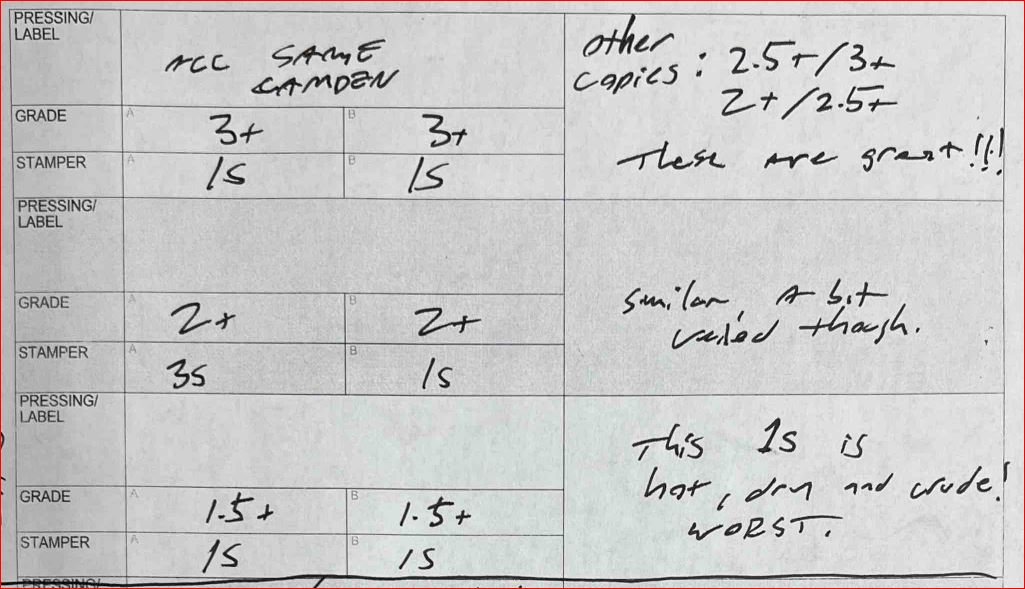
Below you will see the complete stamper sheet for a shootout we did recently.

Note that the album you see pictured is not the record we did the shootout for.

We are not revealing what record had these stampers and earned these grades for the simple reason that we rarely if ever give out the specific information that identifies the best sounding pressing of any album.

As I’m sure you can understand, we want you to buy the copy with the Hottest Stampers from us, not find one on your own! We’re happy to be moderately helpful, but naturally we find it necessary to draw the line somewhere, and giving out “the shootout winning stampers” is where we choose to draw it.

How Come?

Since, as we discovered recently, 1s wins, and handily, why would any 1s pressing sound as bad as the one at the bottom does?

(Which by the way is not actually bad — just far from the best.)

If the 1s wins the shootout as it did here, that means that the received knowledge about RCA Living Stereo pressings being better on the first pressing is correct.

But if you are the unlucky buyer of the 1s that did not do nearly as well, you might say to yourself “Hey, I thought the 1s pressing was supposed to be the hot ticket. Wha’ happen?” (Assuming you don’t conclude that the recording is at fault, which is what most audiophiles and record collectors would be likely to do. I did it and I bet you did too.)

We noted in a commentary from many years ago that the record collecting theories we see commonly promoted by those who consider themselves “in the know” seem to have a great deal of trouble accounting for these anomalies.

We had two copies of Court and Spark, each with one good side opposite a bad side on the same pressing. An excerpt:

(more…)

VICS 1069 – In 2004 We Mistaked Finlandia on VICS for a Demo Disc

Hot Stamper Pressings of the Music of Sibelius Available Now

UPDATE 2024

We played a 4S/1S copy of this record, VICS 1069, and thought it sounded terrible.

It was flat and bright with splashy cymbals and crude brass.

Even if we assume the copy we played many years ago could have been much better than this latest pressing — which is doubtful but certainly possible — there is no reason to pursue this version of the album when there are known top quality pressings of this very same performance on Decca.


Our Old Review

DEMO QUALITY SOUND and quiet surfaces too.

I don’t know when I’ve heard this album with better sound. This one may be better than the best Shaded Dog for all I know — it’s that good.

You’ll notice that there is a copy of this very same record on the website for $1.99. That one sounds dull. I don’t think you’ll be able to find a better sounding copy of this record than the pressing we are selling here, because it really is an exceptionally good sounding record. If it weren’t, it would be more like $1.99.

(more…)

This London from 1961 Didn’t Make the Grade

Hot Stamper Classical and Orchestral Imports on Decca & London

1961 just happens to be one of the greatest years for high quality analog recordings. Just check out this amazing group of albums, all recorded or released that year.

This London LP was released in 1961, right in the heart of the Golden Age, so we figured it had a good chance of displaying the kind of relaxed, immersive, smooth, rich, Tubey Magical Decca sound we absolutely cannot get enough of here at Better Records.

As we were preparing to do the shootout with the six copies of CS 6202 we had amassed over the years, we suddenly ran into a big problem.

(Cue sound effect of record being scratched here.)

(more…)

Another Unimpressive Reissue Pressing of Coltrane’s Music — What Is Going On?

Hot Stamper Pressings of the Music of John Coltrane Available Now

We had an early Blue Label Prestige mono pressing that was not as awful as the original Yellow Label mono we played, but it’s not very good either. Our grade for a record that earns one plus on both sides is passable.

Which means you could play it, maybe even enjoy it, but you would have no idea just how well Rudy Van Gelder recorded the sessions in 1958 that went into the making of the album, which as you know was not compiled for release until 1962.

As you can see from the notes above, it was crude, smeary and thick. We don’t sell records that sound like that.

I can’t say that most modern remastered records are crude, although some of them are, but a great many we’ve played are smeary, and almost all of them are thick — that is, lacking in transparency — to some degree. That last quality — a lack of transparency — may be the most irritating of all, a subject we discuss here.

(A great many records we’ve auditioned over the years are good for testing transparency. Those wanting to improve this aspect of their playback should consider making use of them.

(more…)

Beethoven Symphony No. 7 – This London with Solti Didn’t Make the Grade

Hot Stamper Classical and Orchestral Imports on Decca & London

In our survey for the work, we played a number of the better known recordings from the top conductors and orchestras around the world.

Here is what we heard when we dropped the needle on an early pressing of CS 6093, released in 1959.

Our notes read:

  • Awful,
  • so dry,
  • steely,
  • crude,
  • bad

In other words, it just sounded like an old record. The world is full of records that don’t sound very good. As a matter of fact they undoubtedly make up the bulk of large record collections.

And if you just happen to be the proud owner of a big record collection, how can you possibly find the time to play more than a small fraction of it in any given year. Or even over the course of a decade for that matter.
The fact is that you can’t. Which, on the upside, means that, as far as you know, all your records sound great!

No need to buy another copy of whatever title you care to name. What for? You haven’t played it in twenty years and probably won’t get around to pulling it off the shelf for a spin for at least another twenty.

Here’s hoping your kids like old records because they are going to end up with an awful lot of them.

Back to the Beethoven 7th. What a beautiful cover!

But what good is a beautiful cover when the record sounds as bad as this one does?

(more…)

This Blueback Was Somewhat Opaque and Crude – Does that Surprise You?

Hot Stamper Pressings of the Music of Felix Mendelssohn Available Now

Presenting our latest findings from 2023:

For our most recent shootout, the original we played earned grades of 1.5+ on both sides, a grade that is the absolute minimum for a Hot Stamper pressing to be listed on the site now.

Our best reissues killed it.

The 3D/3E stampers of our early Blueback copy can probably be beaten by others — assuming there are others — but this is just not a good bet for us when it comes to Mendelssohn’s famous Third Symphony, not when there are so many other pressings with superior sound.

Our favorite performance with top quality sound is made from the same recording you see here, but on a certain budget reissue that has much better sound.

It’s very possible that the Speakers Corner Heavy Vinyl pressing from 2003 pictured below would beat the original we describe. We make no claims that it doesn’t, or wouldn’t.

Our claim would be that a properly-mastered, properly-pressed version of the album is very unlikely to be bested by something from Speakers Corner, or any other label making records during the last thirty years.

What I would have played against the Speakers Corner pressing in 2003 would have been an original London Blueback, and maybe a Stereo Treasury or two. Both of them would have been obvious choices, and I was stuck making obvious choices because I simply did not understand enough about classical records at the time to do otherwise.

I confess I knew very little about the recording of the 3rd symphony back in those days, and I certainly didn’t know how good some of the right reissues could sound.

Obviously we needed to do a great deal more research and development, which we began to undertake over the course of the next twenty years in a much more serious way, making one discovery after another.

And that all happened out of the love for great sounding music on vinyl, and, every bit as importantly, because we get paid to do it.


(more…)

Why are the First Pressings of this Title the Worst Sounding?

Hot Stamper Pressings of Recordings by Decca Available Now
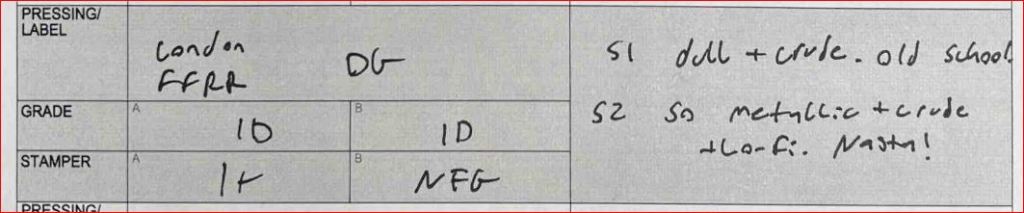

The record you see pictured is not the record we are discussing in this posting. The stamper numbers you see below belong to a different album.

We’ve lately been giving out much more stamper information than we used to, but for now we are keeping this title close to the vest.

We happen to know the best stampers for this album, but somehow a copy with the “bad” stampers ended up in our shootout. It did about as badly as they usually do.

Of course, the person sitting in the listening chair had no idea that a copy with the worst stampers was playing. The jackets and labels of this pressing are identical to the copies with the good stampers.

He simply heard what the recording actually sounds like when it’s mastered badly and registered his complaints.

Side One

  • Dull and crude. Old school.
  • 1+

Side Two

  • So metallic and crude and lo-fi. Nasty!
  • NFG

Apparently Mr. D, real name: Jack Law, did a piss-poor job mastering this album. Another engineer would come along sooner or later and master the record right, so right that it became one of our favorite Demo Discs for sound and performance.

How did this pig’s ear eventually manage to become a silk purse?

Simple. It was always a great recording, it just needed to be mastered right, and whoever got the job to remaster it knocked it out of the park the first time through.

(more…)

The 2013 OJC of Brilliant Corners Has a Problem Many of Them Do

Hot Stamper Pressings of Top Quality Jazz Recordings Available Now

Brilliant corners on the 2013 OJC pressing is not a bad record. At $20, roughly the price they sell for on Discogs, you are getting a decent LP for your money, which is not the case with a lot of what’s produced these days, the worst of which can be found here.

The sound is nice and meaty, which is all to the good, but where this pressing falls apart is in the area of transparency, as in, it doesn’t have much.

In simple language, it is opaque. (Other pressings with a opacity problem can be found here.)

This is a very common shortcoming of the new OJC pressings. When they manage to get the tonality right — which is about  half the time — they still come across as crude and underwhelming. They require too much effort from the listener to become involved and stay that way.

If you see this OJC pressing in your local record store, and you don’t have a good CD player (a dirty little secret: the standard CD is likely to be better sounding). buy it for cheap, but don’t pay much money for it. You may find that, after a spin or two, playing it is more trouble than it’s worth.

(more…)

The Weavers At Carnegie Hall, Vol. 2 Is Bad News in Mono

Hot Stamper Pressings of Live Recordings Available Now

We recently did a shootout for this famous Weavers album. These are just a few of the things we had to say about our shootout winner in the notes:

“Tubey and 3D and weighty”…”very full and detailed vox”…”sweet and tubey and present”…”so much space and bass.” Both of these sides are rich and full, Tubey Magical, and tonally correct from top to bottom. The sound is big and open, with the performers front and center (as well as left and right).

Our notes for the early red label mono pressing we played noted that it was “crude, congested and awful.” There are plenty of mono pressings on Vanguard with excellent sound, but this is not one of them.

Here is an extract from the stamper sheet showing the sonic notes and the stamper numbers of the mono pressing we played.

Crude and congested vocals? On a Weavers record? What could be worse?

We didn’t even bother to play side two. Why waste any more time on such an awful sounding record?

When the voice is wrong, you my friend have yourself a completely worthless piece of vinyl.  (Other titles that get the voice wrong and therefore should be avoided by audiophiles of all stripes can be found here.)

The world is full of old records that just sound like old records. We’ve suffered through them by the tens of thousands. (Yes, you read that right. We play thousands of records every year, and we’ve been doing it for more than two decades . They add up!)

Our website, as well as this blog, are devoted to helping audiophiles find pressings that don’t sound anything like the millions of run-of-the-mill LPs that were stamped out with little regard for sound quality for more than seven decades.

Even a million dollar stereo can’t make the average record sound good, and the more accurate and revealing the system, the more limited and lifeless the average record will show itself to be.

(more…)