 Hot Stamper Pressings of Mercury Living Presence Records Available Now
UPDATE 2025
This listing was written all the way back in 2012 for the first Hot Stamper pressing of SR 90435 we’d ever listed as a Hot Stamper.
Note that it only had one good side, and even that side had a serious problem.
Thirteen years later in 2025 we would do a real shootout for this wonderful recording and learn something very few audiophiles know to this day — that the best stampers and the worst stampers are sometimes the same stampers.
Our 2012 Review
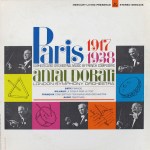
Super Hot Stamper sound for Eric Satie’s wonderfully eccentric Parade (and the Auric piece as well) can be found on this rare original promo copy of Mercury SR 90435, a record that was previously on the TAS List if I’m not mistaken.
It certainly deserves to be. The sound is BIG and OPEN, and like so many Mercury recordings with the London Symphony, it’s rich and full-bodied, not thin and nasally as is so often the case with their domestically recorded releases. Above all the sound is transparent, lively and dynamic.
In many ways this album would certainly serve quite well as an audiophile Demo Disc: the timbre of the wide array of instruments used is (mostly) Right On The Money.
Check out the lengthy and humorous producer’s notes for the sessions below. And people think The Beatles discovered experimental sounds in the studio.
The Brass Lacked Weight
With one small exception: the brass doesn’t have all the weight of the real thing, and for that we have deducted one plus from our top grade of three.
Side one has classic bad Mercury sound.
So screechy, hard and thin. How many audiophiles own records like this and don’t know that the sound of one side is awful and the other brilliant?
Since so few have ever commented publicly about such matters — and even supposedly knowledgeable audiophile reviewers never bother to even bring up the subject of one side versus the other — one must conclude that this is a subject that has yet to pierce the consciousness of most of our audiophile brethren, especially the ones who haven’t yet discovered this site.
Now’s a good time to start. Dig in, you may be surprised by what you find.
Harold Lawrence, RECOLLECTIONS
The Story of the Recording:
Apart from the percussion, we should have no special problems with Parade.” So Antal Dorati assured me a few days before we began to record. There was no reason to doubt him. The music in question was a ballet score by Erik Satie ( 1866-1925), the eccentric French composer who dressed in grey velvet from head to toes, lived in a poor workingman’s suburb of Paris, and represented for composers like Ravel and others the new post-impressionist movement in French Music. Satie’s ballet is ‘easy’ to perform. The-15-minute work, composed for Diaghilev in 1917, moves along at an unvarying metronomic rate of 76; the thematic material is uncomplicated to the point of naivete; and the orchestration is lean, despite the large forces involved. In fact, for some players in the London Symphony, it was perhaps too easy. Remarked Barry Tuckwell, the orchestra’s superb first hornist: “When are you going to give us some semi-quavers to play?”
But James Holland, the principal percussionist, was not so complacent. It was his job to assemble a battery of seventeen instruments, most of which belonged to the traditional percussion family. They included snare drum, bass drum, cymbals, tam-tam, tambourine, woodblocks, small drum, lottery wheel, xylophone, triangle, sirens ( high- and low-pitched ), revolver, faques sonores, and bouteillophone. First, Holland tackled the bouteillophone.
As its name implies, the bouteillophone consists of tuned bottles, fifteen of them whose range extends from D above middle C upwards for two octaves – a typical Satiesque ‘instrument .”I’ve never heard of bottles actually being used in a performance of this score,” explained Holland. “The vibraphone is the closest we percussionists can come to the sound of tuned bottles. But we’ll try.”
The manager of the Watford supermarket began to fill two “shells” (English for “cases” ) with empty ginger-beer bottles.
“What do you plan to do with these?” he said as he lifted them into the counter. “Why, I’m going to ‘prepare’ them for a recording session,” Holland replied; and he placed his strange purchase in the trunk compartment of his car and drove to the Town Hall. In the kitchen, he and his assistant poured varying quantities of water into the bottles, carried them into the auditorium, and began hitting them with mallets. With the vibraphone standing by, Holland began to ‘build’ the required scale. He tapped, listened, poured off water from one bottle, added some to another. Finally, the percussionist had to admit defeat. Standing in a puddle and grasping his wet mallet, he reported that the bottles could not encompass the entire range. The vibraphone was rolled into position and the bottles put back in their shells.
For the second time, water was to spell frustration for the percussion section. In the movement, Prestidigitateur Chinois ( Chinese Conjurer ), Satie scored a brief ~passage for “flaques sonores” ( literally translated: “resonant puddles” ), which are written to resound 15 times. When asked which instrument he planned to use for this, Dorati skirted the puddle and asked me to conduct an investigation into the exact nature of the composer’s ‘instrument.’
I first discussed the problem with Felix Aprahamian, music critic of the Sunday Times and an expert in French music. “I haven’t the slightest idea of what Satie could have had in mind,” he protested. “But why don’t you contact Rollo Myers. He’s written a book on Satie. He’s your man.” I phoned Myers in Sussex. “Plaques sonores! ( Pause ) Probably one of Satie’s jokes.” He liked to invent instruments, you know.” Editions Salabert, Satie’s publisher, was no more helpful. Apparently the choice of instrument is left to the percussion player, I was informed.
Holland and I put our heads together. What would most resemble a resonant puddle? “A small cymbal might do it,” Holland said, whereupon he jangled through his trunk of small percussion instruments and came up with a cymbal which he struck several times. The sound of metal was too dominant. “Choke it this time and use a different stick,” I said. After some experimentation, Holland achieved exactly the right fortissimo splash.
On hearing it, Dorati agreed that the effect was correct, but he said: “Look, gentlemen, why don’t we try to simulate the sound of a real puddle? We have nothing to lose; if it doesn’t work, we’ll return to the cymbal.”
Within minutes, a large roasting pan was located in the Town Hall kitchen, filled with water, and brought into the auditorium. While the recording staff listened in the control room upstairs, the percussionist slammed his cymbal into the “puddle.” The sound of water being agitated was plain, but no splash. Dorati suddenly hopped off the podium, rolled up his sleeves, and, his eyes gleaming with boyish delight, slapped the water vigorously. A dozen first violinists were instantly splattered with the flaque. Over the microphones it sounded as if someone had plunged into a large bath tub. Much laughter. It was decided unanimously that, in this case, imitation of life was preferable to the real thing.
The bottles and roasting pan were put aside, leaving the percussionist free to devote himself to a ‘dry’ Parade. He turned his attention to the six revolver shots in Petite Fille Americaine, the second and third of which were to be fired in rapid succession. After several ear-splitting rehearsals, Holland discovered that the trigger mechanism of his revolver would not allow him to fire off the two shots rapidly enough. He therefore assigned the third shot to an assistant. “Bang . . . Bang-Bang . . . Bang . . . Bang . . . Bang.” Perfect!
Typewriters were now required for the same scene. A pair of office machines had been transported from the headquarters of the London Symphony early on the morning of the first Parade session, along with two typists, male and female. The typewriters were placed on a table near the first violinists, much to the distraction of the players (all male) who kept stealing glances at Sarah Park, the attractive young London Symphony secretary. Feeling that the typing should sound purposeful, Dorati instructed the typists to copy items from daily newspapers, preferably one which they had not yet read. Miss Park, however, alternated between the obituary page and a remembered lesson from typing school: ‘”Now is the time for all good men to come to the aid of the party Cremation private no flowers please now is the time to come to the hospital but no flowers please, etc.” The typewriters were to sound continuously for 16 bars, with a precise start and finish.
The other percussion effects posed no unusual problems, and the section as a whole was deployed in the following manner: bass drum, tambourine, snare drum, and cymbals were placed slightly to the right of center, between the woodwinds and trumpets; lottery wheel, tam-tam, revolver, xylophone, vibraphone, sirens, triangle, and woodblocks were arrayed along the outskirts of the violin sections from left to center; and typewriters and faques sonores were located left of the podium.
As Satie’s gently amusing score unwinds with clocklike regularity in the completed recording, with each percussion effect turning up at the appointed second, it all must seem so effortless to the listener. The chief percussionist, however, will always remember it as the time he was as busy as the sound-effects in an in a Gangbusters radio serial.
Darius Milhaud
Le Boeuf sur le Toit
Jean Françaix
Concertino
George Auric
Ouverture pour Orchestra
Erik Satie
Parade
Ballet réaliste sur un thème de Jean Cocteau
This is an Older Classical/Orchestral Review
Most of the older reviews you see are for records that did not go through the shootout process, the revolutionary approach to finding better sounding pressings we started developing in the early 2000s and have since turned into a veritable science.
We found the records you see in these older listings by cleaning and playing a pressing or two of the album, which we then described and priced based on how good the sound and surfaces were. (For out Hot Stamper listings, the Sonic Grades and Vinyl Playgrades are listed separately.)
We were often wrong back in those days, something we have no reason to hide. Audio equipment and record cleaning technologies have come a long way since those darker days, a subject we discuss here.
Currently, 99% (or more!) of the records we sell are cleaned, then auditioned under rigorously controlled conditions, up against a number of other pressings. We award them sonic grades, and then condition check them for surface noise.
As you may imagine, this approach requires a great deal of time, effort and skill, which is why we currently have a highly trained staff of about ten. No individual or business without the aid of such a committed group could possibly dig as deep into the sound of records as we have, and it is unlikely that anyone besides us could ever come along to do the kind of work we do.
The term “Hot Stampers” gets thrown around a lot these days, but to us it means only one thing: a record that has been through the shootout process and found to be of exceptionally high quality.
The result of our labor is the hundreds of titles seen here, every one of which is unique and guaranteed to be the best sounding copy of the album you have ever heard or you get your money back.