Roy DuNann, Engineer – Reviews and Commentaries

Letter of the Week – “I will spare you the time to comment on my 1992 Analogue Productions Reissue…”

Hot Stamper Pressings of Sonny Rollins’s Albums Available Now

One of our good customers had this to say about some Hot Stampers he purchased recently:

Dear Tom and Fred

After having had the opportunity to listen to the next batch of 7 more records, here are my observations on the now 40 records I bought from you.

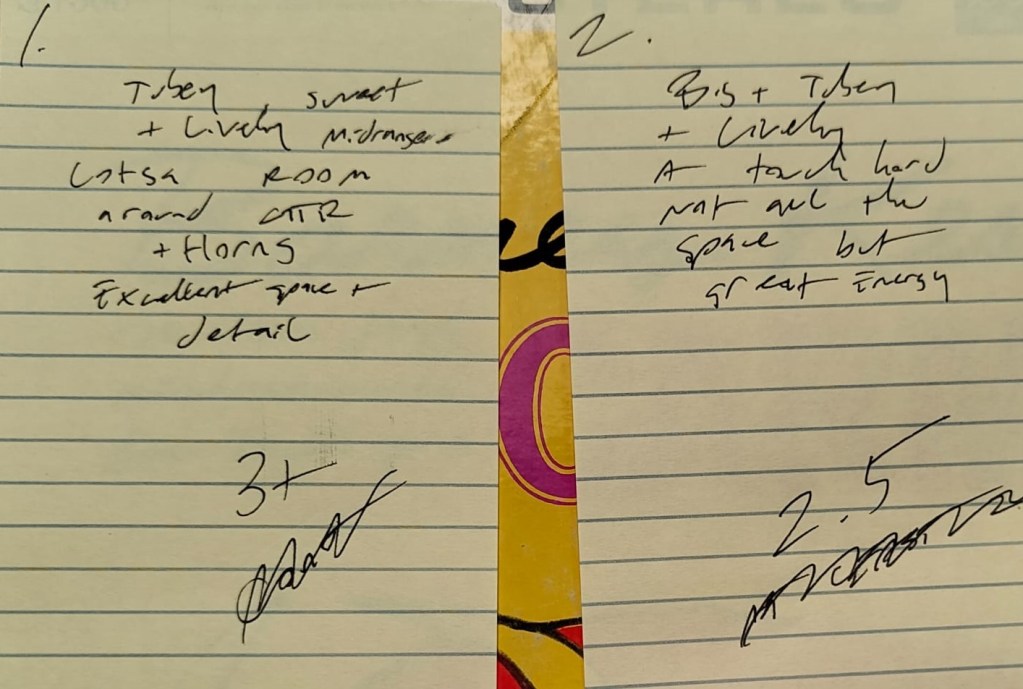
First to my listening experience. After receiving the CSNY 4 Way Street and looking for my own record, I thought was a German press easy to beat I realized it was a white label promo first press and thought, oh, did I make a mistake to buy this for this kind of money from you guys, this may be a tough one to crack?

Not so, your SH Stamper clearly beat the WL promo, check!

Next up was the Miles Davis Sketches of Spain White Hot Stamper, one of my very top Miles favorites.

I did not recall that I had the six eye first press, and on side 2, with identical stampers (when your 3/3 WH show up, you do not have the time to check this but hurry :-since your WH 3/3s sell like hot cakes!).

So even more difficult to beat?? Promising start: your WH was clearly better on side 1, now to the identical stampers side 2: not as clearly but still just more transparent, better drums, less shrill on track 2, check!

But it certainly cannot get better than this 3/3 WH stamper, can it?

Next up is Sonny Rollins 3/3 WH Stamper [of Way Out West]. Hard to believe, but yes, even better than the great Miles 3/3 WHS, and I will spare you the time to comment on my 1992 Analogue Productions reissue which I always thought was quite decent.

And so it goes on…

Christian

Christian,

In less than a year you have acquired a large number of simply amazing sounding records. Congratulations.

As you point out about the stampers, you may have a pressing with the right stampers, but our copy will still beat it. How it was pressed and how it was cleaned are critical to the sound, and that is not something the stamper numbers can tell you. It’s a subject we discuss all over this blog. Here is a good place to start.

As for your 1992 Analogue Productions Heavy Vinyl remaster, I honestly don’t know how anyone can listen to a record with sound like that and consider it acceptable, or, in your words, “quite decent.” I went into the long story of the album in this commentary.

(more…)

Hampton Hawes at the Piano Is His Best Album

Hot Stamper Pressings of the Music of Hampton Hawes Available Now
This Contemporary Yellow Label LP has the best sound and the best music we have ever heard on a Hampton Hawes album.

When we frist dropped the needle on this one many years ago we could not believe our ears — it’s got The Big Sound, that’s for sure.

If you’re a fan of jazz piano trios playing live-in-the-studio, this Contemporary from 1958 surely deserves a place in your collection. Of course it’s a personal favorite of yours truly.

This is my favorite Hampton Hawes record of all time. He died less than a year after these sessions. Looking at the cover, you can almost see in his face his acceptance of the end he knew was coming. He plays with deep emotion here.

Ray Brown and Shelly Manne (the same rhythm section who back Joe Sample on my all-time favorite piano trio album, The Three) accompany Hawes beautifully here.

As good as The Three may be, it is not remotely as natural sounding as this Contemporary recording by Roy DuNann. Due to the multi-miking approach Lee Herschberg took for the session, Shelly Manne’s drums on The Three stretch from speaker to speaker, presenting us with a drummer whose arms are impossibly long.

On this Contemporary recording the drummer is placed in the soundfield in one fixed location and his drum kit is the size of a standard jazz kit of the ’50s. I’m good with either approach, but there’s no question which one is more natural.

Drop the needle on “Blue In Green” on side two — the sound of the bowed bass is WONDERFUL. The version of “Killing Me Softly With His Song” that opens the album is especially lovely. (One high point of this album is the interview that Lester Koenig conducts with Hampton Hawes on the back cover. Lester died soon thereafter himself.)

(more…)

How Does the D1/D1 Jazz Giant Black Label Pressing Sound?

Hot Stamper Pressings of Contemporary Jazz Albums Available Now

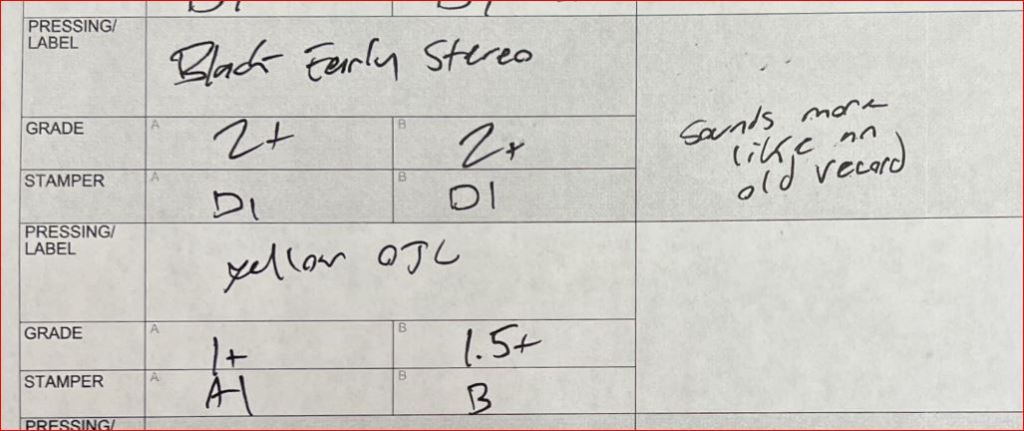
Even though the Black label original of Jazz Gianot we played in our shootout held its own well enough, it did suffer from a slight case of “old record” sound.

Head to head with the best vintage reissues, it was a bit crude, didn’t extend fully on the top end, and wasn’t as resolving in the midrange.

The fact that it earned a Super Hot (A++) sonic grade means that it could not have sounded too much like an old record. It was still doing most everything right.

It just had a few sonic shortcomings we recognized were holding it back.

The reissues that beat it in the shootout showed us just how good the album could sound, maybe not night and day better, but definitely better, a full grade better.

The Black Label original we played would still beat the pants off the godawful Analogue Productions Heavy Vinyl pressing that came out in the 90s, the one mastered by the formerly-brilliant Doug Sax.

For those who may not have been collecting back then, we describe in great detail the bad sound of the Heavy Vinyl pressing that AP produced for their version of Way Out West in 1992.

Mobile Fidelity got into the reissue act in 1994, making murky-sounding records on 200 gram vinyl and calling them Anadisqs.

Classic Records started producing their bright, screechy reissues of Living Stereo titles that year as well.

It seems a lot of bad sounding records were being made back then!

Is it any different now? (If it is, please contact me at tom@better-records.com and tell me what you think the differences are. I am at a loss after playing these six Heavy Vinyl titles in 2024 and finding that all of them fell well short of the mark. What mark is that, you ask? Why, the mark set by their vintage counterparts.)

(more…)

Proper VTA Is Essential to Getting the Sound of Benny’s Muted Trumpet Right

Hot Stamper Pressings of Contemporary Jazz Albums Available Now

For us audiophiles both the sound and the music here are enchanting. If you’re looking to demonstrate just how good a 1959 All Tube Analog recording can sound, this killer copy will do the trick.

The sound of the muted trumpet on side two is out of this world.

It has exactly the sonic signature of good tube equipment — the ability to make some elements of a recording sound shockingly real. There are tradeoffs with tube mastering to be sure, a subject we discuss in some depth here.

The trumpet is also a very good test for turntable setup, tracking, as well as arm and cartridge compatability. You’ve got to be set up properly for every aspect for a difficult-to-reproduce instrument like the trumpet to sound right.

Accurate VTA adjustment is critical to the record reproduction. If you do not have an arm that allows you to easily adjust its VTA, then you will just have to do it the hard way (which normally means loosening a set screw and moving the arm up and down until you get lucky with the right height).

Yes, it may be time consuming, it may even be a major pain in the ass, but there is no question in my mind that you will hear a dramatic improvement in the sound of your records once you have learned to precisely adjust the VTA for each and every one of them.

VTA is not a corner anyone should be cutting.

Careful adjustment of VTA is critical to getting good sound.

Of course, so are anti-skate, azimuth and tracking weight.

(more…)

Audiophiles Should Stick with Stereo on Looking Ahead!

Hot Stamper Pressings of Contemporary Jazz Albums Available Now

As a general rule, audiophiles should stick to stereo pressings of stereo recordings.

Case in point: The early stereo pressing of the album you see pictured to the left is an amazing Demo Disc quality jazz record.

Here is how we described a killer copy we found recently:

We play a lot of vintage Contemporary recordings, but this one surprised us right from the first track with sound that stands out — this on a label that produced many of our favorite standout recordings.

Both of these sides are clean, clear, and transparent, with an abundance of energy and wonderful clarity in the mids and highs.

This is not an easy record to come by, as evident by how long it took us to get our most recent shootout going, and they usually don’t sound anywhere near this good when you’re lucky enough to be able to track one down.

Mono Mistakes

However, do not make the mistake of thinking that any of these wonderful comments apply to the two mono pressings we played.

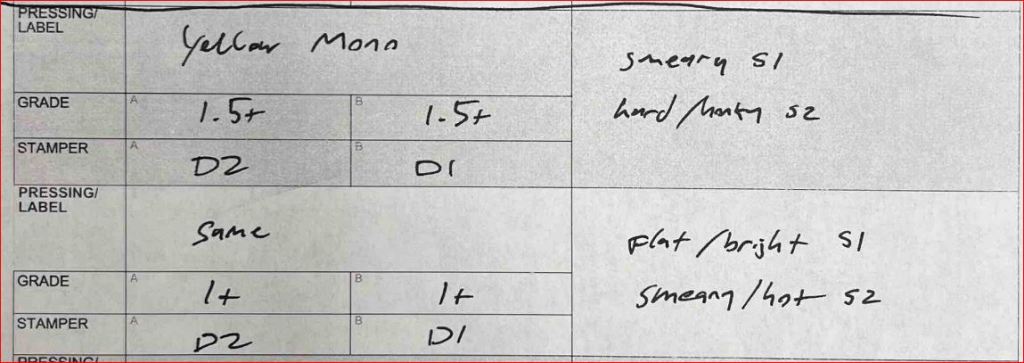
One was passable, earning our 1.5+ grade. It’s a nice enough sounding record I suppose. Smeary, hard and honky.

Of all the Heavy Vinyl pressings we’ve played over the years, only a handfull of the best of them would earn that grade or better. They would suffer from a different suite of problems, but they would be problems nonetheless. Some of our reviews for them can be found here.

1.5+ is four grades down from the top copy. That is a steep dropoff as far as we are concerned. 1.5+ only hints at how good a recording Looking Ahead! can be on the best vintage pressings. (The OJC we played earned the same grade.)

(more…)

You Simply Cannot Record a Piano Better than Roy DuNann

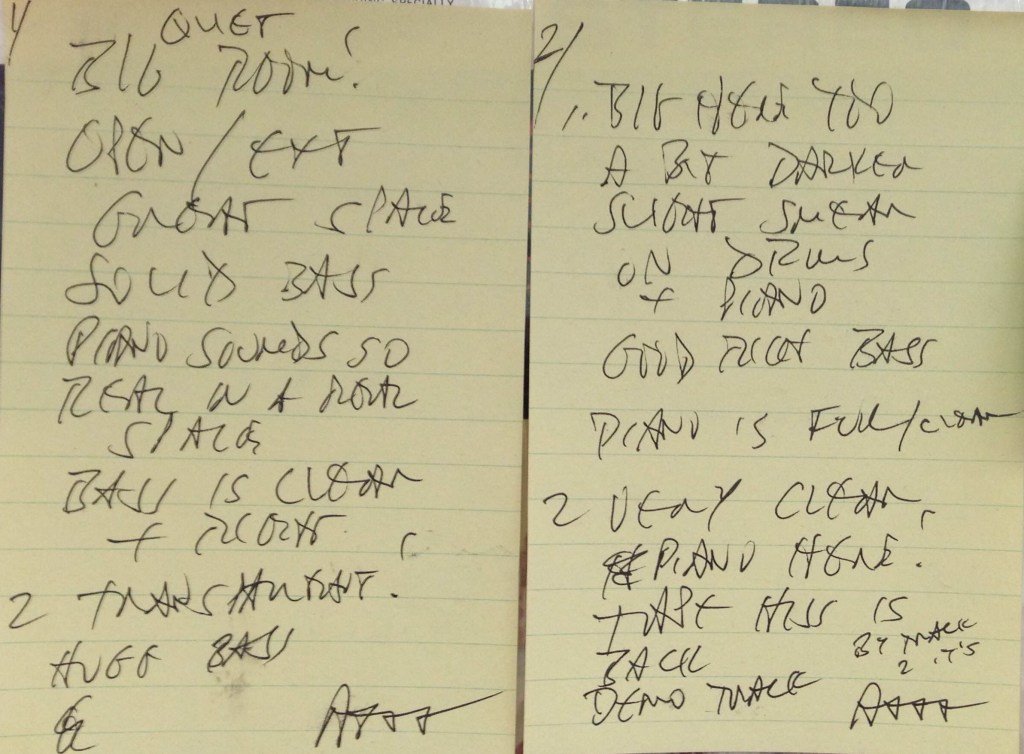
The piano sounds uncannily lifelike right from the start, a beautiful instrument in a natural space, tonally correct from top to bottom. I can’t think of any record off the top of my head that gets a better piano sound than this one.

Listen to the tambourine on the third track on side one. Shelly Manne messes about with lots of percussion instruments on this album and all of them are recorded to perfection.

Not to leave Red Mitchell out, check out the bass; it’s deep and note-like throughout the album.

Better Than a Dream, the second track on side two, has one of the best sounding jazz pianos I have ever heard. My notes say “you cannot record a piano any better” and I stand behind that statement one hundred percent.

There is not a modern reissue on the face of the earth that can hold a candle to the sound of this record.

For any of you out there who doubt my words please take this record home and play it against the best piano jazz recordings you own. If it doesn’t beat them all we are happy to pay the domestic shipping back.

Even our amazing sounding 45 RPM pressing of The Three does not present the listener with a piano that sounds as real as the one on this record.


(more…)

Audiophiles Should Skip the OJC of More Swinging Sounds

Hot Stamper Pressings of Well Recorded Jazz Albums In Stock Now

The vintage OJC pressings we played in our most recent shootout suffer from sonic problems common to many of these reissues: it was bright and dry.

To help you avoid records with this kind of sound, better suited to those who might prefer the sound of a compact disc to vintage vinyl, we have linked to others with similar problems on the blog.

Here are some of the titles we found had dry sound and here are some that had bright sound.

The OJC pressing of this album is clearly better suited to the old school audio systems of the 60s and 70s than the modern systems of today. These kinds of reissues used to sound good on those older systems, and I should know, I had an old school stereo and some of the records I used to think sounded good back in the day don’t sound too good to me anymore (although this one never did).

The OJC pressings of More Swinging Sounds are thinner and brighter than even the worst of the later pressings we’ve auditioned. That is decidedly not our sound. It’s not the sound Roy DuNann was famous for, and we don’t like it either, although we have to admit that we did find the sound of many of these OJC pressings more tolerable in the past.

(more…)

What I Couldn’t Hear on My 90s Tube System

Hot Stamper Pressings of Contemporary Jazz Albums Available Now

I have a very long history with Bells Are Ringing, dating back to the 90s. My friend Robert Pincus first turned me on to the CD, which, happily for all concerned, was mastered beautifully and comes highly recommended if you want to work on your digital playback or other non-analog aspects of your system such as your room, electricity, speaker placement and such like. (More recommended CDs here.)

Back in the day we often used it to test and tweak some of the stereos in my friends’ systems.

Playing the original stereo pressing, all I could hear on my 90s tube system was

  • blurred mids,
  • lack of transient attack,
  • sloppy bass,
  • lack of space and transparency,
  • and plenty of other shortcomings too numerous to mention.

All of which I simply attributed at the time to the limitations of the vintage jazz pressing I owned.

A classic case of me rather foolishly blaming the recording.

I know better now. The record was fine. I just couldn’t reproduce it.

Well, things have certainly changed. I have virtually none of the equipment I had back then, and I hear none of the problems with this copy that I heard back then. This is clearly a different LP, I sold the old one off years ago, but I have to think that much of the change in the sound was a change in cleaning, equipment, setup, tweaks and room treatments, all the stuff we prattle on about endlessly on this blog.

(more…)

Robert Brook Flips Out Over a Killer Pressing of Way Out West

Hot Stamper Pressings of Sonny Rollins’s Albums Available Now

Robert Brook has a blog which he calls

A GUIDE FOR THE DEDICATED ANALOG AUDIOPHILE

He recently found himself in the possession of a killer copy of Sonny Rollins’ famous Way Out West album, one that was clearly superior to everything he used to think sounded just fine. Recent improvements meant that his stereo was now capable of showing him a Way Out West he had no idea existed.

This, as you can imagine, is music to our ears. We know exactly how he feels. This has happened to us countless times over the course of the last twenty years. Sometimes we even write about our experiences with these kinds of breakthrough pressings.

WAY OUT WEST Reveals the ENDGAME in ANALOG Audio

Two quick points:

1) This is the reason why all serious audiophiles do their own shootouts. It’s the only way to find the pressing that can show you just how good a record can sound.

2) And it’s the reason that constant audio improvements are the cornerstone of evolving music appreciation.

“… I’m hearing the studio space and everything in it a whole lot better, and I’m relishing all the more the insane chemistry these musicians have on this record. Musically I could always appreciate how dialed in Rollins, Manne and Brown are on WOW, but now I can actually hear that in the sound of the record, and this brings the performance and the experience of listening to it to a whole new level.”

Whole new level? That’s what I’m talking about!

(more…)

Art Pepper+Eleven – Hard to Beat for Music or Sound

Hot Stamper Pressings of Contemporary Jazz Records Available Now

If you buy only one large group jazz record from us, make it this one – the music is swingin’ fun and the sound is going to blow your mind.

And that’s doubly true if you own any modern reissue. (The best early OJC pressings can be good but often suffer from the standard problems OJCs tend to have — they lack weight, Tubey Magic and can get a bit hot up top.)

This is the kind of sound no later pressing from ANY era can compete with. Last time around we noted:

This vintage Contemporary stereo pressing has plenty of Modern Jazz Classics Magic. On a copy such as this you can really pick out each of the musicians and follow them throughout the course of the track. Being able to appreciate everyone’s contributions really gives you a sense of how much work went into the making of this album. It’s nothing short of epic.

This is one DYNAMIC jazz record — drop the needle on any track and prepare to be knocked out.

The sound is full-bodied and energetic, with breathy brass and plenty of studio ambience.

As is so often is the case with the best Contemporary records, thanks must go to Howard Holzer and Roy DuNann.

If I could only have one Art Pepper record, this would be the one.

(more…)