Norman Smith, Engineer – Reviews and Commentaries

Listening in Depth to Rubber Soul

Hot Stamper Pressings of the Music of The Beatles Available Now

After playing so many copies of this record over the last few years, all of us here at Better Records have come to appreciate just how wonderful an album Rubber Soul really is. It has 14 fairly compact, well-structured, well-arranged pop songs, each of which is a gem in its own right.

It reminds me a bit of the second album (With The Beatles) in that respect — short and to the point, get in and get out. (Having listened to With the Beatles regularly for more than twenty years, I find it to be the weakest of all the studio albums. Unlike most Beatles albums, it would not be coming to my desert island.)

But the second album does not feature acoustic guitars the way Rubber Soul does. From an audiophile point of view, the strumming of those amazingly Tubey Magical acoustic guitars is in large part what makes Rubber Soul such a special recording. (For more records that are good for testing how much Tubey Magic their acoustic guitars have, click here.)

But what we’ve noticed only recently [recently as in about 15 years ago] is how much the tambourine is used. It’s all over this album, and the good news is that most of the time it sounds great. There are other high frequency percussion instruments — shakers and the like — and between the tambourine and all the rest there’s just a lot of percussive energy on most of the songs that really carries them along.

As far as I am concerned, this could be called The Tambourine Album. No other Beatles album features that instrument so boldly in the mix and builds so many songs around it.

Side One

Drive My Car

Mobile Fidelity made a mess of this song on their Half-Speed Mastered release. They took out far too much upper midrange and top end.

What drives the energy of the song are the cow bell, the drums and other percussion. Instead of a scalpel Mobile Fidelity took a hatchet to this slightly bright track, leaving a dull, lifeless, boring mess. Some Parlophone copies may be a little bright and lack bass, but they still manage to convey the energy of the song. The purple label Capitols can also be quite good. A bit harsher and spittier, yes, but in spite of these shortcomings they communicates the music.

As much as I might like some of the MoFi Beatle records, and even what MoFi did with some of the other tracks on Rubber Soul, they sure sucked the life out of Drive My Car. We all remember how much fun that song was when it would come on the radio. Playing it on a very high quality stereo should make it more fun, not less. If you’ve got a Rubber Soul with a Drive My Car that’s no fun, it’s time to get another one.

(more…)

Harry Moss Cut These UK Stampers for Hey Jude – How Did He Go So Wrong?

Hot Stamper Pressings of the Music of The Beatles Available Now

Now with a couple of shootouts for both Hey Jude and the 1967-1970 compilation album under our belts, our main listening guy thinks the versions of the overlapping songs on Hey Jude are a little more fun.

He said that, all things being equal, the best pressings of Hey Jude might be a little more exciting while the best pressings of The Blue Album are a little more polite.

Here is how we described a recent shootout winning copy:

An amazing 10-song compilation from 1970 of some of the band’s biggest and best hits – “Can’t Buy Me Love,” “Paperback Writer,” “Lady Madonna,” and the iconic title track among them.

Longtime customers know that we had never been able to offer this title up until 2022 – it took us twenty years to figure out what the right pressings are, and believe me, we had to go through a lot of crap to find them.

If you know the album at all, you know how bad it sounds on the average copy, and my guess is you just gave up on the idea of finding good sound for these songs, which is more or less the way we felt too, but we finally found what we were looking for, and here it is.

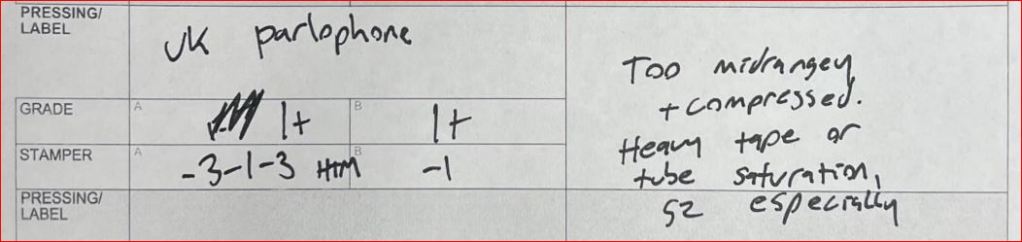
However, some stampers are disappointing as you can see from this section of the stamper sheet we compiled for the shootout.

Harry T. Moss, the man with the initials HTM you see above, is the Parlophone/Apple engineer who cut many of the greatest sounding Beatles albums ever made (and plenty of not-so-great sounding ones, which is why you either need to do your own shootouts or have us do them for you).

Seems at though at least some of the work he did for the Hey Jude album is not his best. We awarded both sides a sub-Hot Stamper grade of 1+, which means the sound is passable at best, even after a good cleaning. (Without a good cleaning it would probably not even earn that one plus.)

We do not sell records with 1+ grades; you can find those on your own. The world is full of them.

Our notes for this pressing read:

  • Too midrangey and compressed
  • Heavy tape or tube saturation, side two especially

Your only other option for hearing some of this music with top quality sound is on the 1967-1970 compilation album, the Hot Stamper pressings of which have only recently been discovered.

(more…)

Driving My Car into a Ditch

Hot Stamper Pressings of the Music of The Beatles Available Now

Mobile Fidelity made a mess of Drive My Car on their Half-Speed mastered release of Rubber Soul in 1982.

Perhaps it’s more accurate to say Stan Ricker, MoFi’s go-to mastering engineer, did.

He equalized out far too much upper midrange and top end.

What fuels the energy of the song are the cow bell, the drums and other percussion. Instead of a scalpel, Mobile Fidelity took a hatchet to this slightly bright track, leaving a dull, lifeless, boring mess.

Some Parlophone copies may be a little bright and lack bass, but at least they manage to convey the musical momentum of the song.

Even the purple label Capitol reissues can be quite good. A bit harsher and spittier, yes, but in spite of these shortcomings they communicate the music, which ought to count for something.

As much as I might like some of the MoFi Beatles records [not so much anymore], and even what MoFi did with some of the other tracks on Rubber Soul, they sure sucked the life out of Drive My Car.

We all remember how much fun that song was when it would come on the radio. Playing it on a very high quality stereo should make it more fun, not less.

If you’ve got a Rubber Soul with a Drive My Car that’s no fun, it’s time to get another one.

By The Way

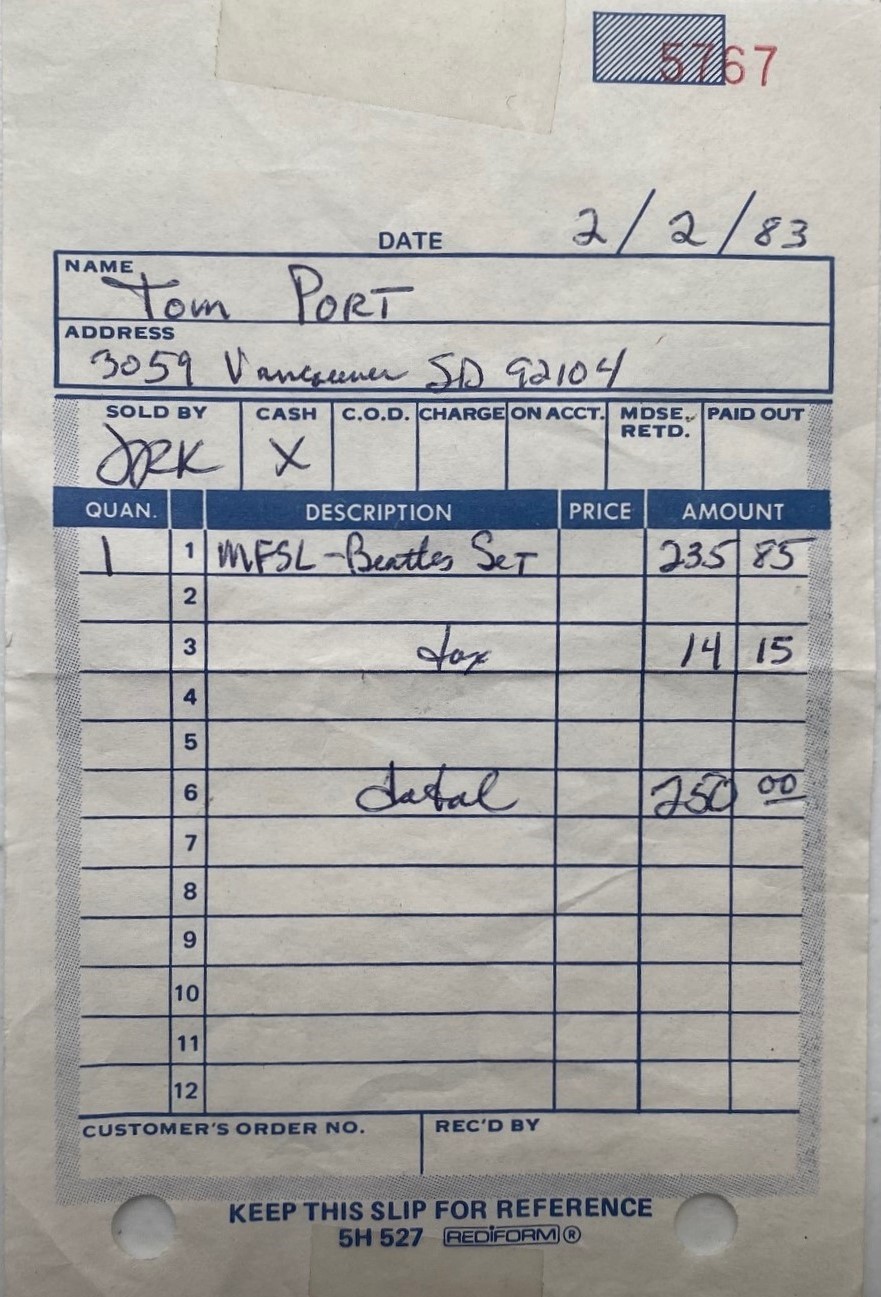
The best $250 — to the penny! — I ever spent on records is the price I paid for my brand new, still-in-the-shipping-carton MoFi Beatles Box. I ordered it in 1982 when I first learned of it, and it finally came the next year. I already owned all The Beatles albums MoFi had done to date, including the UHQR of Sgt. Pepper, which, like a fool, I got rid of once the set came out.

(more…)

Listening in Depth to A Hard Day’s Night

More of the Music of The Beatles

Play it against your MoFi or Heavy Vinyl pressing and you will quickly see why those lifeless LPs bore us to tears. Who in his right mind would want to suffer through a boring Beatles record?

Drop the needle on any song on the first side to see why we went crazy over a recent Shootout Winner on side one. The emotional quality of the boys’ performances really comes through on this copy.

They aren’t just singing — they’re really beltin’ it out. Can you imagine what that sounds like on the title track? We didn’t have to imagine it, we heard it!

Side One

A Hard Day’s Night
I Should Have Known Better
If I Fell

This is a wonderful example of The Beatles’ harmonies at their best. Toward the end of the song, during one of their harmonic excursions, you can hear John’s voice drop out when something apparently catches in his throat, and I could swear that you can hear Paul McCartney react to it with a little laugh.

If their voices sound warm, sweet, and transparent on this track, at the very least you have a contender, and possibly a winner. Not many pressings are going to bring out all the timbral qualities of their voices.

I’m Happy Just to Dance With You
And I Love Her
Tell Me Why
Can’t Buy Me Love

Always starts with a bit of grit and grain, but usually sounds better by the second verse.
(more…)

These Are the Stampers to Avoid on A Hard Day’s Night

Hot Stamper Pressings of the Music of The Beatles Available Now

In our experience, the stereo pressings with -2/-2 stampers are terrible sounding.

We do not have any on hand, but we doubt that -1/-1 — the original, the first, the one approved by George Martin himself! — is any better.

With -2 stampers this is a hall of shame pressing, as well as another early Beatles LP reviewed and found seriously wanting.

You may know that the pressings with -2 stampers are the ones that come in the original BC-13 Beatles Box from 1978.

Some of the titles in that set can sound very good, but this is not one of them. To recognize a mid-70s pressing, note that the back of the jacket will have a laminate strip on the side. At the bottom of this post you can find a picture of it.

Avoid that cover and the record inside it if you want a good sounding pressing of A Hard Day’s Night.

That Old Canard

The early pressings are consistently grittier, edgier and more crude than the later pressings we’ve played. So much for that old canard that “the original is better.” When it comes to A Hard Day’s Night it just ain’t so, and it doesn’t take a state-of-the-art system or a pair of golden ears to hear it.

The audiophile community seems not to have caught on to the faults of the early Beatles pressings, but we here at Better Records are doing our best to correct these and other misconceptions, one Hot Stamper pressing at a time.

It may be a lot of work, but we don’t mind — we love The Beatles! We want to find the best sounding copies of ALL their records, and there is simply no other way to do it than to play them, preferably by the dozens.

(more…)

Two Key Tracks for Testing Rubber Soul

Hot Stamper Pressings of Rubber Soul Available Now

Rubber Soul is one of the most difficult Beatles records to get to sound right. The individual tracks seem to vary drastically in terms of their tonality. Some (What Goes On) sound sweet, rich and near perfect. Others (You Won’t See Me) can be thin and midrangy. What’s a mother to do?

I think what we’re dealing with here are completely different approaches to the final mix. The Beatles were experimenting with different kinds of sounds, and their experiments produced very different results from track to track on this album more than practically any other I can think of besides The White Album (which was recorded in multiple studios by multiple producers and engineers).

Is Your Rig Up To It?

One final note: this is the kind of record that really rewards a good cartridge/ arm/ table combination. You do not want to play this record with a lean or bright sounding cartridge, or a front end that does not track sibilances well. (I could name some equipment that I would not want to play this record on, but rather than insult the owners of such equipment, let’s just say they will have a tough time with this record.)

The Toughest Test on Side One

Nowhere Man.” Unless you have an especially good copy this song will sound VERY compressed, much too thick and congealed to be as enjoyable as we know it can be. The best copies manage to find the richness in the sound as well as the breathiness in the vocals that others barely hint at.

Play this track on whatever copies you own (more than one I hope) and see if it doesn’t sound as compressed, thick and congested as we describe.

The Toughest Test on Side Two

(more…)

Listening in Depth to Help

Hot Stamper Pressings of Help Available Now
More of the Music of The Beatles

Presenting another entry in our extensive Listening in Depth series.

Much like we said about the Please Please Me Hot Stampers, on the top copies the presence of the vocals and guitars is so real it’s positively startling at times.

Drop the needle on You’ve Got To Hide Your Love Away and turn up the volume — on the best copies it will be as if John and Paul were right there in your living room.

The best import copies of this album sound AMAZING, but the typical one is pretty mediocre. Most tend to be dull, with not enough extension up top, as well as thin, lacking weight and body from the lower midrange on down.

Side One

Help! (A Number One Hit)
The Night Before

One of the biggest problems we found with this album is that the top end tends to be somewhat lacking. On the better copies, the cymbals on this track will sound correct and lively.

You’ve Got to Hide Your Love Away

One of the reasons this song sounds so good is that there are only acoustic instruments being played. There’s not an electric guitar to be found anywhere in the mix, one of the few tracks that can make that claim. We love the Tubey Magical guitars and voices found on early Beatles albums, and this song is a good example of both.

(more…)

The Beatles on Vinyl – An Audiophile Wake Up Call

Hot Stamper Pressings of the Music of The Beatles Available Now

No artists’ records have been more important to my evolution as an audiophile than those of The Beatles.

This commentary was written about 15 years ago. Unlike some of the things I used to say about records and audio, practically every word of this commentary still holds true in my opinion.

The sound of the best pressings of The Beatles — when cleaned with the Prelude Enzyme System on the Odyssey machine — are truly a revelation.

So much of what holds their records back is not bad mastering or poor pressing quality or problems with the recording itself.

It’s getting the damn vinyl clean.

(It’s also helpful to have high quality playback equipment that doesn’t add to the inherent limitations of the recordings.)

Know why you never hear Beatles vinyl playing in stereo stores or audio shows?*

Because they’re TOO DAMN HARD to reproduce. You need seriously tweaked, top-quality, correct-sounding equipment — and just the right pressings, natch — to get The Beatles’ music to sound right, and that’s just not the kind of stuff they have at stereo stores and audio shows. (Don’t get me started.)

However, you may have noticed that we sell tons of Beatles Hot Stamper pressings. We have the stereo that can play them, we have the technology to clean them, and we know just how good the best pressings can sound. The result? Listings for Beatles Hot Stampers on the site all the time.

Five of their titles — the most of any band — are on our Rock and Pop Top 100 List. That ought to tell you something. (Let It Be and Revolver would easily make the list as well, but seven albums from one band seemed like overkill, so we’re holding firm at five for now.)

A True Pass/Fail Test for Equipment

(more…)

Listening in Depth to Please Please Me

The Beatles’ debut, Please Please Me, is an amazing sounding recording.

It’s clearly the best sounding title of their first five releases, if you have the right pressing.

Naturally, it’s a founding member of our Top 100 Rock and Pop List, along with five other Beatles classics: Rubber Soul, Revolver, Sgt. Pepper, Magical Mystery Tour and Abbey Road.

Please Please Me (in awesome twin-track stereo no less) captures more of the live sound of these four guys playing together as a rock and roll band than any record they ever made again. (Let It Be gets some of that live quality too and makes a great bookend for the group.)

If you are interested in digging deeper, our listening in depth commentaries have extensive track by track breakdowns for some of the better-known albums that have gone through a number of shootouts.

For most of the major titles by The Beatles, scores of shootouts have been done, with our earliest efforts stretching all the way back to 2005.

Side One

I Saw Her Standing There

Like any of the boys’ most radio-ready singles, this song tends to be a bit bright. If this track sounds at all dull, there’s probably no hope for the rest of this side.

Misery

This track should sound lively and punchy. The best copies have excellent bass definition and superb clarity, allowing you to appreciate how the wonderful bounce of the rhythm section really energizes the song.

Anna (Go to Him)

Does it get any better? This is the real Beatles magic baby!

Chains

Note that the vocals on this track are not as well recorded as they are on the track above. As a rule they’re a bit edgier and not as transparent.

(more…)

How Can Anybody Not Hear What’s Wrong with Old Records Like These?

beatlrubbeoriginalRecord Collecting – A Guide to the Fundamentals

It is our strongly held belief that if your equipment (regardless of cost) or your critical listening skills do not allow you to hear the kinds of sonic differences among pressings we describe, then whether you are just getting started in audio or are a self-identified audio expert writing for the most prestigious magazines and websites, you still have a very long way to go in this hobby.

Purveyors of the old paradigms — original is better, money buys good sound — may eventually find their approach to records and equipment unsatisfactory (when it isn’t just plain wrong), but they will only do so if they start to rely more on empirical findings and less on convenient theories and received wisdom.

A reviewer we know all too well is clearly stuck in the old, mistaken paradigm, illustrated perfectly by this comment:

It’s not my pleasure to be so negative but since I have a clean UK original (signed for me by George Martin!) I’ll not be playing this one again. Yes, there are some panning mistakes and whatever else Martin “cleaned up” but really, sometimes it’s best to leave well-enough (and this album was well-enough!) alone.

We can’t imagine how anyone can have a system in this day and age that can obscure the flaws of the original Parlophone pressings of Rubber Soul (or any other Yellow and Black label Parlophone pressing for that matter, other than Yellow Submarine and Oldies but Goldies).


UPDATE 2022

Here is another exception to that “rule.”


This reviewer apparently does (as do some of our customers, truth be told), but we have something very different indeed. One might even consider it the opposite of such a system.

Our system is designed to relentlessly and ruthlessly expose the flaws of every record we play.

Only the best of the best can survive that level of scrutiny. Our system (comprising equipment, setup, tweaks, room treatments, electricity) operates at the highest level of fidelity we have been able to achieve to date. We are constantly making improvements to our playback system in search of even better sound.

Real Progress

But wait a minute, who are we to talk about being fooled? Bear in mind that as recently as 2000 or so we were still recommending DCC and other Heavy Vinyl pressings. These are records that, with few exceptions, I would have a hard time sitting through nowadays.

My system couldn’t show me how colored and lifeless they were then, but it sure can now.

It’s amazing how far you can get in 10 years [now 20] if you’re obsessive enough and driven enough, and are also willing to devote huge amounts of your time and effort to the pursuit of better audio. This will be especially true if you are perfectly happy to let your ears, not your brain, inform your understanding of the sound of the records you play.

If we thought like most audiophiles, that money buys good sound and original pressings are usually the best, there would be no such thing as Hot Stampers. Old thinking and wrong thinking can really slow down your progress.

(more…)