Top Artists – Blood, Sweat and Tears

Hey Speakers Corner, What The Hell Were You Thinking?

Hot Stamper Pressings of Great Albums from 1968 Available Now

UPDATE 2026

We rarely have either of the first two B,S&T albums in stock, sorry.

The second album is almost impossible to find these days. Our last shootout was in 2024 and it could be years before we get another one going.


Child Is Father to the Man on Speakers Corner is an audiophile hall of shame pressing and a Heavy Vinyl disaster if there ever was one (and oh yes, there are plenty, with reviews for more than 300 on this very blog).

When this pressing of Child Is Father to the Man came out back in 2007, we auditioned one and were dumbfounded at the dismal quality of the sound. We noted:

This is the worst sounding Heavy Vinyl Reissue LP I have heard in longer than I can remember.

To make a record sound this bad you have to work at it. What the hell were they thinking?

Any audiophile record dealer that would sell you this record should be run out of town on a rail.

Of course that would never have happened, and will never happen, because every last one of them (present company excluded) will carry it, of that you can be sure.

Just when you think it can’t get any worse, out comes a record like this to prove that no matter how negative you are about the quality of audiophile record production these days, things can always get worse, and they have.

Is it the worst version of the album ever made? Hard to imagine it would have much competition.

Actually it would, now that I come to think about it. The Gold CD Cisco put out in 2012 was every bit as awful.

(more…)

The Turn Up Your Volume Test – Blood Sweat and Tears

Hot Stamper Pressings of the Music of Blood, Sweat and Tears Available Now

UPDATE 2025

This commentary was written about twenty years ago, back in the days when I could find clean 360 Label pressings of this album actually sitting in the bins of used record stores. The picture at the bottom says it all — I think we had more than forty copies to work through for our first shootout, pressings of the album that I had been buying (many from Robert Pincus, he was the B,S&T expert back then) since the late-80s. Blood, Sweat and Tears and I go way back.

You may notice that we rarely write about the album these days, and that’s simply because we are not able to find clean, early label pressings to play anymore. (The Red Label pressings can be good but they don’t come close to winning shootouts. Without at least some potential Shootout Winning copies, it makes no sense to do the shootout. The winners are the ones that pay for the losers, naturally, with some profit left over if things go as planned.)

Speaking of which: Our last shootout was quite a few years ago. If we somehow managed to luck into a few copies locally, it’s possible we could do the shootout tomorrow, but buying this title on Discogs and Ebay has been a nightmare, with upwards of 90% of the copies we buy ending up marked return to sender.

The cost in labor (and frustration) we incurred to pursue the album long ago forced us to move on, after plenty of swearing and licking of wounds of course. How is it that record sellers can be so oblivious to the scratches and wear on their consistently noisy vinyl offerings is beyond me.

For those of you who can’t devote the resources to finding a good copy on the Columbia 360 Label, the Gold CD put out long ago by Mobile Fidelity is excellent and well worth whatever you have to pay for it. And I mean that sincerely.


Our Old Commentary

In my opinion this is the BEST SOUNDING rock record ever made. I may be biased because I like the music so much, but played on a Big Speaker System a Hot Stamper pressing is nothing less than ASTOUNDING, the ultimate Demo Disc. It has the power of LIVE MUSIC.

You don’t find that on a record too often, practically never in fact. I put this record at the top of The Best Sounding Rock Records of All Time link (seen on the left) and said it was in a class of its own for good reason — IT IS IN A CLASS OF ITS OWN.

As I’ve noted before, this record is a milestone in the history of popular music. Not only is it The Most Successful Fusion of Rock and Jazz Ever. It’s also One of the Finest Recordings of Popular Music Ever.

The sound is nothing short of amazing. Just the drums alone are enough to win awards: the kick drum has real kick, the snare may actually be the best rock snare ever recorded, the cymbals shimmer like real cymbals; almost everything is right with this record. Especially the music.

Good Demo Disc, Good Test Disc Too

This is the kind of record that doesn’t fall into the good Demo Disc, bad test disc trap. It’s both a good Demo Disc and a good test disc; not too many records can make that claim. (Especially the kinds of records audiophiles tend to like.)

The good copies of this album sound good on almost any system. But the better systems reveal qualities to this recording that you are very unlikely to have ever heard on another record. That’s the Demo side.

On the test side, no matter what level your system is at, any change you make will be instantly obvious on this recording, for good or bad. Nothing can fool it. It’s too tough a test, the toughest I know of bar none. For this record to sound right, truly right, every aspect of its reproduction has to be at the highest level. Any shortcoming will be glaringly obvious. The record may still sound good, but it won’t really sound right. (Knowing what “right” means in this context makes all the difference in the world of course.)

One reason the turn up your volume test is such a great test — the louder the problem, the harder it is to ignore.

(more…)

What to Listen For on Child Is Father to the Man

bloodchild_1501_1233141856

Hot Stamper Pressings of the Music of Blood, Sweat and Tears Available Now

At the end of a long day of listening at loud levels to multiple copies of this album you may want to run yourself a hot bath and light some candles. If you have an isolation tank at your disposal, so much the better.

You could of course turn down the volume, but what fun is that?

This music wasn’t meant to be heard at moderate levels. Playing it that way is an insult to the musicians who worked so hard to make their music sound big and lively.

The Right Balance

Every once in a while you hear a pressing in which the right balance has been struck, and we played one years ago that clearly belonged to that group. It’s not perfect; you have to put up with a few rough patches to get the sound that serves most of the music properly. No copy will do it all; with this album the goal is to do the best you can.

When it’s working it’s fantastic. The big Al Kooper productions (I Love You More Than You’ll Ever Know, My Days are Numbered, I Can’t Quit Her, Somethin’ Goin’ On) really work when they have the energy and dynamic drive to carry the emotion of the lyric.

What to Listen For

This record needs fullness; the copies that were thin, like most of the reissues, were unlistenably shrill and spitty.

Next you want the life of the music to come through, which means presence and dynamics.

(more…)

Blood, Sweat & Tears – Self-Titled on the 70s Red Label

More of the Music of Blood, Sweat and Tears

  • Here is a superb Red Label copy of BS&T’s self-titled LP with Double Plus (A++) sound or close to it throughout
  • The sound is huge, rich, dynamic and powerful (particularly on side two) – BS&T is a permanent member of our Top 100 and a Demo Disc par excellence
  • This is Roy Halee‘s engineering masterpiece, and here’s the kind of pressing that, given the right equipment, room, and setup, really makes our case (also particularly on side two)
  • 4 1/2 stars: “Their finest moment and a testimony to the best of the jazz/rock movement … The album is bold, brassy and adventurous.”

(more…)

After You’ve Played 100 Copies of the Album, What’s Left to Learn?

bloodchildHot Stamper Pressings of the Music of Blood, Sweat and Tears Available Now

This commentary is at least ten years old. We can’t say that a red label reissue like the one discussed below would do as well under the improved shootout conditions in our new studio, but the possibility exists, which is the point of the story we are telling here.

A common misconception of many of those visiting the site for the first time is that we think we know it all.

Nothing could be further from the truth. We definitely do not know it all. We learn something new about records with practically every shootout.

Not This Title

Case in point: the record you do NOT see pictured above. (The record we recently learned something new about — this, after having played scores and scores of copies over the years — will remain a secret for the time being. At least until we find another one.)

In 2013 we played a red label Columbia reissue of a famous 60s rock record (again, not shown) that had the best side two we had ever heard. Up to that point no copy other than the 360 original had ever won a shootout, and we’ve done plenty. Lo and behold, here was a reissue that put them all to shame.

I’m still in shock from the experience to tell you the truth, but what a blast it was to hear it!

The recording, which I first played more than 40 years ago at the tender age of 16, was now bigger, less murky and more energetic than ever before. Had you asked me, I would have confidently told you not to waste your time with the second pressing, to stick to the 360s on that title, and I would have been wrong wrong wrong.

How Wrong?

But wait a minute. The 360 original will probably beat 49 out of 50 red label reissue copies on side two, and the best 360 original could not be beaten on side one by any other pressing. When you stop to think about it, we weren’t very wrong at all.

Let’s just say our understanding was incomplete.

This is why we prefer to offer actual physical records rather than just advice, although it’s clear for all to see that we happily do both, and, moreover, we certainly feel qualified — as qualified as anyone can be — to offer up our opinions, since our opinions are based on a great deal of experimental data.

Having big piles of cleaned records at one’s disposal is fundamentally important to this kind of operation. In our experience, shootouts using only a small number of pressings have relatively little value. They are best seen as a guide for the next, more comprehensive attempt to find out what might be the truly killer pressings of any given album.

(more…)

What’s the Average Record Worth?

More Letters from Customers and Critics Alike

What follows is an excerpt from a very old letter (circa 2005) in which the writer attempted to make the case that spending lots of money on records is foolish when a dollar buys a perfectly good record at a thrift store and provides the listener with exactly the same music and decent enough sound.

We think this is silly and, with a few rough calculations, along with a heavy dose of self-promotion and not a little bullying, we set out to prove that the average record is practically worthless. Prepare to confront our exercise in sophistry.

(Yes, we are well aware that our reasoning is specious, but it’s no more specious than anybody else’s reasoning about records if I may say so.)

Jason, our letter writer, points out this fact:

Your records are a poor value in terms of investment. Until you convince the whole LP community that your HOT-STAMPER choices are the pinnacle of sound a buyer will never be able to re-sell B S & T for $300. Even if they swear it is the best sounding copy in the world.

We replied as follows:

If records are about money, then buying them at a thrift store for a buck apiece and getting something halfway decent makes perfect sense. As the Brits say, “that’s value for money.” If we sell you a Hot Stamper for, say, $500, can it really be five hundred times better?

The Math

I would argue that here the math is actually on our side. The average pressing is so close to worthless sonically that I would say that it isn’t even worth the one dollar Jason might pay for it in a thrift store. I might value it somewhere in the vicinity of a penny or two. Really? Yes indeed.

Assuming it’s a record I know well, I probably know just how wonderful the record can really sound, and what that wonderful sound does to communicate the most important thing of all: the musical value.

A copy that doesn’t do that — allow the music to come alive — has almost no value. It’s not zero, but it’s close to zero. Let’s assign it a nominal value. We’ll call it a penny.

What Have You Got to Lose?

You see, when I play a mediocre copy, I know what I’ve lost.

Jason can’t know that. All he knows is what he hears coming from his mediocre equipment as his mediocre LP is playing. To him it sounds fine. To me it sounds like hell. (Hell is in fact the place where they make you listen to bad sounding records all day.)

(more…)

Blood, Sweat & Tears – Child is Father to the Man

More Blood, Sweat and Tears

Reviews and Commentaries for Child Is Father to the Man

  • An original 360 Stereo pressing of BS&T’s debut LP with an INCREDIBLE Shootout Winning Triple Plus (A+++) side one mated to a solid Double Plus (A++) side two – fairly quiet vinyl too
  • This copy will show you just how big, full-bodied, lively and powerful this music can be on the right pressing
  • Not many records on this site are harder to find with top quality sound and reasonably quiet surfaces than this one
  • 5 stars: “Child Is Father to the Man is keyboard player/singer/arranger Al Kooper’s finest work, an album on which he moves the folk-blues-rock amalgamation of the Blues Project into even wider pastures… One of the great albums of the eclectic post-Sgt. Pepper era of the late 60s.”
  • If I were to make a list of my Favorite Rock and Pop Albums from 1968, this album would definitely be on it.

(more…)

Outliers & Out-of-This-World Sound

More Outlier Pressings We’ve Discovered

This commentary was written about ten twenty years ago and has been updated more than a few times since.

A while back we did a monster-sized shootout for Blood, Sweat and Tears’ second release, an album we consider THE Best Sounding Rock Record of All Time.

In the midst of the discussion of a particular pressing that completely blew our minds — a copy we gave a Hot Stamper grade of A with Four Pluses, the highest honor we can bestow upon it — various issues arose, issues such as: How did this copy get to be so good? and What does it take to find such a copy? and, to paraphrase David Byrne, How did it get here?


  • We no longer give Four Pluses out as a matter of policy, but that doesn’t mean we don’t come across records that deserve them from time to time.
  • Nowadays we usually place them under the general heading of breakthrough pressings. These are records that, out of the blue, reveal to us sound that fundamentally changes what we thought we knew about these familiar recordings.
  • When this pressing (or pressings) landed on our turntable, we found ourselves asking “Who knew?
  • Perhaps an even better question would have been “How high is up?”
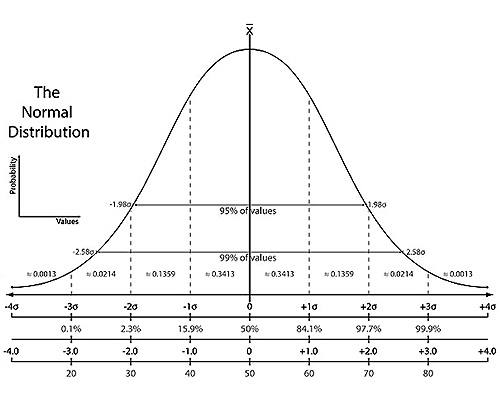
Which brings us to this commentary, which centers around the concept of outliers.

Wikipedia defines an outlier this way:

In statistics, an outlier is an observation that is numerically distant from the rest of the data.

In other words, it’s something that is very far from normal. In the standard bell curve distribution pictured below, the outliers are at the far left and far right, far from the vast majority of the data which is in the middle.

In the world of records, most copies of any title you care to name would be average sounding. The vertical line in the center of the graph shows probability; the highest probability is that any single copy of a record will be at the top of the curve near the middle, which means it will simply be average. The closer to the vertical line it is, the more average it will be. As you move away from the vertical line, the data point — the record — becomes less and less average. As you move away from the center, to the left or the right, the record is either better sounding or worse sounding than average.

Hot Stampers are simply those copies that, for whatever reason, are far to the right of center, far “better” than the average. And as the curve above demonstrates, there are a lot fewer of them than there are copies in the middle. 


Measuring the Record

Malcolm Gladwell has a bestselling and highly entertaining book about outliers which I recommend to all. Last year I read The Black Swan (or as much of it as I could stand given how poorly written it is) which talks about some of these same issues. Hot Stampers can be understood to a large degree by understanding statistical distributions. Why statistics you ask? Simple. We can’t tell what a record is going to sound like until we play it. For all practical purposes we are buying them randomly and “measuring” them to see where they fall on the curve. We may be measuring them using a turntable and registering the data aurally, but it’s still very much measurement and it’s still very much data that we are recording.

No Theory, Just Data

Many of these ideas were addressed in the recent shootout we did for BS&T’s second album. We played a large number of copies (the data), we found a few amazing ones (the outliers), and we tried to determine how many copies it really takes to find those records that sound so amazing they defy not only conventional wisdom, but our understanding of records per se.

We don’t know what causes these records to sound so good. We know ’em when we hear ’em and that’s pretty much all we can say we really know. Everything else is speculation and guesswork.

We have data. What we don’t have is a theory that explains that data.

And it simply won’t do to ignore the data because we can’t explain it. Hot Stamper Deniers are those members of the audiophile community who, when faced with something they don’t want to be true, simply manufacture reasons why it can’t or shouldn’t be true.

That’s not science. Practicing science means following the data wherever it leads. The truth is found in the record’s grooves and nowhere else. If you don’t think record collecting is a science, you’re not doing it right.

Ignoring Outliers

Wikipedia has a good line about ignoring outliers. Under the heading of Caution they write: “… it is ill-advised to ignore the presence of outliers. Outliers that cannot be readily explained demand special attention.” Hear hear.

Now let’s see where the grooves for Blood, Sweat and Tears’ second album led us. They demanded special attention and by god we gave it to them.

The Grooves

We noted some new qualities to the sound that we would like to discuss; they’re what separated the men from the boys this time around. What we learned can be summed up in a few short words: it’s all about the brass. Let me give you just one example of how big a role the brass plays in our understanding of this recording. The best copies present a huge wall of sound that seems to extend beyond the outside edges of the speakers, as well as above them, by quite a significant amount. If you closed your eyes and drew a rectangle in the air marking the boundary of the soundscape, it would easily be 20 or 25% larger than the boundary of sound for the typically good sounding original pressing, the kind that might earn an A or A Plus rating.

Size Matters

The effect of this size differential is ENORMOUS. The power of the music ramps up beyond all understanding — how could this recording possibly be this BIG and POWERFUL? How did it achieve this kind of scale? You may need 50 copies to find one like this, which prompts the question: why don’t the other 49 sound the way this one does?

The sound we heard on the Four Plus copy has to be on the master tape in some sense, doesn’t it? Mastering clearly contributes to the sound, but can it really be a factor of this magnitude?

Intuition says no. More likely it’s the mastering of the other copies that is one of the many factors holding them back, along with worn stampers, bad stampers, bad metal mothers, bad plating, bad vinyl, bad needles and all the rest — all of the above and more contributing to the fact that the average copy of this album is just plain bad news.

Conventional Wisdom

Any reason you like for why a record doesn’t sound good is as valid as any other, so you might as well pick one you are comfortable with; they’re all equally meaningless. Of course the reverse of this is just as true: why a record sounds good is anyone’s guess, and a guess is all it can ever be.

People like having answers, and audiophiles are no different from other people in this respect. Since there are no answers to any of these questions, answers in this case being defined as demonstrable conclusions based on evidence gained through the use of the scientific method, most people, audiophiles included, are happy — if not better off — making up the answers with which they are most comfortable.

This is precisely why the term “conventional wisdom” was coined, to describe the easy answers people readily adopt in order to avoid doing the hard work of actually finding out the truth.

(more…)

Blood, Sweat & Tears – Self-Titled on 360

More of the Music of Blood, Sweat and Tears

  • Here is a superb copy of BS&T’s self-titled LP with Double Plus (A++) sound or close to it throughout
  • The versions of the album we prefer are the 360 originals, but most of the dozen or more stamper numbers we know of cannot hold a candle to this pressing
  • The sound is huge, rich, dynamic and powerful (particularly on side one) – BS&T is a permanent member of our Top 100 and a Demo Disc par excellence
  • This is Roy Halee‘s engineering masterpiece, and here’s the kind of pressing that, given the right equipment, room, and setup, really makes our case (also particularly on side one)
  • Marks in the vinyl are sometimes the nature of the beast with these vintage LPs – there simply is no way around them if the superior sound of vintage analog is important to you
  • 4 1/2 stars: “Their finest moment and a testimony to the best of the jazz/rock movement … The album is bold, brassy and adventurous.”

(more…)

Blood, Sweat & Tears – 3

More Blood, Sweat and Tears

  • An excellent copy with solid Double Plus (A++) sound from start to finish
  • Here is the big jazz-rock sound we love, stretching from wall to wall and extending from floor ceiling, with energy and power that only a handful of albums can begin to compete with thanks to the engineering prowess of Roy Halee
  • This copy shows you just how good Roy Halee‘s engineering used to be, comparable to his brilliant work on BS&T’s previous album, the one we salute to this day as (probably) the best sounding rock record ever made
  • “David Clayton-Thomas remained an enthusiastic blues shouter, and the band still managed to put together lively arrangements, especially on the Top 40 hits ‘Hi-De-Ho’ and ‘Lucretia Mac Evil’… BS&T 3 was another chart-topping gold hit.”
  • This is an excellent title from 1970, which just happens to be a great year for Rock and Pop Music, maybe the greatest of them all

On the best copies, the brass is rich, solid, and present, with correct timbre for every instrument from the bass trombone all the way up the scale to piccolo trumpet — exactly the sound we were looking for and struggle to find.

The right pressing is BIG down low. The vocals are clear and present. The huge 30+ member chorus on the first track works; it doesn’t most of the time. It obviously presents a real challenge to any engineer, but Halee is up to it, judging solely by the sound on this very copy. Mastering and pressing issues end up making that chorus sound small, thin and opaque most of the time.

“Lucretia MacEvil,” a minor hit, has more compression than the rest of the side, to make it more radio-friendly of course, but here it holds up much better than on most copies.

(more…)