*Mistaken Ideas

We used to refer to them as myths but we’ve come to the conclusion that mistaken ideas is more correct.

It’s also a less pejorative way of saying that some things audiophiles believe are lacking in the kind of hard evidence that one would think should be required to defend them.

The fact that good evidence is not required for audiophiles to believe practically anything they think they know about records and audio is one reason we write so much about these subjects on this blog.

Siren on Import Vinyl? Not So Fast

Hot Stamper Pressings of the Music of Roxy Music Available Now

Siren is one of our favorite Roxy albums, right up there with the first album and well ahead of the commercially appealing Avalon.

After reading a rave review in Rolling Stone of the album back in 1975, I took the plunge, bought a copy at my local Tower Records and instantly fell in love with it.

As is my wont, I then proceeded to work my way through their earlier catalog, which was quite an adventure. It takes scores of plays to understand where the band is coming from on the early albums and what it is they’re trying to do. Now I listen to each of the first five releases on a regular basis.

Somehow they never seem to get old, even after more than forty years.

Of all the Roxy albums (with the exception of Avalon) this is probably the best way “in” to the band’s music. The earlier albums are more raucous, the later ones more rhythmically driven — Siren catches them at their peak, with, as other reviewers have noted, all good songs and no bad ones.

Imports? Not So Fast

The British and German copies of Siren are clearly made from dub tapes and sound smeary, small and lifeless.

To be fair, Siren has never impressed us as an exceptionally good sounding recording. Like other middle period Roxy, records such as Country Life and Manifesto (the albums just before and after), it simply does not have Demo Disc analog sound the way Avalon, Stranded or the Self-Titled albums do (the latter two clearly being the best sounding in their catalog).

One would be tempted to assume that the import pressings of Siren would be better sounding, the way the imports of the first four Roxy albums are clearly better sounding. (There has never been a domestic Hot Stamper pressing of any of those titles and, since we never buy them or play them, there probably never will be.)

But in the case of Siren it’s the imports that are made from dubs. It may be a British band, recorded in British studios with a British producer, but the British pressed LPs are clearly made from sub-generation tapes, whereas the domestic copies sound like they’re made from the real masters.

Go Figure. And another thing: when it comes to records, never assume anything.

The typical domestic pressing is flat, bass-shy and opaque, sounding more like compressed cardboard than analog vinyl.

Unsurprisingly, the CD, whether imported or produced domestically, is clean and clear and tonally correct but lacks the warmth and richness of the better vinyl pressings.

(more…)

Thinking Inside the Box

Hot Stamper Pressings of Jethro Tull Albums Available Now

The concepts we discuss below were hashed over in a 2023 letter written to us about a video interview with Michael Fremer, a video, I confess, I’ve never watched.

For background purposes, you should know that Steve Westman and Michael Fremer really like Heavy Vinyl records. Because of this shared interest, they naturally get along well.

I was invited on Steve’s show for a couple of episodes myself, as was Robert Brook, but because neither I nor Robert care much for Heavy Vinyl pressings, we had little in common with Steve or his roundtable. There was no reason for either one of us to be there, and it is unlikely we will be invited back. What would we talk about? How bad the sound quality is on the new records you guys talk about endlessly to the exclusion of everything else? You can imagine what they thought of my views, and vice-versa.

Back to the letter. As I explained to my customer, making generalizations about records is rarely of much use. The devil is in the details. Let’s take a look at what Michael Fremer has written recently about originals.

(more…)

Sgt. Pepper’s and Mistaken Audiophile Thinking (Hint: the UHQR Is Wrong)

Hot Stamper Pressings of Sgt. Peppers Available Now

This commentary was probably written between 2005 when we did our first shootout for the album and 2008, by which time it would have been a regular feature on the site. 

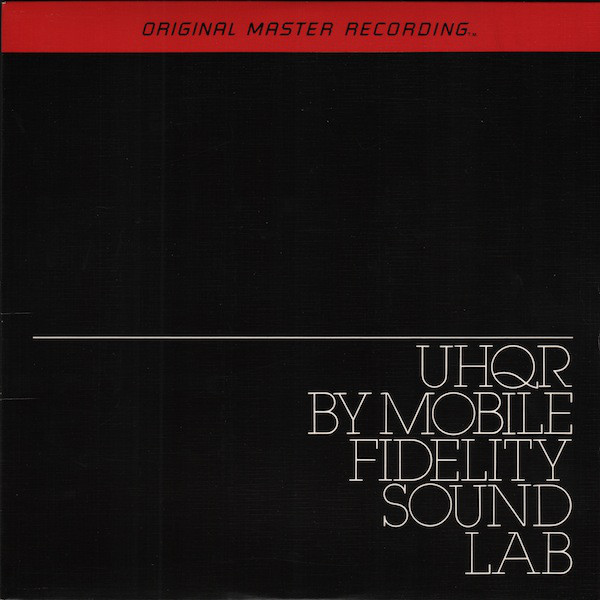
We charge hundreds of dollars for a Hot Stamper Sgt. Pepper, which is a lot to pay for a record. But consider this: the UHQR typically sells for a great deal more than the price we charge and doesn’t sound remotely as good. 

Of course the people that buy UHQRs would never find themselves in a position to recognize how much better one of our Hot Stampers sounds in a head to head shootout with their precious and oh-so-collectible UHQR.

They assume that they’ve already purchased the Ultimate Pressing and see no reason to try another.

I was guilty of the same mistaken audiophile thinking myself in 1982. I remember buying the UHQR of Sgt. Pepper and thinking how amazing it sounded and how lucky I was to have the world’s best version of Sgt. Pepper.

If I were to play that record now it most likely would be positively painful. All I would hear would be the famous MoFi 10K Boost on the top end (the one that MoFi lovers never seem to notice), and the flabby Half-Speed mastered bass (ditto).

Having heard really good copies of Sgt. Pepper, like the wonderful Hot Stampers we put on the site from time to time, now the MoFi UHQR sounds so phony to me that I wouldn’t be able to sit through it with a gun to my head.


UPDATE 2025

If you are still buying these remastered pressings, making the same mistakes that I was making before I knew better, take the advice of some of our customers and stop throwing your money away on Heavy Vinyl and Half-Speed mastered LPs.

At the very least let us send you a Hot Stamper pressing — of any album you choose — that can show you what is lacking on your copy of the album.

And if for some reason you disagree with us that our record sounds better than yours, we will happily give you all your money back and wish you the very best.

To learn more about records that sound dramatically better than any Half-Speed mastered title ever made (with one exception, John Klemmer’s Touch), please go to our Half-Speed mastering main page .

(more…)

How Is It that the Earliest Pressings from the Tube Era Often Lack the Sound of Tubes?

Hot Stamper Pressings of Music on Island Records Available Now

Please note that the album you see pictured on the left is not the one we are discussing here.

It has been our experience going back many years that the earliest pressings for many records on the Island label are not very good.

To be fair, this one — again, not Mr. Fantasy — is not a bad sounding pressing.

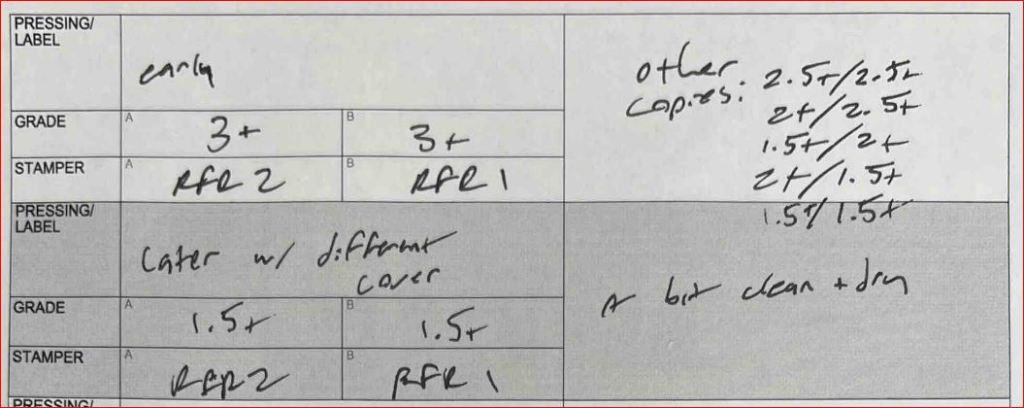
With grades of 1.5+ on both sides, it fits comfortably in our section for good, not great sounding LPs. But the right reissues are a big step up in class sonically. They’re the ones that win shootouts, not these Pink Label LPs.

It’s big and clear but dry and spitty and badly needs tubes — or the sound of tubes — in the cutting chain.

That’s not supposed to happen, the early pressings are supposed to be the most Tubey Magical ones, with the reissues being less Tubey Magical — but in the world of records, when has that rule of thumb ever counted for anything?

Been There, Done That

We’ve run into so many sonically-flawed Pink Label Islands by now that hearing one sound lackluster if not actually awful doesn’t phase us in the least. Some of the other Pink Labels that never win shootouts can be found here.

(more…)

How to Avoid Making this Rookie Record Collecting Mistake

Record Shopping Day Video!

Not sure how much of this video you can stand — nothing could interest me less than watching a couple of vinyl enthusiasts spouting off on what they think about some random records sitting in a local store’s bins.

But one or two bits caught my eye. I thought I might take the opportunity to share my take on them with you.

Is there any value to the comments of these two collectors? If you care about what music they like, perhaps.  Anything about what to look for on the label or jacket that might correspond to better sound?  If it’s there I sure didn’t see it, but I admit to speeding through most of it, so I can’t say for sure.

The first bit I refer to above is at 18:42.  The album in question is the legendary Kind of Blue. At this point the unseen helmet-cammed audiophile picks up the record, recognizes the cover, and proceeds to pull the record out to see what era the pressing is from.

Drat! The disappointment in this audiophile’s voice is palpable as he drops the record back in the bin with his dismissive comment that  “it’s a later pressing.”

But we here at Better Records would be falling all over ourselves to get our hands on that later pressing.

Those late pressings can and often do win shootouts. We would never look down our noses at a Red Label Columbia jazz LP, and neither should you.


UPDATE 2025

As good as the best pressings on the Red Label can sound, it has been years since one won a shootout. Here is our commentary for a recent 70s copy that went up on the site, one that earned a Super Hot grade on both sides.

They tend to sell for four or five hundred dollars these days. Why so much you ask? Because they beat the pants off of every so-called audiophile pressing of the album ever made. The testimony of one of our customers does a good job of describing the differences.

In addition, it turns out that at least nine out of ten of the copies with the red label are not remotely as good as the ones that earn Super Hot grades. The good ones are so rare that we only pick them up locally since practically none of the ones we find on the web have the right stampers. Trying to find the right red label needle in the haystack is more trouble than it’s worth, so don’t expect to see many coming to the site.


Our intrepid audiophile explorer does much the same thing about 23 minutes in. It seems pretty clear to us that he has no respect for such reissues, another example of one of the most common myths in record collecting land, the myth that the  original pressing is always, or to be fair, usually better.

This is simply not true, and those of our customers who have purchased White Hot Stamper pressings from us that turned out to be reissues know exactly what I am talking about. This is especially true for the records we sell by The Beatles. No original pressing has every won a shootout. [With one exception.]

Let’s get back to Kind of Blue.

Is the 50s original always better, is the 70s reissue always better, is the 60s 360 pressing always better?

No to one, two and three.

Why? Because no pressing is always better. All pressings are unique and should only be judged on their merits, and you do that by playing them, not by looking at their labels. For us this truth is practically axiomatic. It is in fact the premise of our entire business. Over the course of the 28 years we have been selling records we have never found any compelling evidence to invalidate it.

The day that someone can accurately predict the sound quality of a specific record by looking at the label or cover is a day I do not expect to come, ever.


UPDATE 2025

The above is somewhat misleading. With enough clean 6-Eye pressings on hand to play in a shooout, one of them will win.

That being the case, we have created two lists for those who would like to know which Columbia labels win shootouts — one for 6-Eye winners and one for 360 Label winners.


(more…)

We Forgot How Mediocre the Originals of A Winter Romance Are

Hot Stamper Pressings of the Music of Dean Martin Available Now

We gave a couple of early pressings another chance and they blew it!

The copies we sell as Hot Stampers are the reissues from the 60s. Here is what we had to say about a copy we posted for sale recently:

With a voice that is relaxed, smooth and warm, Dino is the perfect guy to sing these songs.

The sound of this reissue is far better than any of the originals we played, which mostly weren’t very good. Which just goes to prove (once again) that in the world of vinyl, the idea that the original will have the best sound is a pernicious falsehood.

Rich, sweet, full of ambience, dead on correct tonality, and wonderfully breathy vocals – everything that we listen for in a great record is here.

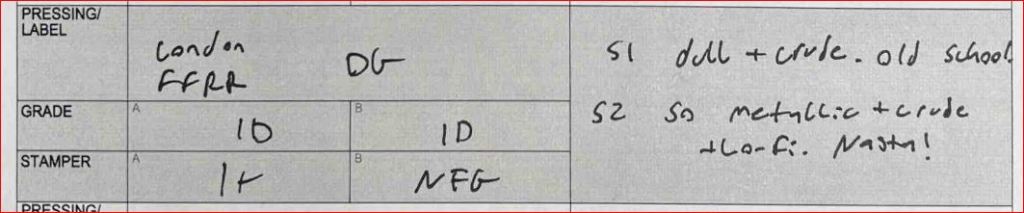
To back that up with actual stamper sheet evidence, here are the grades for the two early pressings we put in our shootout. We’d heard the originals before and never liked them, but sometimes if a particular presssing is cheap and easy to find, we give it another chance.

I think we’re done with the originals now though. They’ve let us down too many times.

Who wants to hear Dean Martin’s gorgeous baritone sounding lean, dry and recessed, or, alternately, murky, nasal, grainy and veiled?

If I didn’t know better I would suspect these originals were modern reissues. This kind of crap sound is all over the Heavy Vinyl records we play, although nobody but us ever seems to notice.

The Point Is

This serves to make a very important point that is near and dear to our hearts:

(more…)

Buy Promos, Don’t Buy Promos — Honestly, Just Make Up Your Mind

Hot Stamper Pressings of Vintage Columbia Albums Available Now

Recently we conducted a shootout for a Columbia recording of jazz fusion music, one that we had auditioned a couple of times before and one for which we knew the music and the general quality of the sound well.

It’s not the record you see pictured. For now we’re keeping the title a mystery, consistent with the idea that we give out lots of bad stampers on this blog, sometimes really bad stampers, but almost never do we give out the good ones.

All the copies we had in our shootout were pressed domestically, and all were mastered by the legendary Robert Ludwig. No Nice Price junk, no imports, none of that crap. We might have made those mistakes in previous shootouts, but having done this shootout a number of times now, we know what works and what doesn’t.

When we do give out the best stampers, as in the case here, we tend to keep the title a mystery. We are not the least bit interested in putting ourselves out of business.

The discussion for today revolves around the idea held by a great many audiophiles that the promo pressings are going to be the best sounding pressings of almost any album they might happen to run across.

And, to be fair, in the case of this mysterious album, they’re potentially right.

Our best sounding copy was a promo pressing.

What interests me in these findings is that the other promo copy, the one you see at the bottom of the shootout sheet, earned 1.5+ on both sides. It came in last in the shootout, earning good, not great Hot Stamper grades.

If an audiophile collector were to go to Discogs, find the promo pressings, write down their stampers, and then check them against the copies he owned or might want to buy, he could either find himself with a top quality copy, or a far-from-as-good copy, depending on his luck.

Why one set of stampers sounds so much better than another set, or the same or similar set on a different pressing, is a mystery.

Does anyone have a practical way to get around the unfortunate reality that allows one set of stampers to sound great and the same or a similar set of stampers to sound not much better than decent?

Well, we can’t say there is a practical way, but we do know of an impractical one. We’ve been practicing and refining that one for more than twenty years.

(more…)

Letter of the Week – “I just figured this was just a bad recording…”

Hot Stamper Pressings of the Music of Steely Dan Available Now

This week’s letter is from our good friend Roger, who, like us, is a GIANT Steely Dan fan. Apparently he had tried every copy of Katy Lied he could get his hands on and practically had given up on the album — until he decided to shell out the princely sum of Three Hundred Clams ($300, probably not the last piaster he could borrow, but a pretty hefty chunk of dough for a fairly common used LP from 1975) to Better Records, with the hope that we might actually find a way to put him in touch with the real Dr. Wu.

Let’s just say it seems that Roger got his money’s worth — and maybe a little more.

The title of his letter is: 

Katy Lied? Are you sure?

I tried your Hot Stamper Steely Dan Katy Lied. You gotta be kidding me. Are you sure this is the same recording? I remember your saying that this one is your favorite SD record and I could never understand why, at least until I heard this secret recording. Other than the HS copy you basically had a choice between the dull and lifeless bland US pressing, or the Mobile Fidelity version, which has those indescribable phasey, disembodied instruments and voices that sound unmusical to me.

I even tried British and Japanese pressings with no luck. I just figured this was just a bad recording, which made sense in light of all the press about the problems during the recording and mixing sessions, and I don’t think I bothered to listen to it again for at least the past 5 years.

But wow, this is clearly in another league. The voices and instruments are in three dimensions, the bass and dynamics are far far better, the saxes are up-front and breathy. I couldn’t believe how good Daddy Don’t Live in that New York City No More and Chain Lightning sounded. Even my subwoofer that I roll off at 30Hz got a good workout. It sounds like live music. So how did you sneak your tape recorder into the studio sessions, anyway?

Roger, we’re so happy to know that your love for Katy Lied has finally been requited after all these years. The reason we go on for days about the sound of practically every track on the album is that we love it just as much as you do.

We struggled ourselves from one bad pressing to another. Eventually, with better cleaning fluids, better equipment and tons of pressings at our disposal, we broke through the Bad ABC Pressing Barrier and discovered the copies that had the real Katy Lied Magic.

We Are Heartened

Everything you said was true. We are especially heartened by the fact that you cited Chain Lightning as a high point of the album we sent you. Your copy, earning a grade of A+ for side two, was a couple of steps down from the best — but it still sounds great! You don’t have to buy the Ultimate Copy to get sound that beats the pants off any “audiophile” pressing, any import, any anything, man.

It’s Not About The Money

You and I both know it’s not about the three hundred bucks. It’s about some of the best music these guys ever made. It’s about their ambitious yet problem-plagued recording surviving the record label’s mass-production-on-the-cheap, opting to stamp the sound on a slice of not-particularly-good vinyl. It’s about the search for that rare pressing with the kind of sound that conveys the richness and sophistication of Becker and Fagen’s music, music that I’ve been listening to since 1975 and do not expect to tire of any time soon (so far so good: as of 2013 this is still my favorite Dan album). [Still true as of 2022.]

So what if it took thirty years to finally get hold of a good one? With a little luck we’ll both be listening to this album for another thirty years, and that works out to the very un-princely sum of ten bucks a year.

I wish I could have sneaked a tape recorder into the studio. I sure wouldn’t have gone in for that crazy DBX Noise Reduction system they used. That alone would have saved us all a decade or two of suffering (unless you like the sound of two trash can lids crashing into each other).

(more…)

How Can the Best Stampers Also Be Some of the Worst?

Hot Stamper Pressings of Vintage Columbia Albums Available Now

Recently we conducted a shootout for a favorite Columbia recording, one that we had auditioned a couple of times before and one for which we knew the music and the general quality of the sound well.

It’s not the record you see pictured. For now we’re keeping the title a mystery, consistent with the idea that we give out lots of bad stampers on this blog, but almost never do we give out the good ones. (When we do give out the best stampers, we keep the title under wraps. We are not the least bit interested in putting ourselves out of business.)

The discussion for today revolves around the idea held by a great many audiophiles that the 6-Eye pressings are going to be the best sounding of almost any album they might happen to run across.

And, to be fair, in the case of this mysterious album, they’re right.

What interests me in these findings is that the stampers for a shootout winning copy, the top one, are almost identical to the one that came in close to last in the shootout outside of the Columbia Special Products reissue, with decent, respectable but far from shootout winning grades of 1.5+ and 2+.

One of the 1K side ones was the best we played, and one was very bright.

If an audiophile collector were to go to Discogs, find the IK pressings, he could either find himself with a top quality copy, or a not-nearly-as-good copy, depending on his luck.

Why one set of stampers sounds so much better than another set, or the same or similar set on a different pressing, is a mystery, and it’s one that we confidently predict will never be solved.

Does anyone have a practical way to get around the unfortunate reality that allows one set of stampers to sound great and the same or a similar set of stampers to sound no better than very good, if that?

Well, we can’t say there is a practical way, but we do know of an impractical one. We’ve been practicing and refining that one for more than twenty years.

We just play lots and lots of copies of the albums to find out how they sound.

(more…)

Mobile Fidelity’s Approach to Mastering – I Have a Theory

Hot Stamper Pressings of the Music of Little Feat Available Now

I have a theory about why MoFi’s mastering approach tended to work for the Waiting for Columbus album when it failed so miserably for so many others. It goes a little something like this. 

Back in their early days, MoFi tended to add bass and treble to practically every record they mastered, regardless of whether or not the master tape they were using needed a boost.

A little extra sparkle up top and a little extra kick down low was what the audiophile public seemed to want.  We call this the smile curve and lots of audiophile records have a case of it.

Truth be told, I was a member of that group and I know I did.

Fortunately for them, Waiting for Columbus is an album that can ofteny use a little at both ends. Rarely did The Mastering Lab supply it, making the original domestic pressings somewhat bass-shy and dull on the extreme top. The MoFi clearly corrected the poor EQ choices The Mastering Lab had often made. 


UPDATE 2024: Poor EQ Choices?

Or perhaps it could have been one or more of the following:

  • Perhaps the band liked it better that way.
  • Perhaps The Mastering Lab found it easier to cut that way.
  • Perhaps the cause of the records lacking extension on both ends comes from some other factors that cannot be known.

Or, if you don’t like those three, just make up some other reasons that sound plausible, or ones that fit in with other ideas you may have, even though there is probably not an iota of evidence to support any of it.

This is the way of the audiophile record collector — theories galore, but not much experimental evidence to back them up (or falsify them as the case may be). We are more inclined to the No Theory approach to finding good records, which you can read about here. We believe it has served us well and can do the same for you.

(more…)