 Hot Stamper Pressings of Vintage Columbia Albums Available Now
Recently we conducted a shootout for a Columbia recording of jazz fusion music, one that we had auditioned a couple of times before and one for which we knew the music and the general quality of the sound well.
It’s not the record you see pictured. For now we’re keeping the title a mystery, consistent with the idea that we give out lots of bad stampers on this blog, sometimes really bad stampers, but almost never do we give out the good ones.
All the copies we had in our shootout were pressed domestically, and all were mastered by the legendary Robert Ludwig. No Nice Price junk, no imports, none of that crap. We might have made those mistakes in previous shootouts, but having done this shootout a number of times now, we know what works and what doesn’t.
When we do give out the best stampers, as in the case here, we tend to keep the title a mystery. We are not the least bit interested in putting ourselves out of business.
The discussion for today revolves around the idea held by a great many audiophiles that the promo pressings are going to be the best sounding pressings of almost any album they might happen to run across.
And, to be fair, in the case of this mysterious album, they’re potentially right.
Our best sounding copy was a promo pressing.
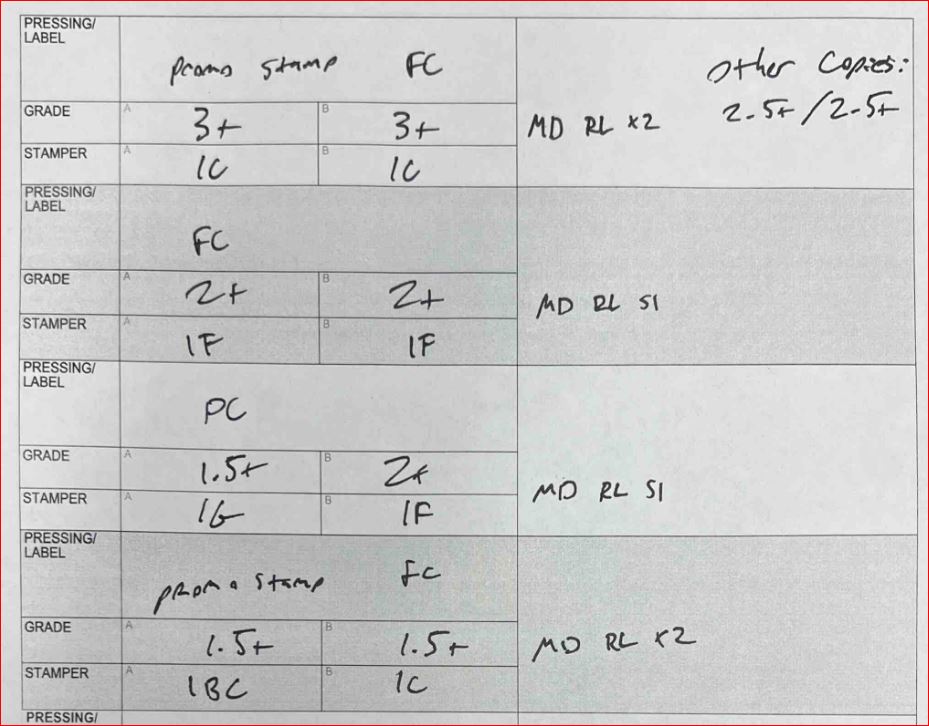
What interests me in these findings is that the other promo copy, the one you see at the bottom of the shootout sheet, earned 1.5+ on both sides. It came in last in the shootout, earning good, not great Hot Stamper grades.
If an audiophile collector were to go to Discogs, find the promo pressings, write down their stampers, and then check them against the copies he owned or might want to buy, he could either find himself with a top quality copy, or a far-from-as-good copy, depending on his luck.
Why one set of stampers sounds so much better than another set, or the same or similar set on a different pressing, is a mystery.
Does anyone have a practical way to get around the unfortunate reality that allows one set of stampers to sound great and the same or a similar set of stampers to sound not much better than decent?
Well, we can’t say there is a practical way, but we do know of an impractical one. We’ve been practicing and refining that one for more than twenty years.
We just play lots and lots of copies of the albums to find out how they sound.
Our Approach
Having the wherewithal to do this difficult work puts us in a unique position to help audiophiles looking for higher quality sound. Or, more accurately, that small subset of audiophiles looking for the highest quality pressings who also have a great deal of disposable income to devote to such pressings.
Yes, we have the obvious resources that would be needed, the staff and the budget.
More important than either of those, we came up with a new (sort of) and much more successful (definitely) approach.
We’ve learned through thousands and thousands of hours of experimentation that there is no reliable way to predict which pressings will have the best sound for any given album.
The impossibility of predicting the sound of individual pressings is one which we’ve learned to accept as axiomatic. As a scientifically-oriented person and a born skeptic, this was a concept I never had any difficulty wrapping my head around.
Early on in my audio career, sometime in the 80s, I realized it was in fact beyond dispute. (I owe a great deal to my friend Robert Pincus for showing me the light.) Like it or not — and, based on what I read on forums and such, there are apparently a goodly number of audiophiles who don’t like it — it was simply a fact.
We take the simplest possible approach to the problem, one that could be taught in a high school science class, if high school science classes were run by experimentally-minded record collectors.
- Guess what pressings might be good for a given album.
- Buy some of those pressings and others like them.
- Clean them up, play them and see if your guess about the sound of the pressing turns out to be right, wrong or somewhere in-between.
- Repeat steps one through three until you chance upon a pressing that sounds dramatically better than all the others.
- Get hold of as many of those as you can and play them against each other under rigorously controlled conditions.
- Continue to make other guesses and acquire other pressings to play against the pressing you believe to be the best.
- Keep making improvements to your playback system and never stop testing as many alternate pressings as possible.
That’s it. Nothing to it. It all comes down to experimenting at a sufficiently large scale to achieve higher rates of success.
Further Reading