Decca/London/Argo – Reviews, Commentaries, Letters, etc.

Mendelssohn / A Midsummer Night’s Dream in Mono with Maag – Reviewed in 2004

More of the Music of Felix Mendelssohn

London mono original Radio Promotion Copy with DEMO QUALITY SOUND!

Another winner on the early London FFRR Red Label. Maag’s performance here is famous, if not definitive. Audiophiles have known of this record”s qualities for decades. As our stereos get better, so do amazingly natural recordings such as this one.

Speakers corner did a reissue of this record on heavy vinyl which was quite good — too fat in the mid bass but otherwise acceptable. It sure doesn’t sound like this though! This is the real thing! You won’t find too many 180 gram records that sound like this one. (If you can find any.)

Here is the commentary I wrote for the Coppelia mono pressing. The same insights hold true.

This is the kind of record that the mono cartridge owners of the world worship. And for good reason. But you don’t need to have a mono cartridge to hear how good — in fact, how much better — this copy sounds than the stereo pressing.

I found out about mono classical records one day when I got a mono copy of the power of the orchestra, vcs 2659. It sounded better than any stereo recording of that work I had ever heard. All the instruments were so much more solid sounding, so palpable, so free from distortion, that it made me recognize for the first time what the mono record lovers of the world were talking about. That was ten [twenty five by now] years ago. Since then many high end mono cartridges have come on the market, specifically to bring out that sound.

But I don’t have a mono cartridge, and I sure don’t need one to hear how good this record sounds. Everything is right on the money. And of course with Ansermet, ballet conductor extraordinaire, you can be sure the performance is of the highest caliber. A top recommendation from better records.

By the way, there’s a good reason why London makes such good mono records. They ran a separate microphone feed into a monophonic tape recorder for their mono recordings, well into the stereo era in fact. Mercury did also, which is why many Mercury monos have excellent sound. RCA, on the other hand, frequently took the three-track master tape and simply mixed it to mono for their mono releases, which explains why a minority of RCA monos have good sound.

London knew how to do it right and the results speak for themselves.

Dvorak’s Symphony No. 1 with Kertesz Is Just Too Smooth

Hot Stamper Classical and Orchestral Imports on Decca & London

This is an IMMACULATE London LP with the old style paste-on back cover. We cracked open the factory seal just to make sure that this was a British pressing.

As we’ve said before, Kertesz is the Dvorak man! He recorded the complete cycle for London; many of those LPs have superb performances and excellent sound.

We dropped the needle momentarily on this title and heard sound that was overly smooth for my taste. If you like your records on the smooth side, this record might be more up your alley than it was ours.

There are a number of other Deccas and Londons that we’ve played over the years that were disappointing, and many of them can be found here.

Albeniz / Iberia from 1960 – Amazing on the Original and the Right Reissues Too

xxx.jpg

More of the music of Isaac Albeniz (1860-1909)

Decca and London Hot Stamper Pressings Available Now

James Walker was the producer, Roy Wallace the engineer for these sessions from May of 1960 in Geneva’s glorious Victoria Hall.

It’s yet another remarkable Demo Disc from the Golden Age of Vacuum Tube Recording Technology, with the added benefit of mastering using the more modern cutting equipment of the ’70s. (We are of course here referring to the good modern mastering of 30+ years ago, not the bad modern mastering of today.)

The combination of old and new works wonders on this title as you will surely hear for yourself on both of these better than Super Hot sides.

The sound of this copy is so transparent, undistorted, three-dimensional and REAL, without any sacrifice in solidity, richness or Tubey Magic, that we knew we had a real winner on our hands as soon as the needle hit the groove.

We were impressed with the fact that it excelled in so many areas of reproduction. The illusion of disappearing speakers is one of the more attractive aspects of the sound here, pulling the listener into the space of the concert hall in an especially engrossing way.

Side One – Iberia (1-4)

A huge hall, correct string tone, spacious and open as practically any orchestral recording you can find! (more…)

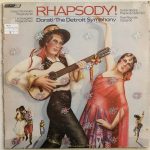
Rhapsody! – The Story of an Old Fave We Were Wrong About

Hot Stamper Classical and Orchestral Imports on Decca & London

A great example of an album We Was Wrong about.

As you can see by the commentary below, I used to think this was a wonderful sounding London “Sleeper” classical recording.

That was many years ago – five, six, seven, I cannot be sure. I ended up acquiring a half dozen copies of the album or so over the course of those years, had them cleaned up and proceeded to do a shootout.

It did not go well. Immediately I noticed that the pressings I was playing were sounding clean, clear and lively, but much too modern, too much like a good CD and not enough like the good Golden Age classical recordings we audition regularly.

Those recordings, on the right pressings, will take your breath away.  Rhapsody! was leaving me asking myself what was wrong. The more I listened the more obvious the faults of the recording became.

The pressings I played lacked warmth, richness, sweetness, space, and a number of other analog qualities I won’t belabor here. Too much of what makes listening to vintage vinyl so involving was just not on these records no matter how much I may have wanted them to be.

The extreme top and bottom were also lacking, giving the sound a “boxy” quality. The presentation was wide but not tall. Of the five levels of sound we discuss on the site in various listings, levels one and five were not as evident as they should have been.

This is, again, what progress in audio in all about. As your stereo improves, some records should get better, some should get worse. It’s the nature of the beast for those of us who constantly make improvements to our playback and critically listen to records all day.

We cannot rely on our previous judgments. With all the changes we’ve made over the years, we can now clean our records better and play our records better than ever before.

That means that some will rise and some will fall. This one fell, pretty hard in fact. Not a bad record, but not a good one either, and far from as good as I once thought.

Below is our previous commentary.  All of this was true for my old stereo and room, my critical listening skills at the time, my old cleaning regimen. And by old I mean my approach from only about five or six years ago!

Things have changed, dramatically, and nothing in all of audio could make me happier.

DEMO QUALITY SOUND! This is one of the greatest SLEEPER albums of all time.

This London reissue from 1979 of recordings from 1978 in Detroit, the year in which Dorati became director of the Detroit Symphony has the kind of orchestral sound we drool over here at Better Records. Dark and rich strings — the basses growl just like the real thing. Dynamic. Deep solid bass. Fluffy tape hiss, which sounds exactly the way it should. This tells you that the top end is untweaked. (Almost all Classic Records have funny sounding tape hiss as you may or may not know. It”s a dead give away that the top end is boosted. Tape hiss is like pink noise: it always sounds the same, unless somebody has fooled with it. Steve Hoffman taught me to listen for this quality and it was a lesson important to my growth as a critical listener.) (more…)

On This Copy of Espana, Capriccio Espagnol Was Where the Action Was

More of the music of Rimsky-Korsakov (1844-1908)

This London Whiteback (CS 6006) TAS List Super Disc really IS a Super Disc, with SUPERB SUPER Hot Stamper sound on both sides. It easily bested the Blueback we put up against it, and most of the pressings of Ansermet’s performance on London/Decca that we like (CS 6438).

What this album has going for it over the London/Decca with Ansermet is an out of this world Capriccio Espagnol, with the kind of orchestral color and excitement that rivals the composer’s Scheherazade and arguably exceeds it, compressing as it does its bright orchestration into fewer than 15 minutes of unalloyed brilliance.

I would argue that the sound here easily bests nine out of ten copies of LSC 2446, quite a feat when you consider what that record is selling for these days.

(Most audiophiles learn too late just how bad the average pressing of Reiner’s performance is. Take our advice, if you’re going to buy one without hearing it first, make sure you can return it. Chances are, if you’re a critical listener, you will want to. If you’re not a critical listener, feel free to buy the Classic Heavy Vinyl pressing. Although it sounds godawful to us, most audiophiles seem to like it just fine, a fact we regret to say does not reflect well on our fellow hobbyists. Or the venerable HP himself for that matter, as it made his TAS List.)

Who can resist these sublime orchestral works? To quote an infamous label, they are an audiophile’s dream come true. Click on the tabs above to read more about them.

We’ve long been of the opinion that only a small percentage of the copies of CS 6006 actually live up to the hype associated with its status on the Tas List. Our recent shootout provided more supporting evidence, as this copy was dramatically better than the other, more original, one we played.

(more…)

The Trout Quintet – Original Versus Reissue

More of the music of Franz Schubert

This unusual 2-pack combines two very different pressings from very different eras to create a complete performance of The “Trout” Quintet with SUPERB Super Hot Stamper (or better) on both sides. One pressing, the one shown, is from the early ’60s; the other is from 1982. How could an imported budget late reissue beat a superb Golden Age pressing on any side you ask? Well, the answer to that question is provided by the records we will send you. 

Side one of this London Whiteback pressing is dark and opaque, with a serious lack of both top end and clarity. Side two however is GORGEOUS: so big, rich, clear and lively, it earned a sonic grade of A++ to A+++! In our shootouts the person reviewing the records (in this case me) never knows which pressing is being critiqued. Imagine my surprise when the late London handily beat the early one.

Actually it’s easy to imagine my surprise, because there was simply no surprise to imagine. In our shootouts here at Better Records, later pressings beat early pressings regularly. We let the records speak for themselves, and that’s what they told us, at least on side one of The “Trout.” The reason the late pressing even made it into our shootout was that in a preliminary round it showed us that it had very good sound on side one. Side two didn’t hold up, but any record with good sound on any side is going to go in the shootout, regardless of the “incorrectness” of its label or country of origin.

On the earlier pressing (CS 6090) the sound is rich and sweet; some might say it’s too rich, but for this music it works. The piano and the strings have that Golden Age Tubey Magical sound we love. It’s been years since I’ve had the opportunity to play this record; most copies are just too beat up to bother with, so I was glad to find this one in such minty condition. (more…)

Every Label Made Mediocre Records – London Released This One in 1963

More of the music of Franz Schubert

More of the music of Antonin Dvorak

The copy we auditioned was opaque and veiled, much like the Heavy Vinyl reissues that are flooding the market these days.

Looking for pressings with audiophile quality sound and mostly quiet surfaces? This link will take you to the Decca/London records that are currently available on our site. They’re guaranteed to have good sound. Quiet surfaces are harder to come by but we’re doing the best we can.

As far as we can tell, based on this single copy, CS 6357 is not an album worthy of a Hot Stamper shootout.

We can’t say that there aren’t good sounding pressings of the album though. If we hear a better one down the road, we would certainly be open to the possibility of doing a shootout and making the best copies available to our customers.

Perhaps you have one you like. If so, please let us know. You can email me at tom@better-records.com

(more…)

Britten / Debussy / Schumann / Cello Sonatas / Rostropovich – Reviewed in 2011

Hot Stamper Pressings of the Music of Claude Debussy Available Now

Both sides of this promo London Blueback pressing (CS 6237) of piano and cello music have SUPERB sound. If you’re a fan of the cello, the piano, or chamber works in general, you will have a hard time finding a better sounding recording than this.

Notice especially that there is practically no smear on the piano — the notes are clear, with their transients fully intact, something one rarely hears anywhere but in a live setting. The tonality of the piano is also correct from top to bottom.

Lately we have been writing quite a bit about how pianos are good for testing your system, room, tweaks, electricity and all the rest, not to mention turntable setup and adjustment.

  • We like our pianos to sound natural (however one chooses to define the term).
  • We like them to be solidly weighted.
  • We like them to be free of smear, a quality that is rarely mentioned in the audiophile record reviews we read.

This is an Older Classical/Orchestral Review

Most of the older reviews you see are for records that did not go through the shootout process, the revolutionary approach to finding better sounding pressings we started developing in the early 2000s and have since turned into a veritable science.

We found the records you see in these older listings by cleaning and playing a pressing or two of the album, which we then described and priced based on how good the sound and surfaces were. (For out Hot Stamper listings, the Sonic Grades and Vinyl Playgrades are listed separately.)

We were often wrong back in those days, something we have no reason to hide. Audio equipment and record cleaning technologies have come a long way since those darker days, a subject we discuss here.

Currently, 99% (or more!) of the records we sell are cleaned, then auditioned under rigorously controlled conditions, up against a number of other pressings. We award them sonic grades, and then condition check them for surface noise.

As you may imagine, this approach requires a great deal of time, effort and skill, which is why we currently have a highly trained staff of about ten. No individual or business without the aid of such a committed group could possibly dig as deep into the sound of records as we have, and it is unlikely that anyone besides us could ever come along to do the kind of work we do.

The term “Hot Stampers” gets thrown around a lot these days, but to us it means only one thing: a record that has been through the shootout process and found to be of exceptionally high quality.

The result of our labor is the hundreds of titles seen here, every one of which is unique and guaranteed to be the best sounding copy of the album you have ever heard or you get your money back.


Side One

Britten – Sonata in C for Cello and Piano
Schumann – Funf Stucke Im Volkston

Side Two

Schumann – Funf Stucke Im Volkston
Debussy – Sonata for Cello and Piano

Benjamin Britten

Britten was an accomplished pianist, frequently performing chamber music and accompanying lieder and song recitals. However, apart from the Holiday Diary (1934), Piano Concerto (1938), Young Apollo (1939), Diversions (written for Paul Wittgenstein in 1940), Scottish Ballad (1941), he wrote relatively little music that puts the piano in the spotlight, and in a 1963 interview for the BBC said that he thought of it as “a background instrument”.

One of Britten’s best known works is The Young Person’s Guide to the Orchestra (1946), which was composed to accompany Instruments of the Orchestra, an educational film produced by the British government, narrated and conducted by Malcolm Sargent. Its subtitle is Variations and Fugue on a Theme of Purcell, the theme is a melody from Henry Purcell’s Abdelazar. Britten gives individual variations to each of the sections of the orchestra, starting with the woodwind, then the string instruments, the brass instruments and finally the percussion. Britten then brings the whole orchestra together again in a fugue before restating the theme to close the work. The original film’s spoken commentary is often omitted in concert performances and recordings.

Britten’s church music is also considerable: it contains frequently performed ‘classics’ such as Rejoice in the Lamb, composed for St Matthew’s Northampton (where the Vicar was Revd Walter Hussey), as well as A Hymn to the Virgin, and Missa Brevis for boys’ voices and organ.

As a conductor, Britten performed the music of many composers, as well as his own. Among his celebrated recordings are versions of Mozart’s 40th Symphony and Elgar’s The Dream of Gerontius (with Pears as Gerontius), and an album of works by Grainger in which Britten features as pianist as well as conductor.

Early in his career, Britten made a conscious effort to set himself apart from the English musical mainstream, which he regarded as complacent, insular and amateurish. Many contemporary critics distrusted his facility, cosmopolitanism and admiration for composers such as Mahler, Berg, and Stravinsky, not at the time considered appropriate models for a young English musician.

Britten’s status as one of the greatest composers of the 20th century is now secure among professional critics.

Wikipedia

The Sound You Might Expect from Decca in 1967

More of the Music of Modest Mussorgsky

Released as Romantic Russia by Decca in 1967, this London can also be found with a different cover and a different catalog number, CS 6503.

DEMO QUALITY SOUND on side one — in some ways. Don’t go looking for the Tubey Magic of an earlier era. What you get instead is super-low distortion, full-bandwidth sound with deep powerful bass and more transparency than most later Londons.

Solti is clearly the man for this music! He’s on fire with this fiery material. THIS is the way you want to hear Russian orchestral showpieces — played with verve and dynamically ALIVE. (more…)

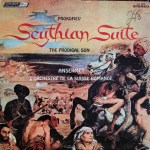
Prokofiev / Scythian Suite – Reviewed Way Back in 2006

More of the music of Sergei Prokofiev (1891-1953)

This is a London Whiteback LP with SUPERB SOUND on both sides. It’s immediate, dynamic, very low distortion, spacious, and relatively sweet.

The bass deserves special mention here. You rarely hear recordings from the ’50s and early ’60s, the kind of LPs that were mastered with tubes of course, having this kind of truly deep punchy bass.

As this album was recorded in ’67 and mastered relatively soon thereafter, the cutting equipment capable of inscribing deep bass onto a slab of vinyl was widely available. For this piece of music it’s almost mandatory to get good solid low end. 

Side two is even sweeter than side one. The strings are tonally Right On The Money (ROTM). The lower strings are especially rich and textured. 


This is an older classical/orchestral review

Most of the older reviews you see are for records that did not go through the shootout process, the revolutionary approach to finding better sounding pressings we started developing in the early 2000s and have since turned into a veritable science.

We found the records you see in these older listings by cleaning and playing a pressing or two of the album, which we then described and priced based on how good the sound and surfaces were. (For out Hot Stamper listings, the sonic grades and vinyl playgrades are listed separately.)

We were often wrong back in those days, something we have no reason to hide. Audio equipment and record cleaning technologies have come a long way since those darker days, a subject we discuss here.

Currently, 99% (or more!) of the records we sell are cleaned, then auditioned under rigorously controlled conditions, up against a number of other pressings. We award them sonic grades, and then condition check them for surface noise.

As you may imagine, this approach requires a great deal of time, effort and skill, which is why we currently have a highly trained staff of about ten. No individual or business without the aid of such a committed group could possibly dig as deep into the sound of records as we have, and it is unlikely that anyone besides us could ever come along to do the kind of work we do.

The term “Hot Stampers” gets thrown around a lot these days, but to us it means only one thing: a record that has been through the shootout process and found to be of exceptionally high quality.

The result of our labor is the hundreds of titles seen here, every one of which is unique and guaranteed to be the best sounding copy of the album you have ever heard or you get your money back.


Further Reading

If you’re searching for the perfect sound, you came to the right place.