test-orchestral

Some of our favorite orchestral test discs.

Violin and Piano Concerto Recordings that Fall Apart

Hot Stamper Pressings Featuring the Violin Available Now

Hot Stamper Pressings of Piano Concerto Recordings Available Now

Many of the vintage orchestral recordings we’ve auditioned over the years did a good job of capturing the lead instrument in a concerto — for example, the piano or violin — but fell apart completely when the orchestra came in, with unacceptable levels of congestion and distortion.

Orchestras are hard to record. Pianos and violins, not so much.

Here are some titles that often have congestion problems when they get loud. If you play your orchestral recordings at moderate levels, you may not be as bothered by this problem as we are, because we do not have the luxury of listening at moderate levels.

We have to put the records through the ringer, and one of the ringers they must go through is they must sound right at loud levels, because live music gets loud, and it does it without getting distorted or congested.

Congestion and distortion are problems for practically all the titles you rarely see on our site, the vintage pressings of recordings by EMI, DG, Philips, Columbia and dozens of others.

We discussed the problem here in more detail.

Speakers Corner Heavy Vinyl and the Loss of Transparency

Hot Stamper Pressings of Classical and Orchestral Music Available Now

We review yet another mediocre Speakers Corner Heavy Vinyl reissue.

We recently gave the Heavy Vinyl pressing from Speakers Corner, the same one that we had previously recommended back in the 90s, a sonic grade of C+. 


UPDATE 2024

Recently in this case means about twenty years ago.


To our ears now it has many more shortcomings than it did back then, which we discuss below.

So often when we revisit the remastered pressings we used to like on Heavy Vinyl we come away dumbfounded — what on earth were we thinking? These are not the droids sounds we are looking for. Perhaps our minds were clouded at the time.

Below are some thoughts from a recent classical listing that we hope will shed some light on our longstanding aversion to the sound of modern remasterings.

What is lost in these newly remastered recordings? Lots of things, but the most obvious and bothersome is TRANSPARENCY.

Modern records are just so damn opaque.

We can’s stand that sound. It drives us crazy.

Important musical information — the kind we hear on even second-rate regular pressings — is simply nowhere to be found. That audiophiles as a whole — including those that pass themselves off as the champions of analog in the audio press — do not notice these failings does not speak well for either their equipment or their critical listening skills.

It is our contention that no one alive today makes records that sound as good as the ones we sell. Once you hear this Hot Stamper pressing, those 180 gram records you own may never sound right to you again. They sure don’t sound right to us, but we are in the enviable position of being able to play the best properly cleaned older pressings (reissues included) side by side with the new ones, where the faults of the current reissues become much more recognizable, even obvious. When you can hear them that way, head to head, there really is no comparison.

A Lost Cause

The wonderful vintage disc we are offering here will surely shame 100% of the Heavy Vinyl pressings ever made, as no Heavy Vinyl pressing — not one — has ever sounded especially transparent or spacious to us when played against the best Golden Age recordings, whether pressed back in the day or twenty years later.


UPDATE 2024

We live and learn. To prove it can be done, here’s one, And we now know of one other. So that makes two.

(more…)
For Arcana, Speed Is Key

Hot Stamper Pressings on Decca and London Available Now

This is a recording that allows your speakers to disappear completely like practically no other. A powerful Test Disc as well. Use this one to check your speed and staging, subtle changes in your equipment can have a big effect on recordings like this

Incredible sound for this CRAZY 20th Century music, featuring wild and wacky works which rely almost exclusively on percussion (not one, not two, but three bass drums!). My favorite piece here may be Ionisation, which uses real sirens (the Old School ones cranked by hand) as part of Varese’s uniquely specialized instrumental array.

But the main reason audiophiles will LOVE this album is not the music, but the SOUND. Ionisation has amazing depth, soundstaging, dynamics, three-dimensionality and absolutely dead-on tonality — it’s hard to imagine a recording that allows your speakers to disappear more completely than this one.

It also makes a superb test disc. Subtle changes in your equipment can have a big effect on recordings like this.

The instrumental palette is large and colorful, giving the critical listener plenty to work with.

And this copy is perfect for testing because is is nearly FLAWLESS in its sound. No other copy could touch it. Many copies are not especially transparent, spacious or three-dimensional, and lack extension on both ends of the frequency spectrum.

The SPEED of the percussion is also critical to its proper reproduction.

No two pieces of electronics will get this record to sound the same, and some will fail miserably.

If vintage tube gear is your idea of the ultimate in sound, this record may help you to better understand where its shortcomings lie.

(more…)

Putting Your System to the (Violin and Piano) Test

Hot Stamper Pressings with Jascha Heifetz Performing

Do you want a recording that is going to put your system to the test? Well this is that record! The violin is REAL. As you compare equipment or tweak your system, you will hear the sound of that violin change and it should be obvious when it gets better and when it gets worse. 

The piano is also very well recorded.

If you lose some body to the piano you’re probably going in the wrong direction.

But since that direction would make the violin almost unbearable sounding, I’m going to guess that would be easily recognized as a mistake.

The balance between those two instruments on this recording is perfection, so if you get this record right, you’re making progress of the most important kind: toward musical naturalness.

Otherwise this violin, at least on the Kreutzer Sonata, is going to tear your head off.

Our previous Hot Stamper review follows.

The Beethoven, which takes up side one, is recorded in a fairly dry acoustic. The sound of the violin is very immediate. It’s quite a showpiece for Heifetz.

I much prefer the Bach on side two, however, which is recorded within a more natural hall acoustic. Sir Malcom Sargent conducts and Eric Freidman plays the second violin in this concerto, which is also his debut for RCA, according to the liner notes.

This piece was recorded in England and to me it has the rich, sweet, glorious sound of Living Stereo at its best.

(more…)

This Carmen Ballet Is a Great Test Disc for Shrill, Gritty Strings

Hot Stamper Pressings of the Music of Georges Bizet Available Now

UPDATE 2025:

I’ve added some tubes-versus-transistors commentary at the bottom of this posting.


This Angel Melodiya pressing of Bizet’s Carmen, rearranged by Soviet composer Rodion Shchedrin for strings and 47 percussion instruments, has two incredible sides. Demo Quality Sound barely begins to do it justice. If you have the system to play it, this copy is a KNOCKOUT.

But boy is it a difficult record to reproduce. You better have everything working right when you play this one — it’s guaranteed to bring practically any audiophile system to its knees.

Speed, resolving power and freedom from distortion are what this record needs to sound its best.

Is your system up to it? There’s only one way to find out.

And if you have any peaky audiophile wire in your system, the kind that is full of detail but calls attention to itself, you are in big trouble with a record like this.

More than anything, this is a record that rewards your system’s neutrality.

Testing

This is a superb Demonstration Disc, but it is also an excellent Test Disc. The sound of the best copies is rich, full-bodied, incredibly spacious, and exceptionally extended up top. There is a prodigious amount of musical information spread across the soundstage, much of it difficult to reproduce.

Musicians are banging on so many different percussion instruments (often at the far back of the stage, or, even better, far back and left or right) that getting each one’s sonic character to clearly come through is a challenge — and when you’ve met it, a thrill. If you’ve done your homework, this is the kind of record that can show you what you’ve accomplished.

On the best copies the strings have wonderful texture and sheen. If your system isn’t up to it (or you have a copy with a problem in this area), the strings might sound a little shrill and possibly gritty as well, but I’m here to tell you that the sound on the best copies is just fine with respect to string tone and timbre. You will need to look elsewhere for the problem.

(more…)

On the Concerto in F, String Tone Is Key

Hot Stamper Pressings of the Music of George Gershwin Available Now

I must admit Classic Records did a passable job with LSC 2586, RCA’s recording of Gershwin’s Concerto in F, with Fiedler conducting the Boston Pops.

The two things that separate the good originals from the Classic reissue are in some ways related.

Classic’s standard operating procedure is to boost the upper midrange, and that, coupled with their transistory mastering equipment, results in strings that are brighter, grittier, and yet somehow lacking in texture and sheen compared to the originals,

This to us is a clear sign of a low-resolution cutting chain.

Once you recognize that shortcoming in a pressing, it’s hard to ignore, and I hear it on every Classic Record I play. (This commentary has more on the subject.)

RCA is more famous for its string tone than anything else.

If the strings on the Classic Records LPs don’t bother you, you can save yourself a lot of money by not buying authentic RCA pressings — and get quieter vinyl to boot.

Here are some other records that are good for testing string tone and texture.

(more…)

The MHS Recording of Chopin’s First Piano Concerto Had the Most Natural Piano of Them All

Hot Stamper Pressings of the Music of Frederic Chopin Available Now

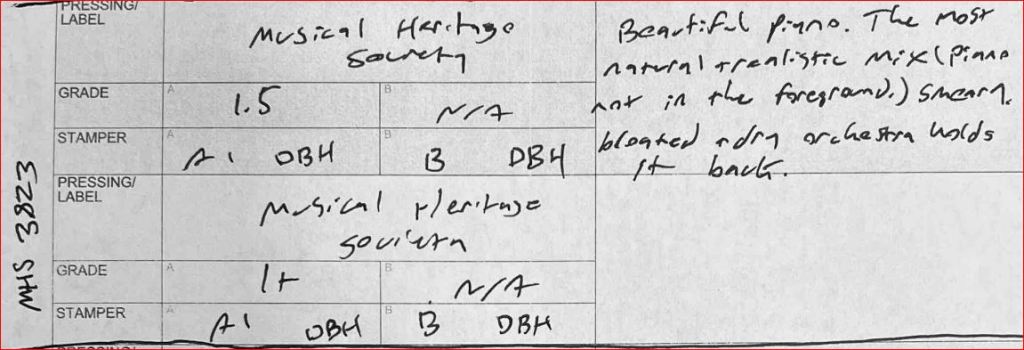
There are some wonderful Musical Heritage Society records sitting in the bins of your local record store or Goodwill, and this one is worth picking up just to hear how well recorded the piano is.

We described it this way:

Beautiful piano. The most natural and realistic mix with the piano not in the foreground.

But there is more to the recording than the sound of the piano.

Smeary, bloated and dry orchestra holds it back.

Well, at least we tried. (Note that side two was deemed not worth grading.)

Our favorite recording for performance and sound is the Living Stereo from 1961, LSC 2575, with Rubinstein at the piano and Skrowaczewski conducting the New Symphony Orchestra of London.

This is what we had to say about the sound of our Shootout Winner:

We love the huge, solid and powerful sound of the piano on this recording. This piano has weight and heft. As a result, it sounds like a real piano.

For some reason, a great many Rubinstein recordings are not capable of reproducing those seemingly all-important qualities in the sound of the piano.

Those are, as I hope everyone understands by now, the ones we don’t sell. If the piano in a piano concerto recording doesn’t sound solid and powerful, what is the point of playing such a record?

Or, to be more accurate, what is the point of an audiophile playing such a record? (Those of you who would like to avoid bad sounding vintage classical and orchestral records have come to the right place. We’ve compiled a very long list of them for precisely that purpose, and we add to it regularly.)

(more…)

Rich, Rosiny Lower Strings in Living Stereo Like These Are to Die For

Hot Stamper Pressings of the Music of Franz Liszt Available Now

Find me a modern record with rich, rosiny lower strings and I will eat it.

And by “modern record” we hasten to include both modern recordings and modern remasterings of older recordings. No one alive today can make a record that sounds as good as this one.

To call it a lost art is to understand something that few vinyl-loving audiophiles appear to have fully grasped since the advent of the Modern Reissue, which is simply this: head to head they are simply not competitive.

After twenty years of trying and literally hundreds of failed examples, both the boutique and major labels of today have yet to make a record that sounds as powerful and lifelike as this RCA from the old days. 

Fortunately for record lovers and record collectors alike, we here at Better Records are not trying to make a record sound the way these sides do.

Our job is much easier than that. We’re just trying to find ones that do. When we find sides as good sounding as these, we call them Hot Stampers and charge a lot of money for them.

But you get what you pay for when you buy a record from us. And if you disagree, for any reason, you get your money back.

(more…)

Compression Works Its Magic on The Christmas Eve Suite

Hot Stamper Pressings of the Music of Rimsky-Korsakov Available Now

Some notes about the compression effects we heard on side two of a Blueback pressing of The Christmas Eve Suite album back in 2012. We wrote:

Side two is even more transparent and high-rez than side one. The texture on the strings and the breathy quality of the woodwinds make this a very special pressing indeed.

The horns are somewhat smeary and do get a bit congested when loud.

There is more compression on this side two than there was on the best copy we played, and that means low level detail is superb, but louder parts, such as when the more powerful brass instruments come in, can present problems.

Note how good The Flight of the Bumble Bee sounds here.

Compression is helping bring out all the ambience and detail in the recording, and there’s no downside because the orchestra is playing softly, unlike the piece that precedes it.

A classic case of compression having sonic tradeoffs.

(more…)

This Sibelius Violin Concerto Was Big and Lush but…

Hot Stamper Pressings Featuring the Violin Available Now
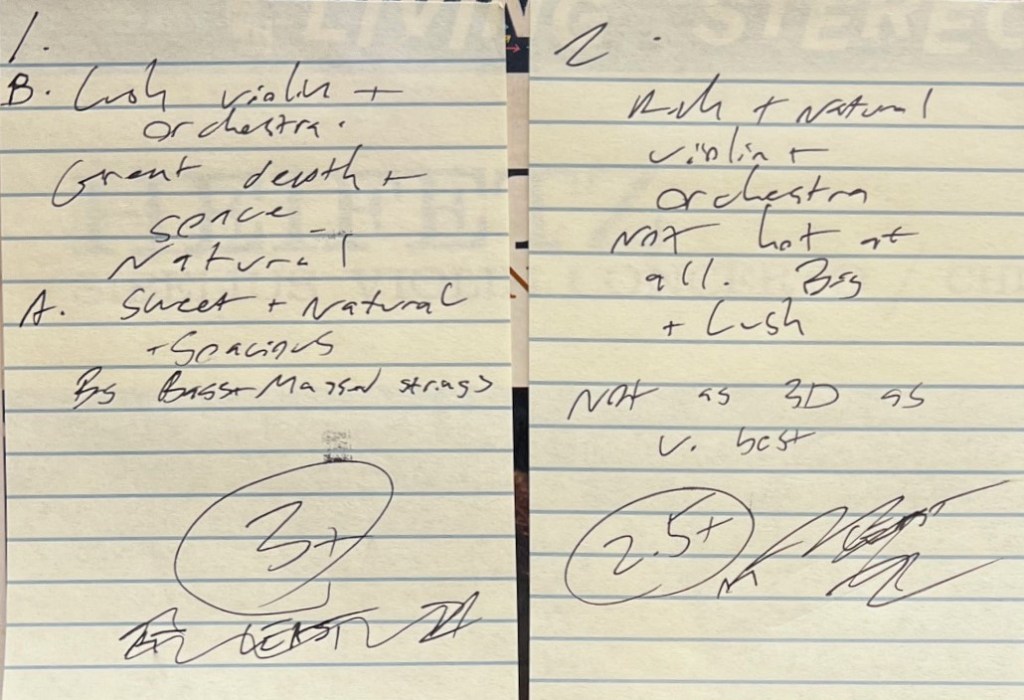
We love the way RCA recorded Heifetz back in the day, the day in this case being 1960. We usually have a good supply of vintage Heifetz titles on the site at all times. They often have our favorite performances, and the best copies, as the notes for the one below make clear, can have absolutely amazing sound.

As you can see from the notes, side one of a recent shootout winning copy was doing everything right.

However, we had a side two that was slightly better than the side two you see here. When we played the two best copies back to back, this side one came out on top, earning a grade of 3+, but the side two of another copy showed us there was even more three-dimensionality to be discovered in the recording than we thought. Consequently this side two was dropped a half grade to 2.5+.

This is exactly why we do shootouts. If you really want to be able to recognize subtle (and not so subtle!) differences between pressings, you must learn to do them too.

(more…)