rrr

We Didn’t Know How Good We Had It in the Seventies

Hot Stamper Pressings of Well-Recorded Folk Rock Albums Available Now

Stealin’ Home has long been a Folkie-Pop favorite of mine, mostly on the strength of the consistently smart songwriting, polished production and audiophile sound quality.

But really, to be truthful, what I found attractive right from the start was Iain Matthews’s especially clear, sweet tenor. That’s the hook that drew me to the album.

Only later would I be pleasantly surprised to find that the recorded sound was wonderful; that the production was equal to the best major label Rock and Pop around (a comparison to The Doobie Brothers would not be a stretch); and, with repeated listening, it was clear that the level of songwriting was high indeed (an a capella rendition of Rodgers and Hammerstein’s You’ve Got to Be Carefully Taught, which opens side two, can’t help but raise your averages).

ian_matthews_-_stealin_homeWe Didn’t Know How Good We Had It

Produced in 1978, the best copies are rich, smooth and sweet in the best tradition of ANALOG recording.

Only a few years later this sound was out of style, replaced by the edgy, hard, digital qualities preferred by synthpop bands like Tears for Fears and Simple Minds.

This would turn out to be a bad time for audiophiles (like me) who liked the pop music of the day but not the pop sound of the day. Heavy-handed processing as well as the overuse of synthesizers and drum effects, with the whole of the production slathered in digital reverb, have resulted in most of the albums from the early- to mid-80s being all but impossible to enjoy on a modern high-end system. Believe me, we’ve tried.


UPDATE 2026

Getting distortion out of the system, electricity, room and all the rest helps make the records from the 80s much more enjoyable. Brothers in Arms comes instantly to mind, but there are scores of others. Obviously some heavily processed recordings are going to sound much better than others, especially if you have the right pressings, but few of them can compete with the better recordings from the 70s.


(more…)

Porgy and Bess Gets the Speakers Corner Treatment, from Sterling No Less

Hot Stamper Pressings of Pop and Jazz Vocals Available Now

Here is how we described a recent Shootout Winning copy of Porgy and Bess.

Spacious, full-bodied and Tubey Magical, with Ella and Louis front and center, this is the sound you want to hear on their brilliant collaboration from 1958.

Two vocal giants came together to perform Gershwin’s timeless opera, revered by both music lovers and audiophiles to this day. If you’ve never heard exceptionally well recorded male and female vocals from the 50s, this is a great opportunity to have your mind blown.

Speakers Corner contracted Ryan Smith at Sterling to remaster their Heavy Vinyl pressing in 2013, which might sound like a wise move — Sterling has a good reputation around these parts, even if RKS does not — but the results were disastrous.

Or maybe it wasn’t such a good idea after all. Our notes tell the story of the sound, and it’s not pretty. Painful is actually the word that comes to mind.

Pity our poor listening panel that had to sit through a record that sounds as bad as this one does.

(This is a four sided set but we could not see the point in playing all of them when the first two sucked so badly.)

(Technically they don’t “have to” play these Heavy Vinyl pressings. We don’t force our talented staff to waste their time on modern records. They do it because they choose to, in order to have a better idea of what the competition is up to. Turns out the competition is up to no good.)

Our two sentence review should tell you everything you need to know. Let us hope it saves you from throwing your money away the way we did.

  • Loud, dry and pinched.
  • Hot vocals, no space, very sour and lacking bass.

When the voice is wrong, the sound is wrong. What more do you need to know?

And when the voice is wrong on a legendary recording such as this, you have a worthless piece of vinyl no matter how much you may have paid for it. (Current price on Discogs: about a hundred bucks.)

(more…)

On Please Please Me, Which Is More 3-Dimensional, Mono or Twin Track?

Hot Stamper Pressings of the Music of The Beatles Available Now

With all due respect to George Martin, we’ve played a number of mono pressings of Please Please Me in the past twenty or so years and have never been particularly impressed with any of them. The monos jam all the voices and instruments together in the middle, stacking them one in front of the other, and lots of musical information gets mashed together and simply disappears in the congestion. 

But is twin track stereo any better?

Yes, when you do it the way Norman Smith did on Please Please Me.

Twin Track stereo (which is actually not very much like two-track stereo, I’m sure Wikipedia must have a listing for it if you’re interested) is like two mono tracks running simultaneously. It allows the completely separate voices to occupy one channel and the completely separate instruments to occupy another, with no leakage between them.

On some stereos it may seem as though the musicians and the singers are not playing together the way they would if one were hearing them in mono. They are in fact recorded on two separate mono tracks, the instruments appearing in the left channel and the singers in the right, separated as much as is physically possible.

Stuck in their individual stereo speakers, so far apart from one another, the members of the band don’t even seem to be playing together in the same room.

That’s on some stereos, and by some stereos I mean stereos that need improvement. Here’s why.

Three-Dimensional Mono?

In the final mixing stage, Norman Smith added separate reverb to each of the two channels, sending the reverb for the sound recorded in each channel to the opposite channel. This has the effect of making the studio, the physical space that The Beatles appear to be in, seem to stretch all the way from the right channel, where the Beatles’ voices are heard, to the back left corner of the studio, where the reverb eventually trails off.

(more…)

Kevin Gray Sacrifices Another Blue Note to the Lo-Fi Crowd

Hot Stamper Pressings of Blue Note Recordings Available Now
We did a shootout for Cornbread in 2023 and again in 2025. For our latest one, we were fortunate to be able to include both the Tone Poets pressing that came out in 2019 as well as the 75th Anniversary Blue Note pressing from 2014.

Here is the way we described a Hot Stamper that ended up being the best sounding pressing we played on one of its sides, and coming in second on the other side.

  • The sound is everything that’s good about Rudy Van Gelder‘s recordings – it’s present, spacious, full-bodied, Tubey Magical, dynamic and, most importantly, alive in that way that modern pressings never are
  • Exceptionally spacious and three-dimensional, as well as relaxed and full-bodied – this pressing was a big step up over nearly all other copies we played

After hearing a copy of the album that sounded as good as that one, the Tone Poets pressing would have had to be at least a bit of a letdown, right?

To be fair, all it really has to be is good sounding. For $30, the price of the average copy that sells on Discogs, can you really expect great?

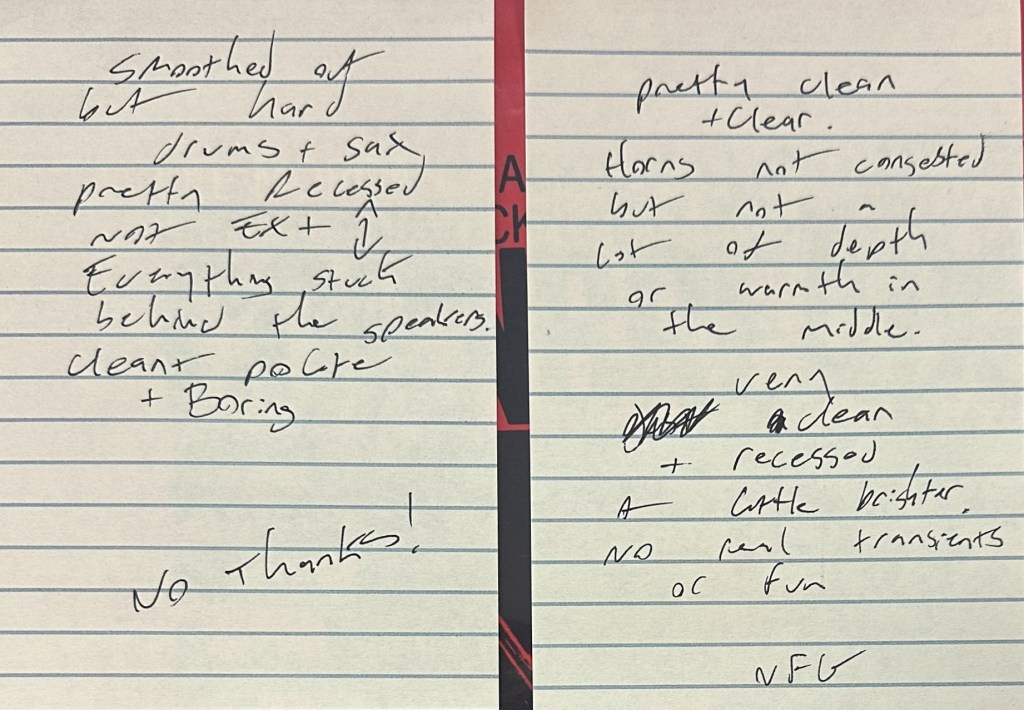
I don’t know what any of the purchasers of these Tone Poets records — of this or any other title — are expecting for their thirty bucks, but I can tell you what they are getting. We took notes while their remastered pressing played, and here’s what we heard.

Side One

(more…)

Port’s Rule and The Song of the Volga Boatman

More Records that Helped Me Make Progress in Audio

The track that started us down the road to our first Sauter-Finegan shootout is, to this very day, our Number One Test Track of All Time, a little ditty known as the Song of the Volga Boatman.

We first heard it back in the 90s on Bob and Ray Throw a Stereo Spectacular, which is still the version we test with, but this album of forward-looking big band contains that track  as well as 10 others, all with truly amazing sound.

Why is the Song of the Volga Boatman our ultimate test track?

The simplest way to understand it is that all the instruments are being played live in the studio, and all of them in the huge soundfield are real and acoustic — string bass, drums, horns of every size and type, woodwinds, percussion, tubular bells, etc.

In addition, the arrangements given to this roomful of players is so complex and lively that if anything sounds “funny,” to use the precise audiophile nomenclature, it really calls attention to itself.

Port’s Rule states: If it isn’t easy for your Test Discs to sound wrong, they are not very good Test Discs.

Wrong is the natural order of things.

Getting it right is where the work comes in to play.

And it should seem more like play than work or you are unlikely to get very far with it. (That’s another one of Port’s Rules, sometimes referred to as music does the driving.)

When the stereo is right from top to bottom, this song is right from top to bottom, and every other record we know the sound of will have the sound it’s supposed to have.

It seems simple and in some ways it is.

We’ve been getting the Song of the Volga Boatman to sound bigger and better now for years, through scores and scores of changes. At our current stage of audio evolution, at the very loud levels we play it at, it’s shocking how big, powerful and real it seems. It has more of the “live music” qualities we prize than almost any other studio recording I can think of.

(more…)

Letter of the Week – “I can’t see myself ever getting bored of the way my music sounds.”

Record Collecting for Audiophiles from A to Z


ab_ba has some comments about the audiophile record collectors he has been watching lately on youtube:

Sometimes I wonder why people are even into records.

I get it that it’s fun to collect them and compare them and brag about them and have a tangible thing you can hold in your hands and put on your shelves.

But for me, those aspects of vinyl listening are a distraction at best, and unhealthy at worst, and I really try to resist their allure.

If somebody’s not doing it for the sound, it’s a dangerous hobby, since it can waste a lot of time and money. If you ARE doing it for the sound, you have to be an empiricist. You have to wonder. You’ve got to be curious! [ab_ba wrote a very nice piece about the importance of curiosity, which you can read here.]

ab_ba

He added this in another email to us:

Part of me envies the dudes who can just buy what they’re told to buy, and believe they have it as good as it can possibly be. Sometimes I think it must be nice to just be complacent like that. But, I’ll bet they eventually stop listening to their records. It’s not all that rewarding a hobby if you stop at pretty good sound. I can’t see myself ever getting bored of the way my music sounds.

ab_ba

I’m sure I will have plenty more to say on this blog regarding record collecting, but for now I would just point out that audiophiles collect records for lots of reasons, and if they enjoy having a collection of audiophile pressings, and find that they derive satisfaction from owning and discussing them with other similarly-interested individuals, then more power to them. Who am I to tell them what they should be doing with their spare time?

For me, and obviously for ab_ba and other letter writers, Robert Brook among them, the appeal to this aspect of record collecting borders on nonexistent, a subject I have written a fair amount about here on the blog, to wit:

For us here at Better Records, collecting for the sake of collecting has never held much appeal.

We like to play records, not just collect them, and we like to play records with the best sound we can find, using the shootout process we developed over the last two decades. We call those kinds of records Hot Stamper pressings, and finding them, and making them available to other like-minded audiophiles, has been the focus of our work for close to twenty years.

All the collecting we leave to other people who enjoy that sort of thing.

The only kinds of records I like to play are the ones that give me a thrill, the way live music (sometimes) does.

(more…)

Getting the Electricity Right Made All the Difference in Our New Studio

Hot Stamper Pressings of the Music of Cat Stevens Available Now

In response to a customer’s letter, I wrote the following a few years back:

The vast majority of audiophiles never get to the higher levels of audio because of the compromises they make at every step in their rooms, speakers, wires and practically everything else.

For example:

  • Speakers too small,
  • Shoved up against a wall,
  • In an untreated room that
  • The family uses to watch TV in?

You can’t get very far that way.

Some of the worst off of these folks end up with a collection of crap Heavy Vinyl because their systems simply will not let them hear how much better their vintage pressings sound.

Better Electricity Made All the Difference

When we moved the business into an industrial park a few years ago, I took the opportunity to build the largest playback studio I could fit on the premises. It was 17 by 22 with a 12 foot high ceiling, with a concrete slab floor and six inch thick double drywall for walls, as well as a complicated system of dedicated electrical circuitry.

It took a surprising amount of work carried out over months to get it to sound right. Day after day we ran experiments. Most of the time it was just me. I actually like working alone. It’s not hard for me to stay focussed.

Oddly enough, what made the biggest difference was getting the electricity right: computers and cleaning machines on isolation transformers, stuff unplugged, stuff left plugged in that made the sound better, lights hooked up to batteries rather than plugged in to the main circuits, etc. 

Over the course of about two months, the sound became night and day better.

More on unplugging here.

Also, Robert Brook has done a great deal of work along these same lines, which he explains in detail here.

This kind of work is not hard for me. We’ve been doing it for decades, but we have a very big advantage over everyone else: we have good sounding records to test with.

We have Hot Stampers! The records are correct. If they sound wrong, it’s not their fault. They are almost never the problem.

I used But I Might Die Tonight from Tea for the Tillerman for weeks and weeks. It was very difficult to get all the parts right, but in the end it was more glorious than I had ever heard it. I wrote an extensive commentary on the experience I went through which you can read all about here.

(more…)

Who on Earth Could Possibly Take the Sound of this Ridiculous Remaster Seriously?

Hot Stamper Pressings on Decca and London Available Now

There actually is such a person who does exactly that, can you imagine?

Only an Audiophile True Believer could be fooled by sound so ridiculously unnatural.

But the world is full of such people. They bought into the audiophile BS of Mobile Fidelity in the 80s and apparently haven’t learned much since.

Now they think Heavy Vinyl is the answer to the world’s problems. The more things change…

If your stereo is any good at all, you should have no trouble hearing the sonic qualities of this album we describe below. If you are on this blog, and you have tried some of our Hot Stamper pressings, there is a good chance you’re hearing pretty much what we’re hearing. Why else why would you pay our prices?

One thing I can tell you: we would never charge money for a record that sounds as weird and wrong as this MoFi.

A well-known reviewer has many kind things to say about this pressing, but we think it sounds like a hi-fi-ish version of a 70s London, which means it’s opaque and the strings are badly lacking in Tubey Magical sheen and richness.

The bass is like jello on the MoFi, unlike the real London, which has fairly decent bass.

If an audiophile reviewer cannot hear the obvious faults of this pressing, I would say there’s a good chance one or both of the following is true:

  1. His equipment is not telling him what the record is really doing, and/or,
  2. His listening skills are not sufficiently developed to notice the shortcomings in the sound.

The result is the worst kind of reviewer malpractice.

But is it really the worst kind? It seems to be the only kind!

MoFi had a bad habit of making bright classical records. I suppose you could say they had a bad habit of making bright records in general. A few are dull, some are just right, but most of them are bright in one way or another.

Dull playback equipment? An attempt to confuse detail with resolution? Whatever the reasons, the better and more accurate your equipment becomes, the more obvious this shortcoming will be. My tolerance for their phony EQ is at an all time low. But hey, that’s me.

(more…)

Bill Evans / Moon Beams on OJC

More of the Music of Bill Evans

  • This Riverside recording of Evans’s 1962 classic pressed on fairly quiet OJC vinyl boasts solid Double Plus (A++) sound or BETTER from first note to last
  • Full-bodied and warm, exactly the way vintage analog should sound, yet as clear and as open as any pressing you’ve heard (or your money back)
  • The first album Evans recorded after Scott LaFaro’s death and it is a deeply immersive experience
  • AllMusic raves it’s “…so well paced and sequenced the record feels like a dream … Moonbeams was a startling return to the recording sphere and a major advancement in his development as a leader.”

Moon Beams is one of the best sounding Bill Evans records we’ve ever played. You can see why we chose it to be the first OJC Hot Stamper of his to hit the site back in 2015.

Play It Might As Well Be Spring for the kind of sublime musical experience you only find on 20th century analog.

(Well, almost. Some of the newer OJC pressings from this century can be quite good too.)

(more…)

Room Treatments Bring Out The Big Speaker Whomp Factor

Hot Stamper Pressings of the Music of Sergio Mendes Available Now

UPDATE 2025

The first Sergio Mendes and Brasil ’66 album is one of those records that helped us dramatically improve the quality of our playback.


Only the best copies are sufficiently transparent to grant the listener the privilege of hearing all the elements laid out clearly, each occupying a real three-dimensional space within the soundfield. 

With recent changes to some of our room treatments, we now have even more transparency in the mids and highs, while improving the whomp factor (the formula goes like this: deep bass + mid bass + speed + dynamics + energy = whomp) at the listening position.

There’s always tons of bass being produced when you have three 12′ woofers firing away, but getting the bass out of the corners and into the center of the room is one of the toughest tricks in audio.

For a while we were quite enamored with some later pressings of this album — they were cut super clean, with extended highs and amazing transparency, with virtually none of the congestion in the loud parts you hear on practically every copy.

But that clarity comes at a price, and it’s a steep one. The best early pressings have whomp down below only hinted at by the “cleaner” reissues. It’s the same way super transparent half-speeds fool most audiophiles. For some reason audiophiles rarely seem to notice the lack of weight and solidity down below that they’ve sacrificed for this improved clarity. (Probably because it’s the rare audiophile speaker that can really move enough air to produce the whomp we are talking about here.)

But hey, look who’s talking! I was fooled too. You have to get huge amounts of garbage out of your system (and your room) before the trade-offs become obvious.

When you find that special early pressing, one with all the magic in the midrange and top without any loss of power down below, then my friend you have one of those “I Can’t Believe It’s A Record” records. We call them Hot Stampers here at Better Records, and they’re guaranteed to blow your mind. (more…)