george-horn

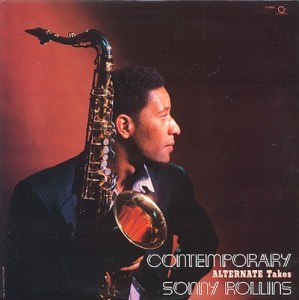
Sonny Rollins – Alternate Takes

  • You’ll have a hard time finding a copy that sounds remotely as good as this vintage Contemporary pressing
  • One of our favorite Sonny Rollins records for sound – both sides here are incredibly big, full-bodied and Tubey Magical
  • 4 1/2 stars: “This LP contains alternate versions of selections from two famous Sonny Rollins albums: Way out West and Sonny Rollins and the Contemporary Leaders. These ‘new’ renditions… hold their own against the classic versions. [T]he music is hard-swinging and frequently superb.”
  • If you’re a 50s and 60s jazz fan, this Must Own compilation of recordings originally released in 1958 surely belongs in your collection

The album is made up of alternate takes from the Way Out West and Sonny Rollins and the Contemporary Leaders sessions, and as such there is a bit of sonic variation between these tracks and the ones on the actual albums. The best-sounding songs here, particularly the material from Way Out West, can sound amazing.

All Tube in ’58

The best copies are rich and tubey; many pressings were thin and modern sounding, and for that they would lose a lot of points. We want this record to sound like something Roy DuNann recorded with an All Tube chain in 1958, and the best copies give you that sound, without the surface noise and groove damage the originals doubtless suffer from.

Some copies have much more space; some are more present, putting the musicians right in the room with you; some are more transparent, resolving the musical information much better than others, letting you “see” everyone in the studio clearly. Some have more rhythmic drive than others. On some the musicians seem more involved and energetic than they do on the average pressing.

The copies that do all these things better than other copies are the ones that win our shootouts.

(more…)

Soultrane Sucks on the Early OJC

Hot Stamper Pressings of the Music of John Coltrane Available Now

The early OJC reissues from 1982 of this title are awful.

And whatever Heavy Vinyl they’re churning out these days is probably every bit as bad, but — I’m guessing, never played one so don’t hold me to it — in the opposite way.

The OJC is thin and bright, and the modern reissue (I’m assuming, based on playing scores of them) is probably thick, veiled, overly smooth, lacking in space and boosted in the bass — because that’s the sound that audiophiles record buyers seem to like these days.

Without the excellent sounding 60s and 70s reissues that we are still able to find in audiophile playing condition, all that we would have available to buy for our shootouts would be the originals. 

At the big bucks those records go for nowadays, shootouts would be impossibly expensive.

So our thanks go to Rudy for doing a good job on these later pressings!


UPDATE 2025

We were surprised to find that the right stampers on the new OJC pressings can have very good sound. Click on the link below to that Soultrane has joined the group of good sounding modern OJC pressings.

(more…)

Bill Evans / Moon Beams on OJC

More of the Music of Bill Evans

  • This Riverside recording of Evans’s 1962 classic pressed on fairly quiet OJC vinyl boasts solid Double Plus (A++) sound or BETTER from first note to last
  • Full-bodied and warm, exactly the way vintage analog should sound, yet as clear and as open as any pressing you’ve heard (or your money back)
  • The first album Evans recorded after Scott LaFaro’s death and it is a deeply immersive experience
  • AllMusic raves it’s “…so well paced and sequenced the record feels like a dream … Moonbeams was a startling return to the recording sphere and a major advancement in his development as a leader.”

Moon Beams is one of the best sounding Bill Evans records we’ve ever played. You can see why we chose it to be the first OJC Hot Stamper of his to hit the site back in 2015.

Play It Might As Well Be Spring for the kind of sublime musical experience you only find on 20th century analog.

(Well, almost. Some of the newer OJC pressings from this century can be quite good too.)

(more…)

Which Art Pepper Today Is Better: Phil DeLancie Digital or George Horn Analog?

Hot Stamper Pressings of the Music of Art Pepper Available Now

UPDATE 2024

This commentary was written in 2010 or thereabouts.

There is new information about the album as of 2024, which can be found here.


We’d wanted to do Art Pepper Today for more than a decade, but the original Galaxy pressings were just too thick and dark to earn anything approaching a top sonic grade. Thirty years ago on a very different system I had one and liked it a lot, but there was no way I could get past the opaque sound I was now hearing on the more than half-dozen originals piled in front of me.

So, almost in desperation we tried an OJC reissue from the ’90s. You know, the ones that all the audiophiles on the web will tell you to steer clear of because it has been mastered by Phil DeLancie and might be sourced from digital tapes.

Or digitally remastered, or somehow was infected with something digital somehow.

Well, immediately the sound opened up dramatically, with presence, space, clarity and top end extension we simply could not hear on the originals. Moreover, the good news was that the richness and solidity of the originals was every bit as good. Some of the originals were less murky and veiled than others, so we culled the worst of them for trade and put the rest into the shootout with all the OJCs we could get our hands on.

Now, it’s indisputable that Phil DeLancie is credited on the jacket, but I see George Horn‘s writing in the dead wax of the actual record, so I really have no way of knowing whether in fact Mr Delancie had anything to do with the copies I was auditioning. They don’t sound digital to me, they’re just like other good George Horn-mastered records I’ve heard from this period.

And of course we here at Better Records never put much stock in what record jackets say; in our experience, the commentary on the jackets rarely has much to do with the sound of the records inside them.

And, one more surprise awaited us as we were plowing through our pile of copies.

When we got to side two we found that the sound of the Galaxy originals was often competitive with the best of the OJCs. Which means that there’s a good probability that some of the original pressings I tossed for having bad sound on side one had very good, perhaps even shootout winning sound, on side two.

This is a lesson I hope to take to heart in the future. I know very well that the sound of side one is independent of side two, but somehow in this case I let my prejudice against the first side color my thinking about the second.

Of all the people who should know better…

(more…)

Don’t Skip the OJC, Put It in a Shootout

Of the three early OJC pressings of West Coast Sound we played recently, only one met our standards. At 2+/1.5+, the sound was good, not great.

One copy earned grades of 1+/1+, which means the sound was passable. The last copy had an NFG side two, which means it was just awful.

(Many of the Heavy Vinyl disasters we’ve been cataloging lately have earned that notorious grade. The unacceptably lo- to mid-fi sound even the better ones offer doesn’t seem to bother the audiophiles who rave about them, however.)

So does side two of the OJC pressing have fairly good sound, merely passable sound, or is the sound hopelessly bad?

In the case of this Shelly Manne album, all three, and the only way we were able to discover that is by cleaning up three of them and playing them head to head with real Contemporary pressings in a blinded experiment.

Obviously we were hoping for better results from our OJCs — only one of the copies we played will turn out to be saleable.

Why did we bother? That old bugaboo the profit motive was all that was needed to make us give the OJC pressings a try. We thought we could make money on them but it turns out that the opposite will happen. Oh well, nothing ventured, noting gained.

More importantly, we are not the least bit shy about coming clean and sharing the results with our readers and customers, especially the part about three identical looking copies with the same stamper numbers all sounding very diffferent from each other.

An added bonus is that side two was worse than side one most of the time. That happens often enough, but nobody but us ever seems to want to talk about it.

If we had had ten OJC pressings to play, we probably would have be able to find at least one or two with a grade of 2+/2+, meaning that George Horn probably did a creditable job mastering the album back in 1984 when he cut it for Fantasy, to sell for the very affordable price of $5.98. It’s most likely the pressing plant that let listeners down.
Needs Tubes

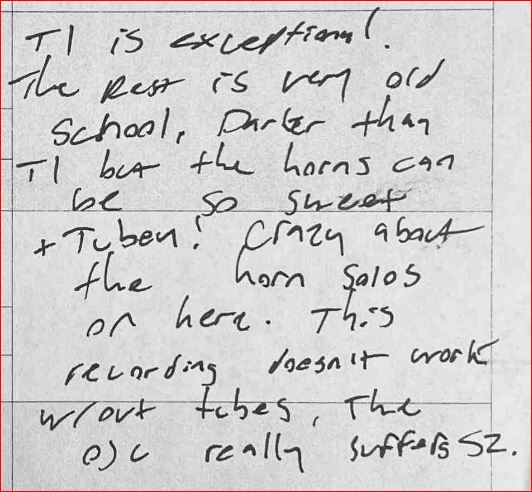
The problem here is that this title needs tubes, or, at the very least, the sound of tubes, and George apparently did not have them, or enough of them, in his mastering chain.

Our specific notes can be seen on the left. We mention that the first track has the best sound (1956 dates), the rest falling short for being darker and more crude (“old school,” some dating from 1953).

The West Coast horn players are the reason to buy this title, with horns that are “sweet and tubey,” but of course to hear that kind of sound you will need a real Contemporary pressing, not an OJC — or anything made in the modern era for that matter.

(more…)

Sonny Rollins Helped Us See the Light Many Years Ago

The following commentary was taken from our mid-90s catalogs, the ones that came out back in the days when it was still possible to find great jazz records like Alternate Takes for cheap, often still sealed.

The Analogue Productions Heavy Vinyl recuts done by Doug Sax had come out a few years earlier, starting in 1992. Those remastered records were in print at the time I wrote this, and I was pretty pissed off at the way they sounded.

Here is our listing with some minor changes from long ago:

Acoustic Sounds had just remastered and ruined a big batch of famous jazz records, and shortly thereafter a certain writer in The Absolute Sound had said nice things about them.

Said writer and I got into a war of words over these records, long, long ago. You’ll notice that no one ever mentions these awful records anymore, and for good reason: they suck. If you own any of them, do yourself a favor and get either the CD or a good LP for comparison purposes. I expect you will hear what I’m talking about.

In my essay on reviewers I attack him for giving a big “Thumbs Up” in TAS to the botched remastering of Sonny’s Way Out West. The OJC reissue, though superior, is still only a pale shadow of the original.

The Real Deal

Now we have the real thing! This LP has three alternate takes from that session, all mastered by George Horn, and surprise, surprise, surprise, they sound just like my original, much better than (but not so different from) the OJC, and worlds away from the muted flab of the Analogue Productions LP!

(more…)

Skip the Original OJC of West Coast Sound (C3507)

Hot Stamper Pressings of Contemporary Jazz Albums Available Now
UPDATE 2025

A new shootout for this title gave us a better understanding of the OJC relative to the other pressings we were playing. We came across one fairly good sounding OJC pressing out of the three we played, one that earned grades of 2+/1.5+, so if you have an OJC, play it and see whether it is one of the good ones or, as is most likely the case, one of the bad ones.

Side two is the side to play to hear what we are on about. The grades ranged from decent, 1.5+, to just awful, NFG.


The sound of the early OJC pressings of West Coast Sound that we played recently were not to our liking.

They are brighter and thinner than even the worst of the real Contemporary pressings.

That is decidedly not our sound.

We have to admit that we used to find the sound of many of these OJC pressings much more tolerable in the past.

More than tolerable. Enjoyable. Recommendable. Saleable even.

Nothing to be ashamed of, that was many years ago. As you may already know, live and learn is our motto. Getting it wrong is a feature, not a bug, of collecting if your goal is to find the best sounding pressings of the music you love.

(If you have some other goal, this may not be the right blog for you. Definitely steer clear of this website. The prices there are ridiculous!)

It’s true: Our old system from the 80s and 90s was tubier, tonally darker and dramatically less revealing, which strongly worked to the advantage of leaner, brighter, less Tubey Magical titles such as this one.

That was thirty or more years ago. Pretty much every dynamic speaker system I ran into had that sound. And I was never a fan of screens or horns. Like most audiophiles, I thought my stereo sounded great. It sure sounded right to me at the time.

And the reality is that no matter how hard I worked or how much money I spent, I would never have been able to achieve substantially better sound for one simple reason: most of the critically important revolutions in audio had not yet come to pass. It would take many technological improvements and decades of effort until I would have anything like the system I do now.

Count Basie & Oscar Peterson – Yessir, That’s My Baby

More Count Basie

More Oscar Peterson


  • Excellent sound for this wonderful Basie/Peterson record pressed on fairly quiet Pablo vinyl, with Double Plus (A++) grades or close to them on both sides
  • This copy is bigger, clearer and more full-bodied than most of what we played (particularly on side one) – man, this is the glorious sound of analog
  • “The two pianists (backed by bassist John Heard and drummer Louis Bellson) play five standards and three blues with predictable swing, finding much more in common with each other than one might have originally suspected.”

(more…)

Chet Baker – Chet

More of the Music of Chet Baker

  • This wonderful album of ballads has Mile Davis’ rhythm section supporting Chet, as well as contributions from other greats such as Kenny Burrell and Bill Evans
  • These guys are playing live in the studio and, on a copy that sounds this clear, you can really feel their presence on every track
  • This Chet Baker record belongs in any serious jazz collection, and for you audiophiles out there, prepare to be shocked when you play this copy against your Heavy Vinyl pressing, no matter which one you have
  • “…this Riverside issue captures the gifted but troubled trumpeter at his best. It might even qualify as Baker’s most satisfying and representative recording.”

Chet is one of the best sounding Chet Baker records we’ve ever played, although that’s not saying much because finding good Chet Baker records is like finding hen’s teeth these days.

The albums he did for Pacific Jazz in the ’50s can be wonderful, but few have survived in audiophile playing condition.

The Mariachi Brass albums are as awful as everyone says — we know, we’ve played them, too. The album he recorded for CTI in 1974, She Was Too Good To Me, is excellent and will be coming to the site again soon I hope.

We’d never heard the album Chet sound better than in our most recent shootout, and that’s coming from someone who’s been playing it since it was first reissued in the ’80s.

The less said about the awful Doug Sax remastering for Analogue Productions in the mid-’90s the better. What a murky piece of crap that was. Audiophile reviewers may have been impressed, but even way back then we knew a bad sounding record when we played one, and that pressing is very bad indeed.

One further note: the Heavy Vinyl pressings being made today, decades later, have a similar suite of shortcomings, sounding every bit as bad if not worse, and fooling the same audiophile reviewers and their followers to this very day. Nothing has changed, other than we have come along to offer the discriminating audiophile an alternative to the muddy messes these labels have been churning out.

Like this one!

Based on what we’re hearing, my feeling is that most of the natural, full-bodied, smooth, sweet sound of the album is on the master tape, and that all that was needed to get that vintage sound correctly on to disc was simply to thread up that tape on a reasonably good machine and hit play.

The fact that nobody seems to be able to make an especially good sounding record — certainly not as good sounding as this one — these days tells me that in fact I’m wrong to think that such an approach would work. Somebody should have been able to figure out how to do it by now. In our experience that is simply not the case today, and has not been for many years.

George Horn was doing brilliant — albeit spotty — work for Fantasy all through the 80s. This album is proof that his sound is the right sound for this music.

(more…)

Hampton Hawes – Vol 2: The Trio

More Hampton Hawes

More Contemporary Label Jazz Recordings

This Triple Plus (+++) pressing from ’55/’56 mono tapes is EVERYTHING that’s good about mono. The size, the weight, the solidity, the clarity, the energy, the rhythmic drive – it’s all here and more.

This killer pressing has the best sound and the best music we have ever heard on any Hampton Hawes album.

There is nothing to fault in the sound of side one of this pressing, and side two was nearly as good – what a record!

Both sides are Tubey Magical, rich, open, spacious and tonally correct. We’ve never heard the record sound better, and that’s coming from someone who’s been playing the album since the ’80s.

These guys are playing live in the studio and you can really feel their presence on every track — assuming you have a copy that sounds like this one.

Based on what I’m hearing my feeling is that most of the natural, full-bodied, smooth, sweet sound of the album is on the master tape, and that all that was needed to transfer that vintage sound correctly onto vinyl disc was simply to thread up the tape on a high quality machine and hit play.

The fact that nobody seems to be able to make an especially good sounding record these days — certainly not as good sounding as this one — tells me that in fact I’m wrong to think that such an approach would work. Somebody should have been able to figure out how to do it by now. In our experience that is simply not the case today, and has not been for many years, if not decades.

(more…)