r and d

Our extensive ongoing research into records, as well as the development of higher quality playback, is what allows us to keep discovering superior pressings with each passing year.

Many of our “finds” are unknown to the audiophile community, mostly because the do not fit the conventional idea of what should be the best sounding version of any given album.

They might be from the “wrong country,” they might have the “wrong label,” they might be cheap reissues — none of that matters to us.

We’re focussed on one thing: higher quality sound, and we know that the only way to find it is through painstaking and expensive experimentation, or, as it is more commonly known, trial and error.

It Took Us Three Attempts to Get The Captain and Me Going

Hot Stamper Pressing of the Music of The Doobie Brothers Available Now

UPDATE 2026

By 2009 I had been randomly buying clean copies of The Captain and Me for two decades, with the expectation that one day I would play them and find the mysterious deadwax and other clues that would lead me to the potentially best sounding copies.

Even though I had learned a fair bit about stamper numbers by that time, there was no getting around the fact that the best stamper numbers cannot be predicted for any given title. I didn’t know any especially good ones, which means that I needed to learn them for this title the way I learned them for all the others — one album at a time.

As I was not a fan of the pre-McDonald Doobies, I confess I really had no idea what to look for. I probably had picked up a few of the exceedingly rare Green Label pressings, but were they the best? I couldn’t say. I just hadn’t spent enough time with the album. And I had disproved that old canard that the originals are always the best sounding so many times by then that believing that nonsense was out of the question.

We had tried twice before to get something going, but could not find the sound we were looking for and had simply given up and moved on to greener pastures. This is long before Prelude Enzyme Record Cleaning System had come our way in 2007. It, along with our Odyssey record cleaning machine and some other tricks we learned about record cleaning, allowed us to get a shootout going a couple of years later.

The failed attempts to understand the album mentioned above happened long before we had turned the business over to carrying out shootouts all day, every day, which is all we were doing by 2009. We had stopped promoting Heavy Vinyl in 2007, and by 2009 we were on our way to selling nothing but records we had cleaned and played and evaluated for their sound quality with our own ears.

Eventually we sat down with the copies of The Captain and Me that we had — more than thirty according to the listing you see below, the one we wrote at the time — and gave it our best shot.

(more…)

Years Ago We Foolishly Thought a Domestic LP Could Beat the Brits on Low

Hot Stamper Pressings of the Music of David Bowie Available Now

This shootout listing for Low was written sometime around 2008. 

In 2008 we hadn’t discovered the right imports for this album yet — that would not happen for many more years, hence the error we made in thinking that some especially good sounding domestic copies could win a shootout.

Back then they could, but with the right pressings in the mix there is not a chance in the world that would happen now.

Just another case of live and learn.

By the way, Low has much in common with another Bowie record we struggled with for years.

To be fair, some domestic pressings do end up having low-level (1.5+) Hot Stampers, but they’re rare. Our best Brits just kill ’em. We haven’t bothered with the domestic pressings in more than a decade, and why would we? The reissue imports we sell now are just too good.

(more…)

Not that Long Ago Blue Was a Nut We Just Could Not Crack

Hot Stamper Pressing of the Music of Joni Mitchell Available Now

This commentary was written in 2006 or thereabouts.

Allow me to tell you about a Blue shootout I tried to do at a friend’s house. The system he owns has some nice equipment in it (the EAR 864, a $4200 tube preamp, for one) and can sound very good — if not wonderful — on certain program material.

But it’s the kind of audiophile system that is easily overwhelmed by difficult to reproduce material. On my copy of Blue his stereo was a complete disaster: grainy, shrill, thin, flat, harsh, compressed, unmusical, no real extension at either end; in short, no magic, tubey or otherwise.

My copy of Blue, which had earlier in the day sounded so good at my house, now sounded so bad at his that I could hardly recognize it as the same LP.

Pieces of the Puzzle

Of course it was the same LP, and by the time I got home the pieces of the puzzle had all fallen into place. It takes a very special stereo to overcome the shortcomings of even the best domestic pressings of Blue in order to reveal the beauty of this music.

The new one isn’t better. It’s just easier to play on the average audiophile system.

Do you have one of those? Most audiophiles do; that’s what being average means. If you’ve been in this hobby for less than five years it’s almost certain you do. I would say a decade of serious dedication to home audio would be the minimum needed to acquire the knowledge and skill to build a truly hi-fidelity system.

(more…)

What It Took to Find Hot Stamper Pressings of Two Very Tough Titles

Hot Stamper Pressings of the Music of Talking Heads Available Now

[Emphasis added.]

Hey Tom, 

Just got my Super Hot Stampers of Remain In Light and Station To Station. I was very much looking forward to the arrival of these LPs… I was not disappointed. Verily, I was completely floored!

First, my apologies. I have been reading your website for over two years, gleaning information to help me find Hot Stampers, or at least good sounding records. I had not made a purchase until this past week. I was starting to feel guilty; you have given me so much great direction and guidance over these years, and I had not supported you in the proper way.

So I made a modest purchase of these two records, to assuage my guilt and support your efforts. You will be getting much more business from this satisfied customer.

I have Remain In Light on LP, CD and even the FLAC file release. My new Hot Stamper truly puts these recordings to shame. No, really, TO SHAME! If this ever gets on the Better Records Testimonials: “People let me tell you…it’s sent a chill up and down my spine…”!

I really can’t believe how well balanced the sound is: great bottom end, mids are pronounced and the shrillness is GONE! No smear anymore! Breathtaking.

My copy of Station to Station is just as wonderful.

I’ve been convinced of “Hot Stamper” recording for quite some time now, thanks to Tom and the BR crew; I’ve found some great recordings after conducting my own modest shoot-outs. Found some real gems. But the best results that I have ever got, and there are only a few, have now been easily matched and outstripped by my first BR purchase!

Rob

Rob,

Thanks for your enthusiastic letter. We’re on the same page. I too get excited when I hear my favorite music sound better than I ever expected it would. (more…)

Debussy & Ravel – A Tale of Two Top Copies

Hot Stamper Pressings of the Music of Claude Debussy Available Now

Hot Stamper Pressings of the Music of Maurice Ravel Available Now

In 2024 we did a shootout for this recording of quartets, LSC 2413, our first in 19 years.

For the shootout winning pressing, we wrote the following:

Juilliard String Quartet’s performance of these wonderful classical works appears on the site for only the second time ever, here with INSANELY GOOD Shootout Winning Triple Plus (A+++) grades on both sides of this original Shaded Dog pressing.

Having just played some killer copies of Death and the Maiden, we’re tempted to say that this Debussy record has the potential for even better sound — it’s richer and sweeter, but every bit as real and immediate as any chamber recording we know of.

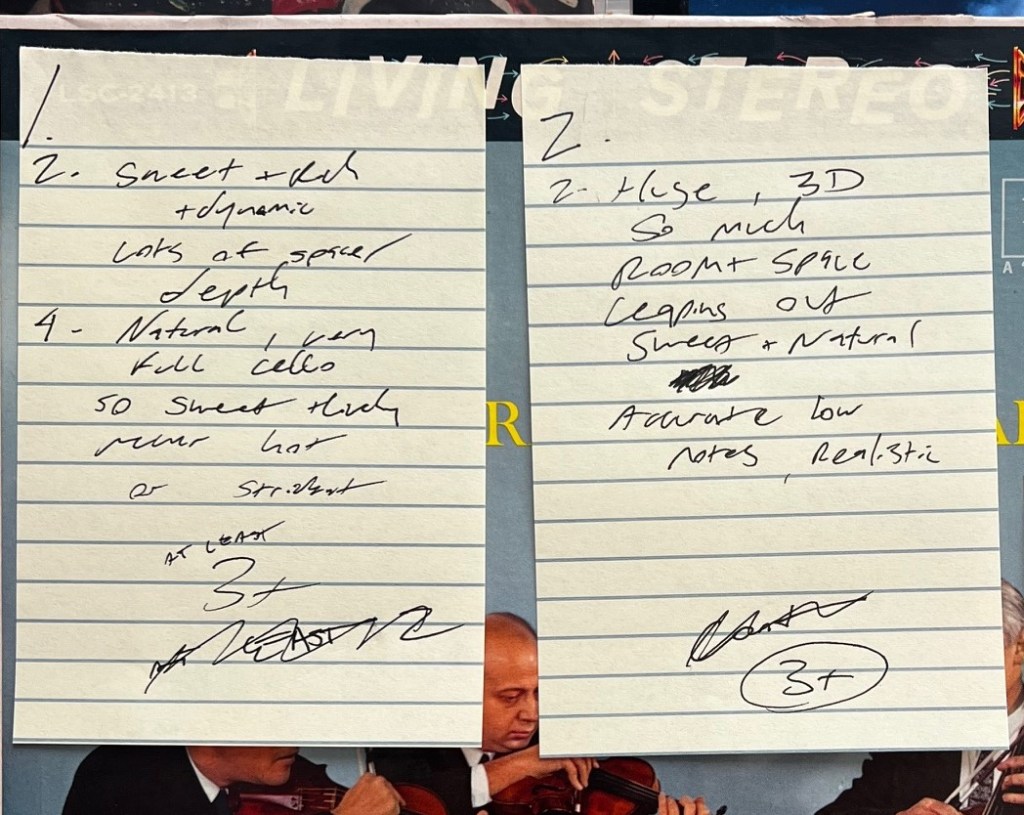
Here are the notes for the actual record we played. Side one really blew our minds, earning a grade of at least 3+.

The second place finisher may not have been quite as good on side one, but it was still so good that it had no problem earning the full three pluses. It had the same stampers as the copy above by the way.

Side two however lacked the space of the very best pressings we played, and we marked it down one half plus for that shortcoming. Although it was “so tubey and 3-D” it did not have “all the space but not hot at all and natural and sweet.”

It’s very unlikely that the person who bought this copy would feel there was any problem with side two. We had two killer side two’s to play against each other back to back, and that’s about the only way these kinds of very subtle differences can be recognized, assuming you have a system that can resolve the space of the recording at an extremely high level to begin with.

The big rooms with high ceilings that systems like those require are not usually found in listening rooms that have not been custom built.

More on this wonderful record:

The Living Stereo sound here is Tubey Magical, lively and clear, with the kind of transparency that puts living, breathing musicians right in your listening room in the way that only the best vintage vinyl pressings can.

Lewis Layton engineered this recording (along with Ed Begley) and he nailed it, perfectly capturing the rich, textured sheen on the strings, the hallmark of Living Stereo sound in the 50s and 60s.

He recorded both the Schubert (LSC 2378) mentioned above and this wonderful Debussy/Ravel record for RCA in 1960 — it would be quite the understatement to say he had a gift for recordings of this kind.


Another superb recording from the 60s, brought to you by your vinyl-loving friends at Better Records.

It’s an exceptional Living Stereo all analog recording from 1960 – nothing else sounds like it.

When you’ve played as many Living Stereo titles as we have (250+ and counting), you’re bound to run into this kind of Demo Disc sound from time to time – it’s what makes record collecting fun.

It’s an amazing find, the kind of record we live for here at Better Records.

(more…)

These Pink Label Pressings Can Sound Good, But Great? Not a Chance

Hot Stamper Pressings of Music on Island Records Available Now

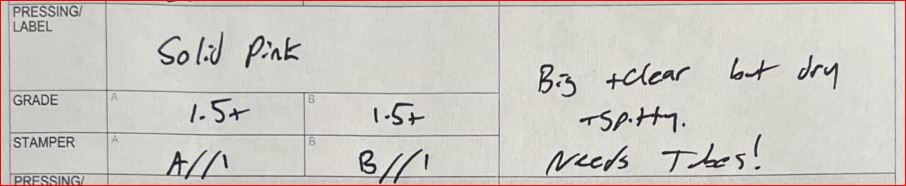
Below you will see the bottom part of the stamper sheet for a shootout we did recently.

Please note that the album you see pictured is not the one we are discussing here.

It very well could have been been a Jethro Tull album, but all we can say for sure is that it was definitely an album on Island, which just happens to be one of our favorite labels, for sound and music.

The earliest pressings for many records on the Island label are not very good. This one — again, not for This Was, for some other record — is not a bad sounding pressing.

With grades of 1.5+ on both sides, it fits comfortably in our section for good, not great sounding LPs — but the right reissues from the 70s are a big step up in class sonically. They’re the ones that win shootouts, not these Pink Label LPs.

It’s big and clear but dry and spitty and badly needs tubes in the cutting chain.

Do the record collectors who prize the Pink Label pressings above all others notice these things?

Do the audiophiles who play them?

Been There, Done That

We’ve run into so many sonically-flawed Pink Label Islands by now that hearing one sound lackluster if not actually awful doesn’t phase us in the least. Some of the other Pink Labels that never win shootouts can be found here.

(more…)

Commitment Issues We All Must Face

Hot Stamper Pressing of the Music of Joni Mitchell Available Now

This commentary about a very special 2-pack was written close to ten years ago. We think it’s every bit as true today as it was then.

The long and the short of it is simply that when it comes to collecting high quality vinyl:

There are no easy answers and there are no quick fixes.

To those of us who have been doing this for a long time, the above is obvious, perhaps even axiomatic in the sense that it is a “self-evident truth that requires no proof.”

(The fact that the modern audiophile reviewer class has yet to appreciate this basic concept goes a long way in explaining how inadequate and error-prone their approach to records and audio has always been. Some of them may still be living in 1982, but I’m glad to say we’re not. Our business could not exist in 1982. Many of the technologies on which it is based had not yet been invented.)

Once you stop looking for easy answers and quick fixes, you will then be free to build a truly wonderful stereo system and acquire a superb sounding record collection to play on it. It will, naturally, and to some of you surprisingly, comprise virtually nothing but vintage vinyl.

The album under discussion today is Joni Mitchell’s Song to a Seagull. Our commentary begins:

It took two records to make this White Hot Stamper 2-pack, with top quality sound from start to finish. The result? One of the best sounding, if not THE best sounding copy to ever hit the site. If you’re a Joni fan this is one of her strongest records, and one that definitely belongs in your collection. If you own any other pressing we’re confident that this copy will positively blow your mind.

These two sides have the kind of sound quality you probably never imagined would be possible — but it is! We played it, we heard it for ourselves, and now we offer it to you, the Joni Mitchell (nee Roberta Joan Anderson) fans of the world.

I’ve been trying to get this album to sound good for more years than I care to remember. If you own a copy you know what I’m talking about — the sound is typically drenched in echo, with Joni sounding like she’s standing at the back of a cave. Harmonically-challenged acoustic guitars. Vocals with no breathy texture (much like practically all the heavy vinyl reissues we’ve suffered through over the course of the last decade or two).

Blue vs Song to a Seagull

In its own way, it’s every bit the challenge that Blue is, just reversed.

Blue tends to be bright, shrill, thin and harsh.

Song to a Seagull is usually dark, veiled, smeary and dull.

(more…)

Three Tracks Are Key on Supertramp’s Fifth Album

Hot Stamper Pressings of the Music of Supertramp Available Now

On the best copies of Even in the Quietest Moments the bottom end is big and punchy, the top end smooth and sweet, and the vocals are present and breathy.

If your copy sounds like that, you have the basic ingredients for a Hot Stamper pressing. Now all you need is half a dozen more cleaned copies and you are ready to do a shootout to find out just how good your copy may be.

On an exceptionally transparent copy the drums really punch through the dense mixes that Supertramp and Geoff Emerick favored for the album, giving the music more life and energy. (More of Geoff’s work can be found here.)

Also make sure that the piano sounds solid and clear with little to no smear, and that the sax is full and breathy. These are all critically important to getting the record to sound right, which of course is simply another way of saying getting the music to sound right.

In 2005 we wrote:

This is actually one of Supertramp’s best albums but it’s almost impossible to find a domestic copy that won’t tear your head off. The vast majority of them are unbelievably bright and grainy. I’ve been buying them lately because I found a copy or two that seemed to sound pretty good, but most of my money was wasted on aggressive, noisy vinyl.

Side one of this copy is no great shakes — it’s too bright — but side two is actually quite good. The highs are sweet and silky, there’s plenty of bass and the vocals are actually quite natural sounding. I can’t call this a Hot Stamper. The best way to look at it is to say it’s a Relatively Hot Stamper. The average copy is so bad that when a copy like this one sounds pretty good it really sticks out. We’re still in the hunt but haven’t got much to show for our efforts to date, I can tell you that.

The good news is that ten years later and more copies than we care to remember we think we’ve got EITQM’s ticket. We now know which stampers have the potential to sound good as well as the ones to avoid. Finding the right stampers (which are not the original ones for those of you who know what the original stampers for A&M records are) has been a positive boon.

Once we figured them out we were in a much better position to hear just how well recorded the album is. Now we know beyond all doubt that this recording — the first without Ken Scott producing and engineering for this iteration of the band — is of the highest quality, in league with the best. Until recently we would never have made such a bold statement. Now it’s nothing less than obvious.

Key Tracks for Critical Listening

Give a Little Bit

The piano can get buried in the dense mix. Side ones that are rich and tubey and smooth with a clear piano did very well in our shootout.

Lover Boy

A Demo Quality track on the best copies. It can be huge, spacious and lively.

Getting the strings to sound harmonically rich without sliding into shrillness is not easy but some copies manage it. The breakdown at about 2:20 is a lot of fun on the biggest, richest copies.

From Now On

On side two the recording quality of the solo piano at the start of this track is nothing short of breathtaking.

No piano on any Supertramp album sounds as good, and only the White Hot Stamper pressing will get it to sound its best.

It’s such a well-recorded piano that it will always sound at least good.

Shootouts are the only way to know when it actually sounds its best.

(more…)

Years Ago We Badly Misjudged the Recording Quality of Tull’s Debut

Hot Stamper Pressings of the Music of Jethro Tull Available Now

A clear case of live and learn.

We listed a White Hot copy of This Was in 2008 on the Island pink label and noted at the time:

Be forewarned: this ain’t Stand Up or Aqualung. I don’t think you’ll be using any copy of This Was to demo your stereo, because the recording has its share of problems. That said, this record sounds wonderful from start to finish and will make any fan of this music a VERY happy person. We guarantee you’ve never heard this album sound better, or your money back.

Now we know a couple of things that we didn’t back in 2008.

1). This album is a lot better sounding than we gave it credit for years ago. It’s not perfect by any means but it is much better than the above comments might lead you to believe.

We chanced upon an exceptional sounding copy of the album in 2017 or so, and that taught us something new about the record:

2). The Pink Label pressings are not the best way to go on this album.

Once we heard the exceptional copy alluded to above, we played it against our best Pink Label copies and it was simply no contest.

In 2008 we still had a lot to learn. We needed to do more research and development, which of course we are doing regularly with Classic Rock records, our bread and butter and the heart of our business.

We do them as often as is practical, considering how difficult it is to find copies with audiophile quality playing surfaces.

Nine years later, we felt we finally had a proper understanding on the various pressings of This Was. It goes like this:

The Pink Label original British pressings can be good, but they will never win a shootout up against copies with these stampers (assuming you have more than one copy — any record can have the right stampers and the wrong sound, we hear it all the time. Beware of small sample sizes).

(more…)

In 2016 We Had to Raise the Bar for Wings at the Speed of Sound

Hot Stamper Pressings of the Music of Paul McCartney Available Now

Okay, we’re not too proud to admit it.

We was wrong about Wings at the Speed of Sound as a recording.

Yes, that kind of thing happens when you regularly play thousands and thousands of records year after year.

The right pressing can show you that your understanding of a given recording is, shall we say, incomplete.

The great thing about our business is that, whenever we have new data that serves to correct a past mistaken judgment, the result is that we are then able to offer even better sounding pressings to our customers.

That way everybody wins. We’ve never pretended to know it all, and there’s no reason for us to start now.

Back to Wings at the Speed of Sound. Previously we had written:

I can’t even begin to convey to you what a rough shootout this was. Copy after copy bored us to tears and most of them were too noisy. It was one of those shootouts that almost defeated us, but we persevered and managed to find a few Hot Stampers. They didn’t do miracles and turn Speed Of Sound into a stunning Demo Disc, but they sounded musical, correct and enjoyable, and that seems to be all you can ask for on this album. 

This is not true.

We played a copy that earned our very special grade of Four Pluses (on one side, two sides would have been too much to ask for) because it showed us an At the Speed of Sound that we had no idea could possibly exist, this after having played dozens of imports and domestic pressings over the previous twenty years or so.

It was DRAMATICALLY bigger and more transparent, with no sacrifice in richness or smoothness.

Here was a very different Wings at the Speed of Sound. Why did it take us so long to find it?

We had never managed to clean and play a copy with the right stampers that could show us the brilliance of the sound that must be on the master tape. We needed to do more research and development, which of course we are in the habit of doing regularly with Classic Rock records, our bread and butter and the heart of our business.

Before we did this shootout, we had no idea how high to set the bar. Which leads us to:

This Key Takeaway 

In that respect we were in exactly the same place as every record loving audiophile on the face of the Earth.

How good can the record sound? How high is up?

We discussed this all-too-common mystery [1] in a listing we wrote for an amazing sounding copy of Heart’s Little Queen album we discovered many years ago, linked here.

In our old listing, we noted: Now that we know what stampers to look for, future pressings are likely to be very, very good sounding, if everything goes the way we hope it will.

[Things did go our way, with plenty of Shootout Winning White Hot copies having been found since we made that breakthrough all the way back in 2016. The right stampers are about five times more rare than the wrong ones, but they can be found. You just have to know what to look for.] 

(more…)