lean-tonality

We Don’t Offer Domestic Pressings of Pour Down Like Silver for One Very Simple Reason

Hot Stamper Pressings of the Music of Richard Thompson Available Now

In spite of the fact that the domestic pressings of this Richard and Linda Thompson classic from 1974 were mastered by the likes of Kendun and Sterling — two of the greatest mastering houses of all time, — they have never impressed us with their sound quality.

The biggest problems with this record would be obvious to even the casual listener: gritty, spitty vocals; lack of richness; bright tonality; lack of bass; no real space or transparency, etc.

The domestic Island pressings did not do nearly as well in our shootout as the best Island imports, no surprise there as the early UK records were mastered by one of our favorite engineers.

Avoid the Carthage pressings mastered by Sterling. They came in last in our shootout.

The domestic breakdown follows:

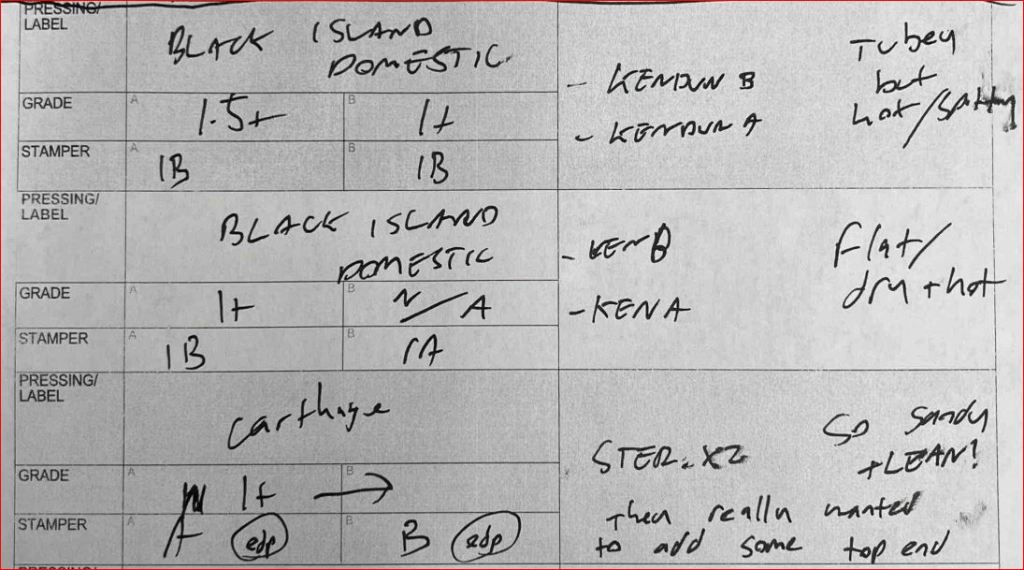
Black Island Domestic #1

  • Tubey but hot and spitty.

Black Island Domestic #2

  • Flat, dry and hot (glary or bright)

Carthage Domestic recut from 1983, Sterling on both sides

  • So sandy and lean! They really wanted to add some top end (!)

Defending the Indefensible

(more…)

A Scheherazade that Lacks Power in the Brass and Richness in the Lower Strings? No Thanks

Hot Stamper Pressings of the Music of Rimsky-Korsakov Available Now

One of the most dynamic Scheherazade‘s on record. The brass really blasts through in this recording. 

Of course the question is how does this recording stack up to the famous Reiner. Well, I’ll tell you.

The Minneapolis Symphony Orchestra is not in the same league with the CSO, that’s well known. Dorati may be every bit as talented as Reiner, but he doesn’t have the players at his disposal capable of pulling off demanding material such as this.

But the orchestra acquits itself well here. The first violinist is quite good. That’s not the problem.

What lets the side down is the Mercury recording team, who fail to adequately present the weight of the orchestra in the lower midrange and below. One thing I noticed recently when playing an original LSC 2446 was how rich and powerful the sound was in the lower strings and in the brass relative to later pressings of the same title and other recordings of the work.

That opening movement of Scheherazade needs power down there and the Mercury simply doesn’t have enough of that power to qualify it as one of the top sounding Mercs.

(more…)

I’m Starting to Get a Bad Feeling About Record Store Day

Hot Stamper Pressings of the Music of Neil Young Available Now

For some reason, don’t ask me why, they keep hiring Chris Bellman to make Heavy Vinyl reissues of Neil Young’s albums, even though he has shown again and again that he has no idea what these recordings are supposed to sould like.

So far he’s ruined After the Gold Rush and Neil Young’s Greatest Hits, and there may be others he’s remastered to death, but no copies of those have come our way so we really don’t know, or care to know, to be honest.

If this is your idea of analog, you are most likely in the wrong hobby and should consider finding a different one. At the very least you are wasting your time and money on worthless crap vinyl pressings put out by the legion of Heavy Vinyl Grifters who emerge from the bowels of the earth on Record Store Day, targeting their rip-off LPs at the low- to mid-fi vinyl collector types who have yet to figure out what a giant scam the whole thing is.

These records have virtually no redeeming features, none that we could find anyway. Allow us to catalog the shortcomings of the three sides that comprise the 2017 Record Store Day release of Harvest Moon.

For the first time in five years we had finally been able to do a shootout for the imports we like, so we knew exactly how good the best pressings could sound. Long story short, they sure don’t sound like this!

Side One

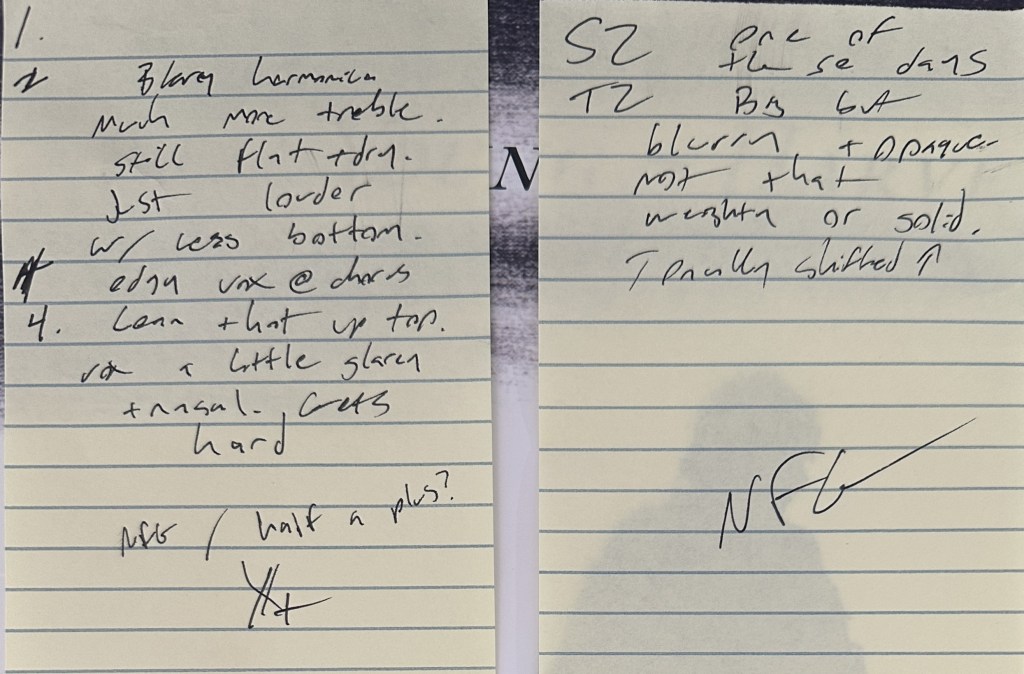
Track Two (From Hank to Hendrix)

  • Blary harmonica
  • Much more treble
  • Still flat and dry
  • Just louder with less bottom
  • Edgy vocals in the chorus

(more…)

An Insult to Aaron Copland on Reference Records

Hot Stamper Pressings of Orchestral Music Available Now

Yet another Reference Record we’ve reviewed and found wanting.

In all the years I was selling audiophile records, one of the labels whose appeal made no sense to me whatsoever (along with their long-forgotten TAS list brethren, American Gramaphone and Telarc) was Reference Records.

Back then, when I would hear one of their orchestral or classical recordings, I was always left thinking, “Why do audiophiles like these records?”

I was confused, because at that time, back in the 80s, I had simply not developed the listening skills that today make it so easy to recognize the faults of their recordings.

I made the mistake of thinking that other audiophiles with more advanced equipment and more refined listening skills must be hearing something I was not.

I had trouble putting my finger on what I didn’t like about them, but now, having worked full time (and then some!) for more than twenty years to develop better critical listening skills, the shortcomings of their records, or, to be more accurate, the shortcomings of this particular copy of this particular title, took no time at all to work out.

My transcribed notes for RR-22:

  • Lean tonality
  • No real weight
  • No Tubey Magic
  • Blurry imaging when loud
  • No real depth
  • Bright tonal balance

Is this the sound you are looking for in an audiophile record?

Shouldn’t you be looking for audiophile quality sound?

Well, you sure won’t find it here.

On our current playback system, this Reference Record is nothing but a joke, a joke played on a much-too-credulous audiophile public by the ridiculously inept and misguided engineers and producers who worked for Reference Records.

This is a reference for something? For what?

As I wrote about another one of their awful releases, if this is your idea of a reference record, you are in real trouble.

It would be hard to imagine that anyone who has ever heard a good vintage classical recording — here are some of our favorites — could ever confuse this piece of audiophile trash with actual hi-fidelity orchestral sound.

(more…)

Tchaikovsky on Classic Records and the TAS List

Hot Stamper Pressings of the Music of Tchaikovsky Available Now

We used to like the Classic Records pressing of LSC 2241 a lot more than we do now, a case of live and learn.

Our tube system from the 90s was very different from the one we are using now.

That system was noticeably darker and by all accounts far less revealing when we had auditioned the Classic sometime in the 90s, and those two qualities did most of the heavy lifting needed to disguise its shortcomings. We mistakenly noted:

HP put the Shaded Dog pressing (the only way it comes; there is no RCA reissue to my knowledge) on his TAS List of Super Discs, and with good reason: it’s wonderful!

The rest of our commentary still holds up though:

But for some reason he also put the Classic Records Heavy Vinyl reissue on the list, and that record’s not even passable, let alone wonderful. It’s far too lean and modern sounding, and no original Living Stereo record would ever sound that way, thank goodness. 

(more…)

Moondance on Heavy Vinyl Is a Disgrace to Audiophiles and Record Lovers All Over the World

Hot Stamper Pressings of the Music of Van Morrison Available Now

The original grade I gave out in 2015 when I last played this remastered version as part of a shootout was “D.” I explained at the time:

Just listen to how strange Van’s voice sounds, so lean, hard and sour. That alone qualifies it for an “F,” but considering how bad most pressings of this album are, let’s be fair, if not downright generous, and call it a “D.”

I just revisited the record in a current shootout, and after giving it some thought I have decided that the right grade is in fact “F.” It cannot be any other, for reasons I discuss below.

In 2014 I had written:

Where is the Tubey Magic of the originals? The sweetness? The richness? And why is there so little ambience or transparency? You just can’t “see” into the studio on this pressing the way you can on the good originals, but that’s fairly consistently been the knock on these remastered Heavy Vinyl records. We noted as much when we debunked Blue all the way back in early 2007, so no surprise there.

Having just played a marvelous shootout-winning early pressing, this time around I found the reproduction of Van’s voice on the reissue to be so leaned-out, artificial and unpleasant that I could hardly stand to listen to it.

We had reset the VTA correctly; the overall tonal balance of the recording from top to bottom was correct. It was only the voice that sounded so off. All the other shortcomings I had mentioned before were still true of course, but none of that mattered. The singer on this record just sounded awful.

As you know, we are constantly making improvements to our playback system. The real Moondance we had just played sounded better than ever. The fake Moondance, however, was sounding worse than ever. That’s what higher quality playback can do for you. It makes your good records sound better than they’ve ever sounded, and shows you just how bad your bad records really are.

Do I have a bad copy of the Heavy Vinyl pressing? Maybe, can’t say I don’t. If any of you out there in the real world have a copy of this pressing that you like, and would be willing to send it to me to hear for myself, I would be more than happy to give it a listen and report my findings on this blog.

Short of that I’m not sure what more I can do. I certainly do not feel the least bit inclined to waste a nickel of my hard-earned money on another copy of this ridiculously badly-mastered crap vinyl.

If you want to read about other records that have these same shortcomings, there are links below to the ones we’ve auditioned and identified to date. Our advice would be to avoid them, and if you own some of these pressings, perhaps now is the time to give them another listen and see if you don’t hear the same faults we did.

And, of course, the Hot Stamper pressings we offer, when played side by side with any of these Heavy Vinyl remasters, can help you to see more clearly just where these new records are going wrong, or, in the case of Moondance, completely off the rails.

(more…)

Today’s Half-Speed Mastered Mess Is Meddle on Mobile Fidelity

Hot Stamper Pressings of the Music of Pink Floyd Available Now

Sonic Grade: D

Same sonic shortcomings as the MoFi Thick As a Brick. Twenty years ago we wrote:

“The MoFi is TRANSPARENT and OPEN, and the top end will be lush and extended. If you prize clarity, this is the one.”

But if you prize clarity at the expense of everything else, you are seriously missing the boat on Meddle (and Thick As A Brick too).

The MoFi is all mids and highs with almost nothing going on below.

This is a rock record, but without bass and dynamics, the MoFi pressing doesn’t rock, so why would anyone want to own it or play it?

I suppose you could argue that on small speakers the shortcomings of this pressing would be much less bothersome, but on the reference system we use — including the one we had twenty years ago — the lack of low end is a real dealbreaker.

The One Thing They Do

The one thing these pressings have going for them is that they tend to be transparent in the midrange.

It sounds like someone messed with the sound, and of course someone did. They took out the bottom end so that the midrange would be clearer.

That’s one of the tricks these labels use to get their records to impress the audiophiles with small speakers, or ones that are pressed up against the wall, perhaps with a television screen mounted between them.

For some reason, some audiophiles like their records to sound pretty and lifeless with blurry bass.

That is not our sound here at Better Records. We don’t offer records with those qualities and we don’t think audiophiles should be paying good money for records that sound like that.

(more…)

Tea for the Tillerman – This Is Your Idea of Analog?

Dear Record Loving Audiophiles of Earth,

I’m afraid we have some bad news. [This was written back in 2011 when the record came out so it’s hard to imagine that what I am about to say is news to anyone after all these years.]

Regrettably we must inform you that the 2011 edition of Tea for the Tillerman pressed by Analogue Productions on Heavy Vinyl doesn’t sound very good. We know you were all hoping for the best. We also know that you must be very disappointed to hear this unwelcome news.

But the record is what it is, and what it is is not very good. Its specific shortcomings are many and will be considered at length in our review below.

Yes, we know, the folks over at Acoustic Sounds, in consultation with the late George Marino at Sterling Sound, supposedly with the real master tape in hand, and supposedly with access to the best mastering equipment money can buy, labored mightily, doing their level best to master and press the Definitive Audiophile Tea for the Tillerman on Vinyl of All Time.

It just didn’t come out very good, no matter what the reviewers say. And what do they say? Allow me to quote one.

…superbly dynamic, spacious and detailed…The attack of the pick on the guitar strings is astonishingly clean and detailed.

Depth is pronounced…

…the resolution of low level detail reveals a host of details that are either buried or glossed over on the other versions I’ve heard…

Uh-oh, wait a minute, here’s a blindingly red flag:

If you have the edition, you’ll find this similar in one way: there’s nothing “mellow” about the overall production and when the music gets loud (and Marino lets it get so) it can get a bit hard, but better that than to soften it and lose the clarity, focus and detail of this superb recording, especially in the quieter passages where the resolution of low level detail is astonishing.

More about that later.

(more…)

How Good Are the Later Reissues of The Bridge?

When we did this shootout ten years ago, we thought the reissues with the cover you see to the left actually sounded better than the original pressings, but we were wrong and we have to admit it, as painful as that may be.

True, we never cared much for the later reissues described below — the tan labels can be passable but fall well short of the standards we set now.

However, even the best orange label pressings from 1975 don’t sound as good to us now as we thought they did ten years ago.

They can be good, but in our experience they can never be great.

Great is the sound that can only be found on the best originals, and they win all the shootouts now.
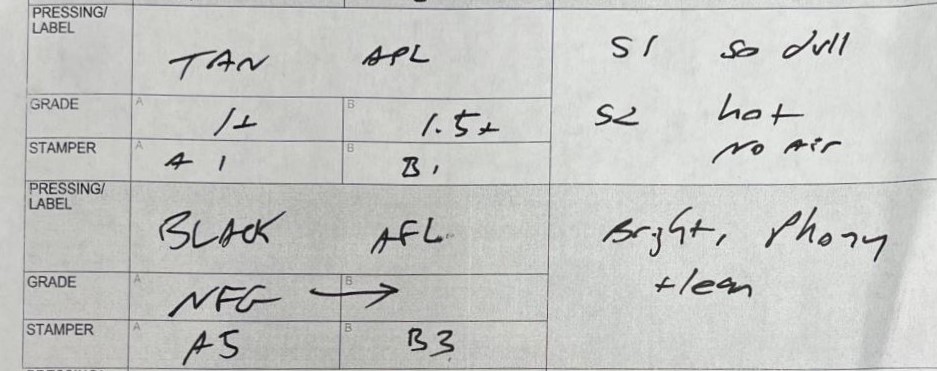
The notes for the AFL pressing with the black label describe it as bright, phony and lean.

This is the kind of sound better suited to the stone age stereos of the past.

I should know. I had a stereo all the way up until the late-90s — not exactly stone age quality, but far from the sound we have now — that prevented me from hearing my records with the highest quality reproduction.

As a result of the shortcomings of my system, I was wrong about a lot of records. (I loved DCC back in those days. Not that many years later I would undergo a “deconversion” as my stereo and critical listening skills improved.)

Of course, I was convinced my stereo was fantastic. It sure sounded better to me than any other system I’d ever heard, and by a long shot.

I had been working with expensive stereo equipment for more than twenty years at that point. The system I had put together by then cost a lot of money, played at loud levels with great energy, was in a dedicated room, et cetera, et cetera.

Are the audiophiles of today making the same mistakes I made back then?

Probably, if not almost certainly, and the one test we can use to determine which audiophiles have made the least amount of progress in this hobby are those who play records like the ones on this list and find nothing wrong with them. Their defense? “They sound just fine to me and who are you to say otherwise?”

Well, we’re the guys who say “you don’t know what you’re missing, and we have the superior-sounding pressing to prove it.”

Which, of course, as is the way of these things, almost always falls on deaf ears, pun intended.

Bottom Line

As of 2024, it’s clear to us that the early pressings have the potential for the best sound, but that the reissues can still sound very good, certainly quite a bit better than any Heavy Vinyl reissue is likely to.

Want to find your own top quality copy?

(more…)

Forget the STS Labels with Black Print on Images Pour Orchestra

More of the music of Claude Debussy (1862-1918)

None of the pressings on this later Stereo Treasury label that we played in our most recent shootouts were very good, unlike the Silver Print labels, which can sound quite respectable.

At this stage of the game, we’ve learned our lesson and will not be giving any more of the Black Label pressings a chance. This goes for practically all the records we’ve played on the later Stereo Treasury label. They rarely sound any good and just aren’t worth the trouble now that we know what the best pressings are.

Both the Ansermet on London and the Munch on RCA are better recordings, but both sell for quite a bit more money than the Stereo Treasury pressings we offer, so if you can’t see spending the kind of bread they command, there is a much more affordable alternative that is guaranteed to satisfy.

(more…)