lacks-bass

Audiophiles Should Skip Swingin’ the ’20s on OJC

Hot Stamper Pressings of Contemporary Jazz Records Available Now

This album is fairly common on the OJC pressing from 1988, but more recently we’ve found the sound of the OJC pressings we’ve played seriously wanting. They have the kind of bad reissue sound that plays right into the prejudices of record collectors and audiophiles alike, the kind for whom nothing but an original will do.

They were dramatically smaller, flatter, more recessed and more lifeless than even the worst of the ’70s LPs we played. (We tend to like those, by the way.)

The lesson? Not all reissues are created equal. Some OJC pressings are great — including even some of the new ones — some are awful, and the only way to judge them fairly is to judge them individually, which requires actually playing a large sample.

Since virtually no record collectors or audiophiles like doing that, they make faulty judgments – OJC’s are cheap reissues sourced from digital tapes, run for the hills! – based on their biases and reliance on inadequate sample sizes.

You can find those who subscribe to this approach on every audiophile forum there is. The methods they have adopted do not produce good results, but as long as they stick to them, they will never have to worry about discovering that inconvenient truth.

(more…)

Thick As a Brick on MoFi

Hot Stamper Pressings of the Music of Jethro Tull Available Now

Sonic Grade: D

Here you will find the same problems as the MoFi Meddle, released the previous year, 1984. Here is what we had to say about it back in the day when we were selling this kind of crap.

The MoFi is TRANSPARENT and OPEN, and the top end will be lush and extended. If you prize clarity, this is the one.

But if you prize clarity at the expense of everything else, you are seriously missing the boat on Meddle (and of course Thick As A Brick too).

The MoFi is all mids and highs with almost nothing going on below.

This is a rock record, but without bass and dynamics the MoFi pressing doesn’t rock, so why would anyone want to own it or play it?

The one thing these pressings have going for them is that they tend to be transparent in the midrange.

It sounds like someone messed with the sound, and of course someone did. That’s how they get those audiophile records to sound the way they do.

For some reason, some audiophiles like their records to sound pretty and lifeless with blurry bass.

The whomp factor on this pressing is Zero. Since whomp is critical to the sound of this album, it’s Game Over for us.

That is not our sound here at Better Records. We don’t offer records with shortcomings like these and we don’t think audiophiles should have to put up with records that sound the way this one does.

(more…)

Pros and Cons of this Copy of Swings in High Stereo

Hot Stamper Pressings of Large Group Jazz Recordings Available Now

Side One

Big and spacious, yet clear, dynamic and energetic. The brass is never “blary” the way it can be on so many Big Band or Dance Band records from the 50s and 60s. (Basie’s Roulette records tend to have a bad case of blary brass as a rule.)

Sharp transients and mostly correct tonality and timbres, powerful brass — practically everything you want in a Hot Stamper is here!

The stage is exceptionally wide on this copy.

Listen to the top end on track two — man, that is some natural sound!

This side could use a bit more weight so we feel a grade of Super Hot (A++) gets it right.

(more…)

Porgy and Bess Gets the Speakers Corner Treatment, from Sterling No Less

Hot Stamper Pressings of Pop and Jazz Vocals Available Now

Here is how we described a recent Shootout Winning copy of Porgy and Bess.

Spacious, full-bodied and Tubey Magical, with Ella and Louis front and center, this is the sound you want to hear on their brilliant collaboration from 1958.

Two vocal giants came together to perform Gershwin’s timeless opera, revered by both music lovers and audiophiles to this day. If you’ve never heard exceptionally well recorded male and female vocals from the 50s, this is a great opportunity to have your mind blown.

Speakers Corner contracted Ryan Smith at Sterling to remaster their Heavy Vinyl pressing in 2013, which might sound like a wise move — Sterling has a good reputation around these parts, even if RKS does not — but the results were disastrous.

Or maybe it wasn’t such a good idea after all. Our notes tell the story of the sound, and it’s not pretty. Painful is actually the word that comes to mind.

Pity our poor listening panel that had to sit through a record that sounds as bad as this one does.

(This is a four sided set but we could not see the point in playing all of them when the first two sucked so badly.)

(Technically they don’t “have to” play these Heavy Vinyl pressings. We don’t force our talented staff to waste their time on modern records. They do it because they choose to, in order to have a better idea of what the competition is up to. Turns out the competition is up to no good.)

Our two sentence review should tell you everything you need to know. Let us hope it saves you from throwing your money away the way we did.

  • Loud, dry and pinched.
  • Hot vocals, no space, very sour and lacking bass.

When the voice is wrong, the sound is wrong. What more do you need to know?

And when the voice is wrong on a legendary recording such as this, you have a worthless piece of vinyl no matter how much you may have paid for it. (Current price on Discogs: about a hundred bucks.)

(more…)

I Was Wrong about a Half-Speed Mastered Record – Not for the First Time, But I Hope for the Last

dixiedregsdd

Hot Stamper Pressings of Jazz Rock Fusion Albums Available Now

A classic case of live and learn.

I’d always preferred the famously rare Half-Speed to the domestic copies I had auditioned back in the day, the day being the 80s and 90s. That’s all changed now of course.

Now, with changes to the stereo and better cleaning techniques and all the rest, that Half-Speed’s weaknesses are hard to ignore.

Where is the rock ’em, sock ’em bottom end that the best originals have?

Gone without a trace.

Yes, the smeary, veiled quality of the typical original pressing is gone too, which is why I used to like the DD Labs version better. It’s simply another case of a reasonably good Half-Speed beating a bad domestic pressing, and in turn being beaten (soundly) by The Real Thing, the kind of record we like to call a Hot Stamper.

(more…)

Kevin Gray Sacrifices Another Blue Note to the Lo-Fi Crowd

Hot Stamper Pressings of Blue Note Recordings Available Now

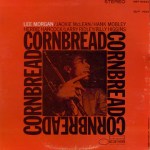
We did a shootout for Cornbread in 2023 and again in 2025. For our latest one, we were fortunate to be able to include both the Tone Poets pressing that came out in 2019 as well as the 75th Anniversary Blue Note pressing from 2014.

Here is the way we described a Hot Stamper that ended up being the best sounding pressing we played on one of its sides, and coming in second on the other side.

  • The sound is everything that’s good about Rudy Van Gelder‘s recordings – it’s present, spacious, full-bodied, Tubey Magical, dynamic and, most importantly, alive in that way that modern pressings never are
  • Exceptionally spacious and three-dimensional, as well as relaxed and full-bodied – this pressing was a big step up over nearly all other copies we played

After hearing a copy of the album that sounded as good as that one, the Tone Poets pressing would have had to be at least a bit of a letdown, right?

To be fair, all it really has to be is good sounding. For $30, the price of the average copy that sells on Discogs, can you really expect great?

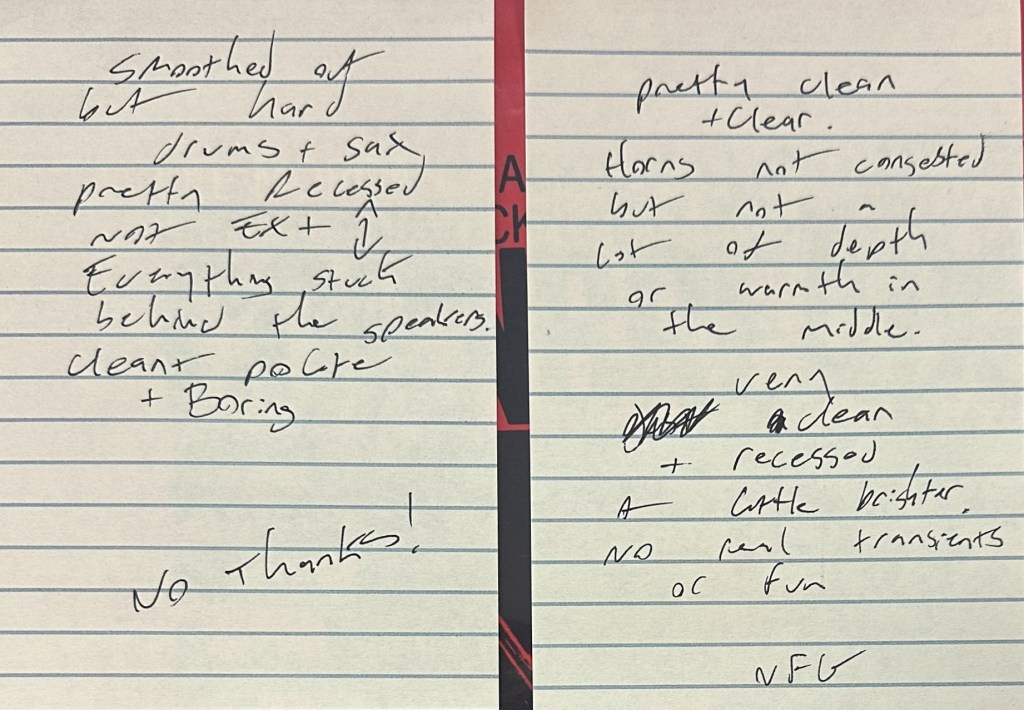
I don’t know what any of the purchasers of these Tone Poets records — of this or any other title — are expecting for their thirty bucks, but I can tell you what they are getting. We took notes while their remastered pressing played, and here’s what we heard.

Side One

(more…)

What Can You Learn from a Mercury Shootout Like This One?

Hot Stamper Pressings of Mercury Classical Recordings Available Now

The short answer is that you can’t learn much from this shootout, because we’re not telling you which title the stampers you see below belong to.

Be that as it may, in the case of this mystery title the conventional wisdom turns out to be correct — the earlier numbered pressings did better than the later numbered pressings, and the early labels did better than the later labels.

That happens a lot, and we are happy to admit that it does. Why? Because the experimental evidence — the datasay that is what happened.

As usual for posts in which the stamper sheet from a shootout is reproduced in its entirety, the stamper numbers shown below will belong to a different album than the one you see pictured.

These can be found under the heading of Mystery Stampers. Most of these posts will illustrate something to be learned from a Hot Stamper shootout, but because the information reveals the shootout winning stampers, the actual title of the record is rarely revealed.

Much more useful stamper information can be found using this link, which includes plenty of stamper numbers for specific titles that are best avoided by audiophiles looking for top quality sound. In addition, we post the winning and losing stampers for some titles that are an unreliable guide to good sound. Unreliable stampers are also quite common.

The right stampers are only one of the many reasons some copies win our shootouts and others don’t, but in the case of this rare Mercury, a record that we only had four copies of, the RFR-2/2 stampers were clearly the best, with no other set of stampers coming close. The best of the others earned grades no better than 2+/2+.

One lesson that was clear was that the best stampers were, to quote our reviewer, “a step up!”

(more…)

The Mono Recut of Revolver from 1981 Is a Ripoff

Hot Stamper Pressings of Revolver Available Now

A great sounding record in stereo, potentially anyway, but this later reissue in mono is so awful it deserves a special place in our hall of shame.

My notes for side one: hard, sour, no bass.

Side two: dumbass small mono, so unclear.

Is it the worst version of the album ever made? That’s hard to say. There is no shortage of competition, that’s for sure.

But it may be the worst sounding version of the album we’ve ever played, and that should be good enough for any audiophile contemplating spending money on this kind of rubbish.

We love the mono mix of For No One, but not when it sounds like this.

The only Beatles vinyl we offer on our site are stereo pressings. Our reasons for doing this are straightforward enough.

The Beatles records in mono, contrary to the opinion of audiophiles and music lovers alike, virtually never have the presence, energy and resolution found on the best stereo copies. If your stereo cannot resolve all the information on the tape, sure, Twin Track Stereo (used on the first two albums, hard-panned multi-track afterwards) ends up sounding like some of the instruments are stuck in the speakers, hard left and hard right, with nothing but a hole in the middle.

But there is a great deal of information spreading into the middle when we play those records here, and nothing feels stuck in the speakers that doesn’t sound like it was supposed to be heard coming directly from one of the speakers.

It is our contention that the best audio equipment, properly tweaked, can show you a world of musical information that exists only on the stereo pressings, information that the mono mixes mostly obscure.

(more…)

Tommy on Classic Records

Hot Stamper Pressings of the Music of The Who Available Now

Sonic Grade: C

The Classic Tommy is bass shy. It could have had amazing bass, like Classic’s Who’s Next, but it doesn’t. Why, I have no idea.

The overall sound is thin, so thin that we immediately knew there was no point in carrying it (back in the old days when we carried Heavy Vinyl, pre-2008).

The only Classic Who record we ever carried was Who’s Next; the rest of them vary from mediocre to dreadful.


Remastering Out The Good Stuff

What is lost in the newly remastered recordings so popular with the record buying public these days?

Lots of things, but the most obvious and irritating is the loss of transparency.

Modern records tend to be small, veiled and recessed, and they rarely image well. But the most important quality they lack is transparency. Almost without exception they are opaque.

They resist our efforts to hear into the music and get lost in it.

(more…)

L.A. Woman Is a Disaster on German Heavy Vinyl, Part One

Hot Stamper Pressings of the Music of The Doors Available Now

There was a German 180 gram pressing of L.A. Woman that was so bad, I called this commentary from 2005 The Audiophile Apocalypse. [Minor edits have been made since then.]

The fact that some audiophiles and audiophile reviewers appeared to like this pressing was a sign that, to me at least, The End Is Near, or May Be. There is no hope for audiophiles if they can’t tell a good record from a bad one, and this is clearly a bad one.

If this isn’t a good example of a pass/not-yet record, I don’t know what would be.

As noted at the top, this commentary was written a long time ago. Much of our thinking about the recordings of The Doors has evolved since then, having played scores of their records in shootouts and learned something new from practically each one. Click here to read more.

Dateline: January, 2005

When I first played it I thought there must be something wrong with my stereo. There was no deep bass. (This recording has amazing deep bass.) The sound was upper midrangey and distorted. There was no extreme top at all.

This surprised me, as I had heard that this was supposed to be a good record.

What I heard coming off the copy that I was playing was pure garbage. I was confused.

So I grabbed a couple of DCC Doors pressings. The first one I played was Waiting For The Sun, my favorite on DCC. Ahh, that’s more like it. Sweet, open, plenty of bass, extended highs, Steve Hoffman’s beautifully liquid midrange — everything I expected to hear on his version was there just exactly the way it should be.

So I knew it wasn’t my stereo. Then I pulled out the DCC LA Woman. What’s the difference you ask? Well, the DCC has a top end. Listen to the cymbals. They ring sweetly and correctly. You can hear that the tape hiss sounds correct, a sure sign that the top end is accurate.

The midrange is a bit recessed compared to the German pressing. Steve says he took out a half DB in the upper mids. There’s distortion on the vocals and he was trying to soften the effect. It might have been better to leave it flat, but either way is preferable to the boosted, aggressive, edgy upper midrange to be found on the German pressing.

The German LP sounds like something playing over the radio. AM, not FM. Part of the problem is that there’s no lower midrange on the German pressing to properly balance out the vocals. Perhaps it’s not on the tape they used. I’m guessing it probably isn’t.

But any mastering engineer worthy of the name should know how to fix a problem like that. Steve did. Apparently this German fellow did not.

And worst of all, there is no deep bass on this record AT ALL. The whole lower octave is missing. Now to be fair, the DCC LP has the same problem. There’s no lower bass on it either. That’s why I don’t recommend that you listen to LA Woman on vinyl. I don’t know of any copy that sounds right.


UPDATE 2025

This was true in 2005 because we had yet to do the work it takes to find the right copies, the ones with plenty of bass and everything else too. I think it took us another ten years to find the pressings with the right stampers. Scroll to the bottom of this listing to see our notes for the copy that won our last shootout in 2024.

(more…)