Roy Halee, Engineer – Reviews and Commentaries

Super Session – A Jack Hunt Mastered MoFi Winner

Hot Stamper Pressings of Music Produced or Performed by Al Kooper Available Now

Sonic Grade: B

Super Session is one of the best-sounding MoFi pressings. The midrange sounds wonderful — silky sweet and transparent. Not having been cut by Stan Ricker, the top end doesn’t have that SR/2 boost. Overall it’s a very nice sounding record, and the music just can’t be beat. 

In fact, it was actually mastered by Jack Hunt, a man we know to be responsible for some of the thickest, dullest, deadest MoFi recuts found in their shameful catalog.

But he did a pretty good job on this one, and for that he deserves some credit.

(more…)

Listening in Depth to Parsley, Sage, Rosemary, and Thyme

More of the Music of Simon and Garfunkel

Presenting another entry in our extensive listening in depth series with advice on what to listen for as you critically evaluate your copy of Parsley, Sage, Rosemary, and Thyme.

Here are some albums currently on our site with similar track by track breakdowns.

Side One

Scarborough Fair/Canticle

Listen carefully to the voices on this track, one of our favorites to test with. On the best copies they sound exceptionally delicate yet full-bodied.

Patterns

The percussion on this track is a great test for smear, a problem that plagues most pressings to one degree or another. On the better copies you’ll distinctly hear the sound of the drummer’s hands hitting the skins of the bongos, as well as lots of ambience and echo around the drums.

Note also that every stereo copy we’ve ever played spits at least a little on this song.

(more…)

For the Best Sound, Stick to the 360s on Parsley, Sage, Rosemary and Thyme

More of the Music of Simon and Garfunkel

More superb sound from the legendary CBS 30th street studios in New York!

This album checks off some big boxes for us here at Better Records.

Turn up the volume, turn down the lights, and you’ll have one of the best — if not THE best — folk duos of all time performing right there in your listening room for you. The sound is open, spacious, and transparent with breathy vocals and unusually low levels of spit. The strings are more dynamic than we’re used to hearing and the bottom end has really nice weight to it.

These old Simon & Garfunkel records weren’t often owned by audiophiles who kept their records in pristine condition. 

No, these were the popular records of their day, purchased by the record-buying public, and they were played and played hard, typically on cheap equipment. There are many quiet passages on this album that are going to reveal whatever surface issues might exist, so a copy that plays Mint Minus Minus is about as good as you can hope for.

Since only the right vintage 360 pressings have any hope of sounding good on this album, that will most often be the playing condition of the copies we sell.

(more…)

Letter of the Week – “whole thing is hopping and dancing with huge beautiful sound”

More of the Music of Simon and Garfunkel

One of our good customers had this to say about some Hot Stampers he purchased recently

Hey Tom, 

That latest S&G album — BOTW — is absofuckinglutely blowing my mind tonight. Wow. Those deep horns (?) blasting at times (end of Keep the Customer Satisfied, chorus of Why Don’t You Write Me, end of The Boxer… whole thing is hopping and dancing with huge beautiful sound. Hard to sit down!!

Dear C.

The power of those horns is exactly what I was telling you about –  they cannot be reproduced properly until you have speakers with dynamic drivers large enough to play the full weight of the brass.

TP


We discuss the idea of Big Speakers in this boilerplate commentary all over the site:

Let’s face it, this is a big speaker record. It requires a pair of speakers that can move air with authority below 250 cycles and play at fairly loud levels. If you don’t own speakers that can do that, this record will never really sound the way it should.

It’s the kind of recording that caused me to pursue Big Stereo Systems driving Big Dynamic Speakers for as long as I can remember. You need a lot of piston area to bring this recording to life, and to get the size of all the instruments to match their real life counterparts.

For that you need big speakers in big cabinets, the kind I’ve been listening to for more than forty years. (My last small speaker was given the boot around 1974 or so and I have never looked back.)

To tell you the truth, the Big Sound is the only sound that I can enjoy. Anything less is just not for me.


Further Reading

Listening in Depth to Bookends

More of the Music of Simon and Garfunkel

Musically side two is one of the strongest in the entire Simon and Garfunkel oeuvre (if you’ll pardon my French). Each of the five songs could hold its own as a potential hit on the radio, and there is no filler to be found anywhere. How many albums from 1968 can make that claim?

The estimable Roy Halee handled the engineering duties. Not the most ‘natural” sounding record he ever made — the processing is heavy handed on a number of tracks — but that’s clearly not what neither he nor the duo were going for.

If you want natural, Parsley, Sage, Rosemary and Thyme has what you are looking for. That said, as of 2022 both are Top 100 Titles.

The three of them would obviously take their sound much farther in that direction with the Grammy winning Bridge Over Troubled Water from 1970.

The bigger production songs on this album have a tendency to get congested on even the best pressings, which is not uncommon for four track recordings from the 60s. Those of you with properly set up high-dollar front ends should have less of a problem than some. $3000 cartridges can usually deal with this kind of complex information better than $300 ones.

But not always. Expensive does not always mean better, since painstaking and exacting setup is so essential to proper playback.

The Wrecking Crew provided top quality backup, with Hal Blaine on drums and percussion, Joe Osborn on bass and Larry Knechtel on piano and keyboards.


Side One

Bookends Theme
Save the Life of My Child

I used to think this track would never sound good enough to use as an evaluation track. It’s a huge production that I’d found practically impossible to get to sound right on even the best original copies of the album. Even as recently as ten years ago I had basically given up trying.

Thankfully things have changed. Nowadays, with great copies at our disposal and a system that is really cooking, virtually all of the harmonic distortion in the big chorus near the opening disappears. It takes a very special pressing and a very special stereo to play this song.

(more…)

Outliers & Out-of-This-World Sound

More Outlier Pressings We’ve Discovered

This commentary was written about ten twenty years ago and has been updated more than a few times since.

A while back we did a monster-sized shootout for Blood, Sweat and Tears’ second release, an album we consider THE Best Sounding Rock Record of All Time.

In the midst of the discussion of a particular pressing that completely blew our minds — a copy we gave a Hot Stamper grade of A with Four Pluses, the highest honor we can bestow upon it — various issues arose, issues such as: How did this copy get to be so good? and What does it take to find such a copy? and, to paraphrase David Byrne, How did it get here?


  • We no longer give Four Pluses out as a matter of policy, but that doesn’t mean we don’t come across records that deserve them from time to time.
  • Nowadays we usually place them under the general heading of breakthrough pressings. These are records that, out of the blue, reveal to us sound that fundamentally changes what we thought we knew about these familiar recordings.
  • When this pressing (or pressings) landed on our turntable, we found ourselves asking “Who knew?
  • Perhaps an even better question would have been “How high is up?”

Which brings us to this commentary, which centers around the concept of outliers.

Wikipedia defines an outlier this way:

In statistics, an outlier is an observation that is numerically distant from the rest of the data.

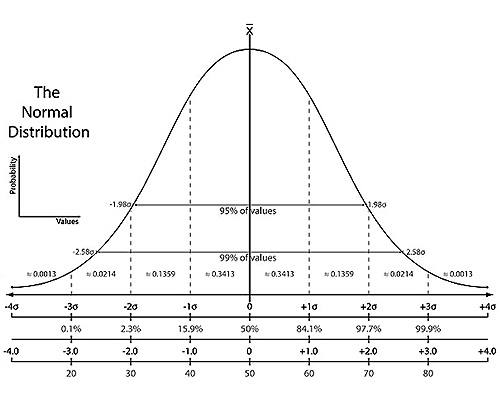
In other words, it’s something that is very far from normal. In the standard bell curve distribution pictured below, the outliers are at the far left and far right, far from the vast majority of the data which is in the middle.

In the world of records, most copies of any title you care to name would be average sounding. The vertical line in the center of the graph shows probability; the highest probability is that any single copy of a record will be at the top of the curve near the middle, which means it will simply be average. The closer to the vertical line it is, the more average it will be. As you move away from the vertical line, the data point — the record — becomes less and less average. As you move away from the center, to the left or the right, the record is either better sounding or worse sounding than average.

Hot Stampers are simply those copies that, for whatever reason, are far to the right of center, far “better” than the average. And as the curve above demonstrates, there are a lot fewer of them than there are copies in the middle. 


Measuring the Record

Malcolm Gladwell has a bestselling and highly entertaining book about outliers which I recommend to all. Last year I read The Black Swan (or as much of it as I could stand given how poorly written it is) which talks about some of these same issues. Hot Stampers can be understood to a large degree by understanding statistical distributions. Why statistics you ask? Simple. We can’t tell what a record is going to sound like until we play it. For all practical purposes we are buying them randomly and “measuring” them to see where they fall on the curve. We may be measuring them using a turntable and registering the data aurally, but it’s still very much measurement and it’s still very much data that we are recording.

No Theory, Just Data

Many of these ideas were addressed in the recent shootout we did for BS&T’s second album. We played a large number of copies (the data), we found a few amazing ones (the outliers), and we tried to determine how many copies it really takes to find those records that sound so amazing they defy not only conventional wisdom, but our understanding of records per se.

We don’t know what causes these records to sound so good. We know ’em when we hear ’em and that’s pretty much all we can say we really know. Everything else is speculation and guesswork.

We have data. What we don’t have is a theory that explains that data.

And it simply won’t do to ignore the data because we can’t explain it. Hot Stamper Deniers are those members of the audiophile community who, when faced with something they don’t want to be true, simply manufacture reasons why it can’t or shouldn’t be true.

That’s not science. Practicing science means following the data wherever it leads. The truth is found in the record’s grooves and nowhere else. If you don’t think record collecting is a science, you’re not doing it right.

Ignoring Outliers

Wikipedia has a good line about ignoring outliers. Under the heading of Caution they write: “… it is ill-advised to ignore the presence of outliers. Outliers that cannot be readily explained demand special attention.” Hear hear.

Now let’s see where the grooves for Blood, Sweat and Tears’ second album led us. They demanded special attention and by god we gave it to them.

The Grooves

We noted some new qualities to the sound that we would like to discuss; they’re what separated the men from the boys this time around. What we learned can be summed up in a few short words: it’s all about the brass. Let me give you just one example of how big a role the brass plays in our understanding of this recording. The best copies present a huge wall of sound that seems to extend beyond the outside edges of the speakers, as well as above them, by quite a significant amount. If you closed your eyes and drew a rectangle in the air marking the boundary of the soundscape, it would easily be 20 or 25% larger than the boundary of sound for the typically good sounding original pressing, the kind that might earn an A or A Plus rating.

Size Matters

The effect of this size differential is ENORMOUS. The power of the music ramps up beyond all understanding — how could this recording possibly be this BIG and POWERFUL? How did it achieve this kind of scale? You may need 50 copies to find one like this, which prompts the question: why don’t the other 49 sound the way this one does?

The sound we heard on the Four Plus copy has to be on the master tape in some sense, doesn’t it? Mastering clearly contributes to the sound, but can it really be a factor of this magnitude?

Intuition says no. More likely it’s the mastering of the other copies that is one of the many factors holding them back, along with worn stampers, bad stampers, bad metal mothers, bad plating, bad vinyl, bad needles and all the rest — all of the above and more contributing to the fact that the average copy of this album is just plain bad news.

Conventional Wisdom

Any reason you like for why a record doesn’t sound good is as valid as any other, so you might as well pick one you are comfortable with; they’re all equally meaningless. Of course the reverse of this is just as true: why a record sounds good is anyone’s guess, and a guess is all it can ever be.

People like having answers, and audiophiles are no different from other people in this respect. Since there are no answers to any of these questions, answers in this case being defined as demonstrable conclusions based on evidence gained through the use of the scientific method, most people, audiophiles included, are happy — if not better off — making up the answers with which they are most comfortable.

This is precisely why the term “conventional wisdom” was coined, to describe the easy answers people readily adopt in order to avoid doing the hard work of actually finding out the truth.

(more…)

Listening in Depth to Still Crazy After All These Years

More of the Music of Paul Simon

Presenting another entry in our extensive listening in depth series with advice on what to listen for as you critically evaluate your copy of Still Crazy. Here are some albums currently on our site with similar Track by Track breakdowns.

As exceptionally well-produced, well-engineered Pop Albums from the ’70s, the very best copies can proudly hold their heads high. Wait a minute. Our last commentary noted what a mess most of the pressings of this album sound like, with so much spit and grain. Have we changed our minds? Well, yes and no, and as usual we make no excuses for having changed our minds. We call it progress.

Yes, most copies are still a mess, but No, some copies now sound far better than we ever thought possible.

As we noted in our previous commentary for the Hot Stamper Still Crazy (back in 2005!), when we first dropped the needle on side one of another copy of this record, we were shocked to hear how spitty, grainy and transistory sounding the album was. We could hardly believe that a mainstream pop album by Paul Simon could sound this bad. It was pure spitty DISTORTION with ZERO midrange magic. A CD would sound better. Even Graceland, a famously compressed, phony, digital sounding album wouldn’t sound this bad!

A bad copy you say? Maybe they don’t all sound bad on side one, but there sure are a lot of them that do. Two tracks in particular — in fact, the two biggest tracks on side one — have fairly bad sound on almost any copy you play: Still Crazy and 50 Ways…

The True Tests for Side One

What separates the mediocre-to-bad-sounding average copy from a Hot Stamper is how well mastered those two songs are. In other words, if you get those two tracks right — breathy vocals, sounding smooth and sweet, with the sibilance under control, supported by good solid bass — the whole side is going to be good, maybe even as good as it gets.

(more…)

Letter of the Week – “…makes my years of developing and investing in my stereo worthwhile.”

More of the Music of Simon and Garfunkel

More of the Music of Pink Floyd

One of our good customers had this to say about some Hot Stampers he purchased recently:

Hey Tom, 

I absolutely love my Hot Stamper of Parsley, Sage, Rosemary and Thyme, and of Dark Side of the Moon, and so many others that you have sold to me.

I find myself just playing the same side over and over, never tiring of the music. Which is something I never do with a CD….. no matter with a Reimyo CD player, or CEC TL-1X with Audiologic DAC, or even Acoustic Arts DAC, which actually sounds pretty good, but still fatiguing, and missing the immediacy and soul of a good LP — and in addition to sounding better, there is just something about having an original copy made back when the music was fresh and newly released, putting me back in my college years, and somehow linking up the past to the present.

The music is living there in those grooves, even better now because I can actually hear the music with a decent system. I don’t think many record players back in 1972- 1978 could begin to do these records justice.

Thanks so much for all the great music – makes my years of developing and investing in my stereo worthwhile.

Kurt B.

Kurt, you are welcome!

We love both these albums and we’re in agreement with you that the music is more alive in these grooves than it could ever be in the digits of a CD.

(more…)

Letter of the Week – “I did not know this was a well known example of a below-standard re-issue…”

More of the Music of Paul Simon

Reviews and Commentaries for the Music of Paul Simon (and Art Garfunkel)

A new customer writes:

Tom,

I read about your experience with the re-issue of Paul Simon’s Graceland.

I did not know this was a well known example of  a below-standard re-issue, but your experience reflects my own  a few years ago,  over here in the Netherlands. Being very disappointed about the sound quality, I have returned my copy to the shop and asked my money back.  As I told you, I have done this more often, but always because of excessive surface noise – that does not belong on a new record at a price of €30+ .  This was the first and only time I have done this because of sound quality – apparently it was that obvious.

Peter

Peter,

This is NOT a well known example of a below standard reissue. We are the only critics of this record that I know of. The audiophile reviewers loved it!

A famously clueless audiophile reviewer even visited the hack who remastered it, that hack being a Mr. Ryan Smith, so he could learn more about the man’s approach to mastering.

Perhaps he wants to stop writing reviews for bad audiophile records and learn how to make them. If so, he is studying at the feet of a master.


A Short History of the Remastered Audiophile LP

Older audiophile records, typically those made by Mobile Fidelity in the ’70s and ’80s, suffered from a common group of problems on practically every record they released:

boosted top, a bloated bottom, and a sucked-out midrange.

Nowadays that phony sound is no longer in vogue. A new, but equally phony sound has taken its place.

What seems to be in vogue these days, judging by the Heavy Vinyl Reissue pressings we’ve played over the last few years, is a very different sound, with a very different suite of shortcomings.

These newer records, with few exceptions, tend to be compressedthickdullopaque, veiled, recessed and lacking in ambience.

These are currently the hallmarks of the Heavy Vinyl LP. Whether made by Speakers Corner, DCC, AP or any other label, starting at some point in the mid-’90s, the sound these labels apparently preferred had an infuriating tonal balance problem we noted in practically every record we played — sound that was just too damn smooth.

(more…)

Bridge Over Troubled Water – A Price Must Be Paid

More of the Music of Simon and Garfunkel

Reviews and Commentaries for Bridge Over Troubled Water

One of the most interesting findings in this shootout was that no Red Label copy scored as high as the best 360 Label copies. The later labels can be very clean and clear, but ultimately they lack the midrange magic, warmth and sweetness of the best early pressings.

Since this recording has a problem in all those areas to start with, most red label copies suffer from a pronounced deficit of  Simon & Garfunkel magic, the kind of magic that is so wonderfully evident on their two previous outings: Parsley, Sage… and Bookends.

The Last of the Four Track Recordings

Why do the two previous albums have more magic?

They’re simpler productions, the kind that can be handled by the four track machine they were recorded on.

Bridge, on the other hand, is the boys’ Grand Musical Statement for All Time, with production and scope far exceeding their previous work. Like the Beatles with Abbey Road, they gave it their all and went out on a high note. (The Beatles planned it that way, while S and G fell victim to their ambition, which you can read about in the AMG review below.)

What a Masterpiece they achieved. Ten weeks at Number One on the charts. Depth and breadth of material only hinted at on their earlier efforts.

Who can argue with this as one of the most important achievements in popular music of the last fifty years? [Make that sixty.]

It’s on this short list for a reason.

Back Away From The Console

The sonic problems and promise of the multi-track approach can both be heard in one track: The Only Living Boy In New York. The song starts out simply, focusing on the duo’s lovely voices, with only minimal instrumentation. It sounds PHENOMENAL on the best pressings, and very good on even the typical copies. Halfway through the song, heavy-handed production kicks in, and the sound suffers significantly. You can’t fault the band for going big, but nor can you blame audiophiles for wishing they had kept it simple.

(more…)