Robert Fine, Engineer – Reviews and Commentaries

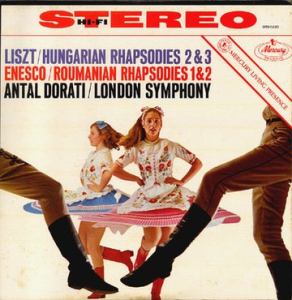
The Enigma Variations on Mercury Was Not to Our Liking (Although We Sure Love the Cover)

Neither the sound nor the performance of this 1959 Mercury (SR 90125) impressed us when we did a shootout for the work years ago.

The performance of the Enigma Variations here seems rushed, and the two other recordings of the work that we like, one on Philips, the other on RCA, are better.

The Philips with Haitink is probably the better of the time and our favorite at this time. Of the three recordings that we felt had the best combination of music and sound, the Merc with Barbarolli was our least favorite, so we decided to concentrate on the best two recordings in our shootout and get rid of the Mercury pressings we had on hand.

(more…)

This Mercury Copland Record Had Screechy, Shrill Strings

Hot Stamper Classical and Orchestral Pressings Available Now

Our notes for SR 90246 read:

Lively and clear but screechy strings. Dry and bright sound.

To help you avoid records with these sonic faults, we’ve linked below to others with similar problems.

Here are some titles we’ve found that tend to have dry sound, and here are some that tend to have bright sound.

And of course shrill strings are the kiss of death on any orchestral record. (Classic Records, I’m talking to you!)

None?

None of the copies of SR 90246 we played were any good, but the RFR3 / RFR6 was the worst of the bunch.

Are there good sounding pressings of the recording?

There may well be. We didn’t hear any, but that doesn’t mean they don’t exist.

However, we have no intention of spending more money trying to find them. If you know of some killer stampers for the album, please shoot us an email.

We tend to like Dorati’s work with the London Symphony Orchestra, but in this case the better Dorati/Copland record was recorded in Minneapolis in 1959, SR 90172.

If You’re a Fan

If you’re a fan of Mercury Living Presence records — and what right-thinking audiophile wouldn’t be? — have you noticed that many of them, this one for example, don’t sound very good?

If you’re an audiophile with good equipment, you should have.

But did you? Or did you buy into the hype surrounding these rare pressings and just ignore the problems with the sound?

(more…)

Mercury Unfortunately Did Not Produce a Good Rossini Overtures

Hot Stamper Pressings of Mercury Living Presence Records Available Now

1960 just happens to be one of the truly great years for quality analog recordings, as can be seen from this amazing group of albums, each of which was recorded or released that year.

However, the sound of this Mercury recording, SR 90139, released that very year, was far from acceptable.

The loud passages are simply full of compressor distortion.

To be fair, we haven’t played this album by the dozens the way we have many of the records we review (more than a hundred in the case of most Beatles album).

Let’s just say I remember being disappointed by a copy or two back in the day — whenever that was — and the latest copy we auditioned was no better, so, as a practical matter, this is not a vein rich enough for us to be mining, not when there are literally hundreds of other recordings we are still pursuing. As always, if you believe you have a killer pressing, please let us know what it is so we can get one in ourselves.

It seems that many early Mercury recordings suffer from this shortcoming, and when they do, we put them in the trade-in pile and move on.

By the way, for those who are interested in these works, our favorite performance of Rossini’s Overtures on record is the one with Maag conducting the Paris Conservatoire.


This Mercury might be passable on an old school system, but it was too unpleasant to be played on the high quality modern equipment we use.

There are quite a number of others that we’ve run into over the years with similar shortcomings. Here they are, broken down by label.

  • London/Decca records with weak sound or performances
  • Mercury records with weak sound or performances
  • RCA records with weak sound or performances

Have You Noticed…

If you’re a fan of Mercury Living Presence records — and what right-thinking audiophile wouldn’t be? — have you noticed that many of them, this one for example, don’t sound very good?

If you’re an audiophile with good equipment, you should have.

But did you? Or did you buy into the hype surrounding these rare pressings and just ignore the problems with the sound?

There is plenty of hype surrounding the hundreds of Heavy Vinyl pressings currently in print. I read a lot about how wonderful their sound is, but when I actually play them, I rarely find them to be any better than mediocre, and most of them are downright awful.

It seems as if the audiophile public has bought completely into the hype for these modern Heavy Vinyl pressings. Audiophiles have too often made the mistake of approaching these records without the slightest trace of skepticism. How could so many be fooled so badly? Surely some of these people have good enough equipment to allow them to hear how bad these records sound.

I would say Mercury’s track record during the ’50s and ’60s is a pretty good one, offering (potentially) excellent sound for roughly one out of every three titles or so.

But that means that odds are there would be a lot of dogs in their catalog. This is definitely one of them.

To see the 50+ Living Presence classical titles we’ve reviewed to date, click here.

(more…)

Classic Records 45 RPM Recut – This Is Your Idea of a Great Firebird?

Hot Stamper Pressings of the Music of Igor Stravinsky Available Now

Many years ago, a customer alerted me to a review Wayne Garcia wrote about various VPI platters and the rim drive, and this is what I wrote back to him:

Steve, after starting to read Wayne’s take on the platters, I came across this:

That mind-blowing epiphany that I hadn’t quite reached with the Rim Drive/Super Platter happened within seconds after I lowered the stylus onto the “Infernal Dance” episode of Stravinsky’s Firebird (45 rpm single-sided Classic Records reissue of the incomparable Dorati/LSO Mercury Living Presence recording).

That is one of my half-dozen or so favorite orchestral recordings, and I have played it countless times.

This is why I have so little faith in reviewers. I played that very record not two weeks ago (04/2010) against a good original and the recut was at best passable in comparison. If a reviewer cannot hear such an obvious difference in quality, why believe anything he has to say?

The reason we say that no reviewer can be trusted is that you cannot find a reviewer who does not say good things about demonstrably mediocre and even just plain awful records. It’s the only real evidence we have for their credibility, and the evidence is almost always damning.

I want a reviewer who knows better than to play such an underwhelming pressing and then waste my time telling me about it. He should tell us what a good record sounds like with this equipment mod. Then I might give more credence to what he has to say.

Reviewer malpractice? We’ve been writing about it for more than 25 years.

P.S.

This is one of the Classic Records titles on Harry Pearson’s TAS List of Super Discs(!)

P.P.S.

Allow me to quote a writer with his own website devoted to explaining and judging classical recordings of all kinds. His initials are A.S. for those of you who have been to his site.

Classic Records Reissues (both 33 and 45 RPM) – These are, by far, the best sounding Mercury pressings. Unfortunately, only six records were ever released by Classic. Three of them (Ravel, Prokofiev and Stravinsky) are among the very finest sounding records ever made by anyone. Every audiophile (with a turntable) should have these “big three”.

Obviously we could not disagree more. I’ve played all six of the Classic Mercury’s. The Chabrier, Ravel and Prokofiev titles are actually even worse than the Stravinsky we reviewed.

This same reviewer raved about a record we thought had godawful sound, Romantic Russia on MoFi, a label that never met an orchestral string section it didn’t think needed brightening.

Find me a Mobile Fidelity classical record with that little SR/2 in the dead wax that does not have bright string tone. I have yet to hear one.

What is it with audiophile record reviewers? They seem to be taken in by the most unnatural sounding pressings. The world is full of wonderful vintage pressings that have no such problems. If you are an audiophile who feels himself qualified to write about records, shouldn’t you at least be able to hear the difference between a phony audiophile pressing and the vintage pressings it supposedly improved?

(more…)

Don’t Waste Your Money on these Mozart Symphonies

More of the Music of Wolfgang Amadeus Mozart

Neither the sound nor the performance of this 1958 Mercury are impressive.

1959 just happens to be one of the all time great years for recording in analog.

If you have any doubt, check out this amazing group of albums, all recorded or released that year.

This Mercury might be passable on an old school system, but it was too unpleasant to be played on the high quality modern equipment we use.

There are quite a number of others that we’ve run into over the years with similar shortcomings. Here they are, broken down by label.

  • London/Decca records with weak sound or performances
  • Mercury records with weak sound or performances
  • RCA records with weak sound or performances

Have You Noticed…

If you’re a fan of Mercury Living Presence records — and what right-thinking audiophile wouldn’t be? — have you noticed that many of them, this one for example, don’t sound very good?

If you’re an audiophile with good equipment, you should have.

But did you? Or did you buy into the hype surrounding these rare pressings and just ignore the problems with the sound?

(more…)

Blary Brass Ruins Another Mercury – This Time It’s Pictures at an Exhibition

Hot Stamper Pressings of the Music of Modest Mussorgsky Available Now

The sound of the pressings we’ve played over the years has always been awful.

On SR 90217, the brass is just too sour and blary. To our knowledge, no copies of the album do not suffer from these problems.  They may exist — who can say they don’t? — but we’ve yet to play one and have no intention of seeking them out, not when there are other superior performances with top quality sound.

The performance is awful, too.

When the horns have clarity, correct tonality, plenty of space around them and a solid, full-bodied sound, probably every other instrument in the soundscape will too.

One minute into side one we knew that this Mercury had failed the brass test.

It was simply much too unpleasant to be played on modern high quality equipment.

The less revealing systems some audiophiles seem to favor can make the shortcomings of a recording such as this more tolerable, but we’ve worked very hard for many decades to make sure our system is as truthful and unforgiving as possible.

We knew right from the get-go this Mercury was not going to make the grade. Here are some others that we’ve found seriously wanting. We’ve also compiled a list of more than 40 of the worst sounding Heavy Vinyl pressings of orchestral and classical music, and it can be found here.

(more…)

Remind Me, What Is the Point of Listening to a Quiet Record with Mediocre Sound?

Hot Stamper Pressings of the Music of Igor Stravinsky Available Now

A lackluster reissue from Philips, bad enough to qualify for our hall of shame.

This is some truly dead as a doornail sound, sound which is not remotely competitive with the real Mercury pressings we’ve played. The FR pressings of the recording can be phenomenally good.  Even the later M2 pressings from Philips can be excellent. 

Back in the 80s and 90s, I actually used to like some of the Golden Import pressings.  That was a long time go, and thankfully our playback system is quite a bit more revealing than the one I had back in those days.

After playing literally tens of thousands of records since then, my critical listening skills are better too.

Now when I play these imports, they sound veiled, overly smooth, smeary and compressed, not too different from the average Philips pressing, which of course is exactly what they are. They’re all remastered by Philips, to give the Mercury tapes the sound that Philips thinks they should have. Sadly, not much of the Mercury Living Presence sound has survived.

We complain about mixing and mastering engineers who felt compelled to bring a new sound to old favorites.

The Philips label that produced the Golden Import series are serial offenders in this regard.

The Golden Import pressings might be good for audiophiles who care more about quiet surfaces than good sound.  We are firmly staked at the opposite side of that trade-off.

Quiet vinyl means nothing if the sound is poor, or, at the very least, wrong for the recording.

(more…)

Bose Salutes the Sound Of Mercury Records (and Some Audio Lessons Learned Long Ago)

Hot Stamper Pressings of Mercury Recordings Available Now

This Bose / Mercury Demonstration LP is autographed by none other than Amar G. Bose. The autograph reads “To EMI, with regards and best wishes, Amar G. Bose.”

Bose may not have ever made very good speakers, but they sure knew good recordings when they heard them. This LP has excerpts from some of the top Mercury titles, including music by Copland (El Salon Mexico), Kodaly (Hary Janos Suite), Mussorgsky/ Ravel (Pictures At An Exhibition), and Rimsky-Korsakov (Russian Easter Overture).

I played one of these Bose records years ago and was surprised at how good it sounded. The transfers of the Mercury tapes were excellent. I guess that makes sense — if you want to show off your speakers you had better use a well-mastered record for the demonstration.

I was duped into buying my first real audiophile speaker, Infinity Monitors, when the clever salesman played Sheffield’s S9 through them. I bought them on the spot. It was only later when I got home that none of my other records sounded as good, or even good for that matter. That was my first exposure to a Direct to Disc recording.

To this day I can still picture the room the Infinity’s were playing in. It was a watershed moment in my audiophile life.

And of course I couldn’t wait to get rid of them once I’d heard them in my own system with my own records. I quickly traded them in for a pair of RTR 280-DRs. Now that was a great speaker! A 15 panel RTR Electrostatic unit for the highs; lots of woofers and mids and even a piezo tweeter for the rest. More than 5 feet tall and well over 100 pounds each, that speaker ROCKED.

(more…)

Robert Fine Does It Again

Hot Stamper Pressings of Mercury Classical Recordings Available Now

The notes you see below are for our Shootout Winner, which earned our top grade of at least 3+ on side one with its Hard to Fault (HTF) sound.

If you are interested in a record with the kind of sound described below, please contact us and we will be happy to put you on the waiting list for the next killer copy that comes along and blows our minds.

As you may well imagine, shootouts for this album are exceedingly rare. For a sought-after TAS List title such as this, we’re lucky to be able to do one every five years or so. Until the next one comes around, please consider trying some of our other classical and orchestral Hot Stamper pressings.

Robert Fine’s recordings for Mercury are some of the most amazing sounding we have ever played. To see what might be available, please click here.

(more…)

And to Think I Used to Like this Strauss Record

Hot Stamper Mercury Pressings Available Now

I used to like this Strauss Family Album back in the old days. Picked them up whenever I saw them, usually for ten bucks or less. They’re fairly common. It’s not exactly HiFi a la Espanola.

Now when we play this Mercury, it doesn’t sound so good. We traded what we had in stock back to stores or gave them away as freebies to our good customers.

A lot of records that I used to like because they were cleaner and brighter — later Red Seal Living Stereos, some OJC jazz, some reissues of rock — sounded much better when my system was darker and less revealing.

Side one of this copy has steely strings, the kiss of death on this kind of music.

Side two is passable, a low grade Hot Stamper. If you see this album for five bucks, pick it up and give it a listen. More than that and you should probably pass.

Many Mercury records simply do not sound good, and this appears to be one of them. The sound is  shrill, and that is just not acceptable on today’s highly-tweaked stereos.

Some of the early Mercs seem better suited to the old school audio systems of the 60s and 70s than the modern systems of today.

Some of these records used to sound good on those older systems, and I should know. I had an Old School stereo and some of the records I used to think sounded good back in the day don’t sound too good to me anymore.

For a more complete list of those records, click here.

How Did We Figure All of This Out?

There are more than 2000 Hot Stamper reviews on this blog. Do you know how we learned so much about so many records?

Simple. We ran thousands and thousands of record experiments under carefully controlled conditions, and we continue to run scores of them week in and week out to this very day.

(more…)