Robert Fine, Engineer – Reviews and Commentaries

Where Cheap Turntables Fall Flat – The Music of Franz Liszt

Hot Stamper Pressings of Classical Music Available Now

Classical music is unquestionably the ultimate test for proper turntable/arm/cartridge setup.

The Liszt Piano Concerto record you see pictured is a superb choice for making small adjustments to your setup in order to improve the playback of these very difficult to reproduce orchestral recordings.

Here are some other reviews and commentaries touching on these areas of turntable setup.

One of the reasons $10,000+ front ends exist is to play large scale, complex, difficult-to-reproduce music such as Liszt’s two piano concertos. You don’t need to spend that kind of money to play this record, but if you choose to, it would surely be the kind of record that could help you recognize the sound quality your tens of thousands of dollars has paid for.

It has been my experience that cheap tables more often than not collapse completely under the weight of a mighty record such as this.

(more…)

The Said and the Unsaid – The Firebird on Mercury

Hot Stamper Pressings of the Music of Igor Stravinsky Available Now

For our shootout years ago of The Firebird we had three minty, potentially hot copies of the Mercury with Dorati, as well as our noisy ref. (We have a noisy reference copy for just about every major title now. We have been doing these shootouts for a very long time. After thirty years in the record business we have accumulated a World Class collection of great sounding records that are just too noisy to sell.)


UPDATE 2024 

This is no longer true. Our customers seem to be able to put up with surface noise on the records we offer if the price is low enough. Not actually low, just low enough. We have a section for records with condition issues, and there are 175 entries in it as of today, which turns out to be more than a quarter of all the Hot Stamper pressings on the site as a matter of fact.


We had one FR pressing and two of the later pressings with the lighter label, the ones that most often come with Philips M2 stampers. This is how we described the winner:

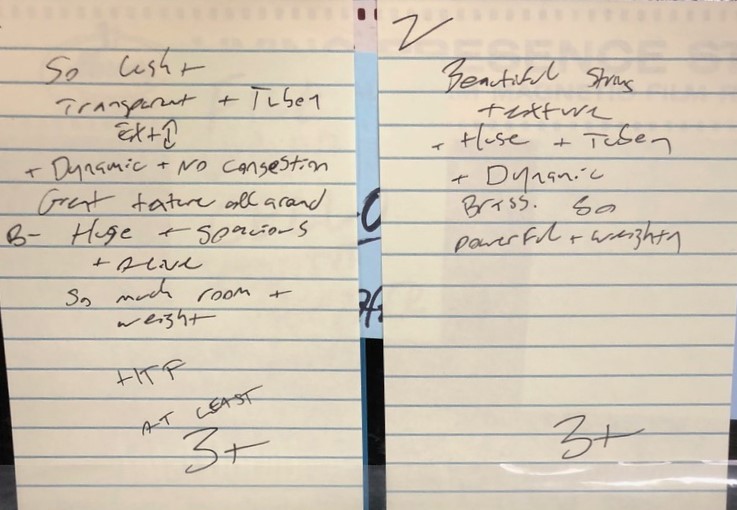
So clear and ALIVE. Transparent, with huge hall space extending wall to wall and floor to ceiling. Zero compression.

Lifelike, immediate, front row center sound like few records you have ever heard.

Rich, sweet strings, especially for a Mercury. This side really gets quiet in places, a sure sign that all the dynamics of the master tape were protected in the mastering of this copy.

What we didn’t say — and what we never say in the listings — is what the second tier copies didn’t do as well as the shootout winner.

We used to. When you read the older entries, most of the time they mention the shortcomings that caused one side or another to be downgraded by some amount, usually something like a half to a full plus.

Not all the top end, not all the bass, not as present, slightly smeary, slightly congested — the list of potential faults for any given pressing is long indeed. These are all the problems we listen for and it’s the rare copy that doesn’t suffer from one or more of them.

We decided years ago that it was better just to let you hear the two sides of the record for yourself and make your own judgments about the sound, rather than make clear to you what areas we felt needed improvement.

Consider this example. If on our system the bass was lacking compared to the very best, perhaps on your system the bass was fine, not an issue, good enough. Without the top copy to compare yours to, how would you know how much better the bass could possibly be?

A classic case of “compared to what?

Shootouts are the only way to answer that question, which, as we never tire of saying, is THE most important question in all of audio. This is why we do shootouts, and why you must do them too, if owning the highest quality pressings is important to you.

Click on the following link to see more records for which we’ve detailed the strengths and weaknesses of a specific copy.

What We Heard on The Firebird

With all that in mind, only the Triple Plus (A+++) copy, as described above, did everything right.

There were two Double Plus (A++) copies, and each of them fell short in different ways.

(more…)

Rachmaninoff / Piano Concerto No. 3 – Years Ago We Liked a Mono Pressing

Hot Stamper Mercury Pressings Available Now

CBFR-1/CBFR-2. This Mono pressing sounds SUPERB, much smoother and more natural than I remember the Stereo pressings sounding. What’s interesting about these Monos is they’re not mastered by Robert Fine. They are mastered by someone with the initials J.J., who apparently does all the Mono mastering. The reason Mercury Monos can sound as good as they do is because they have their own separate microphone feed and their own separate Mono tape recorder dedicated all to themselves. (London did the same thing and that’s why so many London Monos are amazing sounding.)

I don’t think you can find a better sounding Rachmaninoff 3rd on Mercury than this one. 

[UPDATE: Of course we no longer agree with that.  The best stereo copies are in an entirely different league. The mono can be good, but it cannot be great in the way the stereo pressings can be.] (more…)

Have You Ever Noticed that Sometimes the Highs Come Back on Some Pressings?

More of the music of Sergei Rachmaninoff (1873-1943)

This side one is interesting., I would say that it starts out Super Hot (A++) and within a few minutes becomes White Hot (A+++). The piano is a bit veiled at the start, but within a relatively short period of time that subtle loss of transparency disappears and the piano is RIGHT THERE.

This is not unusual in our experience.

The first track on many records can sound dull, and by the second track the highs come back and the tonality is right from top to bottom. Who knows why?

We speculate that the vinyl did not have time to fully heat up the edge of the record, but that’s speculation, something that has almost no value in our (yours and mine) quest for better sounding records. 1A, 1B, first off the stamper, who gives a flying you-know-what. You have to play the record to know how it sounds.

The rest is BS, proffered by those who are simply too lazy to do the work of actually cleaning and playing multiple copies of an album to know what they are talking about.

Side Two

A++, with all the texture and transparency we heard on side one. The strings are PERFECTION — truly Demo Disc quality.

The piano however does not quite have the weight it does on side one, so we knocked a plus off, putting this one at A++.

Only the last quarter inch has the slightest amount of groove damage on the loudest piano peaks. We’ve never heard one that played cleaner all the way through, I can tell you that. [This was written about a decade ago. Now we have, many of them in fact. They are out there, but if you buy a copy, make sure you can return it for Inner Groove Distortion because most of them have a problem in that area.]

What an amazing recording! What an amazing piece of music!

When It Comes to Prokofiev, Classic Records Got One Thing Right

More of the music of Sergei Prokofiev

The Classic pressing has dreadful sound. Their entire Mercury series was nothing but a disaster. Wilma Cozart was right to wash her hands of the whole enterprise.

No audiophile with good equipment and two working ears should have been fooled by the hype swirling around Classic’s Heavy Vinyl pressings, although plenty of audiophiles were. 

Bad equipment? Ears not up to the job? Your guess is as good as mine. 

Classic Records is right about the performance, however. See for yourself:

Whether you prefer the fabulous bass dynamics and savage paganism of the Scythian Suite, the colorful and captivating sound-portrait of the fairy tale Love for Three Oranges Suite, Dorati’s super-charged readings of these scores are unsurpassed. Acclaimed by critics and audiophiles alike as among the very best of the best Mercury’s, this dramatic and riveting combination of Prokofiev, Dorati and Mercury Living Presence is a sure winner. 

What they are not telling you is that their mastering of the album was dreadful.

If you know the sound of Mercury’s records well, you know that the last thing you would want would be a pressing of SR 90006 that could be described by any of the following five words:

  1. Hard,
  2. Sour,
  3. Colored,
  4. Crude or 
  5. Airless.

But that is exactly what you get with the Classic Records pressing.

If you own the Classic, we can show you just how awful it is, right in your own home.

Just buy one of our Hot Stamper pressings and you will hear all the things that your Classic is doing wrong. It does take two working ears and good equipment though, so if you have a top quality system, we have a top quality pressing for you to play on it.

It has long been our judgment that Classic Records made very few good records. Why should this one be any different?

These Mercury releases apparently fooled a lot of audiophiles though.  Allow me to quote a writer with his own website devoted to explaining and judging classical recordings of all kinds. His initials are A.S. for those of you who have been to his site.

Classic Records Reissues (both 33 and 45 RPM) – These are, by far, the best sounding Mercury pressings. Unfortunately, only six records were ever released by Classic. Three of them (Ravel, Prokofiev and Stravinsky) are among the very finest sounding records ever made by anyone. Every audiophile (with a turntable) should have these “big three.”

Obviously we could not disagree more. I’ve played all six of the Classic Mercurys. The Chabrier, Ravel and Prokofiev titles are actually even worse than the Stravinsky we reviewed here on the blog.

(more…)

Respighi / The Birds on Golden Import Reissue

Hot Stamper Mercury Pressings Available Now

These days, most Golden Import reissues we play sound much too much like the bulk of the Philips pressings we’ve played over the years: smooth, smeary, compressed, recessed and veiled. 

Can’t say what this one sounds like, it sold many years ago, but I would not expect very many Golden Imports to sound good to me now.

More than anything the changes we hear in the records we play now tie into the idea of progress in audio, since without progress the records that sounded good to me in 2006 would still sound good to me now, and I’m glad to say they don’t.

Live and Learn is our motto, onward and upward, and we have made that approach to audio the very foundation of our business.

If you are stuck in a Heavy Vinyl rut, we can help you get out of it. We did precisely that for these folks, and we can do it for you.

You may of course not be aware that you are stuck in a rut. Most audiophiles aren’t. The best way out of that predicament is to hear how mediocre these modern records sound compared to the vintage Hot Stampers we offer. Once you hear the difference, your days of buying newly remastered releases will most likely be over. Even if our pricey curated pressings are beyond your budget, you can avail yourself of the methods we describe to find killer records on your own.

A TAS List Mistake?

The famous Bolero on the TAS List had seemed to me to be a Harry Pearson mistake from the old days, a record he clearly liked at one time and simply had not played later in life on better equipment.

In 2006, mostly what we were doing in the commentary you see below was bashing the Just Plain Awful Speakers Corner Mercury series that seemed to please everyone else. We thought those remastered pressings were disgraceful, the worst of the worst. Every title from that series that I played was so wrong as to defy understanding. I stopped after two. Two was all I could take.

And where, may I ask, are those awful Mercury’s now?

On the trash heap of Heavy Vinyl Rip-offs from the past I hope. I hope — audiophiles seem to like so many bad sounding records that it would not surprise me if there were still some die-hard fans of the series.

How bad does a stereo have to be to keep you from hearing what is wrong with the sound of these awful records?

(more…)

British Band Classics Vol. 2 – The First Classical Record I Bought as an Audiophile

Hot Stamper Mercury Pressings Available Now

British Band Classics Volume Two was the first Mercury classical LP I ever bought. After hearing it at an audiophile friend’s house I went down to Tower Records and found one in the bin. I think the price was $3.99 for the Golden Import, the same pressing you see pictured, which of course was all that was available as the real Mercury pressings we long out of print.

That was what I had heard, so I had no idea what the original even looked like, and of course I had no idea that the original sounded dramatically better, or that one day I would be selling original Mercury pressings like it for many hundreds of dollars.

This was the mid-70s, a time when you could walk into a record store and buy new records, not long before HP would create a feeding frenzy for vintage Mercs and other Golden Age recordings.

As I’m writing this, I can picture myself in the store. I can still remember that the clerk who helped me find the record commented that I should have come in the week before when the record was on sale for $1 off. I certainly feel like I got my money’s worth that day. This album went on to become one of my personal treasures. I used to marvel at the way the wind instruments actually sounded like the pipes of an organ. (I wasn’t really sure at first that there wasn’t an organ playing somewhere on the record. I didn’t know much about classical music then. )

When I went to England a number of years ago I attended a wind band concert in the park not far from Buckingham Palace. Out in the open the sound was very sweet but dull — the high frequencies dissipate in the open air. It was one of my early lessons in audio. Live sound is not always what it’s cracked up to be, and recorded sound can be amazing — on the right stereo with the right pressing of the right recording.

Much of the credit for the sound on this album must go to Fennell. I’ve been told that he was a stickler for making sure everyone was perfectly in tune and playing correctly within the ensemble. That’s exactly what you hear when you play a record like this — it’s practically sonic perfection.

Also, if you ever see a clean copy of Vol. 1, which is only available in Mono, pick it up. If it’s cut right, it is out of this world.

(more…)

Love for Three Oranges Suite on Classic Records Heavy Vinyl

More of the music of Sergei Prokofiev (1891-1953)

Reviews and Commentaries for the Music of Sergei Prokofiev

The standard Classic Records failings are as obvious and as irritating on this remaster as they are on practically all of the others.

A lack of ambience. Smeary and hard strings. A lack of Tubey Magic. Overall veiled and recessed presentation.

The Bottom line: This is not a good sounding record.

It should go without saying that the real Mercury pressing is none of these things.

It has long been our judgment that Classic Records made very few good records. Why should this one be any different?

These Mercury releases apparently fooled a lot of audiophiles though.  Allow me to quote a writer with his own website devoted to explaining and judging classical recordings of all kinds. His initials are A.S. for those of you who have been to his site.

Classic Records Reissues (both 33 and 45 RPM) – These are, by far, the best sounding Mercury pressings. Unfortunately, only six records were ever released by Classic. Three of them (Ravel, Prokofiev and Stravinsky) are among the very finest sounding records ever made by anyone. Every audiophile (with a turntable) should have these “big three.”

Obviously we could not disagree more. I’ve played all six of the Classic Mercurys. The Ravel and Prokofiev titles are actually even worse than the Stravinsky we reviewed here on the blog.

(more…)

Love for Three Oranges Suite – Our Review from Years Back

More of the music of Sergei Prokofiev (1891-1953)

Huge hall space, wonderfully textured strings – it’s easy to forget just how REAL a recording like this from 1957 can sound.

With almost none of the Mercury nasality on the strings or the brass, we were knocked out by the sound and, of course, the legendary performance.

My notes for side one, complete with exclamation marks, read:

  • Big hall!
  • Transparent!
  • Zero smear!
  • Dynamic!
  • Huge Bass!
  • Realistic!

If that sounds like the kind of record you would like to play for yourself, here it is.

The Scythian Suite was also very good but it seems to get a bit congested (tape overload? compressor overload?) on the loudest parts. It does sound amazing in the quieter passages. It’s not distorted, just brash. It’s very dynamic of course, as is side one. That’s Mercury’s sound.

This was obviously a record the previous owner did not care for. We acquired a copy of LSC 2449 in the same batch, but unfortunately that was a record the owner must have loved — it’s just plain worn out. (We kept it as a reference copy for a future shootout which, considering how rare the record is, may never come to pass.)

In the heyday of the ’90s, when these records were all the rage, this copy would have sold for at least $1000 and probably more. And the copy that sold for that would have been very unlikely to sound as good as this one, if only for the fact that cleaning technologies have advanced so much over the last ten years or so.

(more…)

Vivid and Accurate Timbre for Reeds and Percussion – A Demo Disc Like No Other

Hot Stamper Pressings of Percussion Recordings Available Now

This is one of the most phenomenal sounding records I have ever heard in my life.

Take the best sound you’ve ever heard from the best authentic Mercury classical record you own (not that Heavy Vinyl BS) and translate it into pop arrangements for clarinets, flutes, saxes, oboes, bassoons, percussion and who-knows-what-else and what do you have?

Sound that leaps out of the speakers with absolutely dead on tonality.

But what is most shocking of all is how vivid and accurate the timbre of every instrument is.

Yes, it’s multi-miked, and sometimes the engineers play with the channels a bit much (especially at the start of the first track).

That said, if you have the system for it, it’s very possible you have never heard most of these instruments sound this real on any other recording. It’s as if you were standing right in the studio with them. Yes, it’s that crazy good.

For our last shootout, it took two copies to provide you with top sound on both sides. Clean stereo pressings are very hard to find. Most copies are mono, and most copies are beat, and that combination makes for some slim pickings indeed. This side two is not especially quiet but it’s the best we can find, and we hope that when you hear the glorious sound the surfaces will be easy to ignore. If not, send it back.

(more…)