Robert Brook runs a blog called The Broken Record, with a subtitle explaining that the aim of his blog is to serve as:
A GUIDE FOR THE DEDICATED ANALOG AUDIOPHILE
We know of none better, outside of our own humble attempt to enlighten that portion of the audiophile community who love records and are looking to understand them better.
Below is a link to a review he has posted from a guest contributor, ab_ba, a person who has written us a number of letters as well.
Please read his posting on Robert’s blog and then check out my notes below.
 Wires dangling from the ceiling?
Check!
ab_ba writes:
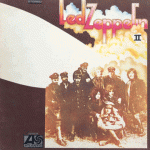
So, if we can’t hear distortion until it’s been removed, reason leads us to conclude that we can never declare a stereo free of distortion, even one that sure sounds like it is. And indeed, Robert could readily demonstrate for me that his system still has some distortion. While I sat there marveling at the sound of John Bonham’s drumming on his pristine Ludwig pressing of Led Zeppelin II, Robert hopped up to shut off the breaker to the fridge.
We have been writing about this subject ourselves for a very long time. Here are a couple of links.
And here is a good overview of our approach: How To Get The Most Out Of Your Records – A Step By Step Guide
As for getting one’s stereo act together, we are all for it. The better the stereo, the more obvious the superiority of a top quality pressing will be. ab_ba notes in his posting:
Listening to good records on a good system is a delight, but hearing a great system is an absolute revelation. If you want to find really great copies of your favorite records, they’re out there, but you need a stereo that will enable you to identify them.
We wrote a commentary addressing that subject, entitled: First Get Good Sound – Then You Can Recognize and Acquire Good Records
One of the (many) reasons Robert Brook’s stereo has such low distortion is that he uses the same Townshend Seismic Platforms that we do. If you are interested in getting distortion out of your system, we can supply you with one to try. We have never had one returned. They are by far the cheapest, fastest, easiest way to improve the sound of any stereo. (Of course unplugging your fridge is even cheaper, but it may not be as easy.)
Robert uses the same Hallographs that we employ to help improve the acoustics of his room. We have three pair. Three of the units can be seen in the photograph above.
Tweaking and tuning are the foundation of good sound. The 80/20 rule is very real, and, if I may offer up my own experience to serve as a guide, the numbers are probably closer to 90/10.