More Living Stereo Recordings
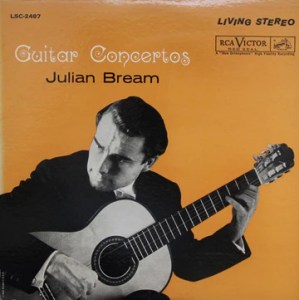
- Amazing sound throughout this original Shaded Dog pressing, with both sides earning INSANELY GOOD Shootout Winning Triple Plus (A+++) grades
- It’s also fairly quiet at Mint Minus Minus, a grade that even our most well-cared-for vintage classical titles have trouble playing at
- These sides are wonderfully full-bodied, rich and present, using state-of-the-art All Tube Living Stereo recording technology that was so advanced in 1961 it thought it could transport a living, breathing Julian Bream directly from his studio into your listening room
- It turns out that with today’s playback systems and cleaning technologies, the dream of being in the “living presence” of the performers has become a reality
- Bream’s guitar sounds sweetly natural, not overly detailed and the orchestra is exceptionally well recorded, as we would expect from a good RCA of this period
This vintage Shaded Dog pressing has the kind of Tubey Magical Midrange that modern records can barely BEGIN to reproduce. Folks, that sound is gone and it sure isn’t showing signs of coming back. If you love hearing INTO a recording, actually being able to “see” the performers, and feeling as if you are sitting in the studio with the band, this is the record for you. It’s what vintage all analog recordings are known for — this sound.
If you exclusively play modern repressings of vintage recordings, I can say without fear of contradiction that you have never heard this kind of sound on vinyl. Old records have it — not often, and certainly not always — but maybe one out of a hundred new records do, and those are some pretty long odds.
What The Best Sides Of Guitar Concertos Have To Offer Is Not Hard To Hear
- The biggest, most immediate staging in the largest acoustic space
- The most Tubey Magic, without which you have almost nothing. CDs give you clean and clear. Only the best vintage vinyl pressings offer the kind of Tubey Magic that was on the tapes in 1961
- Tight, note-like, rich, full-bodied bass, with the correct amount of weight down low
- Natural tonality in the midrange — with all the instruments having the correct timbre
- Transparency and resolution, critical to hearing into the three-dimensional studio space
No doubt there’s more but we hope that should do for now. Playing the record is the only way to hear all of the qualities we discuss above, and playing the best pressings against a pile of other copies under rigorously controlled conditions is the only way to find a pressing that sounds as good as this one does.
Copies with rich lower mids and nice extension up top did the best in our shootout, assuming they weren’t veiled or smeary of course. So many things can go wrong on a record. We know, we’ve heard them all.
Top end extension is critical to the sound of the best copies. Lots of old records (and new ones) have no real top end; consequently, the studio or stage will be missing much of its natural air and space, and instruments will lack their full complement of harmonic information.
Tube smear is common to most vintage pressings. The copies that tend to do the best in a shootout will have the least (or none), yet are full-bodied, tubey and rich.
What We’re Listening For On Guitar Concertos
- Energy for starters. What could be more important than the life of the music?
- The Big Sound comes next — wall to wall, lots of depth, huge space, three-dimensionality, all that sort of thing.
- Then transient information — fast, clear, sharp attacks, not the smear and thickness so common to these LPs.
- Next: transparency — the quality that allows you to hear deep into the soundfield, showing you the space and air around all the instruments.
- Extend the top and bottom and voila, you have The Real Thing — an honest to goodness Hot Stamper.
The Ensemble
- Julian Bream – guitar
- Emanuel Hurwitz and Ivor McMahon – violins
- Cecil Aronowitz – viola
- Terence Weil – cello
- Adrian Beers – bass
- Richard Adeney – flute
- Gervaise de Peyer – clarinet
- Neil Saunders – horn
Side One
Concerto For Guitar And Strings (Giuliani)
First Movement: Allegro Maestoso
Second Movement: Andantino Siciliano
Third Movement: Alla Polacca
Side Two
Guitar Concerto (Arnold)
First Movement: Allegro
Second Movement: Lento
Third Movement: Con Brio
The Absolute Sound Super Disc List
When I was just getting serious about audio back in the 70s, The TAS List comprised a great many excellent recordings that were not as widely known as they are now.
To be honest, practically all of it was over my head, including what HP was saying in his commentary concerning the strengths of the (mostly classical) recordings — lots of talk of depth, soundstaging, the sound of one concert hall compared to another, etc. Back when I was playing the music of Supertramp and Loggins and Messina — or Discovered Again for that matter — his disquisitions concerning the shape and size of specific concert halls registered as little more than gibberish.
Off the Rails in the 90s
Once Classic Records pressings of the great Living Stereo recordings started showing up on the list we knew the whatever standards existed in the 70s and 80s no longer applied. (Let us not forget that there were always plenty of questionable titles on the list in the old days. Played any Fresh Aire records lately? Me neither.)
Now the list is populated by one Heavy Vinyl pressing after another, a sad state of affairs if you ask me.
There are probably more records on the current list that do not qualify as Super Discs than those that do, but I can’t say I am inclined to calculate the ratio.
And many of these albums contain music that is far too esoteric to be of interest to most music lovers. Harry always said the list was about sound, not music. We happily concede that many of the titles on the list have the potential for excellent sound. We just couldn’t care less, and our customers feel the same way. For that reason we simply have no intention of doing shootouts for those titles.
As long as such music holds little appeal for our customers, it’s better that we put our efforts into discovering amazing sounding pressings of music that will stand the test of time. How else would it be possible to justify the cost?
Our customers are willing to pay top dollar for the best recordings made from the 50s to the 90s. Based on the enthusiastic letters we regularly receive for our White Hot Stamper pressings, the exceptional quality of the sound more than compensates for the unusually high prices we charge.
As purveyors of albums commanding hundreds of dollars, we do not have the luxury of considering only the sound quality of the records we offer. Nevertheless there is one uniquely valuable service we can offer those who are fans of the records on the TAS List.
We offer such fans a fairly good selection of Hot Stamper pressings of TAS List titles that actually have proven audiophile sound quality, all 100% guaranteed or your money back.