Dubious Sound I Once Liked

This list contains a sampling of the bad sounding records I used to like. (Not all are bad sounding. Some are just not nearly as good sounding as I thought.)

Through trial and error I learned that they were clearly inferior to other pressings, although at the time I couldn’t have known they were inferior because I hadn’t yet discovered anything better.

Looking back, it’s embarrassing that I used to like these records, but it would be foolish to deny it.

Making mistakes and learning from them is an important aspect of this hobby. Every audiophile on the journey to better sound should have a sizable group of records they left behind a long time ago.

As our stereos and critical listening skills improve, it becomes clear that plenty of records just aren’t as good as we thought they were. These are some of mine.

The “Not-So-Golden-Age” of RCA, Mercury, London and Others

Hot Stamper Pressings of Living Stereo Titles Available Now

We ran into a number of copies of this title that had what we like to call “old record sound,” which is surprisingly common on even the most revered Golden Age labels, RCA included.

No top, no real bottom, congested climaxes and a general shrillness to the sound — we’ve played Living Stereos by the dozens that have these shortcomings and many more.

Some audiophiles may be impressed by the average Shaded Dog pressing, but I can assure you that we here at Better Records are decidedly not of that persuasion.

Something in the range of five to ten per cent of the major label Golden Age recordings we play will eventually make it to the site. The vast majority just don’t sound all that good to us. (Many have second- and third-rate performances and those get tossed without ever making it to a shootout.)

The One Out of Ten Rule

If you have too many classical records taking up too much space and need to winnow them down to a more manageable size, pick a composer and play half a dozen of his works.

Most classical records display an irredeemable mediocrity right from the start. It does not take a pair of golden ears to hear it.

If you’re after the best sound, it’s the rare record that will have it, which makes clearing shelf space a lot easier than you might imagine. If you keep more than one out of ten, you’re probably setting the bar too low, if our experience is any guide.

(more…)

With The Beatles on Mobile Fidelity

Sonic Grade: C+

The MoFi pressing of With the Beatles has so many problems it would take an hour to describe them all. Suffice it to say, it’s thinner and brighter, with voices that are grittier and grainier. The overall effect is the sinking feeling that you are listening to a cheap reissue and not the real thing. Don’t the Beatles sound better than this? To be fair, some tracks are okay, others a disaster.

If you own the MoFi, play it. Listen to it carefully. Make notes of which songs sound better than others and why. That’s how we spend our days, evaluating the relative merits of various pressings, and it’s that and that alone that has given us the critical listening skills necessary to recognize and appreciate the differences among the records we play.

One of the biggest problems with the average Parlophone copy is just the reverse of the MOFI. They tend to have rolled off highs, which emphasizes the harshness in the upper midrange and causes a loss of transparency. (The best Hot Stamper copies are of course as smooth, sweet, and transparent as they come.) Even with those shortcomings though, I would still rather listen to a typical Parlophone pressing. I wouldn’t be frustrated by the sound of somebody fooling with the EQ and screwing it up.  (more…)

I Was Wrong about a Half-Speed Mastered Record – Not for the First Time, But I Hope for the Last

dixiedregsdd

Hot Stamper Pressings of Jazz Rock Fusion Albums Available Now

A classic case of live and learn.

I’d always preferred the famously rare Half-Speed to the domestic copies I had auditioned back in the day, the day being the 80s and 90s. That’s all changed now of course.

Now, with changes to the stereo and better cleaning techniques and all the rest, that Half-Speed’s weaknesses are hard to ignore.

Where is the rock ’em, sock ’em bottom end that the best originals have?

Gone without a trace.

Yes, the smeary, veiled quality of the typical original pressing is gone too, which is why I used to like the DD Labs version better. It’s simply another case of a reasonably good Half-Speed beating a bad domestic pressing, and in turn being beaten (soundly) by The Real Thing, the kind of record we like to call a Hot Stamper.

(more…)

Something Not Very Cool from Cisco Music

Hot Stamper Pressings of Pop and Jazz Vocals Available Now

We went back and played the Cisco version about 6 or 7 10 or 15 years ago and were quite a bit less impressed with the sound than we had been when it first came out. We wrote the review you see below sometime around 2015 or so.


This is a decent Cisco LP, which is now long out of print. Audiophiles who love female vocal albums and pass on this one are missing the boat, because finding a better sounding original in clean enough condition to play is practically impossible these days.

Of course, if you already have a clean original you sure don’t need to waste your money on this LP.    


To recap briefly:

In 2015 or thereabouts we liked the record a lot less than we did when it came out in 2002.

Our take in 2025: I doubt we could sit through it with a gun to our head.

As we mention throughout this blog, Cisco’s titles had to fight their way through Kevin Gray’s opaque, airless, low-resolution cutting system, a subject we discuss in some depth here. (It was even more opaque back then than it is today.)

Other bad sounding records that Kevin Gray mastered can be found here.

(more…)

Please Please Me on MoFi – Another Disgracefully Spitty Half-Speed

Hot Stamper Pressings of the Music of The Beatles Available Now

Sonic Grade: C

If you own the Mobile Fidelity LP, do yourself a favor and buy one of our Hot Stamper pressings. (Actually any good British import pressing will do.)

What’s the first thing you will notice other than correct tonality, better bass and a lot more “life” overall?

No spit!

As we’ve commented elsewhere, because of the wacky cutting system they used, Mobile Fidelity pressings are full of sibilance. 

As I was playing a British pressing of this record many years ago, maybe by about the fifth or sixth song it occurred to me that I hadn’t been hearing the spit that I was used to from my MoFi LP. You don’t notice it when it’s not there.

But your MoFi sure has a bad case of spitty vocals. If you never noticed them before, you will now.

We discuss the sibilance problems of MoFi records all the time. Have you ever read Word One about this problem elsewhere? Of course not.

Audiophiles and audiophile reviewers just seem to put up with these problems, or ignore them, or — even worse — fail to recognize them at all.

Play around with your table setup for a few hours and you will no doubt be able to reduce the severity of the sibilance on your favorite test and demo discs. All your other records will thank you for it too.

Especially your Beatles records. Many Beatles pressings are spitty, and the MoFi Beatles pressings are REALLY spitty. Of course MoFi fans never seem to notice this fact. Critical listening skills and a collection of MoFi pressings are rarely if ever found together. For reasons that should be obvious to anyone spending time on this site, you either have one or the other.

(more…)

Led Zeppelin on Prestigious Japanese Limited Edition Vinyl

Hot Stamper Pressings of the Music of Led Zeppelin Available Now

A classic case of live and learn. In 2006 I finally woke up to how ridiculously bad these Japanese pressings I was selling back in the 90s actually were.

It’s what real progress in audio is all about, in this case about ten years’ worth. Those are ten years that really shook my world, and by 2007 we had discovered much better cleaning technologies and given up on Heavy Vinyl and audiophile bullshit pressings such as these, whew!

Our story from 2006:

I used to sell the German Import reissues of the Zep catalog in the 90s. At the time I thought they we’re pretty good, but then the Japanese AMJY Series came out and I thought they were clearly better.

I couldn’t have been more wrong. I now realize those Japanese pressings are bright as bright can be. Now, not-too-surprisingly, the German pressings sound more or less right (on some of their titles).

They tend to be tonally correct, which is more than you can say for most Zep pressings, especially some of the Classics [linked here], which have the same brightness issue (as well as many other problems).


UPDATE 2024

Only one of the German-pressed Zeppelin records is good enough to win shootouts, the only title of theirs on German vinyl that we buy these days. Of course we tried them all, at no small expense I might add, because there were a great many pressings cut by many different engineers over the course of decades that were pressed in Germany, and the only way we could judge them was to buy them and have them shipped over. In the end only one had the big, bold, dynamic sound we were after.

(more…)

We Review the MoFi Pressing of Let It Be

Hot Stamper Pressings of the Music of The Beatles Available Now

This review was probably written about fifteen years ago, so we can’t say we would agree with the grade we awarded the album at the time.

Sonic Grade: B or B-

Although I haven’t played my copy in quite a while — it might have been as far back as 2007 or 2008 that I last listened to it if memory serves — I recall that it struck me as one of their better titles.

All things considered, it’s actually pretty good, assuming your copy sounds like mine (an assumption we really can’t make of course — no two records sound the same — but for the purposes of this review we’re going to assume it anyway). I would give it a “B” or “B-“.

It can’t hold a candle to the real thing, but at least MoFi didn’t ruin it like they did with so many of the other Beatles albums, especially this ridiculously phony, bright and compressed one.

(more…)

Capriccio Italien on Classic Records and How Badly I Missed the Boat

More of the Music of Peter Ilyich Tchaikovsky

More of the Music of Nikolai Rimsky-Korsakov

Years ago, around 2005 if memory serves, I played a copy of the Classic Records pressing of LSC 2323 and thought it was pretty good.

I thought it was better than the Shaded Dog copies I had compared it to, which, based on hundreds of other Classic Records titles I had auditioned, was unexpected to say the least.

Little did I know that the Shaded Dog pressings on this title are not remotely competitive with the early reissues.

The best of the Shaded Dog pressings we could find, which just happened to have a 1s side one, came in tied for last with the one 70s Red Seal pressing we thought sounded good enough to make the shootout.

(Some inside baseball: most of the Shaded Dogs and Red Seals were needle-dropped, and all but two were eliminated before the shootout. It takes time and wastes money to clean and play pressings that sound hopeless, so a quick elimination round often precedes the cleaning process.)

Back then it was tough to wrap my head around the idea that a Classic Record classical title could actually be better sounding than a Shaded Dog — it had never happened, so I knew there had to be more to the story.

Finding the time to do the serious investigation of LSC 2323 that would be necessary to get to the bottom of it was not in the cards, so I shelved the project for close to the next twenty years.

The title would have to wait until 2024 to go through a proper shooout, and when it did, naturally the Classic was part of the mix, which is the way we do things here at Better Records. Every record gets the chance to show us what it can do, to be evaluated fairly without the listener having any way to know which pressing is playing.

It turns out that side one of the Classic was passable, but side two — the side I had probably never played — was every bit as bad as most of their other classical offerings.

Side One, Second Movement (Tchaikovsky)

  • Big, but bright and compressed
  • Gets loud but opaque and hot
  • Good weight

Side One, First Movement

  • Bright and blurry bells
  • Sort of tubey but a mess
  • Grade: 1+ (passable, but no Hot Stamper)

Side Two (Rimsky-Korsakov)

  • Big but boomy and smeary
  • Brass is edgy and opaque
  • No top end or space
  • Peaks are hot and congested
  • Grade: NFG

To recap: In 2005 I was impressed with Classic’s pressing of LSC 2323. That was only twenty years ago, yet I could not have been more wrong. I thought my stereo was great — I’d owned top quality equipment since 1975 by then — thirty sodding years — so my audiophile credentials would surely dwarf those of the vast majority of forum posters who write about audiophile pressings today. How reliable should we expect their reviews to be?

(more…)

Mozart / Symphony No. 35 – A Cisco Recommended LP, or Is It?

Hot Stamper Pressings of the Music of Mozart Available Now

I wrote this review in 2001, the equivalent of the stone age in my audio world — most everything of value that I’ve learned in audio over the last fifty years I learned in this century — and would now disagree with a great deal of what I said about the sound of the record.

The music and performances are fine, but the sound has all the hallmarks of bad cutting equipment and dead-as-a-doornail RTI vinyl.

This is the review I wrote in 2001:

Hearing this performance from Thomas Nee and his orchestra is like hearing the work for the first time. It may be difficult to reproduce the magic in these grooves but wonderfully rewarding when you do. You won’t be bored! The sound is intimate and immediate; this is the record for those of you who appreciate more of a front row center seat. Count me in; that’s where I like to sit myself.  

I worked hard on my system for about 4 hours one night, using nothing but this record as my test, because of its wealth of subtle ambience cues, excellent string tone, and massed string dynamics. There is a lot to listen for, and a lot to get right, for this album to sound right.

The performance of the Mozart’s 35th Symphony is definitive. Without a doubt this is the best Mozart record currently available, one that belongs in any serious record collection. I give it a top recommendation for its sublime musical qualities that set it apart from other current releases. In short, a Must Own.


UPDATE 2020

Twenty years and a great deal of audio progress later I have changed my tune. Now I would say:

Cisco’s titles had to fight their way through Kevin Gray’s opaque, airless, low-resolution cutting system, a subject we discussed on the blog in some depth here. Other bad sounding records that he mastered can be found here.

An excerpt:

As is the case with practically every record pressed on Heavy Vinyl over the last twenty years, there is a suffocating loss of ambience throughout, a pronounced sterility to the sound. Modern remastered records just do not breathe like the real thing.

Good EQ or bad EQ, they all suffer to one degree or another from a bad case of audio enervation.

Where is the life of the music?

You can try turning up the volume on these remastered LPs all you want; they simply refuse to come to life.

A textbook case of live and learn.


Cisco Music had this to day about their record:

One of Mozart’s most popular symphonies is given a visceral and driving performance. Instead of slowing down the tempo in service to lyricism, conductor Thomas Nee chose to adhere to Mozart’s written instructions: ‘The first movement must be played with fire; the last, as fast as possible.’ Even if you own several recordings of this bright and joyous work, you’ve never heard it played like this, and certainly never with this kind of audiophile sound! 

This is exactly the kind of “audiophile sound” I fell for 20 25 years ago, long before I had a clue as to just how good the best orchestral recordings could sound.

(more…)

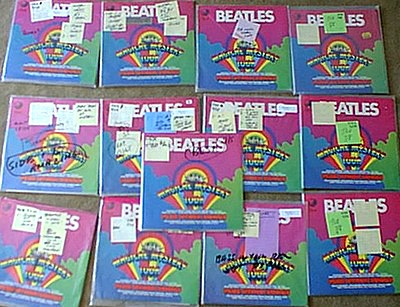
We Was Wrong About The Beatles Magical Mystery Tour (Circa 1985-90)

Hot Stamper Pressings of the Music of The Beatles Available Now

This is a very old and somewhat embarrassing commentary about how ridiculously wrong we were about which are the best sounding German pressings of the Magical Mystery Tour.

Today we would never consider selling a record that sounds as phony as this version of the album does, but we did back in the 90s and probably as late as the 2000s.

Bad sounding records I once liked are common enough on the blog to have their own category, with 76 entries to date. If we had the time to make listings for them, there would surely be hundreds of others. If you’ve been in the audio game for as long as we have, you should have plenty of records that fit that bill. All those old records sitting on the shelves that you haven’t played in years might not sound they way you remember them, but the only way to know that is to pull them out and play them. If you’ve been making regular audio progress, most of them should sound better than ever, but there have to be plenty that won’t. You just don’t know which are which as long as they sit on the shelf.


This German pressing has sound that is dramatically different from that found on other Hot Stamper pressings of MMT we’ve had on the site. I used to be convinced that its sound was clearly superior to the regular German MMT LPs.

Back in the late 80s and into the 90s this was the pressing that I was certain blew them all out of the water.

We know better now. We call this version the “Too Hot” Stamper pressing — the upper mids and top end are much too boosted to be enjoyable on top quality equipment.

It does have some positive qualities though. It has substantially deeper bass than any other version; in fact, it has some of the deepest bass you will ever hear on a pop recording. It can literally rattle the room when Paul goes down deep on Baby You’re A Rich Man.

It also uses a slightly different mix on some tracks and is mastered differently in terms of levels. The level change is most obvious at the beginning of Strawberry Fields, where it starts out very quietly and gets louder after a short while, unlike all other versions which start out pretty much at the same level.

The effect is pleasing, you might even say powerful, but probably not what The Beatles intended, as no other copy I’ve ever heard makes use of the same quiet opening. An unknown mastering engineer made the choice, he created a new sound for the song, probably because he didn’t like all the tape hiss at the opening, during which few instruments were playing loud enough to mask it.

With this mix the record is now more of a Hi-Fi spectacular — great for waking up sleepy stereo systems but not the last word in natural sound.

Records that are boosted on the top and bottom suffer from what we like to call the smile curve. This pressing, as well as lots of records remastered to appeal to audiophiles, have a bad case of it.

(more…)