*Collecting Better Records

Ideas and methods for collecting the best sounding pressings of your favorite music.

Our Advice on the Sgt. Peppers Pressings to Avoid

beatlessgtHot Stamper Pressings of Sgt. Peppers Available Now

Chris, an erstwhile customer from a very long time ago, sent us a letter describing his search for a good sounding Sgt. Pepper.

The first thing that comes to mind when reading his letter is that many record collecting rules were broken in going about his search the way he did. But then I thought, What rules? Whose rules? Where exactly does one find these rules? If one wants to avoid breaking them they need to be written down someplace, don’t they?

Wikipedia maybe?

Sadly, no, not at Wikipedia, or any place else for that matter — until now. As crazy as it sounds, we are going to try to lay down a few record collecting rules for record loving audiophiles, specifically to aid these individuals in their search for better sounding vinyl pressings. And by “these individuals” we mean you.

See if you can spot the rules that were broken by Chris in his fruitless search for a good sounding Sgt. Pepper. Note that this letter came to us long before the new Beatles CDs and vinyl had been remastered.

Hi Tom

A few months ago, I purchased a new UK import of Sgt Pepper. Too bad it turned out to be digitally remastered. I had been checking your site for this album over the last few months, but only saw two: a sealed MFSL UHQR for $1000, and a hot stamper for $500, both out of my price range. So then I started looking at Ebay, and recently purchased two “sealed” versions of Sgt Pepper – a USA Apple, which cost me $170, and a USA Capitol (original rainbow label) for which I paid $80.

Tonight, I wanted to copy one of the Sgt Pepper’s to Hi-rez (192/24) DVD audio. Both sealed records from Ebay were cleaned with Last RCM record cleaner on a VPI 16.5, and treated with LAST record preservative. (My usual routine)

First I tried the Capitol (rainbow). It even had “mastered by Capitol” stamped on the run-out area, usually a good sign, I thought. The sound was quite good, except for two things:

1) the sound level drops about 3 db in the first track where they sing “We’d love to take you home with us , we’d love to take you home” (3 db drop occurs) followed by “I don’t really want to…” 2) the record has thousands of audible ticks. No kidding, when I recorded it, and looked at the waveform in Adobe Audition, there are really about 20 little ticks per second. If I try to clean it up manually, one click at a time, (my usual routine), it will take an eternity to finish the job. (slight exaggeration) [sic] So I tried the $170 sealed “Apple” purchased from someone named “sealedbeatles”.

This record is a total disaster. It has no high end. It’s like someone turned the treble all the way down (if my system had a treble control). I looked at the spectrum of a few seconds of music, and the level at 8 khz is the same as the level at 60 khz, down about 90 db. (duller than poor AM radio). The record is loaded with surface noise too. The record is totally useless.

Finally I tried the UK digitally remastered Parlophone, purchased probably from Music Direct, or some place like that. It sounds harsher than hell, and oddly has a tone actually recorded on the record at about 70 Khz, which you can “see” poking up from the noise floor in its spectrum.

I’m still looking.

Chris

My first thoughts upon receiving this letter:

There is almost no chance Chris would be successful with the approach he took.

The following would have been my five pieces of advice had he told me in advance what he was planning to do.

(more…)

The Said and the Unsaid – The Firebird on Mercury

Hot Stamper Pressings of the Music of Igor Stravinsky Available Now

For our shootout years ago of The Firebird we had three minty, potentially hot copies of the Mercury with Dorati, as well as our noisy ref. (We have a noisy reference copy for just about every major title now. We have been doing these shootouts for a very long time. After thirty years in the record business we have accumulated a World Class collection of great sounding records that are just too noisy to sell.)


UPDATE 2024 

This is no longer true. Our customers seem to be able to put up with surface noise on the records we offer if the price is low enough. Not actually low, just low enough. We have a section for records with condition issues, and there are 175 entries in it as of today, which turns out to be more than a quarter of all the Hot Stamper pressings on the site as a matter of fact.


We had one FR pressing and two of the later pressings with the lighter label, the ones that most often come with Philips M2 stampers. This is how we described the winner:

So clear and ALIVE. Transparent, with huge hall space extending wall to wall and floor to ceiling. Zero compression.

Lifelike, immediate, front row center sound like few records you have ever heard.

Rich, sweet strings, especially for a Mercury. This side really gets quiet in places, a sure sign that all the dynamics of the master tape were protected in the mastering of this copy.

What we didn’t say — and what we never say in the listings — is what the second tier copies didn’t do as well as the shootout winner.

We used to. When you read the older entries, most of the time they mention the shortcomings that caused one side or another to be downgraded by some amount, usually something like a half to a full plus.

Not all the top end, not all the bass, not as present, slightly smeary, slightly congested — the list of potential faults for any given pressing is long indeed. These are all the problems we listen for and it’s the rare copy that doesn’t suffer from one or more of them.

We decided years ago that it was better just to let you hear the two sides of the record for yourself and make your own judgments about the sound, rather than make clear to you what areas we felt needed improvement.

Consider this example. If on our system the bass was lacking compared to the very best, perhaps on your system the bass was fine, not an issue, good enough. Without the top copy to compare yours to, how would you know how much better the bass could possibly be?

A classic case of “compared to what?

Shootouts are the only way to answer that question, which, as we never tire of saying, is THE most important question in all of audio. This is why we do shootouts, and why you must do them too, if owning the highest quality pressings is important to you.

Click on the following link to see more records for which we’ve detailed the strengths and weaknesses of a specific copy.

What We Heard on The Firebird

With all that in mind, only the Triple Plus (A+++) copy, as described above, did everything right.

There were two Double Plus (A++) copies, and each of them fell short in different ways.

(more…)

The Asylum Sound We Love – Great in the Seventies, Gone by the Eighties

Hot Stamper Pressings on the Asylum Label Available Now

Superb engineering by Greg Ladanyi (Toto 4, The Pretender, El Rayo-X, demo discs one and all).

If you know the “Asylum Sound” — think of the Tubey Magical analog of The Eagles’ first album and you won’t be far off — you can be sure the best copies of All This and Heaven Too have plenty of it.

Rarely do we run into recordings from the mid- to late-70s with richer, fuller sound. The bass on the best copies is always huge and note-like.

In the 80s, the engineer for this very record, Greg Ladanyi, would produce solo albums for the likes of Don Henley with no bass.

How this came to be I cannot begin to understand, but record after record that we play from that decade is bright and thin like a transistor radio. This is the main reason why you see so few of them on the site.

But Andrew Gold’s albums from the later 70s are amazingly rich and tubey. That sound apparently never went out of style with him, and it definitely never went out of style with us.

In fact, albums with those sonic qualities make up the bulk of our offerings, from The Beatles to The Eagles, Pink Floyd to Elton John, Simon and Garfunkel to Graham Nash.

In our world, the more “modern” something sounds, the lower its grade is likely to be, other things being equal.

(more…)

Making Mistakes and Other Advice from Better Records

New to the Blog? Start Here

Record shootouts are the fastest and easiest way to hone your listening skills. We believe that the only way to really learn about records is to gather a big pile of them together, clean them up and listen to them one by one, as critically as you can.

Wise men and women throughout the ages have commented on the value of making mistakes. Here is one of our favorite quotes on the subject.

“Making a different mistake every day is not only acceptable, it is the definition of progress.” Robert Brault

If you have twenty copies of Bridge of Sighs, and most of them are British, you are definitely going to find a Hot Stamper pressing or two, assuming you clean them right and listen to them critically.

Keep in mind that having British pressings in your shootout is absolutely crucial to your success, because those are the only ones that ever win our shootouts, for obvious reasons: they’re made from the master tapes.

The domestic pressings are made from dubs, and yes, I suppose you could shootout twenty of those, but you would only be trying to find the best second-rate pressing of the album out of your twenty, since practically any British pressing will beat even the best domestic pressing.

(more…)

After Years of Searching, We Finally Found an Old Beatles Record with Top Quality Sound

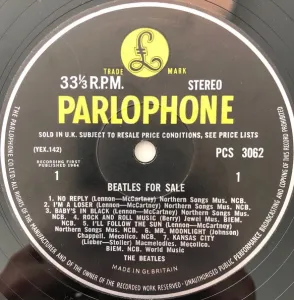
Hot Stamper Pressings of The Beatles for Sale Album

UPDATE 2026

Sometime before 2022 we played a copy of Beatles For Sale on the original label that earned Super Hot Stamper (2+) grades on both sides. This was surprising because we rarely like Beatles albums on the early label with the exception of two titles, Yellow Sub and A Collection of Oldies…


UPDATE: 2022

We just played another original pressing of For Sale and this copy had a Triple Plus (A+++) side one, mated to a Double Plus (A++) side two. For Sale is still the only studio album with top quality sound on the original pressing that we have ever played, but now we can say with some authority that if you have a bunch of originals, you might just have one with killer sound like the one we had. There was a later pressing that also earned our top grade, a subject we touch on in this commentary for Kind of Blue.


UPDATE to the UPDATE: 2023

We’ve just played another original pressing of For Sale in a shootout and amazingly it earned Triple Plus (A+++) grades for its sound on both sides. Most original Beatles pressings on the early label do not even qualify to make it into our shootouts. Their mastering is so crude, congested and distorted that the sound simply cannot be taken seriously on a modern hi-fi rig. On a jukebox, maybe. Mine’s in the shop.

Note that this label information, like most label information, is not as helpful as it might seem. The Yellow and Black Parlophone label was used in the UK all the way up until 1969, during which time a lot of copies of For Sale, first released in 1964, were sold. In other words, if you want to find a great sounding pressing of For Sale on the early label, you have your work cut out for you.


This finding about For Sale is precisely why live and learn is our motto.

We don’t know it all, and we’ve never claimed that we did. We constantly learn things about pressings in our daily shootouts. That should not be too surprising, as record shootouts are the only way to learn anything about the sound of records that’s actually worth knowing.

Start doing your own experiments and your record knowledge might just take off the way ours has. 99% of what we think we know about the sound of records we’ve learned in shootouts over the course of the last twenty years.

We are happy to share our advice with you on getting started.

Before this, the only Beatles record we would sell on the Yellow and Black Parlophone label was A Collection of Oldies… But Goldies. That title does have the best sound on the early label. In numerous shootouts, no Black and Silver label pressing from the ’70s was competitive with the best stereo copies made in the ’60s.

Until now, it was clearly the exception to our rule. From With the Beatles up through Yellow Submarine, the best sounding Beatles pressings would always be found on the best reissue pressings.

Here are the notes for the best sounding For Sale on the early label we played in our 2022 shootout.

For those who have trouble reading our writing, the notes say:

Side One

  • Track one is clear enough, a bit recessed.
  • Track two is clear, open and lively, with good space, but not as weighty as the best.

Side Two

  • Track one is relaxed, solid and musical, with good size.
  • Track two is full, solid and musical, with good bass.

We Was Wrong

A very good sounding record, with few of the problems we heard on the other early label Beatles pressings we’ve played in the past. Most of them had the kind of old record sound — compressed, congested, harmonically distorted, bandwidth limited, etc. — that kept them from making the cut.

But that’s the reason to play records, not judge them by their labels, right? How else would you possibly learn anything about their sound? And you have to play them head to head against other copies, a normally crude process we’ve refined over the last twenty years into a science we like to call the Hot Stamper shootout.

(more…)

For the Best Kinks Sound, Stick with the Tri-Tone Mono Pressings

Hot Stamper Pressings of the Music of The Kinks Available Now

This Pink and Green Reprise original MONO pressing is lively, balanced and vibrant, with a healthy dose of the Tubey Magical richness The Kinks’ recordings need in order to sound the way we want them to, which is less irritatingly bright, thin and harsh.

“Tired of Waiting For You” is the big hit here, and like most Kinks albums from back in the day, they put the hit at the end of the side, so you had better make sure whatever copy you find has not been played much or it will be full of inner groove distortion.

Inner Groove Distortion caused by the non-anti-skate-equipped turntables of the day is a chronic problem with rock and pop records from this era. We check all our records for Inner Groove Damage (IGD) as a matter of course when condition checking the surface quality of the vinyl.

The Poster Boy for Inner Groove Distortion is the song “Thank You” on this album from 1969. That record got played a lot back in the day, on the only turntables that we had available to us at the time, crappy ones.

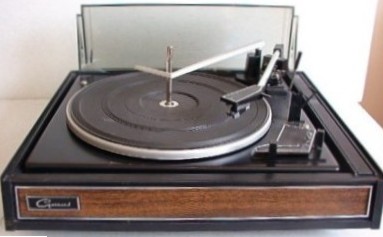
My first “audiophile” table was the extremely plasticky Garrard 40B. I think I bought mine in 1973  and I probably paid about $69 for it. As I recall, this was their entry level model. If any table had been cheaper I would have bought it, which shows you what my starving-college-student budget must have been. Sounded just fine to me, though. What did I know about sound in 1973?

By 1976 I would have some of the best audiophile electronics in the world and the massive speakers you see below. That’s some head-spinning progress if you ask me. Once I had heard how good all my favorite albums were sounding, I got very motivated. This is key: For real progress to occur, the music must do the driving.

(more…)

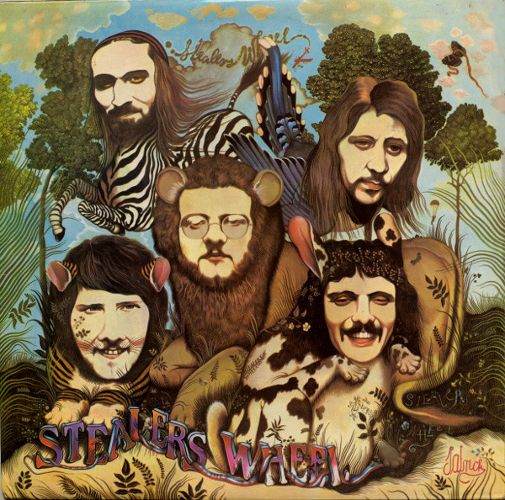
British A&M Vinyl Versus Domestic A&M Vinyl on Stealers Wheel’s Debut

Hot Stamper Pressings of the Music of Gerry Rafferty Available Now

Like so many British bands on the A&M label, when it came time to master the album for the domestic market, the people in charge (whoever they may have been) took the easy way out and simply ordered up a dub of the master tape to cut the album.

Spooky Tooth, Procol Harum, The Police (often but not always), Fairport Convention, my beloved Squeeze and too many others to think about all had their records ruined by sub-generation masters.

But our Hot Stamper pressings will always be British-pressed vinyl from the real master tapes, and that makes all the difference in the world.

Engineering

The legendary Geoff Emerick engineered (along with John Mills) at Apple Studio, which explains why the sound is so good on these import pressings. The album went on to receive the European Edison Award for recording excellence, whatever that is).

Our standard boilerplate for these kinds of records follows:

Tubey Magic Is Key

This original British pressing has the kind of Tubey Magical Midrange that modern records cannot even BEGIN to reproduce. Folks, that sound is gone and it sure isn’t showing signs of coming back. If you love hearing INTO a recording, actually being able to “see” the performers, and feeling as if you are sitting in the studio with the band, this is the record for you. It’s what vintage all analog recordings are known for — this sound.

If you exclusively play modern repressings of vintage recordings, I can say without fear of contradiction that you have never heard this kind of sound on vinyl. Old records have it — not often, and certainly not always — but maybe one out of a hundred new records do, and those are some pretty long odds.

(more…)

If You Own This Classic Records Pressing, I’ll Bet It’s Pristine

Hot Stamper Pressings of Classical Masterpieces Available Now

If I were in charge of the TAS Super Disc list, I would not have put this record on it.

Here are some others that we do not think qualify as Super Discs.

When Classic Records was blowing out its unsold inventory through the Tower Records Classical Annex in Hollywood many years ago — apparently they had run into some financial trouble — this was a title you could pick up for under ten bucks. I remember it being $7, but my memory may not be correct on that point. Whatever the price, it was cheap.

And even at that price it seemed nobody really wanted it.  Which is as it should be. Heavy Vinyl or no Heavy Vinyl, a bad record is a bad record and not worth the bother of sitting down and listening to it.

If you own this record, my guess is it is pristine.

If you played it at all, you played it once and put it away on a shelf where it probably sits to this very day. Good records get played and bad records don’t. If you have lots of pristine records on your shelves, ask yourself this question: Why don’t I want to play them?

You may not like the implications of the answer: They aren’t very good.

And that means you should never have bought them in the first place. But we all make mistakes.

Owning up to them may be hard, but it is the only way to make any real progress in this hobby.

The One Out of Ten Rule

If you have too many classical records taking up space and need to winnow them down to a more manageable size, pick a composer and play half a dozen of his works. You may be surprised at how lackluster the sound is on the majority of them.

Most classical records display an irredeemable mediocrity right from the start.

(more…)

What Are Some Good General Rules for Acquiring Records with the Highest Quality Sound?

More Entries from Tom’s Audiophile Notebook

The Riverside pressings we’ve auditioned of both The Thelonious Monk Orchestra – At Town Hall and Thelonious Monk Quartet Plus Two – At The Blackhawk were just awful sounding.

The OJC reissues of both albums from the 80s, although better, were not overflowing with the rich, natural, relaxed analog sound we were looking for either.

Ah, but a few years back (2015, maybe?) we happened to drop the needle on one of these Monk Milestone Two-Fers. Here was the sound we were looking for and had had so little luck finding until then.

Which prompts the question that should be on the mind of every audiophile:

What are the rules for collecting records with the best sound quality?

The answer, of course, is that there are no such rules and there never will be.

There is only trial and error. Our full-time staff has been running trials — we call them shootouts and needle drops — for more than twenty years now, with far more errors than successes. Such is the nature of records.

(more…)

Better Records’ Record Collecting Axiom Number One

Handy Tips and Tricks for Collecting Better Sounding Records

In an old commentary we wrote for Carole King’s Tapestry album, we took shots at both the CBS Half-Speed mastered audiophile pressing and the Classic Heavy Vinyl audiophile pressing, noting that both fell far short of the standard set by the Hot Stamper copies we had come across years ago

This finding (and scores of others just like it) prompted us to promulgate the first two axioms of audiophile record collecting.

Better Records Record Collecting Axiom Number One

The better your stereo gets, the fewer Heavy Vinyl and Half-Speed mastered pressings you will choose to play, or own for that matter.

This assumes a fact not in evidence: that audiophiles get rid of their bad sounding records.

It has been my experience that the reverse is actually more often the case. Most audiophiles seem to like to hang on to their audiophile pressings, even the bad sounding ones. Why they do this I cannot for the life of me understand.

To me a bad sounding audiophile record is a record not worth playing. It should either be given away or sold, with any proceeds from the sale applied to the purchase of good records — you know, like the ones found on this site.

Click here to read Better Records’ record collecting axiom number two.

We Get Letters

Quite a number of our customers have written us about our Hot Stamper pressings of Tapestry, and their letters can be found here.

(more…)