Rock, Psych – Reviews and Commentaries

Doesn’t Anyone Know What Love Is (Supposed to Sound Like)?

Click Here to See Our Most Recent Review for a Real Gold Label Stereo Pressing of Forever Changes 

The one person we can say for sure who must have absolutely no idea what a vintage pressing of the album is supposed to sound like is Chris Bellman. Allow us to make the case.

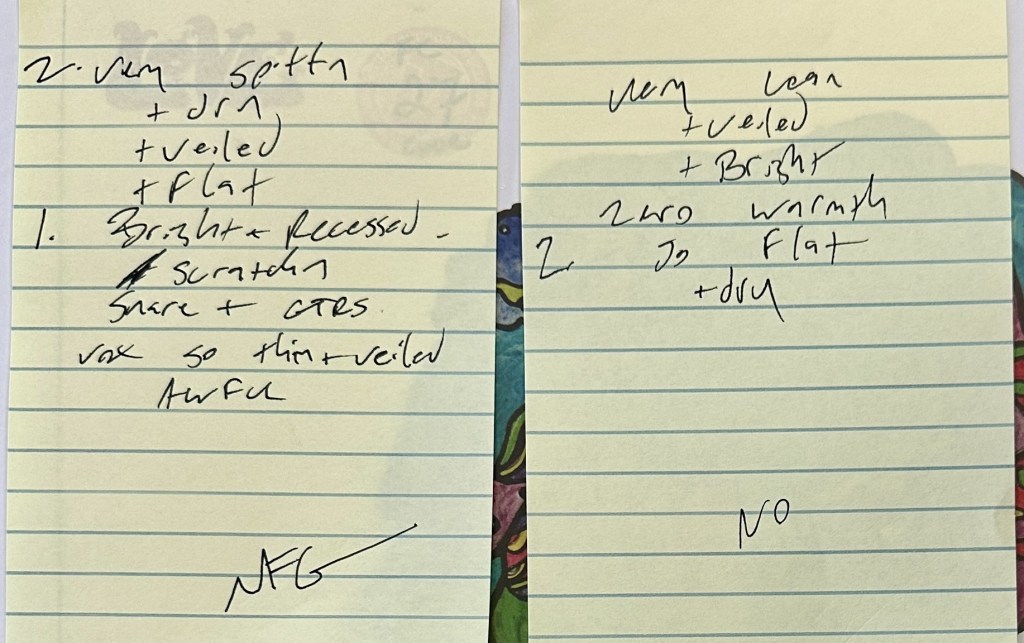
Below you can see our notes for the Rhino Heavy Vinyl pressing of Forever Changes cut by Chris for Bernie Grundman Mastering in 2012.

We recently got hold of a copy locally and figured why not give it a spin and see how one of the most respected mastering engineers of the day, CB, fared with this apparently difficult to master title. (Others have tried and failed. See here and here.)

The Gold Label pressings are the only ones we buy these days. The Big Red E Elektras are passable at best, and everything after them is terrible, including imports and all the Heavy Vinyl reissues that we’ve had the misfortune to play over the years. We hope to be posting some of the stampers to avoid (we call them bad stamps) before too long.

Let’s get right into the sound of this 2012 remaster. We played the two tracks on each side that we’re most familiar with from doing shootouts for the title.

As the record played, to the best of our ability we made notes of the sound we were hearing:

(more…)

If Only I Could Remember My Name – Hand Claps Are Key

Hot Stamper Pressings of the Music of David Crosby Available Now

Note how Crosby’s voice is “chesty” on the better sounding copies. Some make him sound like he’s all mouth and no diaphragm. When his voice is full-bodied and solid, that’s when he sounds more like a real person and less like a pop recording of a person.

All credit must go to Stephen Barncard.

Harry Pearson put this record on his TAS List of Super Discs, not exactly a tough call if you ask us. Who can’t hear that this is an amazing sounding recording? 

Listening Test

One of our key test tracks for side one is Cowboy Movie, and one thing that separated the best pressings from the lesser ones was the sound of the hand claps. It’s a dense mix and they are not easy to hear, but on the best copies there is audible echo and ambience around them, with a richer “flesh on flesh” quality to their sound.

Not many pressings had it, and the ones that did tended to do most other things well also.

Which is what makes it a good test! (more…)

Way Back in 2007 We Discovered the Hottest Meddle Stampers of Them All

Hot Stamper Pressings of the Music of Pink Floyd Available Now

UPDATE 2020

This review from 2007 describes our experience of having stumbled upon the right stampers for Meddle. To this day, only these stampers and no others have won the many shootouts we’ve done for the album in the ensuing years, perhaps as many as a dozen shootouts or more.

These stampers are also very hard to find, which is why you may not have seen a copy of Meddle hit the site in a while. If we could find them, believe me, we would have them up all the time, as this is one amazing sounding album.

To see more albums with one set of stampers that consistently win shootouts, click here.

Want to find your own shootout winner?

Scroll to the bottom to see our advice on doing just that.


This Harvest Green Label British Import pressing has a side one that goes FAR beyond anything we’ve ever heard for this album. We had no choice but to award this side one the very rare A with FOUR pluses. We’ve never given any side of any other Pink Floyd record such a high grade, so you can be sure that you’ve never heard them sound this amazing.

  • Our lengthy commentary entitled outliers and out-of-this-world sound talks about how rare these kinds of pressings are and how to go about finding them.
  • We no longer give Four Pluses out as a matter of policy, but that doesn’t mean we don’t come across records that deserve them from time to time.
  • Nowadays we often place them under the general heading of breakthrough pressings. These are records that, out of the blue, reveal to us sound that fundamentally changes what we thought we knew about these often familiar recordings.
  • When this pressing (or pressings) landed on our turntable, we found ourselves asking “Who knew?
  • Perhaps an even better question would have been “how high is up?”

(more…)

A Pink Label Island LP Left Us with Egg on Our Face

Hot Stamper Pressings of the Music of Traffic Available Now

We used to think that The Best of Traffic had better sound than the early pressings of Mr. Fantasy, but in a head to head comparison with a killer copy we played not long ago, we were proved wrong, or, perhaps more accurately, we proved ourselves wrong, something we pride ourselves in being able to do by carrying out regular shootouts for records we’ve been listening to for more than twenty years.

Oddly enough, in our shootouts we often learn new things about records we thought we knew well.

Here is what we had to say about one of the tracks on Mr. Fantasy that we thought sounded dramatically better on The Best of Traffic back around 2005:

Best evidence: Heaven Is In Your Mind, the second track on side one. It is amazing sounding here and such a disappointment on every Pink Label Island original we’ve played.

Once you know how good that song can sound — by playing a Hot Stamper copy of Best of Traffic like this one — going back to the original version of the song found on the album is not just a letdown, it’s positively painful. Where’s the analog magic? The weight to the piano? The startling clarity and super-spaciousness of the soundfield? The life and energy of the performance?

They’re gone, brother. Not entirely gone, mind you, more a shadow of what they should be, but once you’ve heard the real thing it’s not a lot of fun listening to a shadow.

You can be sure that we did not know what we were talking about when we wrote all that.

What we had done is assumed that all the pink label pressings of Mr. Fantasy sounded like the one we played, something we’ve been telling audiophiles for twenty years not to do, because collecting records by label is a fool’s game.

In this case, clearly we are the fools.

It probably — probably, since all the evidence points in the same direction — had the stampers you see below, apparently known as an Orlake Pressing, something I knew nothing about until reading about it on Discogs just now.

  • Matrix / Runout (Side A, stamped): ILPS+9061+A
  • Matrix / Runout (Side B, stamped): ILPS+9061+B

These same stampers would be used to press the Pink Rim Label copy you see below. We put it into a recent shootout and described it as having “hollow, dubby” sound.

Yes, we heard the very same “dubby” sound on a copy we played about twenty years ago, and thought all the early pressings on Island, pink and pink rim alike, had these same mastering shortcomings.

Back then we didn’t know what we know now, which is that the right UK pressings on Island of Mr. Fantasy are dramatically better sounding.

In fact, they handily win our shootouts, something they have been doing for at least the last ten years or so.

We’ve run into so many sonically-flawed Pink label Island pressings by now that hearing one sound lackluster if not actually awful doesn’t phase us in the least.

Some of the other pink label Island pressings that never win shootouts can be found here.

But before that, back in the dark days of the early 2000s, we clearly were lacking a comprehensive understanding of the sound of the various UK pressings of the album.

There was a great deal of research and development left to be done. Eventually our efforts led to a breakthrough in 2006.

For more than twenty years, this is the kind of work we have undertaken. Why? Because we get paid to do it.

We may be the most knowledgeable experts on the planet when it comes to the best sounding pressings of audiophile-quality recordings — if we’re not I’d like to know who is, and how they came by that information — but that doesn’t mean we know it all.

If we come across that way, it’s the result no doubt of our enthusiastic responses to the hundreds of amazing records we’ve had the pleasure to hear. For example, here’s one, and of course there are literally hundreds and hundreds of others with similarly over-the-top notes. Allow me to apologize for any misunderstanding our commentary may have caused.

One thing we do know: all knowledge, of records or anything else you care to name, is provisional.

If somehow we did know it all, there would not be a hundred entries in our live and learn section.

We regularly learn from our mistakes — like the record reviewed here — and we hope you do too.

However, we learn things from the records we play — not by reading about them, but by playing them. Our record experiments, conducted using the shootout process we’ve painstakingly developed and refined over the course of the last twenty years, produces all the data we need: the winners, the losers, and rankings for all the records in between.

We’ve achieved our results by purposefully ignoring everything there is to know about a record — who made it, how they made it, when they made it — everything, that is, but the sound coming out of the speakers of our reference system.

(more…)

Can Chris Bellman Cut Records As Well As Artisan Used to?

Robert Brook has a blog which he calls

A GUIDE FOR THE DEDICATED ANALOG AUDIOPHILE

Robert’s story begins:

Recently a friend and a frequent reader of my website suggested I review the 50th Anniversary Edition of David Crosby’s debut. He’d read my article from a while back in which I made comparisons between two different Hot Stamper copies of the record, and he knew I was a fan the album.

I’m sure he also knew, as any of my regular readers would, that I’m extremely skeptical of modern reissues. You can find many examples on this site of reissues I’ve written about that have failed miserably to impress me. But this friend was pretty insistent that this one, remastered by long time engineer Chris Bellman, was different. He also told me it was on par with original Monarch pressing of …My Name he also owned.

Bellman was responsible for cutting one of the few heavy vinyl reissues that my friend Tom Port has liked and recommended – a European pressing from 2020 of the Dire Straits record Brothers In Arms. Tom likes precious few “audiophile” reissues. He’s mentioned maybe 4 or 5 over the years as being worthy of any consideration. Given that, and the fact that my friend was so insistent, I figured why not give Bellman’s recut of . . .My Name a shot?

Click on the link to read the whole thing. I left some comments at the end you may enjoy reading. I hope to be able to address some of the other issues Robert brings up at a later date.

IF ONLY I COULD REMEMBER MY NAME: 50th Anniversary Edition

If you are interested in picking up an amazing Hot Stamper pressing of the album, we currently (as of 2/24) have some in stock. Click on this link to see what is available: If I Could Only Remember My Name.

On the website, we talk about just how much we love this album:

(more…)

Hey Mr. Fantasy – Where’s the Bass?

Hot Stamper Pressings of the Music of Traffic Available Now

For our newest take on the sound of the various labels and stampers for Mr. Fantasy, please click here.

A long, long time ago, probably at the start of the 2000s, we put up this early UK pressing on the Island pink label.

Charged good money for it, too, justified by the fact that the early pink label pressing would be assumed to have the best sound for audiophiles in search of higher fidelity.

Back then we didn’t know what we know now, which is that the right reissues are dramatically better sounding.

In fact, they handily win our shootouts, something they have been doing for at least the last ten years or so.

The pink label pressing we review below is very unlikely to earn a grade high enough to qualify for Hot Stamper status.

Our Old Listing

This pink label original Island pressing has amazingly sweet, open, extended and transparent mids and highs.

It has two major shortcomings: a lack of bass, and a fair amount of surface noise.

If you can add a few — let’s say three — dB around 50 cycles and can put up with some surface noise and scratches, you are guaranteed to hear some wonderful sound in the best tubey Island tradition. 

Side two sounds better than side one. It has more bass and is more tonally correct overall.

Live and learn is our motto, and progress in audio is a feature, not a bug, of record collecting at the most advanced levels. (“Advanced” is a code word for having little to no interest in any remastered pressing marketed to the audiophile community. If you want to avoid the worst of them, we are happy to help you do that.)

(more…)

Listening in Depth to John Barleycorn Must Die

The toughest test on side two is the first track, Stranger to Himself.

Getting the voices right is practically impossible. If the voices are full, smooth, yet breathy and clear, you have that rare copy that actually gets the midrange right. Not many do.

Side One

Glad

The last portion of this track has some really interesting percussion and organ effects. Traffic were trying to break out of the standard pop song format by letting this song wander into psychedelic territory for a few minutes at the end. It’s now become my favorite part of the song.

The reason you want to pay close attention to this part is because it helps you to judge the transparency, immediacy, and top end extension for the whole side. It should be amazingly clear and open-sounding. On too many pressings, the percussion instruments are blurred and lost in the mix. On a Hot Stamper copy they’ll be right in front of you, allowing you to appreciate the interplay among the musicians as they contributed their various parts.

Freedom Rider

You’ll need lots of top end extension for this song to sound right. On many copies the double tracked flute solo in the middle of the song will be aggressive and irritating, but on a Hot Stamper pressing, the flutes will sound airy and breathy with a reasonably good sustain.

Empty Pages

The quality of the voice is what really sets the best copies apart. Winwood is much more present on the better copies. He’s recessed on most and that’s just not where he needs to be for the song to work musically. He needs to be right up front, surrounded by the air and ambience of the studio. The transparency found on the better copies will give you precisely that.

Side Two

Stranger to Himself

John Barleycorn

The acoustic guitars that open up this song are absolute perfection on the best copies — this is the sound of Tubey Magical analog at its best.

This is the real test for side two.

The acoustic guitars should sound rich and sweet. You’ll notice at the beginning of the song that they are a little dull. The last thing in the world you want to do, however, is to brighten them up, because when you do that, as some mastering engineers have in the past, the harmony vocals and the percussion and the tambourine become much too bright later on in the song.

You have to strike a balance between all the elements. That means Steve’s voice at the beginning needs to be a little reserved so that the harmony vocals later on will come in right.

(more…)

Listen to Winwood’s Left Hand on “Glad”

More of the Music of Steve Winwood

Many years ago, perhaps in 2015, while playing an especially transparent copy of John Barleycorn, we learned something new about the album. Although it was a title I had been playing since it came out all the way back in 1970, apparently things had changed.

This pressing made it clear — really, for the first time — exactly what Winwood was doing with his left hand on the piano during the song Glad.

There are two musical figures that one can focus on: one involving the lower notes, which tend to be blurry, obscured and murky on most pressings, and two, the right-handed higher notes, which are typically much more clear and audible in the mix.

Only the very best copies let us “see” the bass notes of the piano so clearly and correctly. Next time you’re in the mood to compare different pressings of Barleycorn, pay special attention to the lower notes of the piano on Glad. It is our contention, backed by mountains of evidence, that no two copies of the album will get that piano to sound the same. (It will also help if you have large dynamic speakers with which to do the test.)

Lately we have been writing quite a bit about how pianos are good for testing your system, room, tweaks, electricity and all the rest, not to mention turntable setup and adjustment.

  • We like our pianos to sound natural (however one chooses to define the term).
  • We like them to be solidly weighted.
  • We like them to be free of smear, a quality that is rarely mentioned in the audiophile record reviews we read.

(more…)

Spirit in ’68 – One of the Most Phenomenal Debuts of All Time

More of the Music of Spirit

Hot Stamper Pressings of Psych Rock Albums Available Now

Want a glimpse into the kind of energy the band was generating in the studio? Drop the needle on the opening track, Fresh Garbage, and you will hear this band come alive in a way you probably never imagined you’d experience.

It’s positively startling how immediate and lively the sound is here.

This is the band at their best, fired up and ready to show the world that The Doors are not the only SoCal rock band who have innovative ideas about rock music and the performing chops to pull them off, not to mention the studio wizards who managed to get it all down on tape with State-of-the-Art ’60s Rock sound quality.

The venerable jazz arranger Marty Paich was brought in to lend his talents to the project, something I never knew until I glanced at the liner notes during a shootout many years ago. No wonder the arrangements, especially the string arrangements, are so innovative and interesting. I can think of no Psych record outside of The Beatles’ with better strings.

Spirit’s first album checks off a few of our favorite boxes:

The Doors Vs. Spirit

If I had to choose between The Doors’ first album and Spirit’s, say for a nice drive up the coast with the top down, no contest, Spirit would get the nod (not to take anything away from The Doors mind you). I had the album on 8 Track back in high school and played it to death. Doing this shootout, hearing the album sound so good after so many years, was nothing less than a THRILL. (I went right up to Amazon and bought a CD for the car. Might just take a drive up the coast.)

If you like Surrealistic Pillow and Revolver/Sgt. Pepper-era Beatles and early Doors albums, and you don’t know the album well, you are really in for a treat. It’s a classic of its day that still holds up forty-plus years later.

I simply cannot recommend any current album on the site more highly.

This Demo Disc Quality recording should be part of any serious Rock Collection. Others that belong in that category can be found here.

(more…)

Every Day Is Record Store Day at The Electric Recording Company

Our Review of The Electric Recording Company’s Release of Forever Changes

Recently we took the Electric Recording Company to task for their botched mastering of Love’s Forever Changes.

At ERC they like to point out they are doing things differently, and boy are they ever. They do not remaster the tapes, they simply transfer the tapes onto disc without any interference from equalizers, compressors and the like.

Naturally, they seem less willing to discuss the sludge-like sound their vintage tube cutting amplifiers bring to every tape that’s forced to go through them before it gets to the cutting stylus. I hope to discuss this issue in more depth down the road.

What Is It, Exactly

For now, let’s try to get to the heart of what this pressing is.

This is not an audiophile record, properly understood.

No member of the audiophile community, those lovers of sound you’ve heard so much about, could possibly put up with a record that sounds as bad as this one does.

Having played two of their releases and knowing how all of them are made, I would be surprised if any of this company’s records are any better than awful.

No, this is plain and simply a collectible.

It exists because it could be made as a very limited edition at a profit.

It exists because it could be made with exceptionally high quality packaging.

The vinyl inside the fancy packaging is only there to make sure that all the elements of a collectible release are accounted for.

All the value is tied up in the collector appeal of the release, none in the vinyl, because the vinyl is junk.

(more…)